★ 4,6
Nordic curl cluster sets at home: rest between repetitions

“Nordbelt kolayca bağlanıyor ve sağlam hissettiriyor.”
A pause within a Nordic set organises your existing work. Learn what to keep unchanged, how to record rest and what the research does not establish.
ÜCRETSİZ 10 HAFTALIK ANTRENMAN PROGRAMIÜcretsiz programımı gönder ↓Nordic curl cluster sets at home involve planned rest between individual repetitions or small groups within a set. This differs from lowering more slowly or resting after the whole set is finished. First choose a version that already suits you and keep it unchanged. An extra pause is no reason to lower further, train harder or add repetitions. There is no generally established ideal rest period for home use.
You need a repeatable setup for that comparison. See how Nordbelt secures your ankles for Nordic curls at home, without a training partner or large machine. The strap does not determine rest periods, measure force or make an unsuitable exercise appropriate. Even with a pause, you still need a suitable anchor, comfortable knee support and clear space to catch yourself.
What does a pause within a Nordic set mean?
A regular set is an agreed sequence of repetitions. A cluster set deliberately interrupts that sequence with rest. The term therefore describes how the work is organised, rather than a new Nordic variation. A review of cluster structures defines these interruptions between individual repetitions or small groups. The exercises and protocols studied differ; the definition does not provide a home Nordic programme (Tufano et al., 2017).
In an eccentric Nordic, you control the forward movement from your knees, catch yourself with your hands in time and return with assistance. Returning also takes time. It is not automatically a planned rest period. If you count only the seconds between two lowering movements, you may unknowingly combine the return, resetting and actual rest.
Describe what you mean by a pause. Does it begin once you are back in the starting position, or do you include the return? You can record either, provided you keep using the same convention. Keep the return assisted; a cluster set does not require a fast active rebound. For that separate movement question, read about Nordic curl tempo and the return.

Keep these three interruptions separate
The difference is what you interrupt. This classification helps describe your existing training; it does not prescribe repetitions or rest periods.
| Interruption | What happens? | What do you record? |
|---|---|---|
| Returning and resetting | You return with assistance after one lowering movement | The assistance used and when you are ready again |
| Planned rest within the set | You deliberately interrupt a sequence that is not yet finished | Where the pause starts and ends, plus the actual time |
| Rest between sets | The agreed sequence is completed before you rest | The end of the set and the start of the next one |
Adding another exercise introduces a further difference: the content of the interruption changes too. The page on Nordic curls as supersets or straight sets covers that choice. Do not silently treat a sequence containing another exercise as the same comparison as resting quietly between Nordic repetitions.
Context image of a pause; the photograph does not show a Nordic cluster set or a measured rest period.
What does Nordic research say about rest?
Drury and colleagues had ten young, well-trained male team-sport athletes perform two sets of six Nordics. They compared one with three minutes of rest between sets. They found no detectable difference between these conditions in the force measures examined; peak force declined from the fourth repetition within the sets. This was an acute laboratory comparison, not a test of planned rest between repetitions (Drury et al., 2021).
This does not provide personal advice to pause after a particular number of repetitions. The study did not compare Nordic cluster sets with continuous sets or measure subsequent muscle growth, home safety or injury outcomes. Nor does an undetected difference in this small group prove that all rest periods are equivalent for everyone.
The useful distinction is that rest between sets was studied in a particular Nordic task, while your question concerns rest within a set. For the broader first question, see the explanation of rest between sets in strength training. Do not automatically use a research interval as a timer setting for a different task.
Nordic curl'de ilk tekrardan 10. haftaya ilerleyin.
Acele etmeden, hafta hafta ilerlemenizi sağlayan 7 sayfalık pratik bir plan.
PDF7 sayfaDoğrudan e-posta kutunuza
- 01Hafta hafta açık bir plan
- 02Teknik ve kaçınılması gereken hatalar
- 03Pratik bir antrenman günlüğü

İndirme sayfasını yeniden açın veya gönderdiğimiz e-postayı kontrol edin.
İndirme sayfasını aç ↗≤ %51
✓Araştırmalara dayalı
Van Dyk ve diğerleri, 2019: NHE içeren programların meta-analizi. Nordbelt veya bu program için yapılmış bir etki değerlendirmesi değildir.
Keep the exercise unchanged when recording pauses
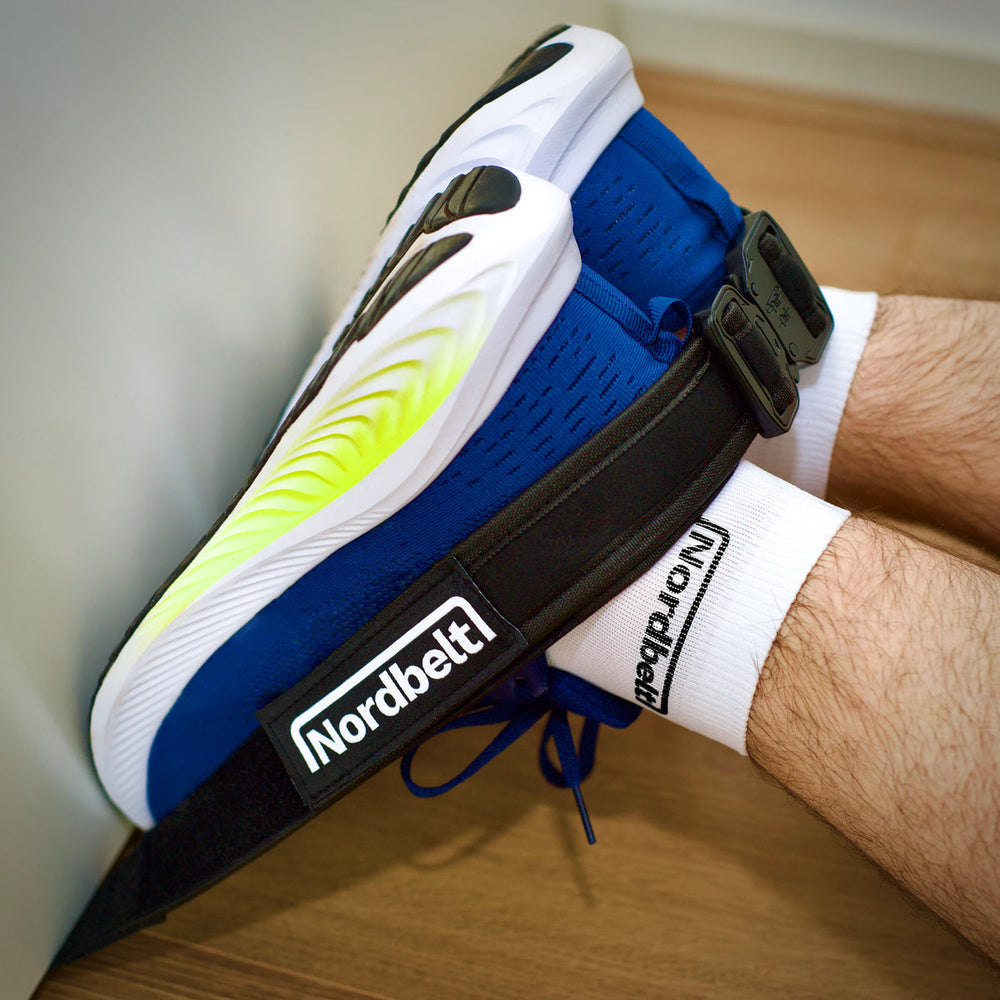
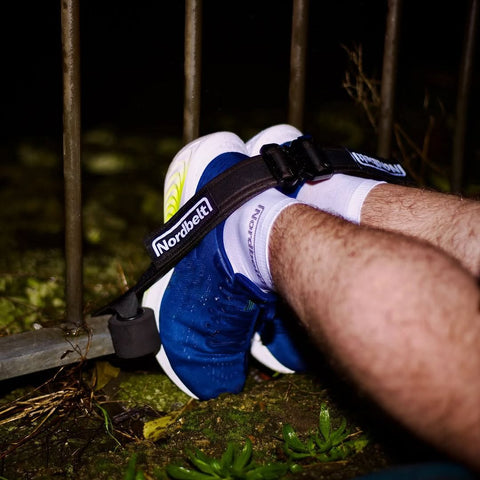
Use a Nordic variation you already control. Keep the fixation, knee support, movement limit and assistance on returning recognisably the same. The top photograph shows a kneeling start on an apparatus, rather than a pause or evidence that such equipment is necessary. Adding rest does not change the requirements of your own setup.
A door must be firmly closed and suitable for the attachment according to the attachment instructions. A bench or fence is usable only if its structure and anchor can withstand the load without moving. A loose chair or movable fence does not automatically meet those requirements. Check the setup before loading it and again if anything has moved.
If you cannot control the next lowering movement, make the exercise easier or end the sequence. Do not use pauses to force a greater range of movement. Stop if you feel sharp pain or the fixation shifts. Have persistent or recurring symptoms assessed by a doctor or physiotherapist; this article does not clear you to exercise after an injury.
A note that separates rest from returning
Record four things about your existing training: the chosen variation, your convention for timing the pause, the actual elapsed time and any changes in movement or assistance. For example: “Returned with assistance; timed the pause from the restored starting position; caught myself earlier on the next repetition.” This is a fictional note, not a prescribed exercise sequence.
That last detail matters. If you catch yourself earlier or use more assistance, the rest period alone no longer describes the same task. A useful note may therefore also say: “Not comparable; setup adjusted.” You do not need to turn it into a score or a conclusion about recovery. The purpose is to see what you did, not to accumulate extra work.

Context image for training notes; the notebook contains no readable programme or researched rest period.
Frequently asked questions
How long should the pause between Nordic repetitions be?
The sources discussed do not provide a universal rest period for home use. With a programme that already suits you, specify where you measure rest and avoid changing the exercise at the same time. If you have a coach or clinician, discuss changes within that programme. Research on rest between sets does not automatically answer this question.
Does returning with assistance count as rest?
That depends on your timing convention, but it remains a separate action. Record whether you include the return or start only when you are ready again. Keep the assistance unchanged. Otherwise, a longer measured interruption may mainly mean spending more time returning.
Can extra pauses let me do more or harder Nordics?
That does not follow from this explanation. A cluster set describes how work is organised and does not authorise extra loading. Keep the variation that already suits you; choose an easier task or stop if control is lacking. Assess any programme change separately.
Does a better next repetition prove cluster sets work better?
No. It is an observation about one performance. First check whether range of movement, catching yourself and assistance stayed the same. You cannot infer long-term strength gains, muscle growth or lower injury risk from it. Those outcomes require their own research with an appropriate comparison.