Hamstring pain after ACL surgery: donor site and advice

“Nordbelt kolayca bağlanıyor ve sağlam hissettiriyor.”
Hamstring pain after ACL surgery may be related to the area where tendon tissue was taken, but pain alone cannot establish that. Discuss new, worsening or persistent symptoms with your doctor or physiotherapist; seek same-day medical advice for fever, wound discharge or a painful swollen leg. Chest pain or breathlessness needs emergency help. Your graft, any meniscus procedure and your own surgical instructions determine appropriate loading.
Only if Nordic curls later fit your individual progression can Nordbelt for Nordic curls at home secure the ankles without a training partner or large machine. It needs a suitable, solid setup. The aid does not treat pain or protect the operated tendon. Assessment and an agreed plan with your clinician come first; neither a purchase nor an online exercise programme is needed for that.
Why does the tendon used matter?
An anterior cruciate ligament reconstruction uses a graft. If your own hamstring tendon tissue was used, there is an area where it was harvested as well as the operated knee: the donor site. Ask which tendon or tendons were taken and from which leg. Do not assume every ACL operation uses a hamstring graft.
The donor site provides useful context for a conversation, rather than an explanation that lets you dismiss new symptoms yourself. One study of pain control around this area involved 27 patients and only the first two hours after surgery. It cannot tell you whether your pain weeks or months later is harmless, or what training you can do. (Bushnell et al., 2010)
Strength and pain are also different outcomes. A systematic review of seven studies compared strength measurements after different hamstring tendon harvests. That comparison does not diagnose your pain or select a graft or exercise for you. (Ardern and Webster, 2009) For broader background, read about hamstring injuries and recovery; general information does not replace your surgical protocol.

When should you contact someone sooner?
Use the contact instructions in your discharge information. Contact your surgical team, doctor or urgent medical service the same day for fever, chills, leaking fluid or pus from the wound, increasing redness or swelling around the knee, or a newly painful swollen leg. Throbbing or cramping leg pain after surgery also needs prompt advice. Do not first try stretching or strength exercises to test these symptoms.
For breathlessness or chest pain, especially alongside leg pain and swelling, call emergency services immediately. Do not wait for a physiotherapy appointment or drive yourself. These are reasons to seek help, not a way to diagnose an infection or blood clot at home.
Also report new changes in sensation, clear loss of strength, a new pop or worsening walking to your care team. Explain when it started and what changed. A sudden deterioration needs advice sooner than the next scheduled check. If these signs are absent but symptoms recur or interfere with sleep and daily movement, ask for reassessment. Having no warning signs does not prove everything is recovering well. Read general information about persistent pain behind the thigh only as background and always mention your operation when seeking advice.
What should you tell the team about donor-site pain?
Prepare a short note so you do not have to reconstruct events from memory during the discussion. This prepares a conversation; it is not a diagnostic test or scoring system:
- Operation: date, operated side, graft and any additional procedure, such as meniscus treatment. Bring discharge and exercise instructions.
- Onset and course: was pain present immediately, did it begin with a clear event or build gradually? Include changes after earlier improvement.
- Location and feeling: point out the area and describe pulling, stabbing, cramp or altered sensation without assigning a tissue diagnosis yourself.
- Daily function: what changes with walking, sitting, sleep and exercises you were already given? Note what happens later that day.
- Associated signs: report wound changes, swelling, fever, altered sensation or new weakness, and explain which advice you have followed.
A useful question is: “Does this change fit my operation and current instructions, or do I need to be examined first?” Then ask whom to call if things worsen. You do not need to perform a maximal knee-bending strength test, deep stretch or Nordic curl to justify an appointment.
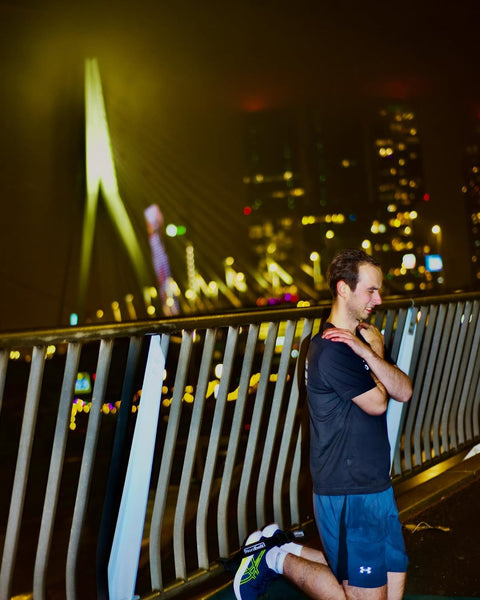
 Context image for making notes; it does not show an operated patient or prescribed exercise.
Nordic curl'de ilk tekrardan 10. haftaya ilerleyin.
Acele etmeden, hafta hafta ilerlemenizi sağlayan 7 sayfalık pratik bir plan.
- 01Hafta hafta açık bir plan
- 02Teknik ve kaçınılması gereken hatalar
- 03Pratik bir antrenman günlüğü

≤ %51
✓Araştırmalara dayalı
Van Dyk ve diğerleri, 2019: NHE içeren programların meta-analizi. Nordbelt veya bu program için yapılmış bir etki değerlendirmesi değildir.
İndirme sayfasını yeniden açın veya gönderdiğimiz e-postayı kontrol edin.
İndirme sayfasını aç ↗Why is there no starting schedule here?
ACL surgery is different from an ordinary muscle strain. The graft, other treated structures and individual instructions matter. Do not use a general overview of recovery and progression instead of your own team's instructions.
The Aspetar guideline considers exercise therapy an important part of ACL reconstruction rehabilitation, while acknowledging uncertainty about dosage and progression criteria. That supports individual guidance; it does not provide a universal starting week for Nordic curls. (Kotsifaki et al., 2023) Do not change resistance, range of movement or exercise based on a calendar or someone else's online experience.
Ask what loading has been agreed, which responses to report and when you will next be assessed. If hospital and physiotherapy instructions are unclear or differ, ask the teams to coordinate them. Less pain on one day is not clearance to return to sport. Feeling stronger does not establish that every load is suitable again.
Where might Nordic curls fit later?
In a Nordic curl you kneel with your ankles secured and lower your body forward under control from the knees. This only describes the exercise; it is not an invitation to test it after surgery. Discuss whether, when and with what assistance it might fit with your clinician.
If the exercise becomes suitable later, check the setup separately: a suitable solid door following the instructions, a stable bench or a sufficiently fixed and suitable low fence anchor. A loose bench, fragile door or moving fence is not a usable anchor. Straps and an anchor do not replace agreed assistance or loading progression. Then read the setup instructions. Nordbelt provides ankle fixation; it does not decide your rehabilitation or return to sport.
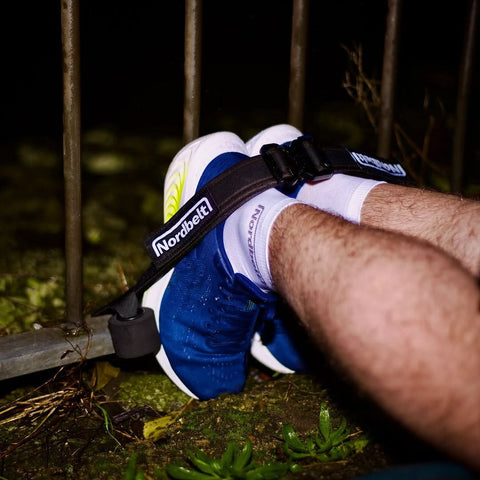
 An example of ankle fixation to a bench, not a demonstration of exercise after ACL surgery.
Frequently asked questions
Is hamstring pain after ACL surgery always donor-site pain?
No. First establish which graft was used. Even with a hamstring graft, location alone does not establish the cause. Report new or worsening symptoms to your team and use the warning signs above to seek quicker contact.
How long can the donor site hurt?
There is no fixed deadline that safely labels your pain normal. Its course, operation details, associated symptoms and function need to be assessed together. If things worsen, do not wait for a particular week to pass.
Can I stretch the hamstring or test it with Nordic curls?
Do not use deep stretching or a heavy strength test to establish the cause yourself. Follow individual exercise instructions and ask for advice first if symptoms change or you are unsure. An online protocol does not give permission for your operated leg.
Can an ankle strap protect the graft?
A training strap does not diagnose anything or guarantee graft protection or recovery. Ankle fixation only provides the setup for an exercise chosen as suitable later. Your team agrees loading with you; equipment and one pain-free repetition do not replace that assessment.