★ 4,6
Why does your physio test your hamstrings at 15 and 90 degrees?

“Nordbelt kolayca bağlanıyor ve sağlam hissettiriyor.”
Your legs score much the same with your knee bent. What about when it’s nearly straight? Two lines from a sample test report show you which numbers to compare.
ÜCRETSİZ 10 HAFTALIK ANTRENMAN PROGRAMIÜcretsiz programımı gönder ↓Your physio tests your hamstrings at 15 and 90 degrees to see how much force you can produce with your knee almost straight and with it bent. Your previously injured leg may produce less force with the knee nearly straight even if the two legs score much the same at 90 degrees. To track progress, compare the same leg at the same angle across visits. If pain made you hold back in one position, tell the physiotherapist who tested you. Silder et al., 2013
If you and your physio later agree on Nordic curls at home, you’ll need something to hold your ankles down. When you train alone, Nordbelt’s three videos on securing your ankles show how to choose a solid anchor and adjust the buckle. For today’s test results, all you need is your report and a conversation with your physio.
Which two numbers should you compare?
Say it was your right hamstring that you injured. The first line on your report says 170 N on the right and 200 N on the left at 15°. The next line, at 90°, says 205 N on the right and 210 N on the left. N stands for newtons, a unit of force. These numbers are made up to show how to read the report. There’s no target to hit here.
You can answer two different questions with those numbers. To see how one leg compared with the other on the day, read across a single line. At 15° the gap was 30 N. At 90° it was 5 N. If your physio says, “Your legs were pretty close with your knee bent,” you can see where that came from. The line above tells you how they compared with your knee closer to straight.
To see what has changed since that session, pull out the next report. Suppose the right leg now reads 184 N at 15°. Compare that with the original 170 N. The 205 N from the 90° test answers a different question. Ask whether both tests used the same setup and how much results tend to vary when that test is repeated. That puts the 14 N difference in perspective.

What does your leg actually do during the test?
In an isometric test, you try to bend your knee while your lower leg stays still. Picture drawing your heel towards your bottom while your physio or the equipment holds it in place. The angle tells you how far your knee was already bent. In reports that use this convention, a straight knee is 0°. At 15° there’s a small bend. At 90° your shin is at a right angle to your thigh.
“I was lying on my front” is a start, but it leaves out part of the setup. In a study by Silder and colleagues, the participants lay on their fronts for tests at both 15° and 90°. The examiner resisted the movement by hand, recorded any pain and graded strength on a scale. At 90° the team also used different rotations of the lower leg. Even on a single report, two lines marked 90° can refer to different test positions. Silder et al., 2013
Why might a difference show up with a straighter knee?
Researchers studied fourteen male athletes with a history of hamstring strain and fourteen athletes without that history. The athletes tried to bend the knee against the stationary arm of a testing machine. It measured torque, the turning effect of their effort at the knee. They tested at 30°, 60° and 90°. In the group with a previous injury, peak torque was lower on average on the previously injured side at 30°. At 60° and 90°, the researchers found no statistically significant difference between the two legs in that group. Nara et al., 2022
If your scores are close at 90°, the other line on your report still matters. And if you have a result for 15°, this study doesn’t give you an expected score for it. The smallest angle they tested was 30°. The researchers compared limbs at one point in time. They didn’t follow individual athletes from week to week or establish a score for returning to a match.
Nordic curl'de ilk tekrardan 10. haftaya ilerleyin.
Acele etmeden, hafta hafta ilerlemenizi sağlayan 7 sayfalık pratik bir plan.
PDF7 sayfaDoğrudan e-posta kutunuza
- 01Hafta hafta açık bir plan
- 02Teknik ve kaçınılması gereken hatalar
- 03Pratik bir antrenman günlüğü

İndirme sayfasını yeniden açın veya gönderdiğimiz e-postayı kontrol edin.
İndirme sayfasını aç ↗≤ %51
✓Araştırmalara dayalı
Van Dyk ve diğerleri, 2019: NHE içeren programların meta-analizi. Nordbelt veya bu program için yapılmış bir etki değerlendirmesi değildir.
What’s worth writing down for next time?
Put the date at the top and note which side you injured. For each line, write the angle, whether you were sitting or lying down, how the resistance was applied and the unit or scale used. Add a few words about how it felt. “Held back on the right at 15° because it hurt” will be much easier to discuss at your next appointment than “right side lower”.

If an old report leaves out the angle, ask whether the clinic can look it up. If it remains unclear, keep the result with a note saying so. The first test with a known setup can become the start of a new series. There’s no need to recreate a maximum-effort test at home to fill in a missing detail.
Read the column headings, too. A manual strength grade, a force in newtons and a torque in newton-metres each belong on a separate line. If your club’s Nordic test lists N/kg, that is force divided by body mass. The guide to Nordic strength per kilo in youth football shows how that works. Twelve bridge repetitions are another kind of score. If that’s in your notes, the single-leg hamstring bridge test explains what the repetitions represent.
What should you discuss before sprinting again?
Name the movement you want to get back to. Suppose you play football and jogging during the warm-up already feels comfortable. Ask your physio what they’d like to see before you accelerate from a standing start to chase a through ball. On the pitch your leg is moving as you accelerate. That is a different task from holding your shin still during a test.
In Silder and colleagues’ study, athletes who had recently strained a hamstring followed one of two exercise programmes. When they returned to sport, the researchers considered strength and symptoms during running, among other findings. Strength had largely returned on clinical examination while changes were still visible on MRI. The study didn’t identify a single strength score that clears you to sprint. If the familiar pain keeps returning during the same acceleration, describe that movement when preparing for a hamstring reassessment. Silder et al., 2013

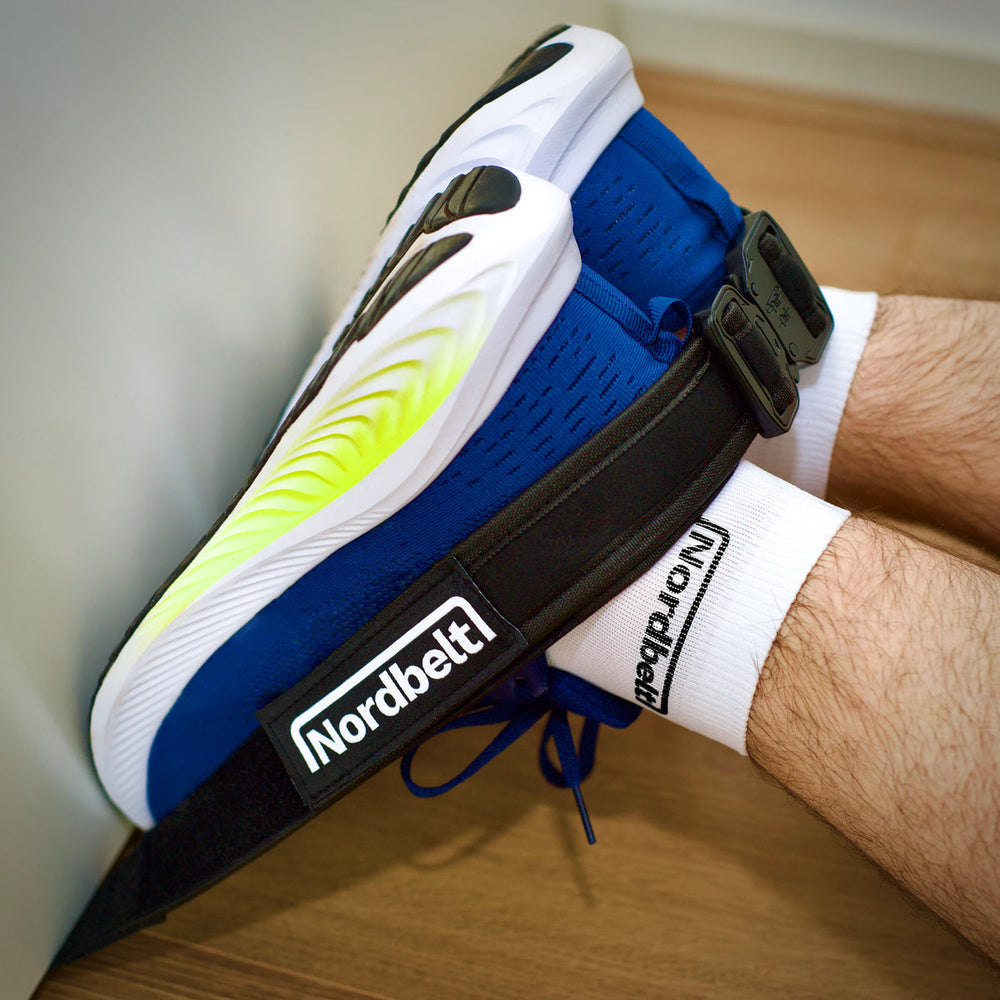
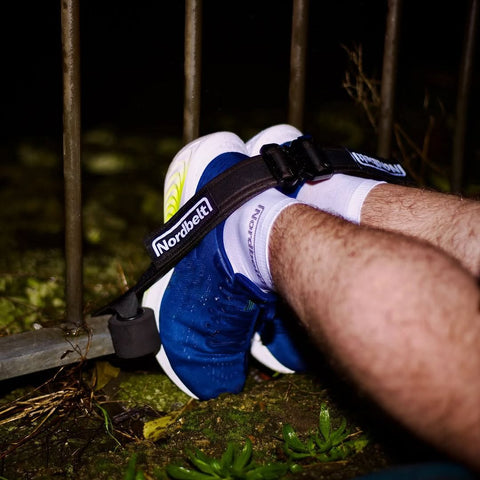
Already agreed on Nordic curls as part of your strength work? The photo shows where the strap sits across the ankles in a bench setup. The bench should stay put when you pull on the strap. The Nordic curl setup guide also shows how to use a suitable door or a sturdy fence. Log the repetitions with your training for the week so you can find them separately from the strength measurements.
Frequently asked questions
Is my knee nearly straight or deeply bent at 15 degrees?
If the report measures knee flexion from 0°, it’s nearly straight at 15°. A drawing that marks the angle inside the knee can look quite different. Ask your physio to point out the two positions on your report if you’re unsure. You’ll know which line goes with the position where your shin was almost horizontal as you lay on your front.
Can I compare a grade of 5 out of 5 with a value in newtons?
A grade of 5 out of 5 describes the examiner’s assessment during a manual strength test. It doesn’t give you a measured force in newtons. Compare it with an earlier grade using the same angle and method. If it’s your first time getting a reading from a device, ask which setting to look for at the next visit.
The test felt fine at 90 degrees but hurt at 15. What should I say?
Describe when you felt it. Was it as you settled into position, as you built up force or only during your hardest effort? Mention if you eased off or stopped early. That gives your physio the context to interpret the lower score and agree on how to approach the next test.
My coach wants to know if I can play on Saturday. Which score should I send?
Start with what you and your physio agreed about training or playing and share that with your coach. If you also pass on a test result, add the leg, the angle and the unit. That way your coach has the context for the number as well as the plan for this week on the pitch.