★ 4.6
How far from your hips should your heels be in a hamstring bridge?

「Nordbeltは簡単に取り付けられて、運動中も安定感があります」
Moving your heels further from your hips makes the lever longer. Compare two holds on the same mat and find the one you can control without your heels sliding.
無料10週間トレーニングプロトコル無料プランを受け取る ↓For a two-leg hamstring bridge, start with your heels close enough to lift your hips comfortably. Want more work at the back of your thighs? Move both heels a little further away, keep a slight bend in your knees and try the same lift. That’s a long-lever hamstring bridge. Choose a position where your heels stay put and you can keep your hips steady at the same height.
All you need for the floor bridge is a surface with good grip. If you also do kneeling Nordic curls without a partner to hold your ankles, see how to secure both ankles at a door, bench or fence with Nordbelt. Three short setup videos show where the adjustable strap goes. For the floor bridge, leave your heels free.
Try two heel positions on the same mat
Lie on your back with your arms relaxed by your sides and your feet about hip-width apart. Line up your heels. Start close enough to your hips that you can lift your pelvis smoothly. Press your heels into the floor and lift. Keep breathing, notice where you feel the effort and check that both feet stay put. Lower your hips fully before moving either heel.
Now move both heels a hand’s width towards the end of the mat. This gives you a second position you can find again. Lift to about the same height and hold for the same length of time. Your knees will be a little straighter. If the back of your thighs works harder and you’re just as steady, you’ve found a position worth trying again.
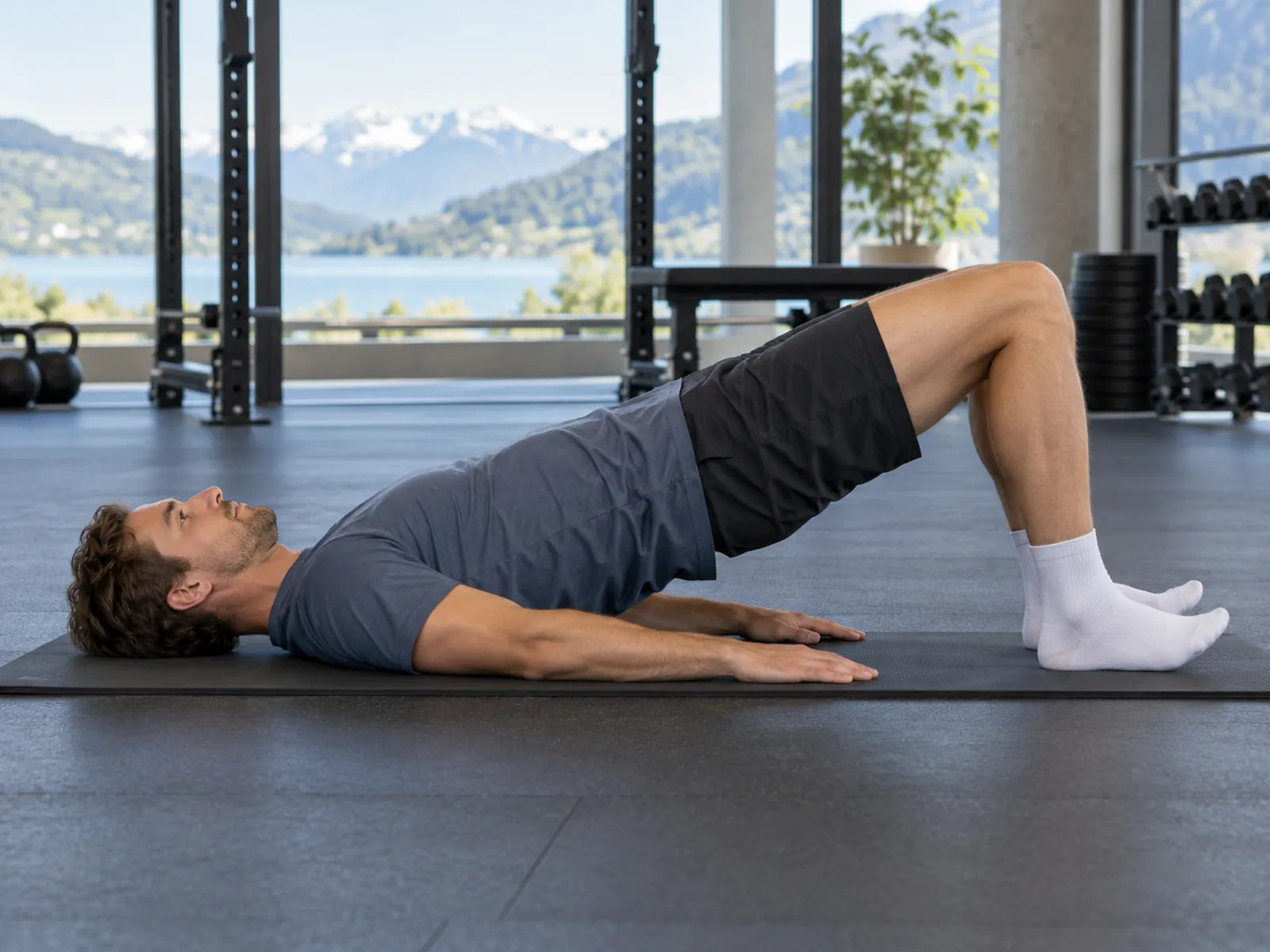
Say you can talk comfortably in the first hold. In the second, your hips stay level at first but your right heel gradually slips forwards. Bring both heels in a little and use a grippier patch of floor. Otherwise, much of the extra effort goes into stopping your feet from sliding. Socks on polished wood and bare heels on a grippy mat make for quite different holds.

How can you tell if your heels are too far away?
A side view helps. Prop your phone on the floor and compare a moment from each hold once your hips are still. Where are your heels in relation to your knees? Is your waistband at roughly the same height in both clips? If you move your feet out and barely lift your hips the second time, you’ve changed two things. Bring your heels back until you can reach a height you can hold in both positions.
Watch your arms too. If they rest on the floor for one hold but you’re digging your elbows in for the next, you’ve added support. Pick an arm position you can use for both. You don’t need to arch your back to get higher. Lower yourself if your ribs start to lift while your hips drop.
Why does the effort feel different?
Your hamstrings run along the back of your thighs and help hold your hips up in the bridge. Heel position changes how much your knees bend. In one study, 25 physically active men performed bridges at four knee angles. With less knee bend, the researchers measured more electrical activity in the long head of the biceps femoris, one of the hamstrings. The difference was especially clear between 40 and 120 degrees of knee flexion. Those were the angles in the experiment. You don’t need a protractor at home. Ho et al., 2020.
In another study, 15 healthy young men performed bridges at 60, 90 and 120 degrees of knee flexion. Researchers used their movement data in a computer model to estimate how much force different muscles produced. The estimated force in the biceps femoris was higher with less knee bend. That’s consistent with what you may feel as you move your heels away, but the model can’t tell you how much force your own muscles are producing today. Takeshita et al., 2022.
Both studies looked at what happened during the exercise. They didn’t follow athletes training with different heel positions for months. Their findings give you neither an ideal distance in centimetres nor a prediction of which position will build more muscle. Your two clips can answer a different question today. Which position lets you repeat the hold with steady hips and heels that stay put?
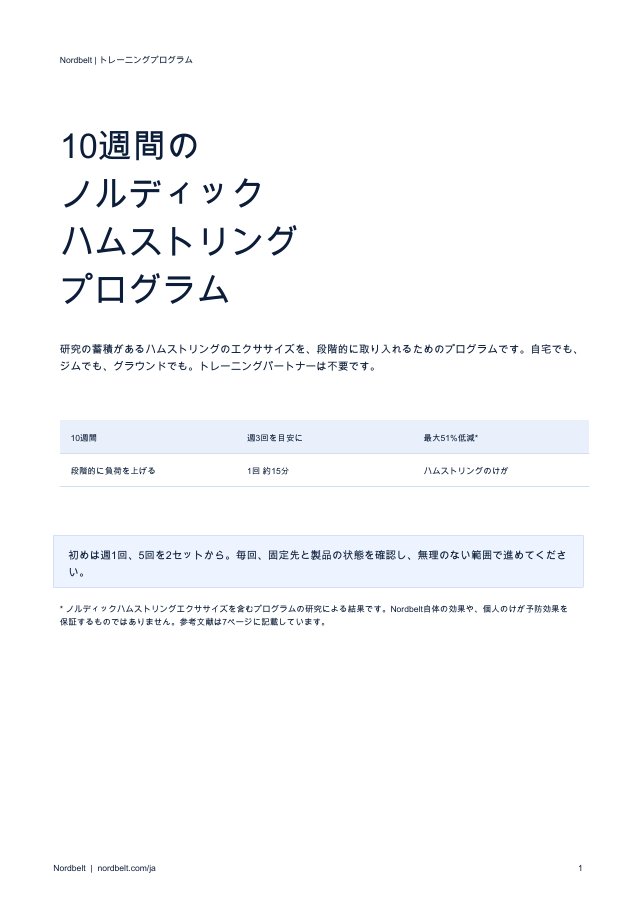
ノルディックカールの最初の1回から 10週目まで。
全7ページの実践的なプログラム。無理をせず、週ごとに段階を進められます。
PDF7ページメールで直接お届け
- 01週ごとの段階的なトレーニングプラン
- 02テクニックと避けるべき間違い
- 03実際に使えるシンプルなログ
ダウンロードページを再度開くか、送信したメールをご確認ください。
ダウンロードページを開く ↗≤ 51%
✓研究に基づく内容
Van Dykら(2019):NHEを含むプログラムのメタ分析。Nordbeltや本プログラム自体の効果を測定したものではありません。
Find the same position next session
Put your mat in the same place and line your shoulders up with a fixed point, such as a seam. Mark your heel position with tape beside your foot so that your heel stays in contact with the same surface. Make a short note, for example “bare feet, heels at the second floorboard join, arms relaxed by my sides”. Next time you can tell whether the exercise feels easier or your feet have simply crept closer to your hips.
If you follow the four-week home hamstring plan, use your chosen position for the regular bridge. In a bridge walkout the heels move a step at a time during the repetition. With hamstring sliders, the sliding is deliberate. Save those variations for another set to keep your comparison of two fixed positions useful.
What changes in a kneeling Nordic curl?
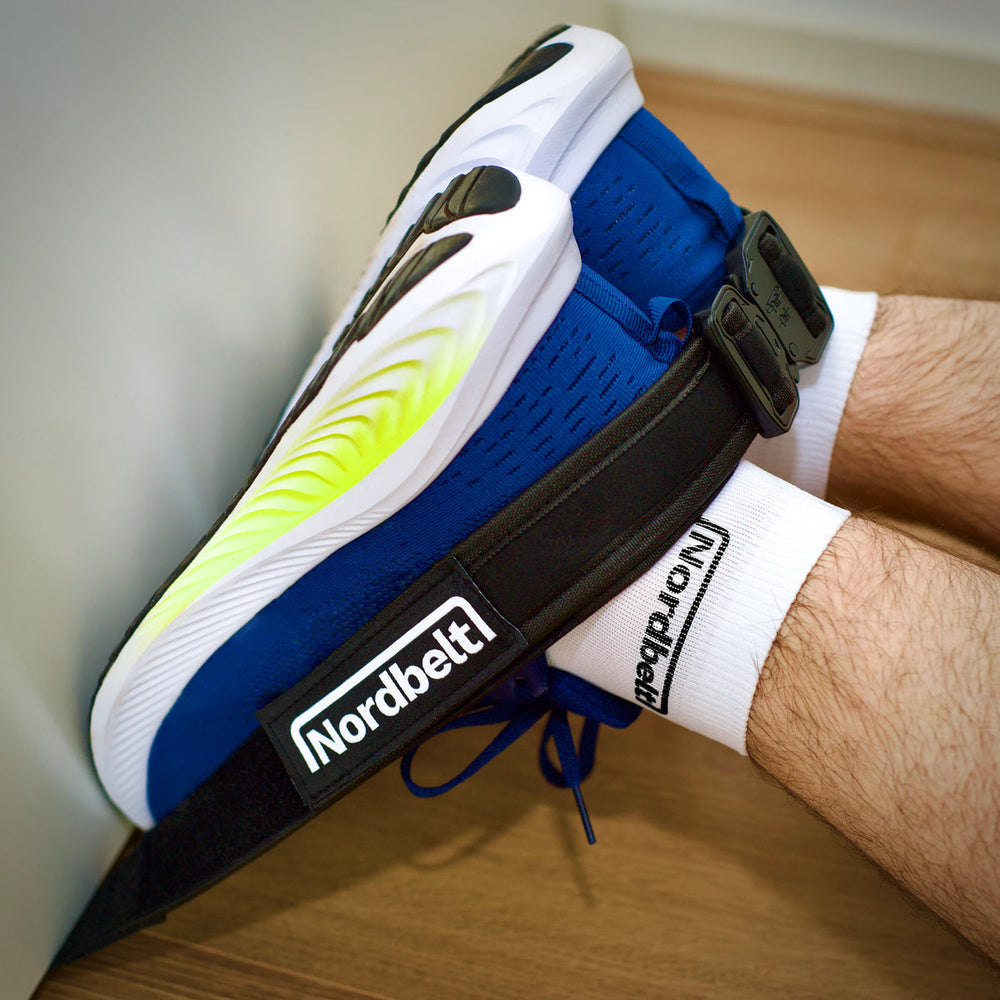
When you roll over and kneel for a Nordic curl, your feet have a different job. You lean forwards from the knees. Your feet can lift unless someone or something holds your ankles in place. The black strap in the photo goes around a training bench and secures both ankles. You can leave that setup out of your floor bridge.

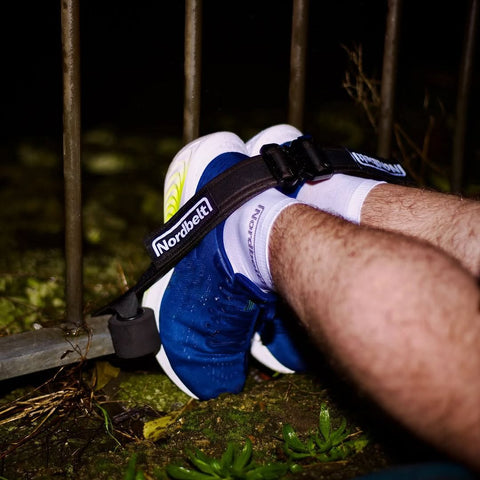
For a Nordic, choose a door that stays closed in the direction you pull, a bench that can’t slide or tip, or a fixed fence with a solid low anchor. Close the buckle and pull in the direction of the exercise before you start. If the anchor moves, choose another spot. The guide to securing the strap at a door, bench or fence shows each setup separately.
Frequently asked questions
How far should my heels be from my hips?
Start close enough to hold the bridge steadily, then compare it with a position a hand’s width further out. Choose the one that gives you the effort you want while your heels stay planted. The distance that suits a teammate with longer legs won’t tell you much about yours.
Do I need to straighten my knees completely?
Keep a little bend. Moving both heels a short distance before lifting your hips already makes the lever longer. Bring them back in if your hips drop straight away or your heels slip.
Can I use this to compare my left and right hamstrings?
Both legs are working together in this bridge. To count repetitions on each side, the single-leg hamstring bridge test uses a different setup and its own rules for technique and counting. Feeling more effort in a two-leg bridge doesn’t give you a strength score for either leg.