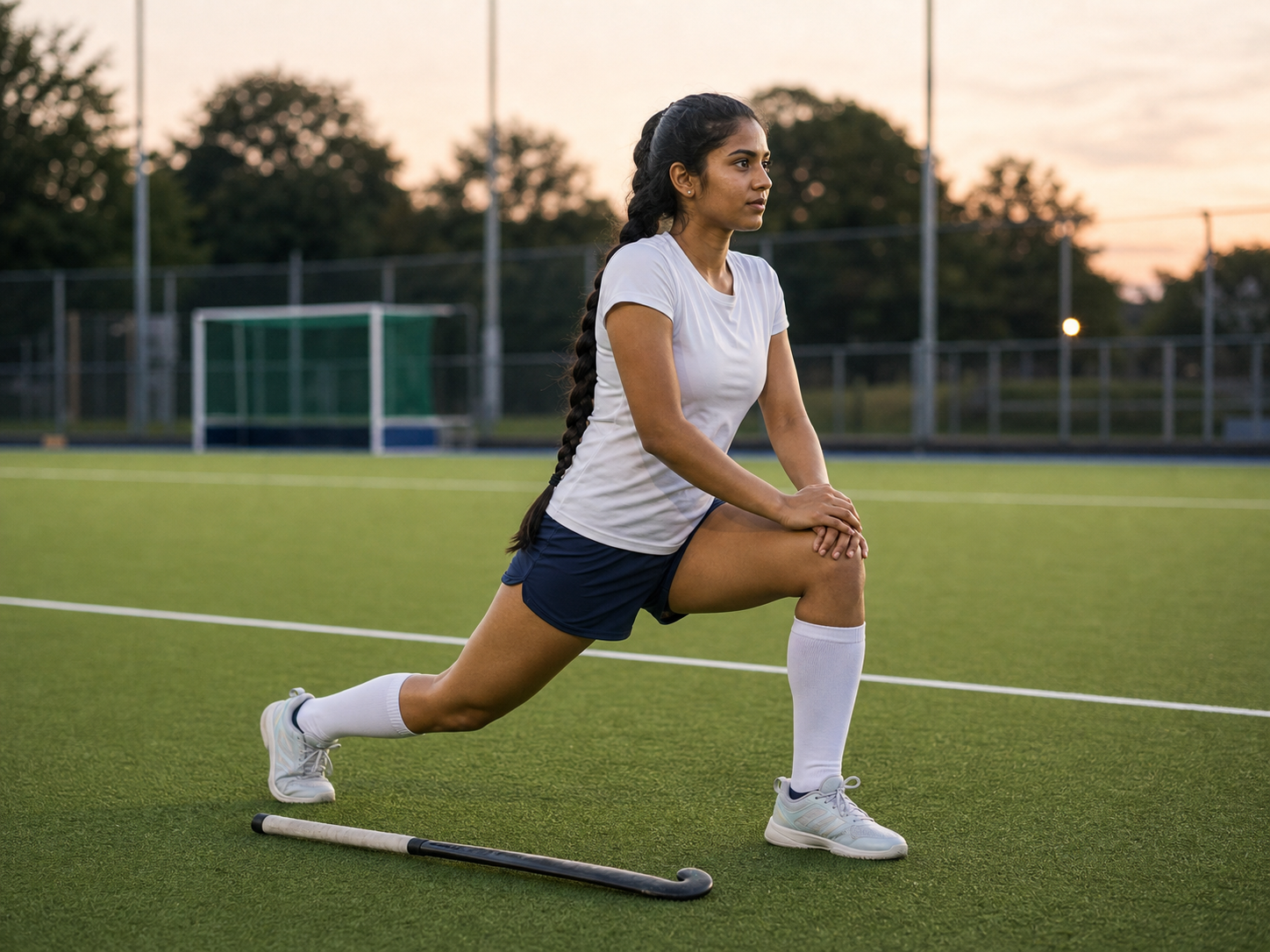
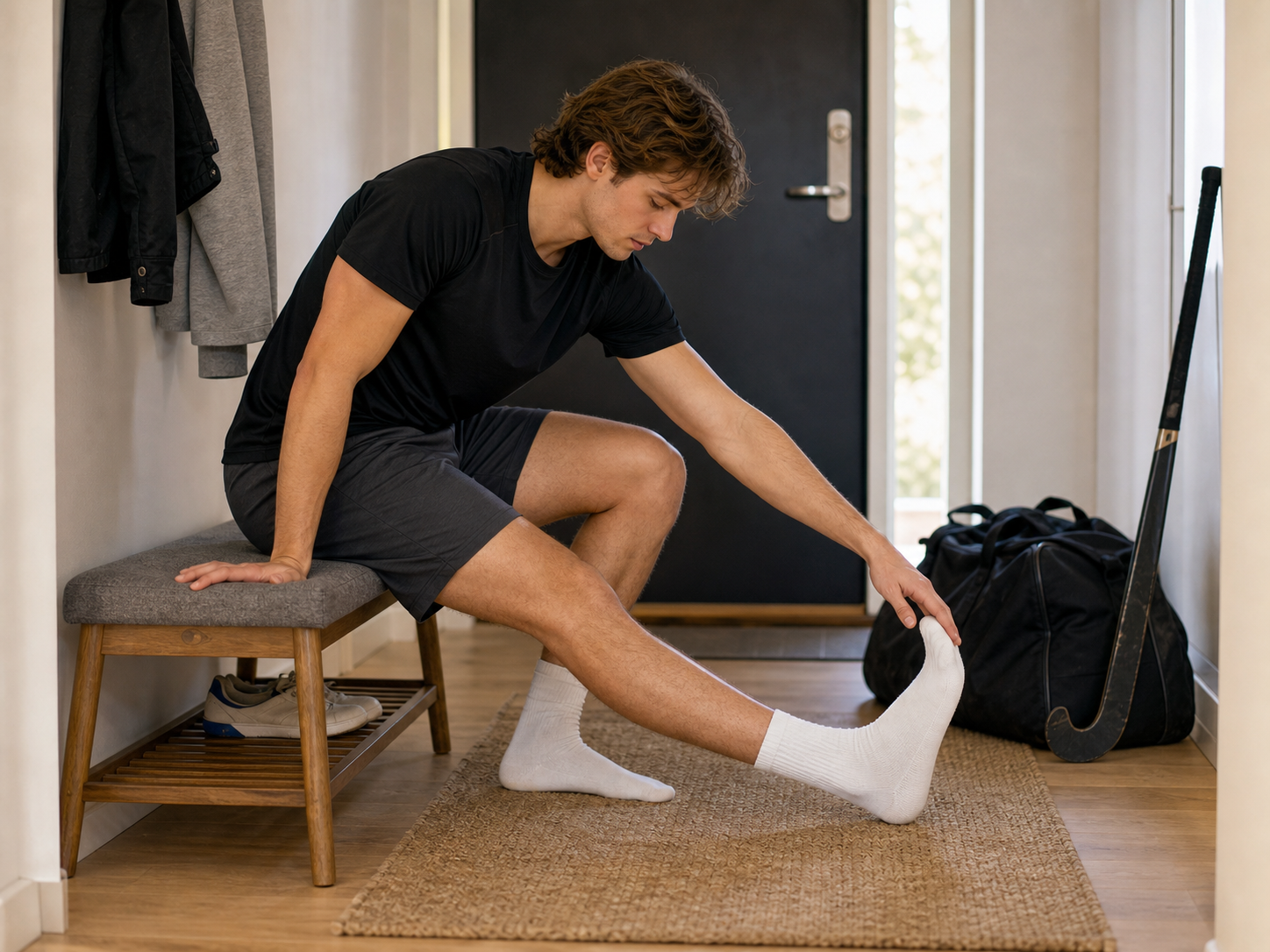
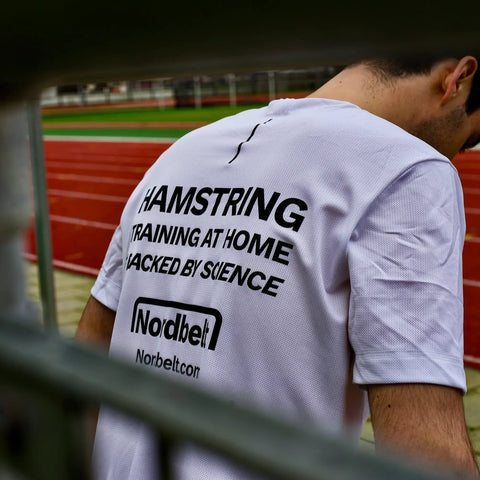
L’entraînement des ischio-jambiers pour le hockey sur gazon doit accompagner accélérations, freinages et changements de direction. Combinez force de hanche, flexion du genou et travail sur le terrain. Les Nordic curls sont une option complémentaire, pas un programme complet ni une garantie contre les blessures.
Choisissez deux mouvements maîtrisés
Associez une extension de hanche, comme un bridge ou soulevé de terre roumain léger, à une flexion du genou, comme un slider curl court. Gardez le bassin contrôlé et les talons libres de glisser avec les sliders. Quelques séries de qualité avec réserve constituent un exemple de départ pour un sportif en bonne santé, pas une prescription de rééducation.
VRAIE PHOTO DU PRODUIT
Nordbelt
Des Nordic curls sans partenaire ni banc — à la maison, en salle et sur le terrain.★★★★★ 4,8 sur Google · 1000+ sportifs
Découvrir Nordbelt
€39,99
€34,99Livraison gratuite · 30 jours pour changer d’avis
★★★★★
“Un indispensable pour tout sportif passionné.”
Conservez le travail spécifique au terrain
Les ischio-jambiers subissent des contraintes élevées en course rapide ; les études biomécaniques décrivent notamment les interactions hanche-genou pendant le sprint. (Schache et al., 2012) Augmentez progressivement accélérations, freinages et changements de direction après échauffement. La musculation ne remplace pas l’apprentissage de ces actions avec crosse et balle.
Pour passer à la pratique
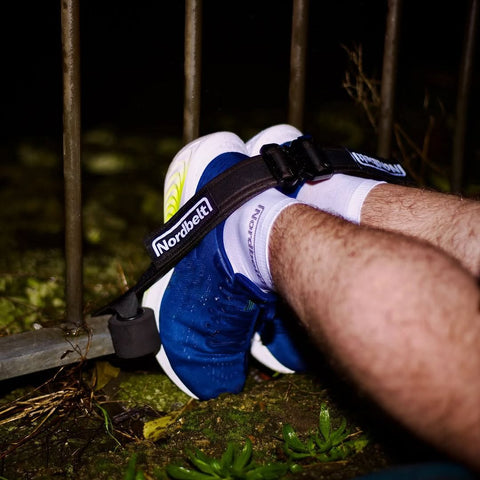
Pour les Nordic curls assistés, Nordbelt permet de fixer les chevilles. Vérifiez l’ancrage, l’appui des genoux et l’espace pour vous réceptionner tôt avec les mains avant chaque séance. Cet accessoire ne remplace ni la technique ni une progression adaptée. Le guide d’utilisation explique le montage et la position de départ.
PROTOCOLE GRATUIT DE 10 SEMAINES
Faites progresser votre Nordic curl de la première répétition à
la semaine 10.
Un plan concret de 7 pages : progresser semaine après semaine, sans aller trop vite.
01Une progression claire semaine après semaine
02La technique et les erreurs à éviter
03Un journal simple à vraiment utiliser
≤51%
moins de blessures aux ischio-jambiers dans les programmes incluant le Nordic Hamstring Exercise (NHE)
✓Fondé sur la recherche
Van Dyk et al., 2019 : méta-analyse de programmes avec NHE. Aucun effet mesuré pour Nordbelt ou ce protocole.
✓
Votre protocole est déjà prêt
Rouvrez la page de téléchargement ou consultez l’e-mail que nous vous avons envoyé.
Une variante courte avec appui précoce des mains peut compléter la force excentrique. Vérifiez ancrage, fixation des chevilles et support des genoux. Les études de prévention souvent citées portent sur le football ; elles ne prouvent pas le même résultat pour chaque hockeyeur. (Petersen et al., 2011)
VRAIE PHOTO DU PRODUIT
Nordbelt
Des Nordic curls sans partenaire ni banc — à la maison, en salle et sur le terrain.★★★★★ 4,8 sur Google · 1000+ sportifs
Découvrir Nordbelt
€39,99
€34,99Livraison gratuite · 30 jours pour changer d’avis
★★★★★
“Un indispensable pour tout sportif passionné.”
Comment organiser la semaine ?
Évitez de découvrir une forte dose de Nordics juste avant une séance rapide ou un match. Placez le renforcement là où récupération et technique restent compatibles avec le terrain. Notez la réaction le lendemain et modifiez un paramètre à la fois. Les adaptations décrites dans les revues ne constituent pas un calendrier individuel. (Medeiros et al., 2020)
Une extension de hanche et un curl que vous maîtrisez, avec une charge compatible avec la semaine de hockey.
Les Nordics sont-ils obligatoires ?
Non. Ils peuvent compléter le programme si leur tâche et leur difficulté conviennent.
Que faire avec une douleur vive ?
Interrompez la charge et faites évaluer une douleur nette ou persistante, surtout avec faiblesse ou hématome.
NORDIC CURLS — PARTOUT — NORDIC CURLS — PARTOUT —
Outil pour le Nordic Hamstring Curl
Des ischio-jambiers plus forts. Partout.
Nordbelt permet d’effectuer partout l’un des exercices pour les ischio-jambiers les mieux étudiés — sans partenaire ni banc coûteux. À la maison, en salle ou sur le terrain. Prêt en moins d’une minute.
✓ Commandé avant 22 h, expédié le jour même
VIDÉO RÉELLE · 0:12
offre−
€5
ANCRAGEPORTE · BANC · BARRIÈRE
INSTALLATION < 01:00
★★★★★
« Un indispensable pour tout sportif ou coureur assidu. »
Jesse van Hofwegen · Trustpilot
EXPÉRIENCE1000+sportifs utilisent déjà Nordbelt
PROFESSIONNEL50+cabinets de kinésithérapie l’utilisent
GOOGLE4,8 Note moyenne
Jusqu’à
51%
moins de blessures aux ischio-jambiers dans les programmes incluant le Nordic Hamstring Exercise (NHE)
Utilisé parplus de 50 cabinets de kinésithérapie différents
Regardez. Et comprenez pourquoi le Nordic curl fonctionne.
Progression du mouvement
20%
Phase 01Pieds fixés. Inclinez-vous lentement depuis les genoux.
Phase 02Freinez en excentrique — le muscle se renforce en s’allongeant.
Phase 03Réceptionnez-vous avec les mains, repoussez et recommencez.
Le travail excentrique — produire de la force pendant que le muscle s’allonge — cible précisément le moment où les ischio-jambiers sont le plus sollicités lors d’un sprint. Le Nordic curl entraîne exactement ce moment.
02 COMMENT ÇA MARCHE
Fixez. Réglez. Exécutez.
Passez du sac de sport à votre première répétition contrôlée en moins d’une minute. Les trois vidéos s’enchaînent automatiquement — touchez une carte pour la revoir.
★★★★★
« C’est très agréable de pouvoir faire cet exercice seul. »
00:04
01 — CHOISIR
Trouvez un point d’ancrage solide
Placez Nordbelt sous une porte robuste ou fixez-le à un banc, une barrière ou une poutre.
00:05
02 — CLIQUER
Fermez et ajustez à votre taille
Fermez la boucle et ajustez la sangle pour une position ferme et confortable autour des chevilles.
00:09
03 — CURL
Commencez avec contrôle
Vos pieds sont fixés. Progressez calmement et graduellement dans vos Nordic Hamstring Curls.
↳ Guide pratique et protocole d’entraînement progressif de 10 semaines inclus.
Placez les ancrages de l’autre côté de la porte, fermez-la complètement et vérifiez la fixation avant de commencer.
★★★★★
« Où que vous soyez, s’entraîner devient facile. »
Recommandé par
Un magazine de référence sur le fitness et la santé.
Traduction de l’article néerlandais · p. 84
La rédaction de Men’s Health présente chaque mois ses équipements favoris dans la rubrique Editor’s Pick. Nordbelt y a été sélectionné comme outil compact pour les Nordic curls.
“Renforcer ses ischio-jambiers sans aménager une salle de sport chez soi ?”
Men’s Health NL · page 84
Entraînez-vous où vous voulez
Chez vous, à la salle ou sur le terrain.
Une installation simple
À fixer à une porte, un banc, une clôture ou une poutre.
✓
Livraison gratuite✓
Délai de retour de 30 jours
04 LE KIT
Tout pour votre première série.
★★★★★
“Le sac et les cartes sont vraiment bien pensés.”
1 / 6 · touchez pour changer
01
Nordbelt
Outil réglable pour Nordic Hamstring Curl avec boucle solide et rouleaux souples aux chevilles.
02
Sac de rangement
Compact pour la maison, la salle ou le terrain — il ne pèse presque rien.
03
Guide
Instructions claires d’installation et de sécurité pour les trois points d’ancrage.
04
Protocole de 10 semaines
Progression d’entraînement fondée sur les sciences du sport.
VRAI DÉBALLAGE — VOICI CE QUE VOUS RECEVEZ
Thomas PereiraMédecin, scientifique du sport et co-fondateur
05 L’HISTOIRE
Pas un gadget. Une frustration résolue.
Lorsque j'ai subi une blessure aux ischio-jambiers, j'ai remarqué à quel point il était difficile de s'entraîner correctement à la maison sans équipement coûteux ni aide extérieure. C'est pourquoi j'ai développé Nordbelt.
01
Issu d'une véritable expérience de blessure
Le point de départ était un vrai problème d’entraînement — pas une idée marketing.
02
Fondements médicaux et scientifiques du sport
Perfectionné avec des kinésithérapeutes et des sportifs de terrain.
S’entraîner sur des bases scientifiques. Sans exagération.
Le Nordic Hamstring Exercise est l’un des exercices les mieux étudiés en sciences du sport. Nordbelt n’ajoute rien de magique — il rend simplement l’exercice autonome, pratique et reproductible. C’est précisément l’objectif.
01
Exercice fondé sur les preuves
Les programmes intégrant le Nordic Hamstring Exercise montrent une nette diminution des blessures aux ischio-jambiers.
02
Progresser pas à pas
Commencez à un niveau adapté et augmentez la charge et le volume de façon contrôlée — le protocole de 10 semaines vous accompagne.
03
Largement applicable
Du football et de l’athlétisme au fitness et à la rééducation encadrée.
Utilisez toujours un point d’ancrage stable, vérifiez chaque connexion et suivez l’avis d’un médecin ou d’un kinésithérapeute en cas de blessure, de rééducation ou de reprise sportive.
07 LE CHOIX
Le même exercice. Une voie plus intelligente.
Comparaison entre Nordbelt, un banc Nordic et l’entraînement avec un partenaire
Critère
Nordbelt
€34,99
Banc Nordiccoût d’achat plus élevé
Partenaire d’entraînementGratuit — s’il est disponible
S’entraîner en autonomie
✓
✓
✗
Tient dans votre sac de sport
✓
✗
—
Maison, salle et terrain
✓
✗ un emplacement fixe
± selon les disponibilités
Prêt en < 1 minute
✓
± installation et espace
± fixation variable
Fixation constante et solide
✓
✓
✗
Nordbelt
VScomparer à▾
NordbeltBanc
S’entraîner en autonomie✓
Tient dans votre sac de sport✓
Maison, salle et terrain✓
Prêt en < 1 minute✓
Fixation constante et solide✓
Banc Nordic · coût d’achat plus élevé
Comparaison indicative fondée sur les bancs Nordic courants et l’entraînement avec l’aide d’une autre personne.
★★★★★
“Idéal si vous ne voulez pas acheter un banc coûteux.”
Convaincu par cette voie plus intelligente ? Délai de retour de 30 jours. Consultez les conditions de retour.
Kim van HeumenKinésithérapeute du sport MSc. · Google★★★★★
« Une excellente solution pour réaliser correctement et facilement le Nordic Hamstring Curl. Pratique dans mon travail de kinésithérapeute et dans différents lieux. »
“Avec Nordbelt, vous pouvez faire des Nordic curls chez vous, à la salle ou sur le terrain.”
Sélection de la rédaction · p. 84
Jesse van HofwegenSportif passionné · Trustpilot★★★★★
“Un indispensable pour tout sportif ou coureur passionné. C’est très appréciable de pouvoir faire cet exercice précis en autonomie avec Nordbelt.”
Hidde DemoedCabinet de kinésithérapie · Google★★★★★
“Un outil très pratique pour réaliser le Nordic Hamstring Curl. Un indispensable pour tout cabinet de kinésithérapie.”
PaulTrustpilot★★★★★
Expédition rapide et outil idéal pour le Nordic Hamstring Curl si vous ne souhaitez pas acheter un banc coûteux. Idéal pour renforcer vos ischio-jambiers.
Cem SelcukUtilisateur de Nordbelt · Trustpilot★★★★★
“Très pratique et robuste. Nordbelt se fixe facilement et reste stable. Le programme d’entraînement est clair et efficace.”
Sportfysio van LieropKinésithérapeute du sport · Trustpilot★★★★★
Excellent outil pour réaliser le Nordic Hamstring Curl à la maison : utile en récupération et facile à emporter.
John MeeuwisseUtilisateur de Nordbelt★★★★★
“Beau produit, livré rapidement et très pratique !”
Des informations claires à l’avance — pas de petites lignes cachées derrière le bouton d’achat.
Une question personnelle ?contact@nordbelt.com
Réponse généralement sous un jour ouvré.
Comment utiliser Nordbelt ? +
Choisissez une porte, un banc de fitness, une barrière ou une poutre stable. Fermez la boucle, réglez la longueur, vérifiez la fixation et commencez par des répétitions contrôlées.
Que contient le colis ? +
Nordbelt, un sac de rangement compact, un guide pratique et un protocole d’entraînement progressif de 10 semaines.
Ai-je besoin d’un partenaire d’entraînement ou d’un banc ? +
Non. Nordbelt est justement conçu pour s’entraîner seul, sans grand banc Nordic. Un point d’ancrage solide et stable reste toutefois indispensable.
Est-ce adapté à la récupération ou à la rééducation ? +
Nordbelt peut faciliter un renforcement contrôlé des ischio-jambiers. Pendant la récupération, définissez le moment, la charge et la progression avec votre médecin ou votre kinésithérapeute.
Combien coûtent les frais de livraison ? +
Livraison standard pour la Belgique : gratuite. Commandé avant 22 h, expédié le jour même.
Puis-je le retourner ? +
Vous pouvez demander un retour dans les 30 jours suivant la réception. Le produit doit être inutilisé, propre et dans son emballage d’origine ; les frais de retour sont à la charge de l’acheteur.
Nordbelt convient-il aux débutants ? +
Oui. Commencez avec une amplitude plus courte et une assistance si nécessaire, gardez des répétitions contrôlées et suivez le protocole de 10 semaines inclus. Arrêtez si votre technique se dégrade ou si vous ressentez une douleur.
Quels points d’ancrage sont sûrs ? +
Utilisez uniquement une porte solide, un banc de fitness lourd, une clôture robuste ou une poutre fixe qui ne peut ni s’ouvrir, ni glisser, ni basculer. Avant chaque série, tirez fermement sur la fixation dans le sens de la charge.
À quelle fréquence puis-je faire des Nordic Hamstring Curls ? +
Il n’existe pas de fréquence unique adaptée à tous. Utilisez le protocole de 10 semaines comme point de départ progressif et adaptez le volume et la récupération à votre niveau, à votre charge sportive et à votre technique.
D’où vient l’affirmation de 51 % de blessures aux ischio-jambiers en moins ? +
Les 51 % concernent des programmes incluant la Nordic Hamstring Exercise, et non Nordbelt en tant que produit. Une revue systématique et une méta-analyse portant sur 8 459 sportifs (van Dyk, Behan & Whiteley, Br J Sports Med, 2019) ont rapporté une réduction allant jusqu’à 51 % ; les résultats individuels ne sont pas garantis.
✓
Délai de retour de 30 jours
Essayez Nordbelt.
Délai de retour de 30 jours
Le retour est possible sous 30 jours. Le produit doit être inutilisé, propre et dans son emballage d’origine ; les frais de retour sont à votre charge.
Voir la politique de retour
↩
Délai de retour de 30 jours
Les frais de retour sont à la charge de l’acheteur