

Nordic curl or 45-degree hip extension for hamstrings at home


Nordic curl or 45-degree hip extension for your hamstrings at home? Choose the Nordic if you mainly want to train knee flexion and can create stable ankle fixation in a small floor area. Choose a 45-degree hip-extension bench if you want to train hip extension and have room for an adjustable, permanent station. Neither is a one-for-one substitute: first identify the movement task you need, then check whether its setup genuinely fits your home.
What is the real difference between a Nordic curl and a 45-degree hip extension?
The first difference is the movement task. During a Nordic curl, your body stays in one line as much as possible while the knees gradually extend. The hamstrings have to slow that forward movement around the knee. During a 45-degree hip extension, your thighs rest against a support and your torso moves around the hip. That is a hip-extension task, not simply the same curl performed on a larger machine.
The second difference is the setup. A Nordic requires a comfortable surface, clear space in front of you and low fixation that holds both ankles securely. A 45-degree bench uses a fixed frame, an upper support that suits your build and footrests that let you organise your position. The machine usually occupies space permanently; a compact Nordic setup can be put away after use.
One training study assigned thirty recreationally active men to ten weeks of Nordic training, hip-extension training or no training. Both exercise groups showed changes in hamstring architecture, but measured muscle growth was not the same for every muscle and exercise. This supports the idea that the movements partly overlap while also providing different training stimuli; the study does not decide which piece of equipment you should buy for your home (Bourne et al., 2017).
The separate page about using the Nordic curl as your only hamstring exercise at home examines programme completeness. This page has a narrower purpose: choosing between two physical home setups.

Ankle fixation for Nordic curls at home
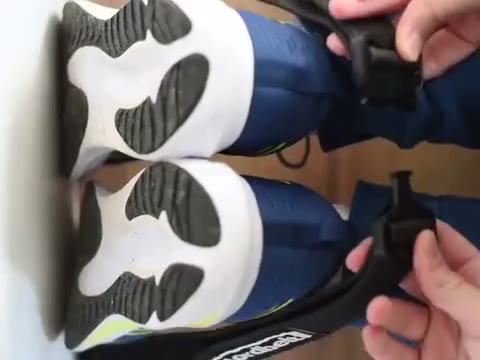
Do you also want to add Nordic curls at home? Assess the anchor first and the equipment second. The attachment must not shift when you load it with your hands, both ankles should be fixed low and evenly, and your knees need a surface that does not force your position. Start with a short range you can slow down deliberately and increase it only while the anchor, body line and control remain consistent. The dedicated guide to a safe Nordic setup at home explains the anchor check and progression in more detail.
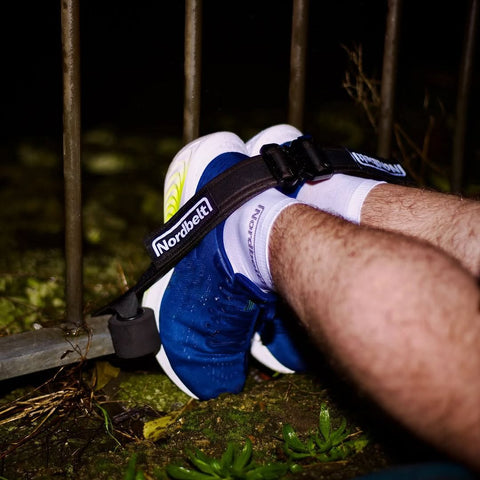
With Nordbelt for Nordic curls at home, stable ankle fixation becomes practical without a training partner or large fitness machine. That is the defensible product job: a repeatable, compact Nordic setup at home. The equipment does not turn the movement into a 45-degree hip extension and does not replace an anchor check, kneeling comfort, technique or gradual load selection.
When is a 45-degree hip-extension bench a better fit at home?
A 45-degree station is a better fit when hip extension is the task you actually want. Check whether the upper support adjusts enough to let the hip move freely, whether your feet stay secure and whether you can get onto and off the frame without twisting. Consider its fixed length and width as well as the size of the footrests. You also need room around the machine to lower and raise your torso under control.
Do not treat “45 degrees” as a quality label in itself. The angle describes the frame, but it does not automatically mean the support fits your build or that you can organise the movement well. If you still need to learn the general hip movement, first use the dedicated guide to learning the hip hinge. This comparison does not prescribe a back position, repetition count or personal load.
A 2026 study compared an incline Nordic with bilateral hip extension on a Roman chair in 25 healthy men. The researchers found task- and group-specific differences in hamstring and trunk muscle activation and stressed that the findings were descriptive and associative. That is a useful warning against treating the exercises as identical, but it is not proof that one setup is better for every home trainee (You et al., 2026).

Take your Nordic curl from the first rep to week 10.
A concrete 7-page plan: build up week by week, without pushing too fast.
- 01A clear week-by-week progression
- 02Technique and the mistakes to avoid
- 03A simple log you will actually use

≤51%
✓Backed by research
Van Dyk et al., 2019: meta-analysis of programmes with NHE. Not an effect test of Nordbelt or this protocol.
Open the download page again or check the email we sent you.
Open the download page ↗Use the task-space matrix to make your choice
The task-space matrix is an editorial decision framework, not a researched training protocol. Start on the left with what you want to train. Only then move right to determine which setup you can prepare consistently and safely enough.
| Decision point | Compact Nordic-curl setup | 45-degree hip-extension bench |
|---|---|---|
| Primary movement task | Knee movement: slow the forward body line around the knee | Hip movement: lower and extend the torso around the hip |
| Essential fixation | Low, stable and even ankle fixation plus a kneeling surface | Suitable thigh support, stable foot position and a solid frame |
| Space during use | Clear path in front of the knees; often stored away afterwards | Permanent floor area plus room around the frame |
| Main fit check | Anchor holds, ankles stay even and knees are comfortable | Support leaves the hip free and footrests suit your build |
| Wrong assumption | A small aid automatically makes the Nordic easy | A larger station automatically makes the exercise more complete |
Give each decision point a simple outcome: required, possible or not suitable. Reject a setup when its movement task does not match your goal, even if it fits the room perfectly. Conversely, reject a suitable exercise if you cannot set it up securely or if it blocks a walkway after every session. This double check makes the matrix more useful than a ranking of the “best hamstring machines”.
Can you combine both setups?
Yes, but only if you deliberately want to include both movement tasks and have room for both. A Nordic setup and a 45-degree bench can complement one another; they do not need to replace one another. Keep the exercises clearly distinct when you first combine them. Do not change range, resistance, session order and setup at the same time, because you will no longer know which choice influenced your execution.
Use the research modestly here too. The study by Bourne and colleagues examined specific groups and a ten-week programme; the study by You and colleagues examined acute muscle activation in healthy men. Together, they mainly support that the tasks and outcomes are not identical. They do not provide a universal programme for your home or training goal (Bourne et al., 2017; You et al., 2026).
If your main question is how much floor space a storable Nordic setup needs, see the focused guide to Nordic curls in a small space. This keeps the present page responsible for the choice between a compact anchor and a 45-degree station, rather than every detail of either setup.
Decide with five checks, not by muscle feel
- Name the task: do you want knee flexion, hip extension or deliberately both?
- Measure the working space: include the movement path and access around the setup, not just the equipment.
- Test the contact points: for the Nordic, check the anchor, ankle fixation and kneeling surface; for the bench, check the support, foot position and frame stability.
- Choose a regression: your first version must be controllable without relying on an unfamiliar, heavily loaded end position.
- Repeat the same setup: a choice is practical only when you can prepare it in the same way next session.
Stop if an anchor moves, a frame wobbles, a contact point does not fit or you cannot end the movement under control. Pain, a recent injury or unexplained loss of strength falls outside this equipment comparison; have it assessed by a qualified healthcare professional instead of changing exercise or load on your own.
After choosing the Nordic, if you want to review the attachment, strap position and starting line calmly, use the Nordbelt guide to Nordic curls at home. The guide helps make the home setup repeatable; it does not turn the Nordic into a hip-extension exercise or decide which movement task your programme needs.
Frequently asked questions
Nordic curl versus 45-degree hip extension: which is better at home?
Neither is better without context. Choose the Nordic when you need a knee-flexion task and can create compact, stable ankle fixation. Choose the 45-degree bench when you want to train hip extension and have room for a suitable frame. Use the task-space matrix to assess the goal and the setup separately.
Is a Nordic curl the same as a back extension for the hamstrings?
No. In the Nordic, the main movement occurs around the knee as your body line moves forwards. In a back or hip extension on a 45-degree bench, the torso moves mainly around the hip. Both involve the hamstrings, but research shows that their measured activation and adaptations are not completely identical (Bourne et al., 2017; You et al., 2026).
Can a Nordic curl replace a 45-degree hip-extension bench?
Only when your original goal is the Nordic knee-flexion task and you do not need the hip-extension task. If you deliberately want to train hip extension, a Nordic does not replace that movement. “Replace” therefore refers to function, not just how much space or money a setup requires.
What is the minimum you need for Nordic curls at home without a partner?
You need an anchor that does not shift under gradually applied hand pressure, low and even fixation for both ankles, sufficient kneeling comfort and clear space in front of you. Begin with a short range that you can slow down under control. Equipment can make fixation more practical, but it does not replace these checks.
When do both hamstring setups make sense at home?
Both make sense when you deliberately want to train knee flexion and hip extension, can perform each movement separately and have enough room to use each setup securely. Do not combine them only for variety: write down the task each setup must fulfil and keep the first changes limited.