

Nordic hamstring curl at home: safe setup with a door, bench or fixed anchor


“Nordbelt is easy to secure and feels stable.”
You can do Nordic hamstring curls safely at home if your ankles are fixed properly and you build the exercise up gradually. This article gives you three practical setup options, a safety checklist and a simple four-week build-up.
Nordic hamstring curl at home: the short version
The Nordic hamstring curl is an eccentric hamstring exercise where you lower yourself forward from a kneeling position and control the braking phase mainly with your hamstrings. It is especially relevant for athletes who want to build hamstring strength for sprinting, deceleration and injury prevention (Medeiros et al., 2020) (Petersen et al., 2011).
Training at home works well if three conditions are met:
- your anchor point does not move;
- you kneel on a stable, soft surface;
- you start with regressions if full reps are still too heavy.
If one of those three is missing, the setup is not ready yet.
When home training makes sense, and when it does not
Home training is especially useful if you do not have a partner, a Nordic bench or a dedicated machine. In that situation, a setup you can repeat in under a minute usually makes the difference between consistent training and skipping the exercise altogether.
Not every home environment is suitable. A light chair, a door that swings towards you or a slippery floor creates unnecessary risk. If you already have pain high in the hamstring or under the glute, start with a lighter build-up before you move into full Nordic variations.
If you want a more repeatable home solution rather than improvising every session, the general Nordic hamstring curl guide and the how-to guide are the most logical next steps.

Choose your home setup before the first repetition
| What you have | What to check | Next step |
|---|---|---|
| A suitable solid door | Door construction, closing direction and compatibility with the anchor's instructions. Keep others from opening it during use. | Follow the door setup and inspect the anchor before loading it. |
| A stable training bench | The bench cannot tip or slide and the strap cannot slip off its attachment point. | Follow the bench setup; a light chair is not an equivalent anchor. |
| No suitable fixed anchor | Improvised furniture or a loose object cannot provide dependable ankle fixation. | Choose another exercise while arranging an appropriate setup. |
Compare the space and attachment requirements in the Nordic curl equipment guide. For an exercise that does not need fixed ankle anchoring, see hamstring slider exercises. Sliders train knee flexion in a different position; they do not certify that you are ready for a full Nordic curl.
Take your Nordic curl from the first rep to week 10.
A concrete 7-page plan: build up week by week, without pushing too fast.
- 01A clear week-by-week progression
- 02Technique and the mistakes to avoid
- 03A simple log you will actually use

≤51%
✓Backed by research
Van Dyk et al., 2019: meta-analysis of programmes with NHE. Not an effect test of Nordbelt or this protocol.
Open the download page again or check the email we sent you.
Open the download page ↗Safety criteria for every anchor point
Whatever setup you choose, always check these five points first:
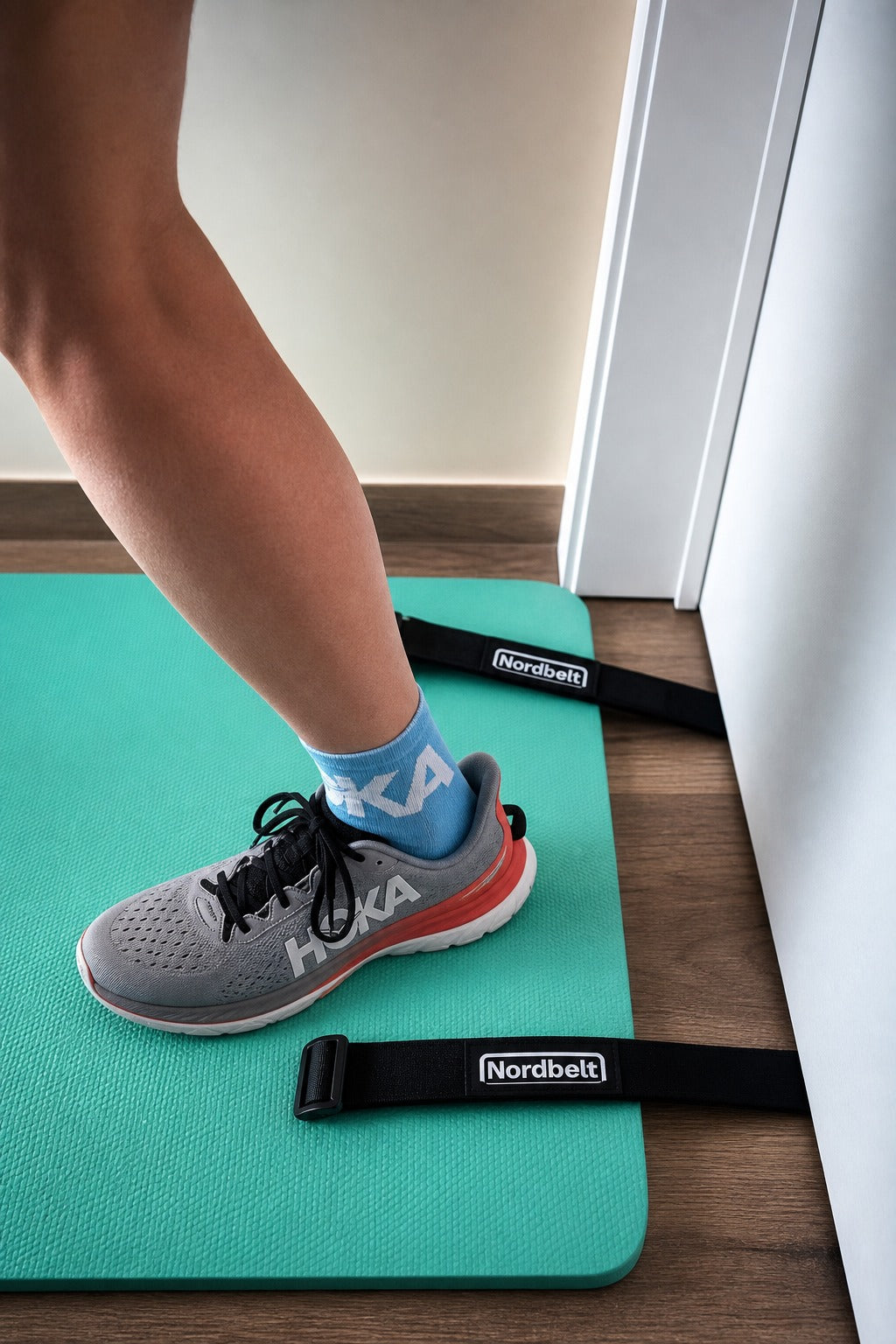
- The anchor point does not move when you pull hard on it.
- Your ankles are fixed low and firmly enough.
- Your knees are on a mat or thick towel.
- The floor gives you enough grip.
- You have room to catch yourself with your hands if the braking phase drops away.
A loose strap or improvised setup can work, but only if the fixation is genuinely reliable. It helps to think of setup, safety and progression as one system rather than a loose piece of equipment. If you want a repeatable home setup, the Nordbelt product page is the most practical next step.
Setup 1: door
A door setup only works if the door closes away from you, shuts firmly and cannot swing open unexpectedly. Place the anchor low, test the tension with your hands first and only then move into position.
Use this sequence:
- Close the door fully.
- Place the anchor low on the other side of the door.
- Pull hard on the fixation by hand to check that nothing shifts.
- Kneel on a mat with a long torso and your hips extended.
- Start with a shorter range and catch yourself with your hands when needed.
This option is especially useful if you want a quick setup and do not have much space.
Setup 2: bench
A heavy training bench or another very solid bench often feels more stable than a door because the ankle position is easier to control. The common mistake here is using a bench that is too light or trying to anchor too high under the edge.
Use this sequence:
- Only use a bench that will not slide.
- Make sure your ankles stay fixed low.
- Place your knees on a mat directly behind the bench.
- Keep shoulders, hips and knees in one line.
- Lower yourself in three to five seconds.
For athletes who already do gym work, the bench setup usually feels the most natural.
Setup 3: fence or fixed anchor
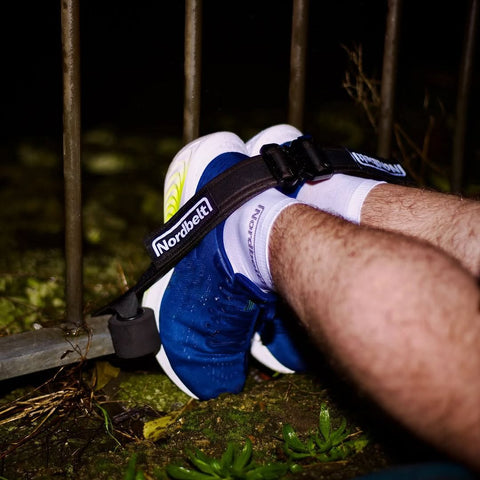
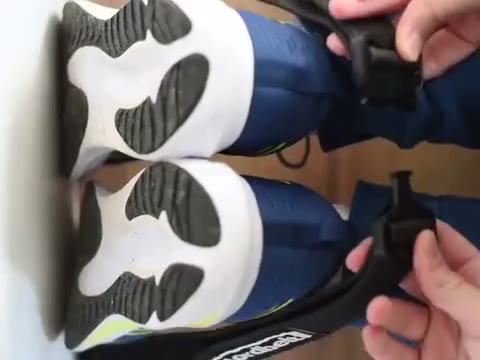
A solid fence, low rack or other fixed anchor point can work very well, as long as it does not move and the fixation does not creep upwards during the rep. Outdoors or in a garage, this is often the most robust option.
The rule is simple: if the anchor point is lighter or less stable than you are, it is not a good anchor point.
Technique checklist for the first reps
A good Nordic hamstring curl looks simpler than it is. Use this checklist:
- keep your hips extended;
- do not hang into your lower back;
- lower slowly instead of dropping;
- think of one long line from knee to shoulder;
- catch yourself with your hands as soon as control fades.
The biggest mistake is trying to prove too early that you can already do full repetitions. For most athletes, controlled lowering is more than heavy enough at the start.
Start with regressions, not perfect full reps
If you cannot do a full rep yet, that is normal. Start with one of these regressions:
- a shorter range of motion;
- more hand support at the bottom;
- a slow eccentric phase, then return with help;
- fewer reps with better control.
That is not a step backwards. It is exactly how you keep the exercise safe long enough to get stronger. Progress comes from consistent eccentric loading, not from forcing reps that are too heavy (Medeiros et al., 2020).
A simple 4-week build-up
Progressive structure for stronger hamstrings
Week 1
- 1 session per week: 2 sets of 5 reps
Week 2
- 2 sessions per week: 2 sets of 5 to 6 reps
Week 3
- 3 sessions per week: 3 sets of 5 to 6 reps
Week 4
- 3 sessions per week: 3 sets of 6 to 8 reps
Once that feels under control, keep building volume or range gradually rather than jumping straight to harder reps. If you want broader hamstring training around this exercise, the how-to guide and the Nordbelt product page are the most practical follow-up resources.

Common mistakes
The most common mistakes are:
- choosing an unstable setup because it probably holds;
- trying to get to full reps too quickly;
- doing the exercise with bent hips;
- training too often while your hamstrings are still very sore;
- assuming more reps are always better.
With this exercise, better control usually gives you more than extra volume.
Frequently asked questions
Can I do Nordic hamstring curls at home without a machine?
Yes, as long as your anchor point is genuinely stable and you treat the exercise like a heavy strength movement rather than a fast bodyweight drill. For most people, a solid door, heavy bench or fixed anchor works well if you test the setup first and start with regressions when full reps are still too heavy.
Is a door strong enough for Nordic curls?
Sometimes, yes, but only if the door shuts firmly, closes away from you and the fixation has been tested hard with your hands first. If the door moves, the frame creaks or the setup feels uncertain, use a bench or fixed anchor instead.
How often should I train this exercise each week?
For most athletes, twice per week is enough to build up without unnecessary irritation. A third session can work, but only if your total sprint and strength load is low enough and you leave at least 48 hours between heavier hamstring sessions. Injury prevention depends more on consistency over time than on squeezing in one extra hard workout (Petersen et al., 2011).
What if I still cannot lower myself under control?
That does not mean you are not ready to start. It simply means you are not yet at full Nordic reps. Use regressions such as a shorter range, more hand support or assisted reps, and focus first on controlling a three-to-five-second lowering phase.