

Cable hamstring curl technique: setup and form


The best cable hamstring curl technique starts with a low, straight cable path, an ankle strap that does not shift, and a position in which only your knee bends. Choose a standing or lying variation, begin with light resistance, and move without swinging: draw your heel toward your glute, pause briefly while your pelvis remains still, and let the cable return under control. End the set as soon as your hip joins the movement or the cable changes your position.
A cable curl is therefore not a test of how much weight you can move. The aim is a repeatable knee bend in which the cable, ankle strap, and body keep the same role from the first repetition to the last.
What do you train with a cable hamstring curl?
In a cable hamstring curl, you bend the knee against the pull of a cable station. The hamstrings assist with both knee flexion and hip extension, but those two tasks are not the same. Research comparing knee flexion and hip extension found different patterns of performance and muscle involvement; hip and knee position also changed the knee-flexion task (Yanagisawa and Fukutani, 2020).
That is why a cable curl does not automatically replace a Romanian deadlift, bridge, or another hip-dominant exercise. If you first want to understand the difference between these movement families, use the guide to posterior chain exercises. This page stays focused on the cable curl as a knee-flexion exercise.

The four-point cable check
Check four points before every working set. Together they form a practical framework for assessing your form without guessing at one perfect foot or torso angle.
- Cable path: the cable runs freely and pulls as straight as possible along the direction in which your lower leg moves. It does not rub against a bench, rack, or floor.
- Ankle strap: the strap sits where the cuff is designed to sit, stays closed, and does not shift during a light test repetition.
- Body block: your pelvis and torso remain still. Only your knee clearly changes angle; your hip does not swing to start the weight moving.
- End-position control: choose an end point you can reach and leave without jerking. The return remains as controlled as the pulling phase.
If one point changes, the repetition is no longer readily comparable with the previous one. Reduce the resistance or shorten the range of motion before choosing another variation.
How to perform a cable hamstring curl
Use this sequence to perform the cable hamstring curl:
- Check that the cable station, pin, carabiner, and ankle strap are attached according to the manufacturer's instructions.
- Set the cable low enough for the line of pull to remain clear in your chosen position.
- Attach the cuff and perform one light test bend without using your full range of motion.
- Lengthen your torso, hold your pelvis still, and keep hold of a support if you are working standing up.
- Bend the knee without a run-up. Let your heel move toward your glute for as long as your body block remains still.
- Return slowly and prevent the weight stack from landing hard.
- End the set when the cable path, ankle strap, body block, or end-position control changes.
The stability-ball curl shown is not a cable curl. It does illustrate the same distinction: knee flexion is the main task while you try to prevent the rest of your body from taking over the movement. For a sliding home variation, the guide to hamstring slider exercises provides its own clearly defined explanation.
Take your Nordic curl from the first rep to week 10.
A concrete 7-page plan: build up week by week, without pushing too fast.
- 01A clear week-by-week progression
- 02Technique and the mistakes to avoid
- 03A simple log you will actually use

≤ 51%
✓Backed by research
Van Dyk et al., 2019: meta-analysis of programmes with NHE. Not an effect test of Nordbelt or this protocol.
Open the download page again or check the email we sent you.
Open the download page ↗How to position the ankle strap for a cable leg curl
A cable leg curl ankle strap should above all remain predictable. Use a cuff intended for the cable station and this exercise, close it as instructed, and check that no skin, shoelace, or loose fabric is caught in the fastening. Placement differs by cuff, so follow the product instructions instead of copying a universal number of centimetres above the ankle.
Test the attachment with your hands first and then with a very light knee bend. The strap must not slide toward the foot, twist, or pull the cable off line. If either side feels uneven or unstable, resolve that before increasing the resistance.
Ankle fixation for Nordic curls at home
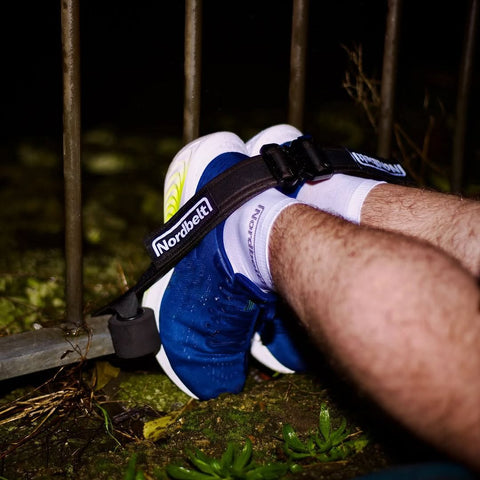
The exercise task then changes. A cable curl moves your lower leg against a cable; a Nordic curl instead fixes both ankles while your body moves forward from a kneeling position. With Nordbelt for Nordic curls at home, you can create that stable ankle fixation without a training partner or large fitness machine, provided the door, anchor point, floor, and clear space are suitable and checked beforehand.
Nordbelt is not a standing or lying leg-curl machine and does not perform a cable hamstring curl. Its product role is solely to provide a home setup for Nordic curls. Decide which exercise you want to train first; only then choose the equipment.
Standing cable hamstring curl
The standing cable hamstring curl is suitable when you want to move one leg at a time and have a solid support available. Keep a slight bend in the standing leg, hold your torso upright, and use a rack or handle only for balance. Keep the working thigh as still as possible; the lower leg moves backward through knee flexion.
This variation makes compensation visible. If your pelvis moves forward, your lower back arches, or your working knee travels forward, the resistance is probably too high or your support too uncertain. A lighter set with a still thigh provides more useful technical information than a heavier set with a great deal of hip movement.
Lying cable hamstring curl
For a lying cable hamstring curl, lie on your stomach with your feet pointing toward the low cable. Before lying down, check that the cable can move freely along its entire path and that you can safely reach the cuff. Keep your pelvis against the surface and bend one or both knees only through a range in which the strap remains stable.
A lying position reduces the balance requirement, but it does not automatically improve the setup. The cable may run along the bench, the cuff may twist, or your hips may lift when the resistance is too high. A study of regional muscle activity found differences between a lying leg curl and a stiff-legged deadlift, but the authors stressed that differences in activation do not automatically establish which long-term adaptation will follow (Schoenfeld et al., 2015).
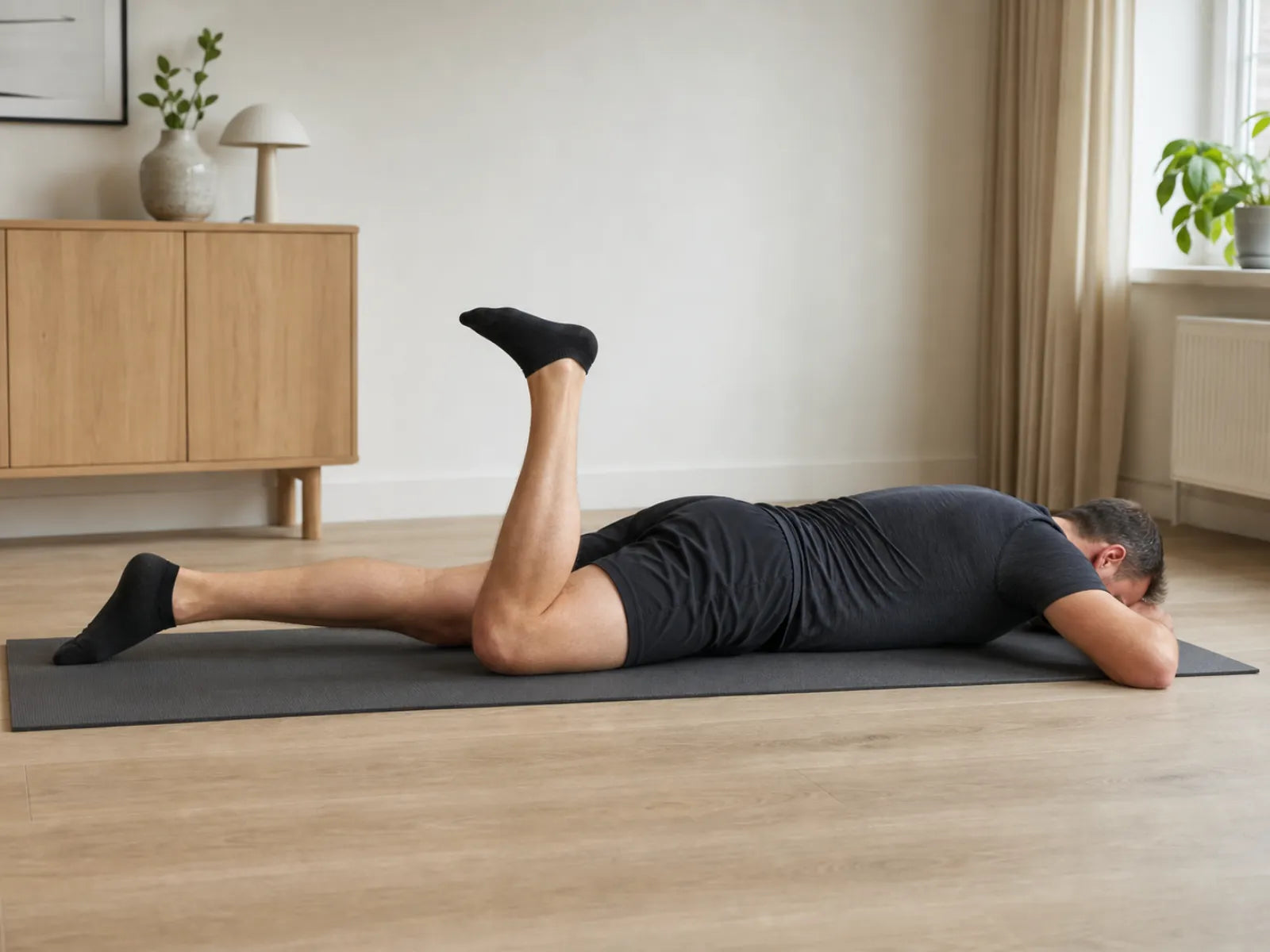 Prone knee curl without added resistance. Context image; the full exercise with the equipment described is not shown.
Standing or lying: which variation should you choose?
Choose standing when you can keep the cable path clear, have a reliable support, and want to control one leg separately. Choose lying when you have a suitable bench or floor setup, can reach the cuff safely, and the cable does not rub anywhere. Neither is sensible when the space, attachment, or weight stack forces you to improvise.
Hip position can change the length and task of the biarticular hamstrings. In a twelve-week comparison, seated leg-curl training produced more muscle growth than the prone variation in that specific study group; this result does not automatically make a standing or lying cable curl better or worse, but it does show that positions are not interchangeable (Maeo et al., 2021).
Common cable hamstring curl mistakes
The most common cable hamstring curl mistakes are:
- starting the weight stack with a swing of the hip;
- accepting an angled cable path because the exercise “still works”;
- trying to rotate the cuff into place only during a heavy set;
- dropping the return phase;
- forcing a larger range of motion after the pelvis has already started moving;
- training standing up without a reliable support;
- using an attachment for which the cable station or manufacturer describes no safe application.
High-density EMG research shows that different hamstring exercises can produce different intermuscular and regional activation patterns (Hegyi et al., 2019). That is a reason to choose your exercise deliberately, not to present small foot rotations or one “magic” cable-curl angle as a proven solution.
How does the cable curl fit into hamstring training?
Use the cable curl as the knee-flexion component of a broader programme, not as a complete replacement for every other hamstring task. Combine only exercises that suit your goal, available time, and recovery. The broader guide to hamstring exercises for strength and flexibility helps distinguish knee flexion, hip extension, and gradual progression.
If you specifically want to know which type of Nordic setup is suited to home use, the guide to Nordic hamstring curl equipment covers that separate equipment choice. For installing and using the home fixation, you can then follow the practical how-to guide. Those routes do not turn a cable curl into a Nordic curl or vice versa.
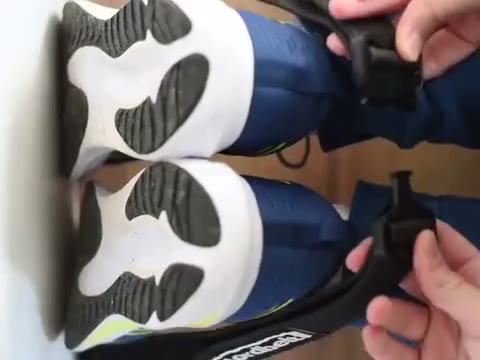 Hands fastening Nordbelt straps around the shoes. Context image; the full exercise with the equipment described is not shown.
Frequently asked questions
How high should you set the cable for a hamstring curl?
Set the cable low enough to pull freely and as straight as possible along the direction in which your lower leg moves. The exact position depends on the cable station, your position, and the cuff used. Always perform a light test repetition first and change the height if the cable rubs against equipment or pulls the strap off line.
Where should you place the ankle strap for a cable leg curl?
Position the cuff as instructed by the ankle-strap manufacturer. It must stay closed, not slide toward the foot, and not twist the cable. Do not use a universal placement rule if it conflicts with the shape or instructions of your attachment.
Is a cable hamstring curl better standing or lying?
Not in general. Standing requires more balance and a good support; lying requires a safe bench or floor setup and a clear cable path. Choose the variation in which the cable, cuff, pelvis, and return phase remain most predictable.
Should you pull your heel all the way to your glute?
No. Use only the range of motion in which your pelvis remains still, the cuff does not shift, and you can let the cable return under control. A smaller repeatable range is better than a larger movement created by hip swing or an angled cable.
Is a cable leg curl the same as a Nordic curl?
No. In a cable leg curl, your lower leg moves against cable resistance. In a Nordic curl, both ankles remain fixed and your body moves forward from a kneeling position. Both can load the hamstrings, but the setup, movement task, and progression differ.
Summary
A good cable hamstring curl is built around four consistent checks: a clear cable path, stable ankle strap, still body block, and controlled end point. Start light, choose standing or lying based on the available setup, and stop as soon as your hip or the cable takes over the knee bend. Treat a cable curl, slider, hip hinge, and Nordic as different exercises, each with its own task.