

Hamstring slider exercises: 6 variations and safe progression


Hamstring slider exercises are a practical way to build controlled hamstring strength at home or in the gym. You use sliders, towels or smooth pads under your heels and let your legs move away slowly. That trains control in the braking phase without jumping straight into the heavy load of a full Nordic hamstring curl. Start with both legs, keep the hips steady and only progress to single-leg versions when you get no cramp, sharp pain or clear next-day setback.
In brief
Slider curls fit well between light bridge variations and heavier eccentric hamstring exercises. They are easy to scale: you can shorten the range, use both legs, make only the outward phase slow, or reset after every repetition. That makes them useful for athletes who want strength, but also for coaches and therapists who want to see control before adding more demanding hamstring work. Use this guide alongside the broader hamstring exercises page and the focused guide to eccentric hamstring exercises.
Why sliders are useful for hamstrings
A slider curl asks the hamstrings to work while the knee angle changes and the hips stay stable. That is different from a simple glute bridge, where the feet usually stay in the same place. It is also easier to dose than a full Nordic because you can stop immediately, lower your hips or shorten the range when control drops.
This matters because exercise choice is not only about which movement looks hardest. Different eccentric hamstring exercises load the muscle group in different ways, so the best option depends on the goal, the athlete and the current tolerance (Guruhan et al., 2021). Recent EMG work also included the supine sliding single-leg curl as a functional hamstring exercise next to the Nordic curl and kettlebell swing (Gulgosteren et al., 2025).
Sliders, towels and flooring: check the combination
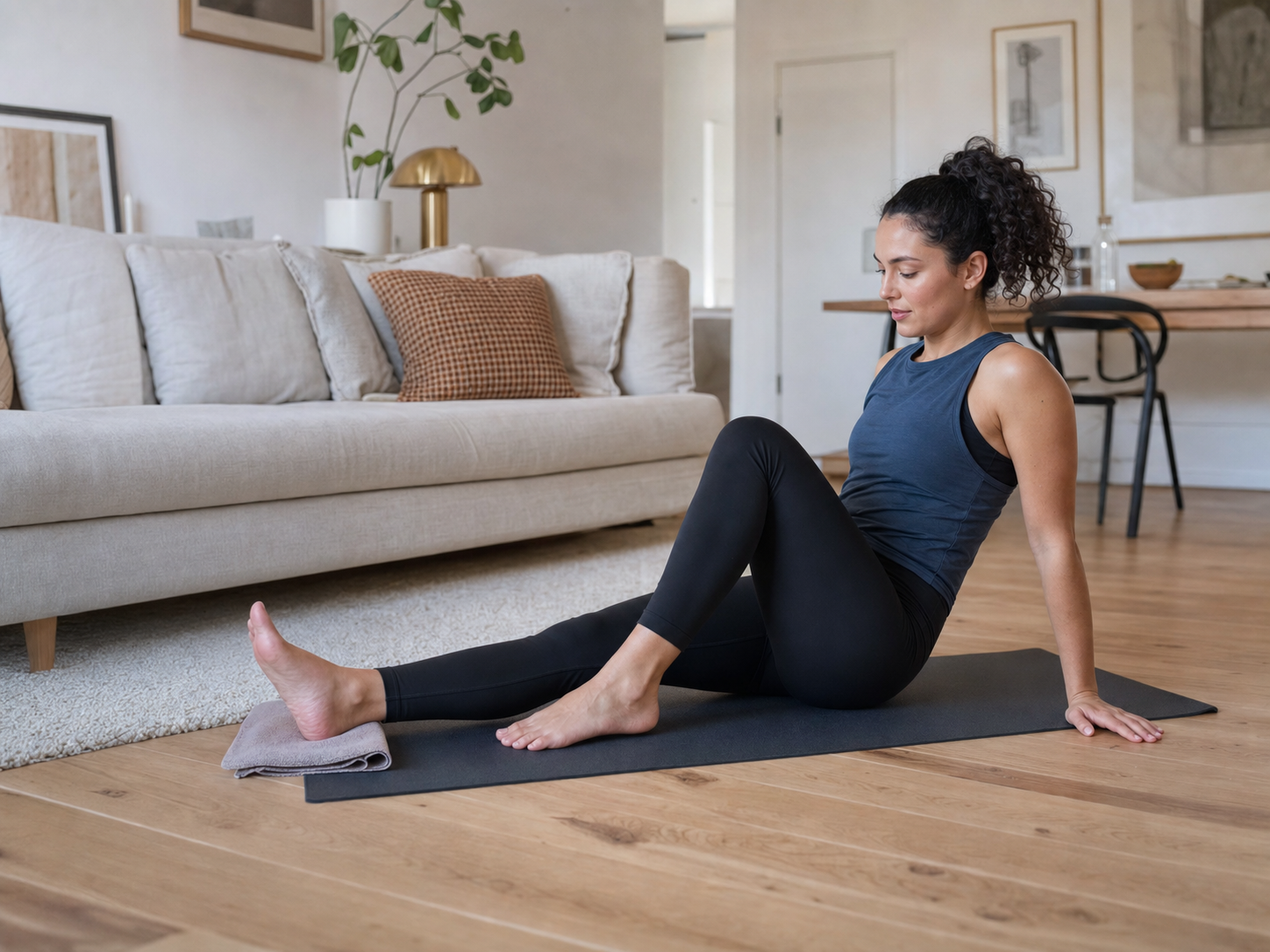
A sliding leg curl, hamstring slider curl and heel-slide curl usually describe the same basic pattern: your heels slide away and back while you control your hips. The surface changes the friction, so the same repetition can feel different on another floor.
| What happens? | What to check |
|---|---|
| The pad catches or moves unevenly | Check the manufacturer's floor compatibility, clear the movement path and inspect both surfaces. Do not force the movement over an obstacle. |
| Your legs slide out faster than you can control | Shorten the movement and use both legs. Reset the position rather than trying to save an uncontrolled repetition. |
| Your hips drop on the return | Use a shorter range or practise the outward phase with a reset between repetitions. |
Check a small clear area before exercising; a towel is not suitable for every floor and not every slider surface suits every floor covering. Floor compatibility and scratch protection are product-specific, so check the instructions for the accessory you use.
Technique: keep the slider curl controlled
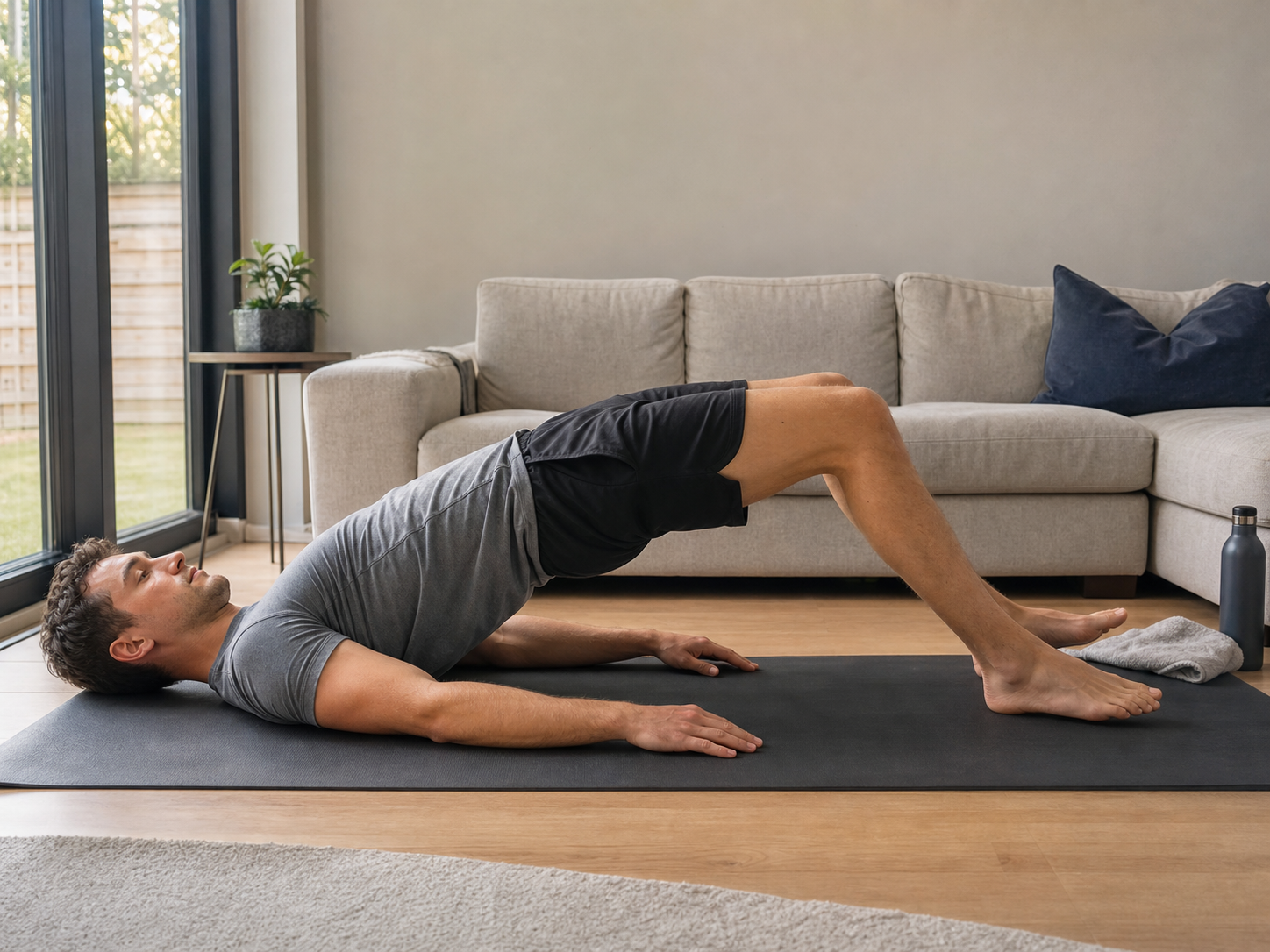
Lie on your back with your heels on sliders. Press lightly through the heels, brace your trunk and lift the hips. Pull the heels in, then let them slide away slowly. The useful part is usually the slow outward phase, not a rushed repetition that ends with the hips dropping.
Use three rules. Keep the hips high enough without arching the lower back. Keep the knees tracking straight rather than drifting in or out. Stop the repetition before you lose control. If the hamstrings cramp right away, shorten the range or lower the hips between repetitions. If pain is part of the picture, start with the guide to hamstring exercises with pain before adding harder variations.
6 hamstring slider exercises
1. Two-leg slider curl
This is the starting point. Use two sliders, lift the hips, pull the heels in and slide out under control. Keep the first sessions small and smooth. You do not need full knee extension on day one.
2. Eccentric slider curl
Pull the heels in with both legs, then slide out over three to five seconds. Lower the hips and reset after each repetition. This version focuses on the braking phase without making the return phase too demanding.
3. Alternating slider curl
Keep both heels on sliders, but move one heel slightly farther away at a time. This adds a control challenge without the full jump to single-leg work. The goal is to keep the hips quiet while the legs alternate.
4. Assisted single-leg slider curl
One leg does most of the work while the other helps lightly. This is often the best bridge for athletes who find the two-leg version easy but still lose control in a true single-leg curl.
5. Single-leg slider curl
This is demanding. Use one slider and keep the other leg lifted or lightly bent. Start with a short range and a few repetitions. If the hip drops, the foot jerks or the hamstring cramps, the step is too large for now.
6. Slider curl to Nordic progression
Use slider curls as preparation for heavier knee-dominant work. Once the eccentric slider is controlled, add assisted Nordics. The Nordic hamstring curl guide explains the setup and the next technical step.
Sets, repetitions and progression
Start with two sets of five to eight calm repetitions once or twice per week. The right dose depends on the rest of the training week. A footballer in season may need less volume than someone doing a general strength block at home.
A simple progression is: two-leg slider curl with short range, two-leg full range, eccentric slider curl, alternating curl, assisted single-leg curl, and then single-leg slider curl or assisted Nordic. Do not increase range, volume and speed at the same time. Change one variable, keep the next day in mind and step back if running or field training feels clearly worse.
Nordic training is better researched than slider curls for eccentric strength and muscle architecture. Reviews show improvements in eccentric strength and fascicle length after Nordic hamstring training, but they also make clear that the dose must be realistic enough to repeat (Medeiros et al., 2020; Franke et al., 2025). That is why sliders are useful as a stepping stone.
When to move on to Nordics
Slider curls can remain an exercise in their own right. If Nordic curls suit your goal, start with a short assisted version and a checked anchor. Two sets of eight slider repetitions are not a validated readiness test. Choose difficulty according to control, symptoms and next-day recovery.
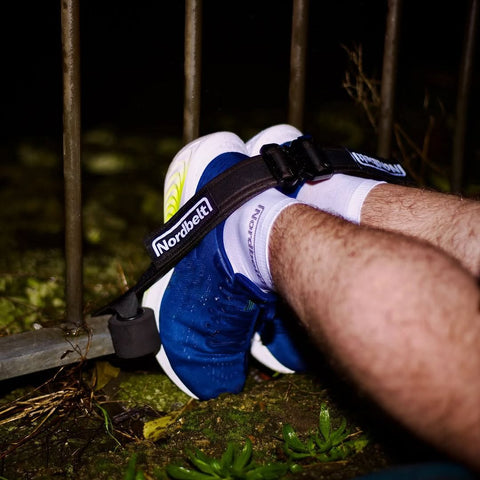
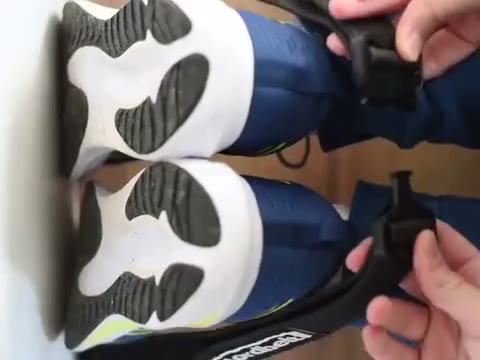
Nordbelt helps because the set combines sliders with repeatable low ankle fixation for Nordics. That makes the transition clearer: first slide and brake, then fix the ankles and learn to lower the body as one unit. View Nordbelt if you want one compact setup, but keep the load gradual. Good fixation makes the exercise more stable; it does not make the hamstrings ready for too much volume overnight.
Common mistakes
The first mistake is rushing to single-leg work. Single-leg sliders look simple, but many athletes lose the pelvis or cramp before the hamstrings are ready. The second mistake is ignoring the slow outward phase. For hamstring control, the braking phase is often the reason you chose the exercise.
The third mistake is treating sliders as the whole programme. They are a strong building block, not a complete plan. Later you still need hip-dominant strength, running exposure, recovery rules and, when appropriate, Nordics.
FAQ
What are hamstring slider exercises good for?
They build controlled hamstring strength, especially in the braking phase of the movement. They are useful as a bridge from easy bridge work toward harder curls and Nordic variations.
Can I do hamstring sliders at home?
Yes. On a smooth floor, sliders or towels can work. On carpet you usually need real sliders. The key is that the movement must be smooth enough to control slowly.
How often should I do them?
Once or twice per week is enough for most athletes at the start. Add volume only when the movement and the next-day response stay predictable.
Are sliders suitable with hamstring pain?
Sometimes, but only when symptoms are mild, predictable and do not increase. Sharp pain, bruising, loss of strength or pain during sprinting needs a more cautious route.
Are slider curls better than Nordic hamstring curls?
No. They are different. Slider curls are easier to dose and often work well as a stepping stone. Nordics are heavier and better researched for eccentric adaptations.
Do I need special sliders?
Not always. Towels can work on some smooth floors, but real sliders move more predictably and make progression easier to repeat.