

Reverse hyperextension for hamstrings: technique and setup


The reverse hyperextension for hamstrings is a hip-extension movement in which your torso stays supported while your legs move backward. First set the support surface, handles, clear leg path and lightest practical resistance. Start with your legs below your hips, move without swinging until your pelvic position is about to change, then return along the same controlled path. Treat the exercise as hip-dominant work for the hamstrings, glutes and spinal erectors, not as a replacement for a leg curl or Nordic curl.
What do you train with a reverse hyperextension?
During a reverse hyperextension, your upper body stays on a support surface while your thighs move relative to your torso. The movement comes mainly from the hips. The hamstrings assist hip extension together with the glutes, while the spinal erectors help control the position of the torso and pelvis.
Small EMG and biomechanical studies show that the reverse hyperextension loads the biceps femoris, gluteus maximus and erector spinae. These studies describe muscle activity and movement at a specific testing moment, not a guarantee of a particular training result (Cuthbert et al., 2021; Lawrence et al., 2019). The practical conclusion is therefore modest: the exercise can fit within posterior-chain training, but execution and exercise selection still matter.
For a broader overview of hip extension, knee flexion and trunk control, the guide to posterior-chain exercises remains the general guide. This article focuses only on the reverse hyper.

Reverse hyperextension or regular hyperextension?
During a regular hyperextension, your legs are usually supported while your torso moves around the hips. In the reverse version, your torso stays supported and your legs move instead. The support point, moving mass and sensation are therefore not the same.
A comparison of the two exercises found differences in range of motion, moments and muscle activity. That does not mean one variation is universally better; it means you should not exchange them based only on their name or how the muscles feel (Lawrence et al., 2019).
How to set up the reverse hyper machine
Preferably use a reverse hyper machine and always follow the instructions for that specific model. A random high bench is not automatically suitable for a moving leg path or added resistance.
Check the following before your first repetition:
- Support surface: the surface is stable, designed for this purpose and supports your torso without sliding.
- Hip position: your hips are close enough to the edge for your legs to move freely, without having to balance on the edge.
- Handles: you can reach them without shrugging your shoulders or pulling your torso forward.
- Leg path: there is enough free space behind, below and beside your legs for the full outward and return path.
- Resistance: start with the lightest practical setting prescribed for the machine and one that lets you start the pendulum without a jerk.
Also check how the manufacturer says to position your feet or lower legs. Do not use an improvised strap, loose platform or weight that was not designed for the machine.
Take your Nordic curl from the first rep to week 10.
A concrete 7-page plan: build up week by week, without pushing too fast.
- 01A clear week-by-week progression
- 02Technique and the mistakes to avoid
- 03A simple log you will actually use

≤51%
✓Backed by research
Van Dyk et al., 2019: meta-analysis of programmes with NHE. Not an effect test of Nordbelt or this protocol.
Open the download page again or check the email we sent you.
Open the download page ↗Four checks before using the reverse hyper machine
Use four traffic lights to decide whether your execution is still controllable. All four should remain green before you increase the range of motion, repetitions or resistance.
- Support surface green: your chest and pelvis remain supported; you do not slide forward or sideways.
- Clear leg path green: your legs and the machine move without touching the floor, frame, cable, wall or another person.
- Pelvic stop green: you stop the backward movement as soon as your pelvis starts to tilt or your lower-back position clearly changes.
- Return path green: you control your legs on the way back and begin the next repetition without bouncing or swinging.
If one light turns amber, first shorten the path or remove resistance. If a light turns red because the machine is unstable, the leg path collides, you lose your grip or a new sharp symptom appears, stop the set. This check supports a technique decision; it is not a diagnosis.
How to perform a reverse hyperextension step by step
Take the set starting position and hold the handles as the machine instructs. Let your legs hang in the lower starting zone without deliberately adding extra rounding or arching to your back. Brace your torso enough to maintain contact with the support surface.
Then perform every repetition in the same order:
- start the movement calmly from the hips;
- move your legs backward without first swinging them forward;
- keep your knees and feet in a repeatable position that suits the machine;
- stop when your legs reach the planned height or your pelvis starts to move;
- control the pendulum or your legs back to the starting position;
- begin each new repetition from a controlled standstill.
The highest leg position is not a performance target. A shorter path with the same pelvic stop and controlled return provides more useful technical information than a higher swing that changes your form.
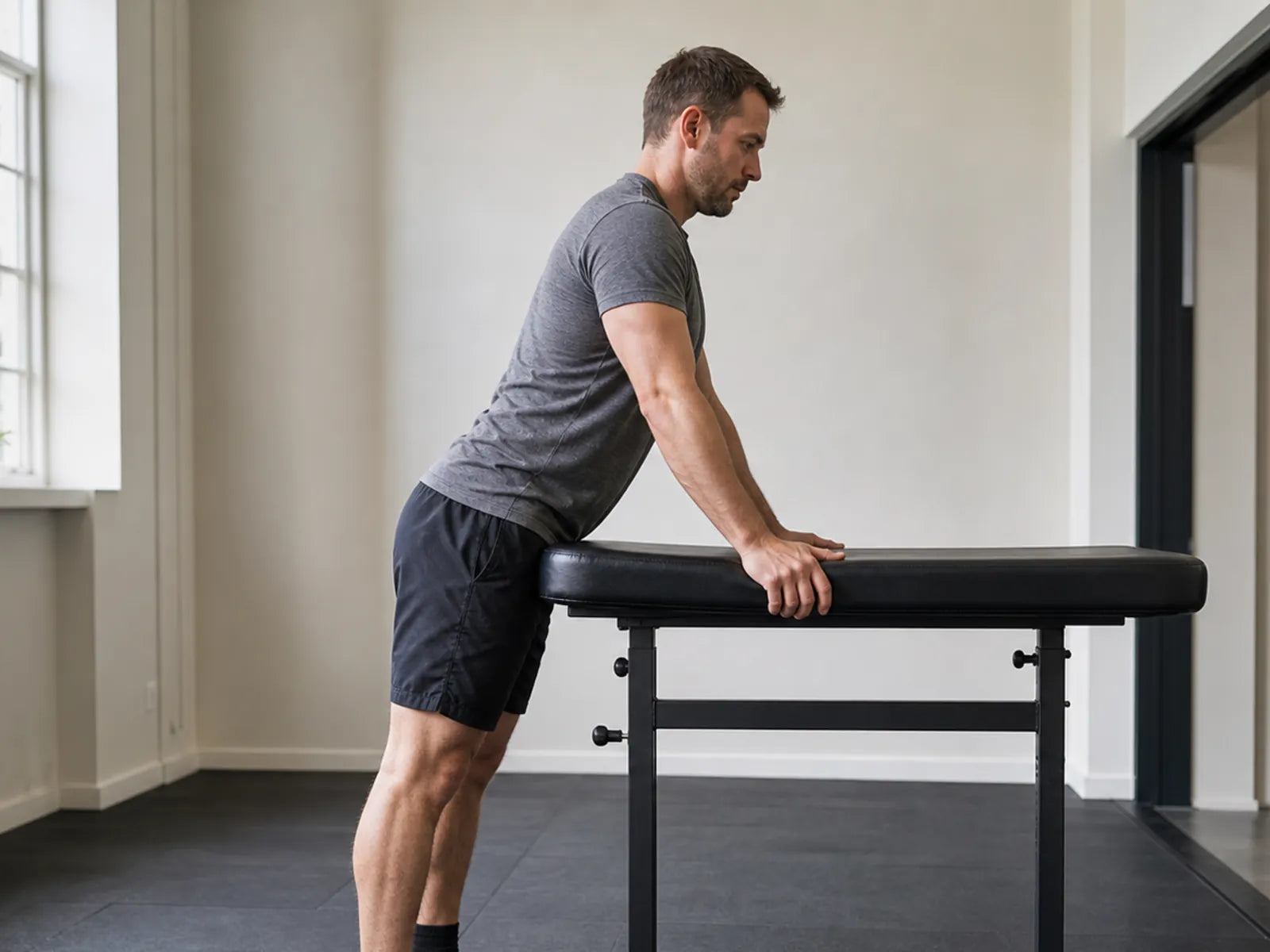 Athlete leaning on a flat exercise bench with both hands. Context image; the full exercise with the equipment described is not shown.
Reverse hyper mistakes that change the movement
The most common mistake is confusing speed with range of motion. Once you swing your legs forward to come back higher, the return path becomes a run-up. Other mistakes include:
- not checking the machine for a clear leg path;
- moving farther backward after the pelvis has already started to tilt;
- using the handles to pull the torso across the support surface;
- adding resistance while the pendulum is still bouncing at the bottom;
- using a different knee angle or foot position on each repetition;
- treating the regular hyperextension and reverse hyper as the same technique;
- replacing the machine with an unsuitable bench or loose construction.
Ankle fixation for Nordic curls at home
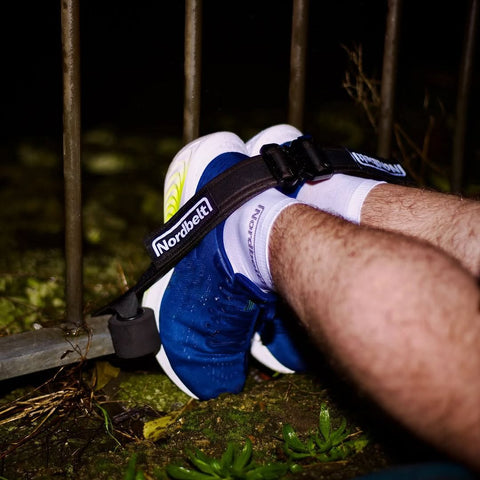
You would then be choosing a different hamstring task. In the reverse hyperextension, your legs move from the hips while your torso is supported. In a Nordic curl, your ankles stay fixed and your body pivots around the knees from a kneeling position. With Nordbelt for Nordic curls at home, you can arrange stable ankle fixation without a training partner or large fitness machine, provided the door or anchor point, symmetry, kneeling surface and clear space have first been found suitable.
Nordbelt does not perform a reverse hyperextension and is not a seated or lying leg-curl machine. Its product role begins only when you also want to add Nordic curls at home alongside hip-dominant work and stable low ankle fixation is the missing part of the setup.
Building resistance and range of motion
Increase only one variable at a time. For example, first use the same light resistance with a more controlled return. You can then increase the number of technically identical repetitions. Only when the support surface, leg path, pelvic stop and return remain unchanged should you consider more resistance.
Research comparing different loads on a reverse hyper machine found that more load did not simply increase the measured movement, force and muscle activity in a linear way (Lawrence et al., 2022). This supports a practical rule: do not use more weight as automatic proof of a better repetition.
You can record a compact progression as follows:
- support-surface and handle settings;
- resistance used according to the machine;
- selected leg height or clear technical stop;
- quality of the return path;
- which traffic light turned amber first.
This makes the next session depend on repeatable execution, not on the highest weight on the pendulum.
Difference from the leg curl, Nordic curl and hip hinge
The reverse hyperextension is primarily hip-dominant. A seated or lying leg curl instead flexes the knee against resistance. The Nordic curl is also strongly oriented toward knee flexion, but uses fixed ankles and body weight as a long lever. A standing hip hinge moves the hips backward while the feet remain on the floor.
Research on hamstring activation shows that exercise selection creates different emphases within the muscle group; one high activation figure does not make exercises fully interchangeable (Bourne et al., 2017). Use the guide article on learning the hip hinge when you want to learn the standing pattern. For weight held in front of the body, the Romanian deadlift as a hamstring exercise belongs on a different page. The good morning for the hamstrings also has its own loading position.
How does the reverse hyper fit into your training?
Use the reverse hyper as one hip-dominant exercise within a session. Do not automatically stack several heavy hinges, hyperextensions and machines because they all feel like work for the back of the body. First decide which task is missing: hip extension, knee flexion, single-leg control or a specific sports movement.
The general guide to effective hamstring exercises helps divide those tasks. For the reverse hyper itself, mainly record the machine settings and traffic lights. That lets you reproduce the same setup in a later session.
If you later want to assess the Nordic setup, use the Nordbelt home guide. Check the low ankle fixation and clear body path there as a separate setup; that guide does not turn the reverse hyper into the same exercise.
Frequently asked questions
Is the reverse hyperextension a hamstring exercise?
Yes. The hamstrings contribute to hip extension during the reverse hyperextension together with the glutes and spinal erectors. It is not an isolated hamstring curl. Use the exercise as hip-dominant posterior-chain work and choose separate knee-flexion work when that is your goal.
How high should your legs go during a reverse hyper?
There is no mandatory maximum height. Stop at the planned machine path or as soon as your pelvis starts to tilt, your back position clearly changes or you can no longer keep the return controlled. A lower, repeatable leg path is more useful than extra height from a swing.
How do you set up a reverse hyper machine?
Check the intended support surface, the position of your hips near the edge, reachable handles, the prescribed foot or lower-leg fixation, clear space and the lightest practical resistance. Follow the manual for the specific machine; do not use an improvised strap, bench or loose platform.
Why do I mainly feel the reverse hyper in my lower back?
The spinal erectors contribute, so some sense of effort is not unexpected. If your lower back becomes the only place you feel it, check whether you are swinging too high, your pelvis is tilting, the pendulum is bouncing or you increased resistance too early. Shorten the path and stop if you experience a sharp or persistent symptom.
What is the difference between a reverse hyper and a Nordic curl?
In the reverse hyper, your legs move from the hips while your torso is supported. In a Nordic curl, your ankles stay fixed and your body moves around the knees from a kneeling position. They require a different setup and create a different emphasis; neither is a direct replacement for the other.
Summary
The reverse hyperextension for hamstrings is hip-dominant work with a supported torso and moving legs. First set the machine, support surface, handles, clear path and light resistance. Then use four traffic lights: support surface, clear leg path, pelvic stop and return path. Increase range of motion or resistance only when all four remain green. Keep the reverse hyper distinct from regular hyperextensions, leg curls, Nordic curls and hip hinges so that each exercise retains a clear task.