

Low-cadence cycling or strength training: which to choose?


Choosing between low-cadence cycling and strength training off the bike starts with your goal and the full workload. A big gear does not automatically replace weights: effort, duration and recovery matter too. Distinguish ordinary low-cadence intervals, specifically designed high-intensity strength efforts on the bike and resistance training with weights. Here you can compare the methods, understand the evidence and decide what to record.
Which three types of training should you distinguish?
The question is not just where you train, but exactly what you do. The same bike can serve for an easy ride or repeated demanding efforts. Cadence alone does not describe the programme. Likewise, “strength training” says too little without the exercise, resistance and recovery.
| Training method | What belongs in your plan? | What should you ask before replacing a session? |
|---|---|---|
| Ordinary low-cadence intervals | Cadence, power or perceived effort, interval duration | Is this still endurance work at a different cadence? |
| High-intensity strength efforts on the bike | Resistance, effort per repetition, sets and rest | Is the workload defined and is the equipment suitable? |
| Strength training off the bike | Exercise, weight, repetitions, technique and rest | Which separate movement do I want to perform against more resistance? |
Use this table to complete your plan, not as a proven training schedule. Recording only “big gear” leaves too little information to justify replacing a strength session. Fill in the gaps before removing or adding anything.

What does research say about low cadence and weights?
A review of seven studies found no strong general evidence of benefits from training at an imposed low cadence. Participants and programmes differed considerably. “Low” also needs to be understood relative to freely chosen cadence and power output. This does not prove such training never works, but it does rule out promising a universal cadence or guaranteed strength gains (Hansen & Rønnestad, 2017).
A meta-analysis of seventeen studies involving 262 adult endurance cyclists compared supplementary heavy strength training with cycling training alone. Average improvements included cycling efficiency, anaerobic power and pooled performance outcomes. Certainty of evidence was low, so the findings do not establish an optimal programme for every cyclist. The performance outcomes combined time trials and time to exhaustion: they are not a prediction of your race improvement (Llanos-Lagos et al., 2026).
A direct comparison involved 37 well-trained cyclists over ten weeks. Two groups added deep squats or very intense, maximal pedalling efforts; a control group continued cycling alone. Intensity, volume, sets and rest were matched between the strength groups. No significant differences were found between those two groups. That makes the specific cycling intervention interesting, but does not demonstrate general equivalence or hamstring growth from an ordinary low-cadence ride (Pallares et al., 2025).

Context image: an exercise bike at home illustrates a training environment, not the intensive setup used in the study. The cyclist in the opening photo is not demonstrating a prescribed exercise or treatment either.
Which option fits your training goal?
Want to reorganise an existing ride? Describe what the cadence interval should achieve within it. Do not automatically call it a replacement for weights. Want to develop a separate strength skill, such as a controlled weighted squat? Then that movement itself matters, including learning the technique and keeping track of resistance.
Considering intensive strength work on the bike because a gym is impractical? First discuss whether resistance, effort and recovery can be set reproducibly. An exercise bike with a stiff resistance knob is not by itself a copy of the research programme. Do not simply adopt a study's maximal efforts as a home workout.
For a cycling interval, record the bike and settings, whether you sit or stand, cadence, power when available, duration and rest. Without a power meter, record the settings and perceived effort. Recognise that a different bike or different conditions may not produce precisely the same workload.
For a weighted exercise, record the variation, weight, completed repetitions, range of motion and rest. A heavier but much shorter movement does not automatically mean progress on the same task. Record when you could no longer repeat the intended technique too.
Only replace an existing session once you can write down which goal remains and which task disappears. Keep a useful session for now if that comparison is still unclear. For separate exercise choices, see the guide to hamstring exercises for cyclists.
Take your Nordic curl from the first rep to week 10.
A concrete 7-page plan: build up week by week, without pushing too fast.
- 01A clear week-by-week progression
- 02Technique and the mistakes to avoid
- 03A simple log you will actually use

≤ 51%
✓Backed by research
Van Dyk et al., 2019: meta-analysis of programmes with NHE. Not an effect test of Nordbelt or this protocol.
Open the download page again or check the email we sent you.
Open the download page ↗Want to add Nordic curls separately?
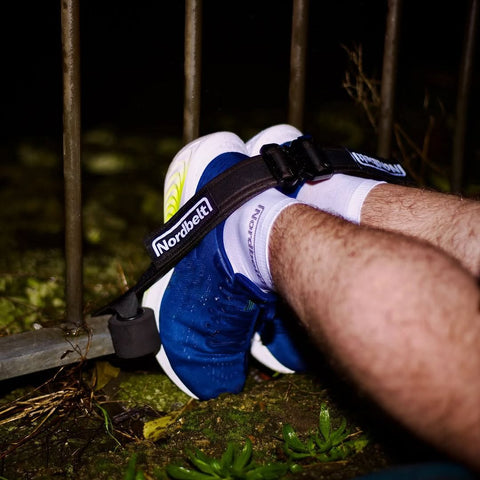
Dedicated hamstring training is a separate decision. If you choose bilateral Nordic curls at home, Nordbelt explains options for fixed ankle anchoring without a training partner or large machine. A suitable, checked anchor point is still necessary. The equipment is not a cycling accessory and does not replace weights or intensive cycling resistance. You do not need it to answer the cadence question.
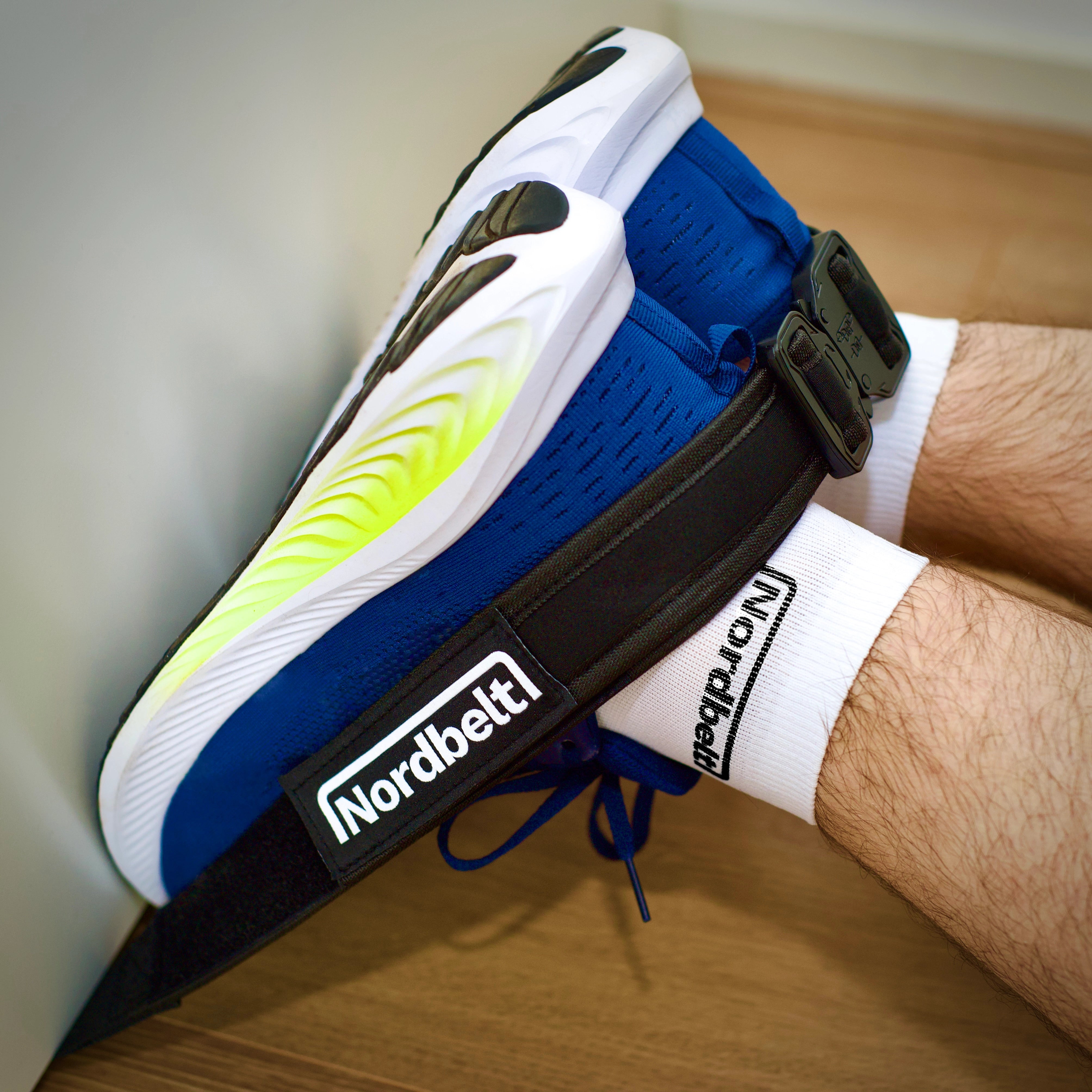
Equipment image: the ankle straps are visible, but the photo does not show a complete Nordic curl. Read the separate explanation of the Nordic hamstring curl if that is the exercise you want to learn. Choose other hamstring exercises according to their own movement and purpose.
Make sessions comparable with a simple training log
Before training, write down your goal, for example “describe an existing cadence interval more clearly” or “track my controlled squat”. Then record the execution relevant to that goal. This is an editorial logging example, not a tested training or prevention protocol.
A fictional example: Sanne initially writes only “heavy legs after cycling”. That does not reveal whether she rode longer, pushed harder or used a different gear. Next time she records the same route, interval duration, position, cadence and perceived effort. She can then trace a difference. She has not thereby measured a change in muscle strength.
Another fictional example: Koen wants to replace squats with hard pedalling. His first question is which strength skill he will still assess. If improving his squat is the main goal, removing it changes the task. Comparing a specific cycling intervention requires a separate plan and suitable guidance.
Assess your chosen task using the same measurement method and comparable conditions. A harder-feeling session, higher heart rate or stiff legs is not, on its own, evidence that you are achieving your goal more effectively.
Frequently asked questions
Is cycling in a big gear strength training?
That depends on the full execution. A big gear during an endurance interval differs from the shorter, closely controlled maximal efforts in the direct comparison. That study specified intensity, volume and rest; copying only the gearing does not make your ride the same training (Pallares et al., 2025).
Which cadence should I choose to get stronger?
The review discussed here does not establish a universal cadence that produces strength gains for everyone. The meaning of low cadence depends partly on power, participants and programme. Define your goal and workload first; do not turn a research setting into a general starting recommendation (Hansen & Rønnestad, 2017).
Can intensive cycling training replace weights?
One specific, carefully matched cycling intervention has been studied as an alternative in well-trained cyclists. That is a narrower finding than “all cyclists can skip the gym”. No significant difference between groups also does not prove that the methods are equivalent in every situation (Pallares et al., 2025).
Will strength training definitely make me faster on the bike?
No. The meta-analysis supports possible benefits of heavy strength training alongside endurance cycling, but certainty of evidence was low. Group averages do not predict an individual's race time. Starting level, execution and the rest of your training remain relevant to the assessment (Llanos-Lagos et al., 2026).
Should I add separate hamstring exercises too?
That does not automatically follow from choosing low cadence or weights. Consider which movements your plan already includes and what additional task you actually want to train. A Nordic curl is a separate exercise; the cycling comparison does not establish an extra cycling benefit from adding it or using a particular aid.