If you develop sudden pain at the back of the thigh during sprinting, accelerating or another explosive movement, stop the activity and reduce the load. The first 48 hours are mainly about avoiding further provocation, checking how much function is lost and recognising signs that need assessment. This guide is general information and does not replace a diagnosis.
What to do first
stop sprinting, jumping and other movements that clearly reproduce the pain;
keep normal movement only within a tolerable range;
avoid aggressive stretching and heavy strength testing in the acute phase;
watch walking, swelling, bruising and strength rather than repeatedly testing the injury.
When to seek an assessment
Seek prompt assessment if you felt a clear pop or tearing sensation, develop substantial bruising or swelling, have marked weakness, cannot walk normally, or symptoms are severe or worsening. Persistent or recurrent symptoms also deserve assessment. Pain high near the buttock, especially with sitting, can involve a tendon or another cause and should not automatically be treated as a simple muscle strain.
Should you rest completely?
Complete inactivity is not automatically necessary. Calm daily movement can often be maintained if it does not clearly worsen the symptoms. The useful amount of activity depends on the injury, so treat worsening pain or function as a reason to reduce the load and seek advice.
Should you stretch?
Do not force a deep hamstring stretch in the first phase simply because the area feels tight. Stretching that produces sharp or strong pulling pain is not a useful test of recovery. The early priority is sensible load management and assessment of function.
What happens after the acute phase?
Once the acute irritation is settling and basic movement is improving, rehabilitation usually shifts towards controlled loading, then progressive strength and later sport-specific demands. More demanding eccentric work such as Nordic curls is not automatically a first-line exercise after a fresh injury. Read the guide on recovery, exercises and rebuilding strength for the next phase.
Where does Nordbelt fit?
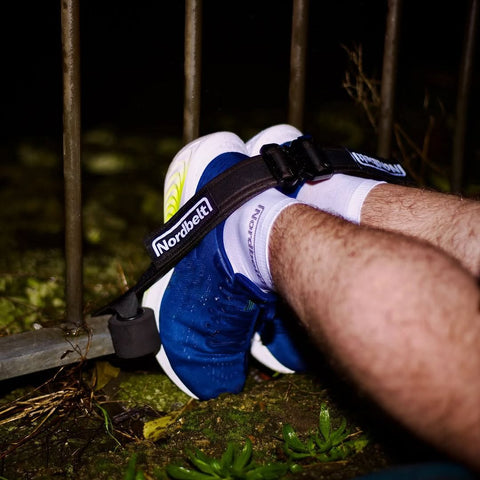
If Nordic curls later become appropriate in your training plan, Nordbelt fixes the ankles so the exercise can be performed without a training partner. It is a training tool, not a treatment for an acute injury and not a substitute for professional assessment.
Frequently asked questions
Can I test the hamstring by sprinting?
Not in the acute phase. A maximal effort can aggravate an injury and does not provide a safe diagnosis.
When can I start exercises?
That depends on severity, function and response. Start only with a level of loading that is appropriate for your situation and progress gradually.
When should I see a doctor or physiotherapist?
Seek help sooner with substantial loss of function, a pop, major bruising or swelling, difficulty walking, severe symptoms, or when the problem is not improving as expected.
REAL PRODUCT PHOTO
Nordbelt
Nordic curls without a partner or bench — at home, in the gym and on the field.★★★★★ 4.8 on Google · 1000+ athletes
Discover Nordbelt
€39.99
€34.99Free shipping · 30-day return period
Nordbelt makes one of the best-researched hamstring exercises possible anywhere — without a training partner or expensive bench. At home, in the gym or on the field. Ready in under one minute.
✓ Order before 22:00, shipped the same day
REAL FOOTAGE · 0:12
offer−
€5
ANCHORDOOR · BENCH · FENCE
SETUP < 01:00
★★★★★
“A must-have for every dedicated athlete or runner.”
Jesse van Hofwegen · Trustpilot
EXPERIENCE1000+athletes already use Nordbelt
PROFESSIONAL50+physiotherapy clinics use it
GOOGLE4.8 Average rating
Up to
51%
fewer hamstring injuries in programmes that include the Nordic Hamstring Exercise (NHE)
Phase 01Feet secured. Lean forward slowly from the knees.
Phase 02Control the descent eccentrically — the muscle gets stronger as it lengthens.
Phase 03Catch yourself with your hands, push back and repeat.
Eccentric training — producing force while the muscle lengthens — targets the moment when the hamstrings are loaded most during sprinting. The Nordic curl trains exactly that.
02 HOW IT WORKS
Secure. Click. Curl.
Go from your sports bag to your first controlled rep in under one minute. The three videos play automatically in sequence — tap a card to replay it.
★★★★★
“It is great to be able to do this exercise by myself.”
00:04
01 — CHOOSE
Find a solid anchor point
Place Nordbelt under a sturdy door or attach it to a fitness bench, fence or beam.
00:05
02 — CLICK
Fasten and adjust to fit
Click the buckle closed and adjust the strap for a firm, comfortable position around your ankles.
00:09
03 — CURL
Start with control
Your feet are secured. Progress your Nordic Hamstring Curl training gradually and with control.
↳ Includes a practical guide and a progressive 10-week training protocol.
Place the anchor parts on the other side of the door, close it fully and check the attachment before you start.
04 THE KIT
Everything for your first set.
★★★★★
“The bag and cards are a really nice touch.”
1 / 6 · tap to switch
01
Nordbelt
Adjustable Nordic Hamstring Curl tool with a sturdy buckle and soft ankle rollers.
02
Storage bag
Compact enough for home, gym or field — it weighs next to nothing.
03
Manual
Clear setup and safety guidance for all three anchor points.
04
10-week protocol
A progressive training plan based on sports science.
REAL UNBOXING — THIS IS HOW IT ARRIVES
Thomas PereiraDoctor, sports scientist and co-founder
05 THE STORY
Not a gadget. A frustration solved.
When I suffered a hamstring injury, I noticed how difficult it was to train properly at home without expensive equipment or help from others. That's why I developed Nordbelt.
01
Originated from real injury experience
A real training problem was the starting point — not a marketing idea.
02
Medical and sports science foundation
Further developed with physiotherapists and athletes in the field.
03
Built in Rotterdam
Practical, direct and without unnecessary complexity.
The Nordic Hamstring Exercise is one of the best-studied exercises in sports science. Nordbelt adds no magic — it simply lets you perform the exercise independently, practically and repeatedly. That is exactly the point.
01
Evidence-based exercise
Training programmes that include the Nordic Hamstring Exercise show a clear reduction in hamstring injuries.
02
Build up progressively
Start at a level that suits you and increase load and volume in a controlled way — the 10-week protocol helps you do that.
03
Widely applicable
From football and athletics to fitness and supervised rehabilitation.
Always use a stable anchor point, check every connection and follow a doctor’s or physiotherapist’s advice during injury, rehabilitation or return to play.
07 THE COMPARISON
The same exercise. A smarter route.
Comparison of Nordbelt, a Nordic bench and training with a partner
Feature
Nordbelt
€34.99
Nordic benchhigher purchase cost
Training partnerFree — if available
Train independently
✓
✓
✗
Fits in your sports bag
✓
✗
—
Home, gym and field
✓
✗ one fixed location
± schedule-dependent
Ready in < 1 minute
✓
± setup & space
± variable fixation
Consistent, firm fixation
✓
✓
✗
Nordbelt
VScompare with▾
NordbeltBench
Train independently✓
Fits in your sports bag✓
Home, gym and field✓
Ready in < 1 minute✓
Consistent, firm fixation✓
Nordic bench · higher purchase cost
Indicative comparison based on common Nordic benches and training with another person’s assistance.
★★★★★
“Ideal if you do not want to buy an expensive bench.”
Convinced by the smarter route? 30-day return window. See the return conditions.
The editors of Men’s Health choose their favourite gear each month in Editor’s Pick. Nordbelt earned a place in that selection as a compact tool for Nordic curls.
“Build strong hamstrings without setting up half a gym at home?”
Clear information upfront — no fine print hidden behind the buy button.
A personal question?contact@nordbelt.com
We usually respond within 1 business day.
How do I use Nordbelt? +
Choose a stable door, fitness bench, fence or beam. Close the buckle, adjust the length, check the attachment and start with controlled repetitions.
What is included in the package? +
The Nordbelt, a compact storage bag, a practical guide and a progressive 10-week training protocol.
Do I need a training partner or bench? +
No. Nordbelt is designed for independent training without a large Nordic bench. You do always need a firm, stable anchor point.
Is this suitable for recovery or rehabilitation? +
Nordbelt can support controlled hamstring strengthening. During recovery, decide on timing, load and progression together with your doctor or physiotherapist.
What does shipping cost? +
Standard shipping — Spain: free. Order before 22:00, shipped the same day.
Can I return it? +
You can request a return within 30 days of receipt. The product must be unused, clean and in its original packaging; return shipping costs are paid by the buyer.
Is Nordbelt suitable for beginners? +
Yes. Start with a smaller range of motion and support if needed, keep repetitions controlled and follow the included 10-week protocol. Stop if your technique breaks down or you feel pain.
Which anchor points are safe? +
Only use a solid door, heavy fitness bench, sturdy fence or fixed beam that cannot open, slide or tip. Before every set, pull firmly on the attachment in the same direction as the training load.
How often can I train Nordic Hamstring Curls? +
There is no single frequency that suits everyone. Use the 10-week protocol as a progressive starting point and match volume and recovery time to your level, sporting load and technique.
Where does the 51% fewer hamstring injuries claim come from? +
The 51% refers to programmes that included the Nordic Hamstring Exercise, not to Nordbelt as a product. A systematic review and meta-analysis of 8,459 athletes (van Dyk, Behan & Whiteley, Br J Sports Med, 2019) reported a reduction of up to 51%; individual results are not guaranteed.
✓
30-day return period
Try Nordbelt.
30-day return period
Returns are accepted within 30 days. The product must be unused, clean and in its original packaging; return shipping is paid by the customer.
View return policy
↩
30-day return period
Return shipping costs are paid by the buyer