

Your first half marathon: how to plan your training week

Good half marathon preparation starts with a training week that matches what you can currently manage. Plan your available running days first, give each session a clear purpose and leave room for recovery. An easy run, a second familiar run and a longer run can form a useful weekly structure. Here is how to arrange that week, where existing strength training fits and what to change when you miss a session.
Start with your current running week
For your first half marathon, your starting point matters more than the number of weeks on a downloaded plan. Write down how often you have run in recent weeks, the duration of your familiar longest run and how you functioned afterwards. Include work, sleep, other sports and travel time. A free Sunday is less useful if you work late on Saturday and have heavy lifting to do on Monday.
Next, choose regular slots that are usually realistic. Allow time to change, eat and get home as well. Have you only just started running, or are you returning after a long break? Establish a regular running routine first. The example below assumes that you already tolerate three running sessions; it is not a plan from scratch or proof that you are ready for 21.1 kilometres.
Alongside your race date, write down one practical goal: repeating your running week without every next session feeling like catching up, for example. A plan can only guide you if it matches that starting point.

Give the easy run and long run separate jobs
The easy run keeps your week manageable. Choose an effort at which you can generally speak in sentences, slowing down when necessary. Treat that as a practical cue, not an exact measurement of your training zone. Your second run does not have to be an interval session either. For a first half marathon, a repeatable routine is a good reason to keep it familiar for now.
The longer run mainly demands more time. Leave room around it and start from a duration you already know. In an observational study of recreational half marathon and marathon runners, greater training volume was associated with better race performance. That association does not prove that every beginner should add kilometres; the groups studied do not provide an individual safe minimum either (Fokkema et al., 2020).
Avoid changing distance, speed and frequency all at once because race day is getting closer. Use an appropriate plan or work with a coach to decide which change suits your current base. A long run is also an opportunity to practise route choice, clothing and the practical preparation for spending longer outside.
A practical example with three running days
This is an editorial planning example for someone already used to three running days. For each run, enter a duration that fits your current plan. The table does not prescribe a minimum distance, fixed pace or preparation guaranteed to be sufficient.
| Day | Main task | Practical arrangement |
|---|---|---|
| Monday | Rest from running | Notice how you feel after Sunday; do not add a catch-up run. |
| Tuesday | Easy, familiar run | Keep the effort manageable and choose a known route. |
| Wednesday | Rest or existing strength training | Only strength work already in your routine that does not disrupt your next run. |
| Thursday | Second familiar run | Keep it easy if the week feels demanding. |
| Friday | Rest from running | An ordinary walk is an option if you feel like it. |
| Saturday | Unscheduled time | Leave time for sleep, meals and preparing for Sunday. |
| Sunday | Longer easy run | Use a duration from your appropriate plan; assess recovery afterwards too. |
You can move the days around. If you work on Sundays, your longer run could be on Saturday. Reconsider Friday and your next running day as well. Move the training load together with its recovery time, rather than simply dragging a session name into an empty calendar slot.

Take your Nordic curl from the first rep to week 10.
A concrete 7-page plan: build up week by week, without pushing too fast.
- 01A clear week-by-week progression
- 02Technique and the mistakes to avoid
- 03A simple log you will actually use

≤51%
✓Backed by research
Van Dyk et al., 2019: meta-analysis of programmes with NHE. Not an effect test of Nordbelt or this protocol.
Open the download page again or check the email we sent you.
Open the download page ↗Where does strength training fit into this week?
If you already do strength training, start with that familiar routine. A systematic review in middle- and long-distance runners found that additional strength training can improve running economy. Participants had running experience and the programmes differed. The research did not test whether a new strength block prepares a beginner for a half marathon (Blagrove et al., 2018).
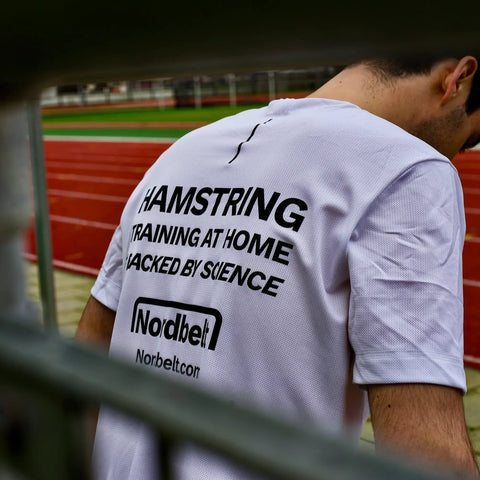
If you want to do your existing hamstring training at home and independently choose Nordic curls, Nordbelt as a home setup for Nordic curls provides fixed ankle support without a training partner. A suitable anchor point, appropriate technique and room for recovery remain necessary. The strap does not determine your running progression or guarantee a race result.
Exercise selection deserves its own consideration; the overview of hamstring exercises for runners can help. Avoid adding unfamiliar heavy leg training just before your planned long run. If you are completely new to strength training, keep Wednesday as a rest day for now. For distributing strength training across a longer preparation period, see strength training during marathon preparation.
What if time is short or you miss a session?
If work makes you miss Tuesday, you do not need to make up that run on Wednesday on top of everything already planned. Review your week. If you feel normal and Thursday still fits, resume with that familiar session. Do not automatically extend Sunday's long run to compensate for the missing kilometres.
If you consistently have only two running days, you need a different arrangement. Do not squeeze three sessions into two larger ones. Discuss whether your current base, available weeks and race goal fit together. Sometimes allowing more preparation time is a better adjustment than making a session harder in an already busy diary.
Ask three brief questions at the end of the week: did I manage the planned sessions, did my usual effort feel different, and does the same week fit my diary again? Look at the pattern across several days. One difficult session calls for a different decision from a succession of weeks in which you start every next run exhausted.
Take persistent fatigue and pain seriously
A plan needs room to adapt. Lack of sleep, illness and unusually heavy legs are reasons to reassess the intended load. Shorten a session, skip it or seek guidance if you are unsure what is appropriate. Do not try to make up a missed week with a sudden training spike.

Stop the session and seek an assessment if you have sharp or increasing pain, or pain that changes the way you run. A general race plan is not enough for that situation. The article on hamstring problems while running provides further context; it does not replace an individual assessment.
Frequently asked questions
Is running three times a week enough for a half marathon?
Three running days can be a workable arrangement, but the number of days alone tells you little. Your current running base, total load, available preparation time and goal determine whether it fits. The example week is therefore no guarantee that you can manage the distance.
Do I need to have run 21.1 kilometres beforehand?
Do not use completing the race distance as a standalone entry test. The appropriate length of your longest session depends on your preparation and recovery. Let a suitable plan or coach guide the progression instead of forcing one distance to gain confidence.
Can I make up a missed long run later?
Review the rest of your week first. Catching up can remove the space before your next demanding session. Do not automatically add the kilometres to another run. Resume or adapt your plan according to why you missed the session and how you feel.
Are Nordic curls necessary for my first half marathon?
No. Choosing a hamstring exercise is separate from planning your running week. Nordic curls are one possible strength exercise when they fit your experience and capacity. Your preparation starts with appropriate running, enough recovery and a realistic diary.