

Askling protocol: exercises, phases and safe progression


The Askling protocol is a hamstring rehabilitation approach built around controlled lengthening exercises. It is not a fixed calendar plan, but a way to reintroduce longer muscle lengths, control and sport-specific loading. The best-known exercises are the Extender, Diver and Glider. In acute hamstring injury research, a lengthening-focused protocol supported faster return to full training, but timing and tolerance still matter (Askling et al., 2014).
What is the Askling protocol?
The protocol is often used as the L-protocol: a line of exercises that loads the hamstrings while they lengthen. The aim is not to stretch aggressively. The aim is to expose the injured area to controlled tension, then move from simple positions toward sport-like tasks.
This makes the protocol useful for athletes who eventually need to sprint, accelerate, brake or reach again. For the first injury phase, read the guide on hamstring injury first steps. This article focuses on the specific Askling route. hamstring injury first steps.
The protocol does not replace assessment. Hamstring rehabilitation should consider diagnosis, load tolerance, strength, symptom response and the final sport task together (Erickson and Sherry, 2017; Hickey et al., 2022).
Askling hamstring protocol: when does it fit?
The Askling protocol usually fits once the acute response has settled and the athlete can move with control. Walking and stairs should be predictable, light bridge or hinge work should not flare symptoms, and the athlete should understand the difference between controlled tension and sharp pain.
If exercise is still painful, start lower. The guide to hamstring exercises with pain is a better first layer. For clinicians building a wider decision framework, use the hamstring training protocol for physiotherapy. hamstring exercises with pain. hamstring training protocol for physiotherapy.
The exercises: Extender, Diver and Glider
Extender
The Extender is usually the calmest entry. The athlete lies on the back, lifts the leg and slowly extends the knee inside a controlled range. The goal is not maximum range, but tolerable active length.
Diver
The Diver looks more like a hip hinge with balance. It asks the pelvis, trunk and hamstring to work together while the body tips forward. The Glider is often the hardest step: one foot slides forward while the hamstring controls a longer position.
Glider
Because the Glider places a larger demand on braking control, it belongs later in the progression. In the Swedish sprinter and jumper trial, the lengthening protocol outperformed a more conventional protocol for time to full training (Askling et al., 2014).
How to progress safely
Progress by response, not by week number. Start with low-symptom movement, add the Extender within a calm range, then use the Diver when balance and hip control remain stable. Add the Glider only when the earlier steps are predictable, then reconnect the plan to running or sport-specific loading.
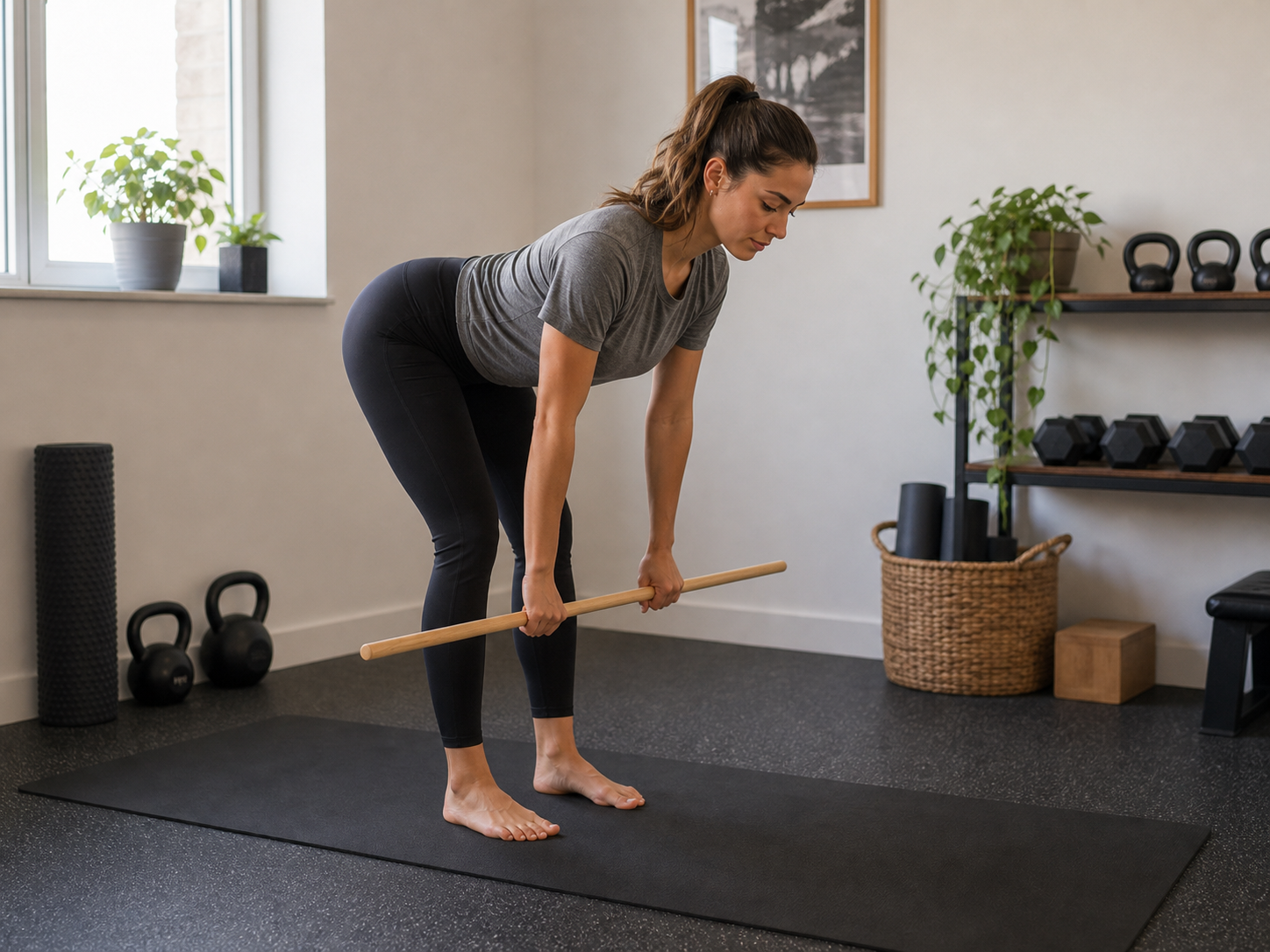 Hip hinge with a wooden dowel. Context image; the full exercise with the equipment described is not shown.
Reviews suggest that lengthening exercises can be useful in hamstring rehabilitation, but the full plan also needs progression criteria, running exposure and return-to-sport decisions (Pas et al., 2015; Green et al., 2020).
Where Nordbelt fits later in the plan
The Askling exercises and Nordic curls are different tasks. Decide with the treating clinician whether and when an assisted Nordic suits the athlete's current capacity. Ankle fixation is needed for that Nordic setup, not for every hamstring exercise.
Read the explanation of the Nordic hamstring curl if this exercise is being added. Nordbelt can provide repeatable ankle fixation; the setup does not determine readiness or justify skipping rehabilitation steps.
How to progress without rushing the protocol
Use the Askling protocol as a response-based progression. A session is only a good session if the athlete can walk normally afterwards, if the next morning is predictable, and if the exercise quality stays the same from the first rep to the last. When the Extender is calm, add range before you add speed. When the Diver is stable, add control demands before you add fatigue. When the Glider appears in the plan, keep the range short enough that the athlete still brakes the movement instead of dropping into the end position.
For return to running, separate hamstring exercise tolerance from sprint tolerance. Jogging, tempo running and high-speed exposure are different steps. A player or runner can feel fine during slow running and still be unprepared for acceleration, deceleration or a long stride at speed. That is why the protocol should sit inside a broader plan with strength checks, pain response, sport drills and gradual exposure to the exact task the athlete needs to perform.
Track simple signals instead of chasing perfect numbers: pain during the exercise, stiffness two to twenty-four hours later, confidence in longer positions, and whether sprint mechanics change when speed rises. If any of those signals move the wrong way, repeat the previous phase or reduce the range. Progression is not lost when you hold a level for another week; it is lost when the hamstring is forced into work it cannot yet absorb.
Common mistakes
The main mistakes are starting too early, treating every movement as a hard stretch, rushing the Glider and forgetting the final sport task. A good plan connects the exercises to running, sprinting or field work instead of ending with a checklist.
FAQ
Is the Askling protocol suitable for every hamstring injury?
No. It can be useful in hamstring rehabilitation, but it does not fit every injury or every phase. Sharp pain, major loss of function or uncertainty about diagnosis should be assessed first.
What is the Askling Extender?
The Extender is the controlled lying exercise where the leg is lifted and the knee extends inside a safe range. It is usually the easiest of the three well-known Askling exercises.
How do the Askling Diver and Glider differ?
The Diver focuses on hip hinge, balance and trunk control. The Glider loads the hamstring in a longer position and usually belongs later.
Can I do the Askling protocol at home?
Some parts can be done at home if technique and next-day response stay calm. Later strength work needs a safe surface and stable fixation.
Is the Askling protocol the same as the Nordic hamstring curl?
No. The protocol uses lengthening exercises. Nordic training is a separate eccentric strength stimulus that can be added later when appropriate.