

TRX Hamstring Curl Technique: Setup and Execution


The best TRX hamstring curl technique starts with a reliable suspension setup, your heels in the foot cradles and your hips high enough to form a straight line from shoulders to knees. Then draw both heels slowly towards your glutes without letting your pelvis drop, pause only while your position stays unchanged and extend your knees under control. Make the exercise easier by keeping your hips slightly lower or shortening the movement; stop as soon as a strap, the anchor or your body position shifts.
The aim is not to pull the straps as far towards you as possible. In a good repetition, the anchor, straps, heels and torso remain predictable while your knees bend and extend again.
What does a suspension trainer hamstring curl work?
For a suspension trainer hamstring curl, you lie on your back with your heels in the foot cradles. You lift your hips off the floor, bend your knees and draw your heels towards you. The hamstrings produce knee flexion, while the glutes and trunk help keep the pelvis and hips in a workable position.
Knee flexion and hip extension are related but distinct hamstring tasks. Research comparing the two movement families found different performance and activation patterns as hip and knee positions changed (Yanagisawa and Fukutani, 2020). A suspension curl therefore does not automatically replace a hip hinge, deadlift or complete hamstring programme.

Check your suspension setup first
Use only a suspension trainer, attachment point and foot-cradle setup that the manufacturer states are suitable for this exercise. Check the fasteners, stitching, carabiners and anchor before you lie down. Do not improvise with a loose door, furniture, railing or structure when its load capacity or closing direction is unclear.
Next, clear the floor area. You need to be able to extend your legs without hitting a wall or piece of furniture, and leave the foot cradles without twisting underneath the anchor. Put down a flat mat and keep children, pets and loose items away from the movement path.
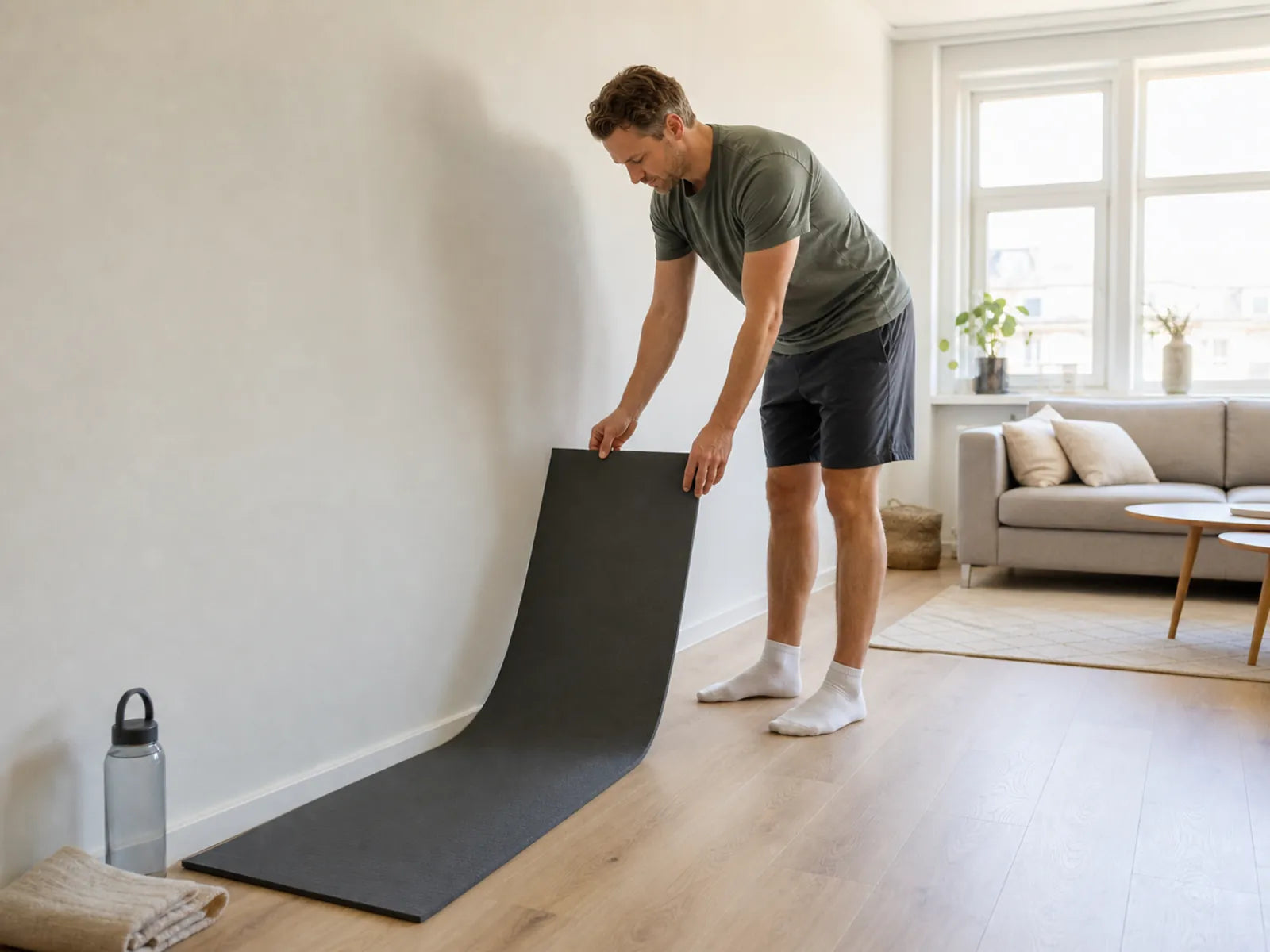 Preparing an exercise mat on the floor. Context image; the full exercise with the equipment described is not shown.
The five-point check before every set
Use these five checks before every working set. The framework shows which factor changes when a repetition becomes untidy.
- Anchor and straps: the anchor stays still, both straps are the same length and no component rubs against an edge.
- Foot cradles and heels: both heels sit in the same way and cannot unexpectedly slip outwards.
- Body line: the shoulders stay on the mat, the ribs remain quiet and the pelvis does not rotate away.
- Curl path: the heels travel evenly towards you as the knees bend; one leg does not pull visibly faster.
- Return: you extend the knees slowly, keep tension on the straps and finish without letting the hips drop suddenly.
If one point changes, make only one difficulty factor easier. For example, shorten the range of motion first. Do not change strap length, hip height and speed at the same time, because you will not know which adjustment restored control.
Take your Nordic curl from the first rep to week 10.
A concrete 7-page plan: build up week by week, without pushing too fast.
- 01A clear week-by-week progression
- 02Technique and the mistakes to avoid
- 03A simple log you will actually use

≤ 51%
✓Backed by research
Van Dyk et al., 2019: meta-analysis of programmes with NHE. Not an effect test of Nordbelt or this protocol.
Open the download page again or check the email we sent you.
Open the download page ↗TRX leg curl execution step by step
Follow this fixed sequence for the TRX leg curl:
- Set both straps to the same length and check the anchor, fasteners and clear floor area according to the product instructions.
- Sit down, place your heels gently in the foot cradles and turn onto your back under control.
- Extend your legs without forcefully locking the knees and place your arms securely by your sides.
- Lift your hips to a height you can hold without arching or rotating away.
- Draw both heels slowly towards your glutes. Let the knees bend while the pelvis stays still.
- Pause only while the anchor, foot cradles and body line remain unchanged.
- Extend the knees under control and maintain tension until you return to the starting position.
- Lower your hips, remove tension from the straps and leave the foot cradles without rolling or pulling.
Research on different hamstring exercises shows that exercise choice and body position can change activation across the hamstrings (Hegyi et al., 2019). This supports using a consistent technique, but does not prove that one exact hip height is optimal for everyone.
Ankle fixation for Nordic curls at home
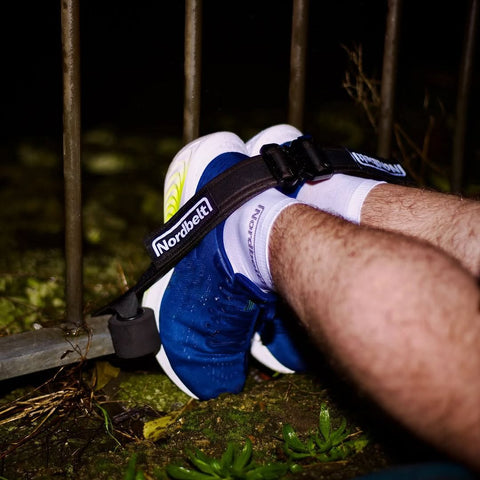
The exercise task then changes. In a TRX curl, your heels move in the foot cradles while your upper back stays on the floor; in a Nordic curl, both ankles remain fixed as your body travels forwards from a kneeling position. With Nordbelt for Nordic curls at home, you can arrange that stable ankle fixation without a training partner or large fitness machine, provided the door, anchor point, floor and surrounding space are suitable and have been checked beforehand.
Nordbelt is not a suspension trainer or a standing or lying leg-curl machine, and it does not perform the TRX hamstring curl. Its product role is limited to the home setup for Nordic curls. Choose the movement you want to train first and the equipment second.
Hip height during the TRX hamstring curl
“Hips high” does not mean pushing the pelvis as far upwards as possible. Find a position where your shoulders, pelvis and knees form one calm line and your ribs do not flare upwards. If your hips drop during every curl, the lever is probably too demanding for the range of motion you selected.
Make the set easier by keeping your hips slightly lower, drawing your heels less far towards you or shortening the eccentric return. Once you can keep the same line for several repetitions, increase only one factor. A regional activation study found clear differences between a lying leg curl and a stiff-leg deadlift, but such activation differences do not automatically show which long-term adaptation an individual home exerciser will achieve (Schoenfeld et al., 2015).
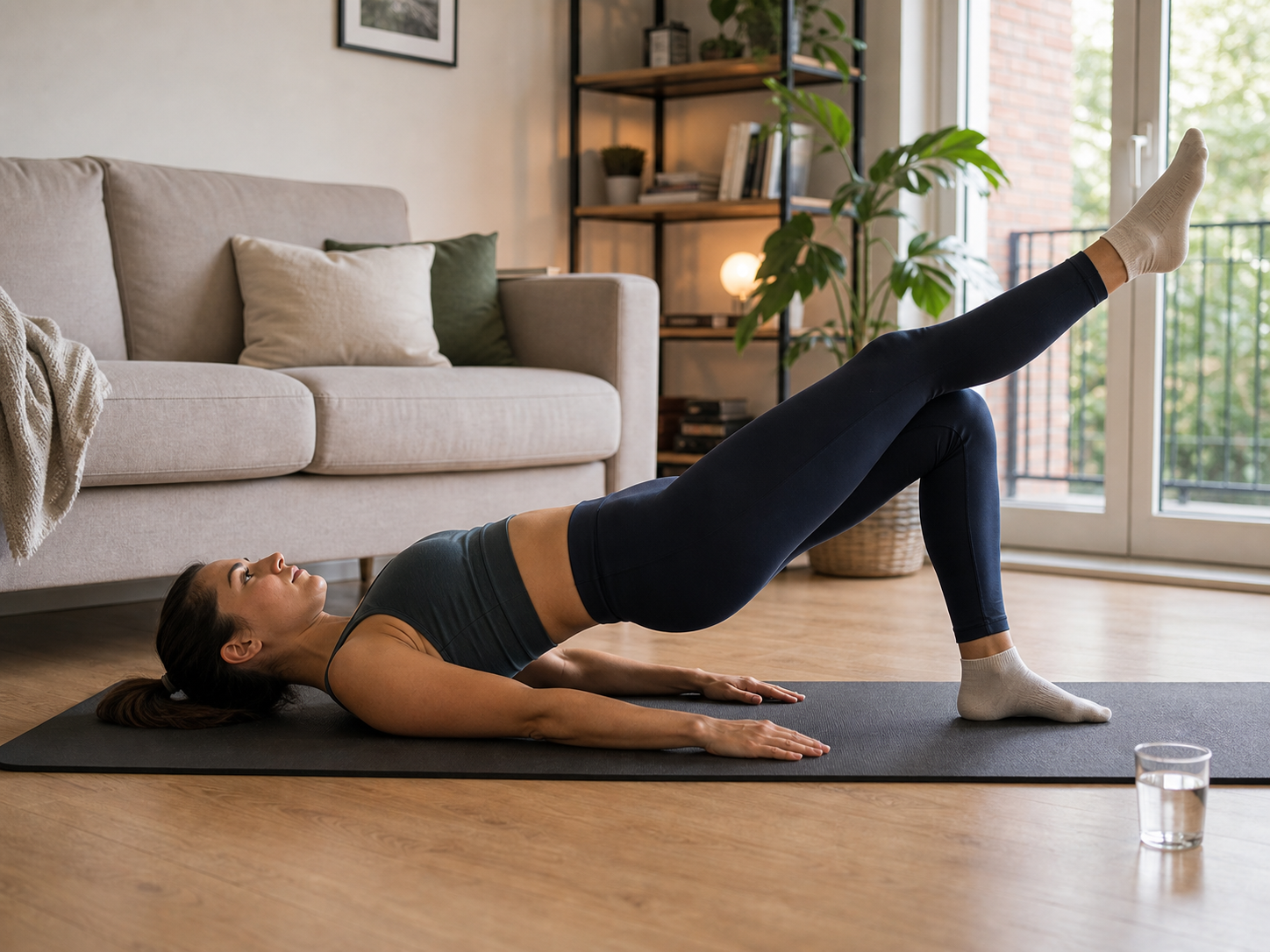 Single-leg hip bridge on a mat. Context image; the full exercise with the equipment described is not shown.
TRX hamstring curl for beginners
A TRX hamstring curl for beginners does not start with the longest lever or the highest bridge. Use this regression ladder:
- first learn a controlled two-leg bridge without straps;
- then keep your heels in the foot cradles while lifting only your hips briefly;
- add a small two-leg knee bend;
- only then increase the curl path;
- choose a higher hip position only when the ribs, pelvis and return remain unchanged.
A single-leg variation comes later. It changes not only the resistance but also the demand on pelvic control and symmetry. If the two-leg curl still rotates, drops or speeds up, using one leg generally gives you less useful information and more compensation.
Suspension trainer hamstring curl versus other curls
A suspension curl fits when you have a suitable anchor and foot cradles and want to combine knee flexion with bridge control. For a simpler sliding task at home, the guide to hamstring slider exercises has its own progression. A hamstring curl with a stability ball adds a rolling support surface, while cable hamstring curl technique focuses on the cable path, ankle cuff and knee flexion at a cable station.
The exercises look similar because the knees bend, but their constraints differ: sliders need a suitable floor, a ball requires control over a rolling surface, a cable requires a station and cuff, and a suspension trainer needs a safe anchor plus stable foot cradles. EMG research across several hamstring exercises likewise found different activation patterns, which mainly underlines that “a hamstring curl” is not a fully interchangeable category (McAllister et al., 2014).
Common TRX hamstring curl mistakes
Common TRX hamstring curl mistakes include:
- starting without checking the anchor, fasteners and clear floor area;
- placing the heels loosely in the foot cradles so that one foot shifts;
- letting the hips drop on every repetition and only pushing them back up at the end;
- starting the curl with speed rather than knee flexion;
- bending the knees unevenly;
- letting the return accelerate;
- changing three regression variables at once;
- ignoring sharp pain, cramp or loss of control;
- improvising an anchor or foot-cradle setup not specified by the manufacturer.
Stop the set if the anchor moves, a strap twists, your heel is about to slip or you cannot leave the setup under control. For a new, sharp or persistent symptom, a technique article is not a diagnosis; have the situation assessed appropriately.
How do you progress the exercise?
Begin with a few easy test repetitions, then choose only sets in which all five checks remain unchanged. End a set before your hips visibly drop or the return speeds up. In a later session, increase just one factor: a little more range of motion, a higher hip position, a slower return or, eventually, a single-leg variation.
If you want to assess which equipment suits a Nordic setup after the suspension curl, the guide to Nordic hamstring curl equipment compares that different exercise task. For installing and checking the home fixation, use the practical how-to guide. That route does not turn a TRX curl into a Nordic curl.
Frequently asked questions
How high should your hips be during a TRX hamstring curl?
Keep your hips high enough for the shoulders, pelvis and knees to form a calm line without flaring your ribs or arching your lower back. The exact height varies by person and regression. Lower your hips or shorten the curl if your pelvis drops during the repetition.
Where should you place your feet in the TRX straps?
Place your heels in the foot cradles according to the instructions for the suspension trainer you use, and check that both feet sit evenly. The foot cradles should not twist or slide towards the forefoot. Test the setup without a full curl first and leave the foot cradles under control if anything shifts.
Is a TRX hamstring curl suitable for beginners?
Yes, when the anchor is suitable and you simplify the movement enough. Start with a regular bridge, then a short hip lift with your heels in the foot cradles, and only then add a small two-leg curl. A long lever, high bridge or single-leg variation is not a necessary first step.
Is a suspension trainer hamstring curl the same as a Nordic curl?
No. During the suspension curl, your heels move in foot cradles while your upper back stays on the floor. During the Nordic curl, the ankles stay fixed and the body travels from a kneeling position. Both load the hamstrings, but their setup, movement task and progression differ.
What should you do if your hips keep dropping?
Shorten the range of motion first or keep your hips slightly lower. Then check that your heels sit evenly in the foot cradles and that you can slow the return. If your pelvis still drops, go back to a regular bridge or a short isometric position before adding curls again.
Summary
A good TRX hamstring curl relies on five fixed checks: a stable anchor, even foot cradles, a calm body line, a symmetrical curl path and a controlled return. Start with a short two-leg movement, change only one regression factor at a time and stop as soon as the anchor, heel position or pelvic control shifts. Treat suspension curls, cable curls, sliders, stability-ball curls and Nordics as different exercises, each with its own setup and task.