

Trap bar or straight bar: which deadlift should you choose?

When choosing a trap bar or a barbell deadlift, consider the movement you want to train and the setup you can repeat. With a trap bar, you stand inside the frame; in a conventional barbell deadlift, the straight bar is in front of your legs. Record the handle height too. More weight with a different bar does not prove greater progress: first compare your performance within the same variation. Neither bar is the best choice for everyone.
What does the shape of the bar change?
A trap bar, also called a hex bar, has a space to stand in and handles beside your body. With a straight bar, you grip the bar in front of you. This changes the position of your hands relative to your body and the path the equipment can follow. These are different setups, even when the plates carry the same weight.
Check which handles you use on a hex bar. Some models offer both high and low handles. A higher handle places your hands higher at the start when the same plates rest on the same floor. Do not just write “trap bar” in your log: handle height belongs in the description of your variation.

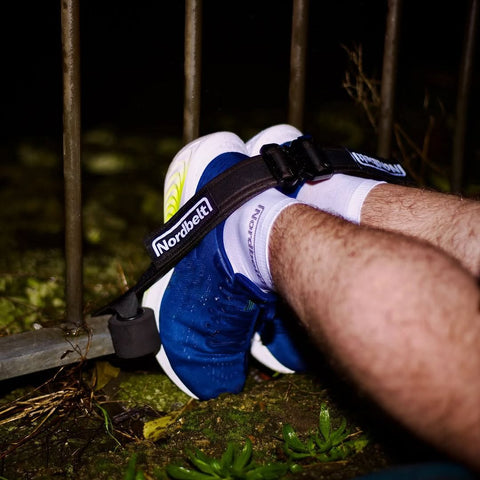
Equipment detail: a raised handle. The image does not show a complete deadlift.
Want to learn the movement first? Use the separate guide to deadlift technique for beginners.
What do the comparison studies show?
Swinton and colleagues studied nineteen male powerlifters using straight and hexagonal bars. With the tested hex bar, they found lower peak moments at the lower back and hip, and a higher peak moment at the knee. A joint moment describes a rotational mechanical load; it is not a measured probability of injury. The study compared immediate movement characteristics and performance, not years of training or the development of back pain (Swinton et al., 2011).
In another comparison, twenty men with deadlifting experience performed repetitions with both bars. The hex bar produced higher measured activity in one of the front thigh muscles; the straight bar produced higher activity in the biceps femoris, a hamstring muscle, during the lifting phase. These were local EMG measurements in a specific test, not evidence of greater growth of the whole muscle group (Camara et al., 2016).
The useful conclusion is that bar choice changes the task. These studies do not establish a universal winner for hamstrings, back safety or beginners. Nor can their findings automatically be applied to every modern high-handle model.
Which variation suits your training goal?
Start with the task in your programme. Do you need to learn or track a specific straight-bar deadlift? Practise that variation. If the aim is simply a loaded lifting movement, you have more choice, provided the execution suits your experience and available equipment.
| Your question | Practical choice |
|---|---|
| Do I want to improve my straight-bar deadlift? | Keep the straight bar as your clearly defined main variation; treat the trap bar as a different exercise. |
| Do I need a repeatable lifting variation without a fixed bar requirement? | Compare the available setups with a manageable load and choose one clearly described variation. |
| Do I mainly want to train a specific hip hinge? | Check whether the intended exercise is a Romanian deadlift, rather than simply picking a different bar. |
For that last question, see the full technique guide to the Romanian deadlift for hamstrings. Decide which movement your programme calls for before choosing between bars.
Compare your training log, not just the kilograms
The following example is fictional. The weights and repetitions are not starting recommendations and do not come from a training test. They show what you need to record to understand a change.
| Log entry | Execution | What can you conclude? |
|---|---|---|
| A: 80 kg, five repetitions | Straight bar, from the floor | A starting reference for this variation. |
| B: 90 kg, five repetitions | Trap bar, high handles | A different bar and starting position; not direct evidence of strength gain compared with A. |
| C: 90 kg, six repetitions | The same trap bar and handle height as B | A useful comparison with B only if the rest of the execution is comparable. |
Record the total weight including the bar, the grip, starting height, repetitions and any change in execution. An unknown bar weight makes a precise comparison impossible. If you change gyms, check the equipment you actually use again. This prevents a different setup from quietly becoming a personal record in your log.
Also want to train knee flexion separately at home?
Choosing between two deadlift bars does not tell you whether to add separate knee-flexion work. If you deliberately choose to do Nordic curls at home as well, a different practical question arises: how will you secure both ankles? The comparison of Nordic curls and Romanian deadlifts at home helps distinguish these movement tasks.
With Nordbelt for Nordic curls at home, you can secure both ankles without a training partner or a large exercise machine. You still need a suitable anchor point, low and symmetrical attachment, a comfortable surface and clear space. The aid helps with that separate setup; it does not support a deadlift or determine which bar or load suits you.
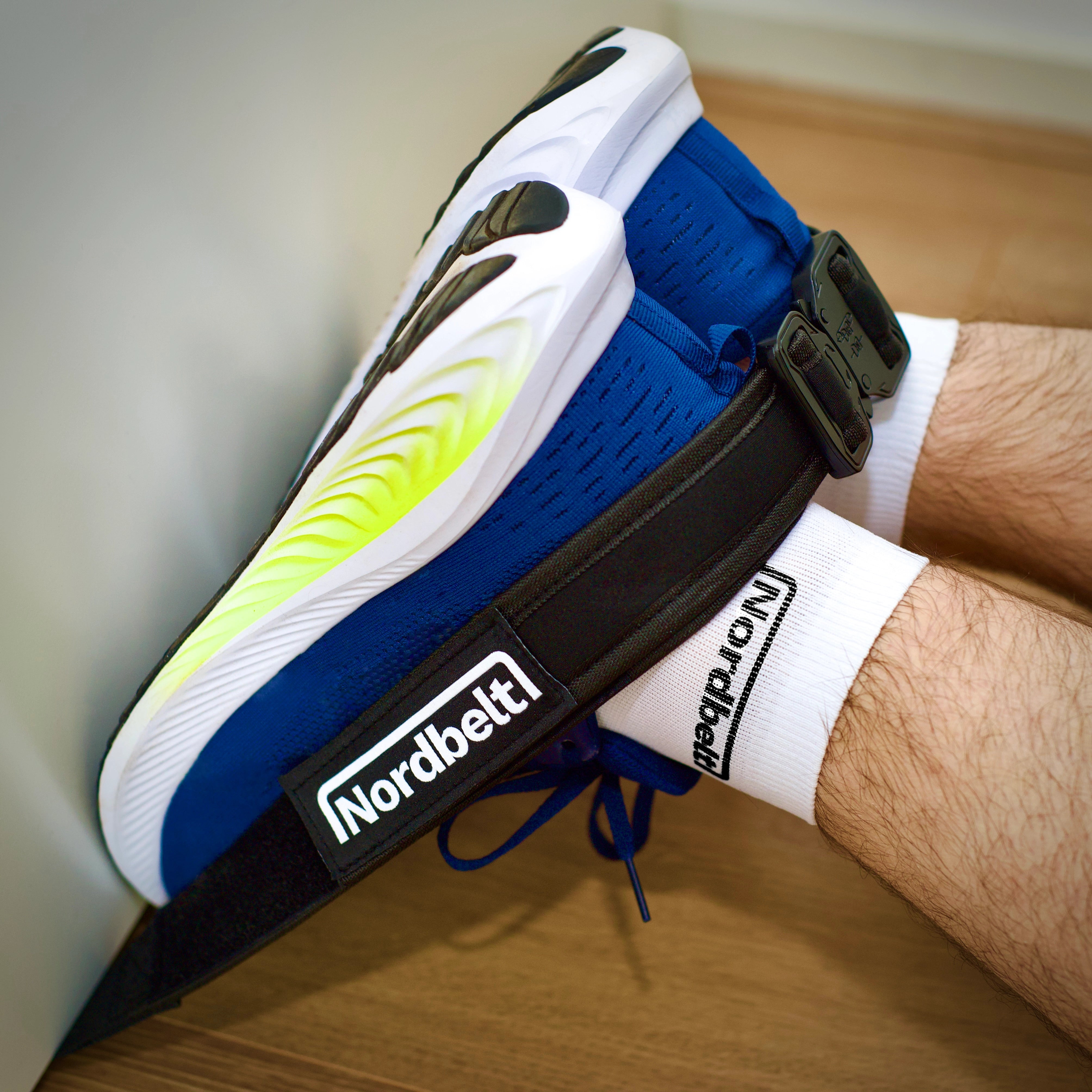
Ankle-attachment detail for a separate Nordic setup; the anchor point and exercise execution are not visible.
Check the complete setup using the guide to Nordic curls at home. If you do not want to add Nordic curls, choosing a deadlift bar does not require an extra purchase.
What should you record when changing bars?
Create a new log entry for the new variation and reassess the load. Do not automatically carry over your old working weight. Start with a load that lets you calmly check the chosen starting position and movement, then assess how the repetitions go.
Before the session, decide what should stay the same: the bar, handles, plates, starting height and way you lower the weight. Record any departures from that setup. You do not need to eliminate differences; you need to make them visible. Note, for example, when you use another grip or start a repetition from blocks. An execution note is more useful than putting the old and new weights in the same column without explanation. Only then does the number beside “deadlift” have a meaning you can recover later.
If you experience pain or cannot control the setup, stop the attempt. Another bar is not an automatic solution to symptoms. Seek individual advice for persistent or unexplained symptoms instead of treating a general bar comparison as treatment advice.
Frequently asked questions
Is a trap bar better for your back?
You cannot say that in general. In their acute comparison, Swinton and colleagues found lower peak moments at the lower back with the tested hex bar. They did not measure injuries or recovery. A lower mechanical peak in that test is therefore no safety guarantee for your technique or symptoms (Swinton et al., 2011).
Can you always lift more with a trap bar?
No. Swinton’s nineteen powerlifters lifted a higher average maximum with the hex bar, while Camara found no statistically significant difference in maximum weight among twenty experienced men. The setup and participants matter. Do not use a fixed percentage to convert your working weight (Swinton et al., 2011; Camara et al., 2016).
Which bar is better for your hamstrings?
That depends on what you want to train and which executions you compare. Camara found higher measured biceps-femoris activity with the straight bar during the lifting phase. This does not prove greater long-term hamstring growth. Choose a clearly defined movement and track it consistently rather than using one EMG finding to declare an overall winner (Camara et al., 2016).
Do high and low handles count as the same variation?
Keep them separate in your log. When the plates rest on the same floor, a high handle starts your hand higher. The starting position has therefore changed. Specify which handles you use; the bar name and kilograms alone are not enough to compare sessions fairly.
Can I simply replace a conventional deadlift with a trap bar?
First check why the conventional deadlift is in your programme. If that specific execution is the goal, a trap bar is not an identical replacement. If the goal is broader, discuss or choose a suitable variation and record the change as a new exercise. The choice need not be a final verdict on either bar.