

RIR in strength training: how many reps did you have left?


RIR in strength training means how many more repetitions you estimate you could have performed after a set with the same weight and the same agreed technique. RIR 2 therefore means about two reps left, not that you must do two more. Record the estimate alongside what you actually performed and why you stopped. This lets you read an RIR-based programme without confusing the score with a precise measurement, a rating for the whole workout or your maximum weight.
What does RIR 2 mean in your programme?
RIR stands for repetitions in reserve. The estimate applies to one specific set and the intended technique. Research uses different definitions of stopping and failure, so agree on which execution counts (Pelland et al., 2022).
A fictional example: after eight reps, you think about two more were possible. Write 8 reps, estimated RIR 2. The eight were performed; the two were not tested. This is not a training prescription. Keep your programme's RIR target separate from your own estimate.

Keep the same task in mind
Estimate the reserve without changing the weight, range of motion or support. For a push-up variation, that includes keeping the same hand height. A shorter movement or extra assistance makes the comparison a different task.
If you stop because you lose balance, equipment shifts or you get distracted, your reserve is not automatically known. Note the reason; do not resume just to obtain a score. Research also distinguishes voluntarily stopping from being unable to complete another repetition (Pelland et al., 2022).

Context image of a push-up position with elevated hands. The photograph shows neither a completed set nor measured repetitions in reserve.
What is the difference between RIR, RPE and percentage of 1RM?
RPE describes perceived exertion. On a RIR-based set RPE scale, for example, RPE 9 means one rep left. Other RPE scales rate general effort or an entire session. Ask which scale your programme uses before trying to convert a score (Bastos et al., 2024).
Percentage of 1RM describes the load relative to your maximum weight for one repetition. It does not state a reserve: the same relative load can allow different people to perform different numbers of repetitions (Pelland et al., 2022).
| Notation | What does it describe? | What else is needed? |
|---|---|---|
| RIR | Estimated repetitions remaining after a set | The same task and the reason for stopping |
| RIR-based set RPE | An effort rating described through reserve | The scale being used |
| Percentage of 1RM | Relative weight load | What you actually performed with that weight |
Take your Nordic curl from the first rep to week 10.
A concrete 7-page plan: build up week by week, without pushing too fast.
- 01A clear week-by-week progression
- 02Technique and the mistakes to avoid
- 03A simple log you will actually use

≤51%
✓Backed by research
Van Dyk et al., 2019: meta-analysis of programmes with NHE. Not an effect test of Nordbelt or this protocol.
Open the download page again or check the email we sent you.
Open the download page ↗How accurately can you estimate reps in reserve?
An exploratory meta-analysis combined thirteen publications covering twelve studies with 414 healthy participants. On average, participants underestimated the number of remaining repetitions by 0.95, but differences between studies were very large. That average is therefore not a rule to always add one to your own estimate (Halperin et al., 2022).
Another review described 31 studies with 855 adult participants, mostly men. RIR was useful for regulating training effort in certain situations studied; generalising to other participants and exercises remains limited (Bastos et al., 2024).
The research verification is not an instruction to train to failure yourself, test heavier loads or use pain as a reference point. Keep uncertainty visible; your personal estimate remains an estimate.
A fictional set log: the same eight reps, different information
Every entry is invented: no real exerciser or training prescription is involved. A and B use the same exercise, weight and movement; the recorded estimate differs.
| Entry | Actually performed | Estimated reserve | Reason for stopping and confidence |
|---|---|---|---|
| A | Eight agreed repetitions | About two | Planned set completed; reasonably confident estimate |
| B | Eight agreed repetitions | About four | Planned set completed; less confident estimate |
| C | Six repetitions | Unknown | Lost balance; stopped the set |
A and B do not prove a gain in strength. C is not automatically RIR 0 either: the reason for stopping leaves the reserve unclear. This way, you can discuss what you actually did without inventing an outcome.

Context image of a training note. The person pictured is not a participant in the fictional set log.
Would you also like to do Nordic curls at home?
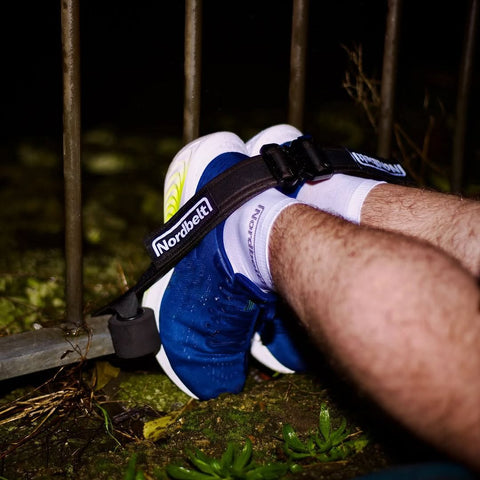
You do not need an ankle strap to estimate RIR. If you separately choose to do Nordic hamstring curls at home, that exercise requires reliable ankle fixation. Nordbelt for Nordic curls at home makes this possible without a training partner or large machine. A suitable, checked anchor point, knee support and clear space to catch yourself are still needed. The strap neither measures your effort nor determines an appropriate reserve. For the difference between the kneeling variations, read the comparison of reverse Nordic and Nordic hamstring curls.
Make your next entry useful
Record the exercise and variation, load, completed repetitions, agreed technique, estimated RIR and reason for stopping. Feel free to add “uncertain”. Keep a prescribed RIR target in a separate column so the target does not become your observation after the fact. Also note any change in support or movement.
For example, your programme specifies a target of two reps left, but after the set you estimate about four. Keep both entries. Do not change your estimate to two just because the programme said so. Differences provide something to discuss, not an automatic instruction to increase the weight. Also record whether the last repetition still met the agreed technique. If you cannot judge that, retain the uncertainty in your note and ask for the technique to be explained.
Compare only recognisably similar tasks. For breaks between sets, use the separate guide to rest in strength training; a different break is additional context, not an automatic RIR correction. Exercise selection and progression at home are covered in the home hamstring programme.
Stop if you experience sharp pain, lose control or have an unreliable setup. Do not record reserve as though pain measured effort. Have persistent or recurring symptoms assessed by a doctor or physiotherapist. You can discuss changes to your personal programme with the person who designed it.
Frequently asked questions
Does RIR 0 mean I used my maximum weight?
No. RIR 0 means you estimate that no extra repetition of the same task was possible. You can record that after several repetitions with a lighter weight. In contrast, 1RM concerns the heaviest weight for one repetition. An estimated reserve of zero also does not prove that your limit was actually measured; self-report and percentage loading describe a set in different ways (Pelland et al., 2022).
Should I do two more reps at RIR 2?
No. The score describes your estimate after the completed set. In the fictional example, eight completed repetitions therefore remain eight. A prescribed RIR target has a different role: it describes the intended reserve. If you do not understand how that target fits with the other instructions, ask for clarification instead of doing extra repetitions as a check.
Which RIR number is best for muscle growth?
The methods papers and reviews discussed here do not establish one universally best number for your exercises and programme. Differences in participants, definitions and measurement methods limit such conclusions. This explanation helps you understand the notation, not choose a personal training prescription. Use the target in your existing programme and discuss uncertainty without treating the estimate as a guaranteed outcome (Pelland et al., 2022).
What should I record if I do not know my reserve?
Write “RIR unknown” and state why you stopped. Add the repetitions actually performed and the technique used. This keeps your log useful even without a score. You do not need to take a later workout to failure to fill the blank. Keep uncertainty visible and later compare only sets whose tasks are sufficiently similar.