

Hand-assisted Nordic curl: lower and return with control


A hand-assisted Nordic curl lets you control the lowering phase and use your arms to support your weight and help you return. Your ankles stay secured, your knees rest on a mat, and your hands take over before you drop without control. You do not have to pull yourself back up without help. Choose a short movement you can repeat; increasing the range and reducing hand support are separate next steps.
What do your hands do during a Nordic curl?
In the Nordic hamstring curl, you lean forward from kneeling while your ankles remain secured. Your hamstrings slow the movement. Hand support lets you adapt the exercise to the part you can currently control.
Distinguish three moments:
- Lowering: move forward with control, keeping your hands ready to support you.
- Taking support: let your hands take your weight before the movement becomes a fall. Allow your elbows to bend rather than landing on straight arms.
- Returning: push with your hands to help you return to the kneeling start. You may use more help here than during the descent.
A controlled lowering repetition with help on the return differs from a full repetition without assistance. Record which version you use. That lets you compare your own technique fairly, without having to prove in every session that you can already do a full Nordic.

Secure your ankles and leave your hands free
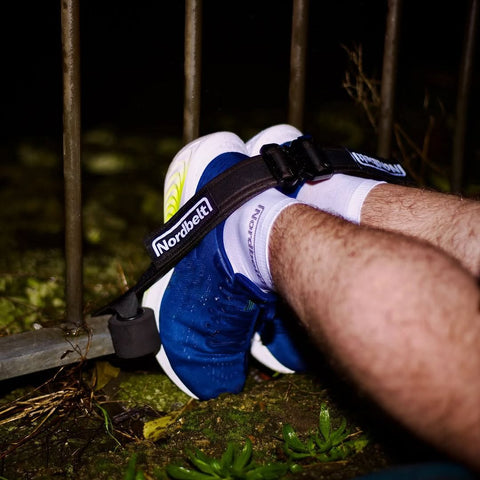
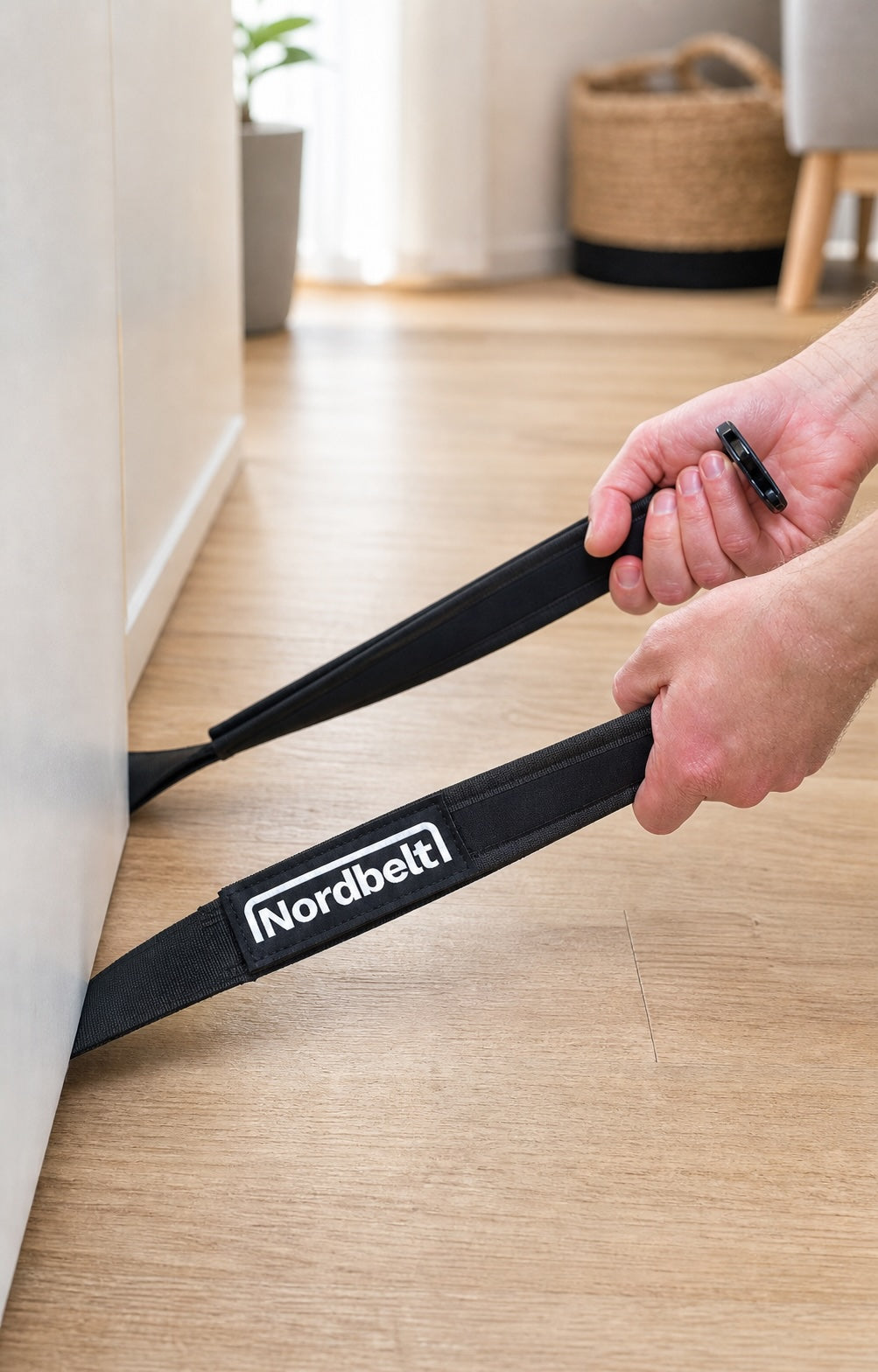
To practise on your own, you need suitable, stable ankle fixation. With Nordbelt, you connect your ankles to a suitable anchor, so you do not need a partner holding your feet. Your hands remain available to support you and push you back up. The strap secures your ankles; your hands provide the support for your body weight.
Use only an anchor that suits the prescribed attachment and cannot open, slide or tip. Not every door or bench is suitable. Follow the instructions and demonstrations, inspect the strap and buckle, and close any door used fully. A manual pull check may reveal a loose connection, but does not prove its load capacity.
Place a stable mat under your knees and allow enough space in front for your hands and torso. If a foot or the anchor moves during the exercise, stop and unload the attachment. More hand support cannot fix an unsuitable setup. For choosing an anchor, read the home Nordic curl setup guide.
How to use hand support during the repetition
- Start upright. Kneel on the mat with both ankles secured. Keep your torso long and your shoulders, hips and knees as closely aligned as possible. Bring your hands in front of you.
- Lean forward slowly. Move from your knees and choose a distance you can control. Do not keep lowering just to reach the floor.
- Take support in time. Place your hands before you lose control. Let your arms take your weight and bend your elbows gradually. Do not try to stop a sudden fall with a hard landing.
- Help yourself return. Push against the floor with your hands and return calmly to the start. You do not need to do the return using only your hamstrings or pull on the ankle straps.
- Assess the next repetition. Repeat only while the attachment stays in place and you can reproduce the same controlled movement without pain.
If the floor is too far away to take support in time, do not force a longer unsupported descent. A fixed, suitable raised hand support can make support accessible earlier. Do not use a loose stool, slippery surface or pile of cushions. If you cannot control the movement even with an adjusted setup, choose a less demanding hamstring variation for now.
Take your Nordic curl from the first rep to week 10.
A concrete 7-page plan: build up week by week, without pushing too fast.
- 01A clear week-by-week progression
- 02Technique and the mistakes to avoid
- 03A simple log you will actually use

≤51%
✓Backed by research
Van Dyk et al., 2019: meta-analysis of programmes with NHE. Not an effect test of Nordbelt or this protocol.
Open the download page again or check the email we sent you.
Open the download page ↗Build control without making everything harder at once
Record two things separately: how far you lower without hand support and how much help you use to return. Include the height of any hand support in your notes. This prevents a longer descent with substantial pushing help from being compared unknowingly with a shorter repetition without that help.
Change one thing in a later session: a slightly longer controlled descent, less support or more repetitions. Keep the other elements the same. If you land harder on your hands or your hips keep moving backwards, return to your previous version. This is a practical comparison aid, not a validated test or fixed progression programme.
Progress only when your response to the previous session allows it. Soreness that clearly affects normal movement or technique is a reason to adjust the next load. Stop if the exercise hurts. With an injury or recurring symptoms, decide with your clinician which exercise and load are appropriate. For technique problems, also see common Nordic curl mistakes.
What research on assisted Nordics tells us
In an acute study with 16 professional footballers, external assistance during Nordics reduced measured eccentric force; the exercise was generally perceived as less demanding too. Assistance came from an apparatus rather than the hands. The study therefore provides neither a hand-support percentage nor a personal training programme (Burrows et al., 2020).
Another study compared assisted and unassisted Nordics in 16 male sprinters and found better control of movement range in the assisted condition. This was also not a study of this home variation or Nordbelt. The paper appeared online in 2021 and in the journal issue in 2024 (Alt et al., 2024).
These findings support adjusting difficulty with assistance. They do not establish how much hand support you need, which variation works best for you or whether the tool itself prevents injuries.
Frequently asked questions
Does a Nordic curl count if I push myself back up with my hands?
You are doing an assisted variation with help on the return. Describe it that way in your training notes. You do not have to return without your hands to practise a controlled lowering phase.
When should I place my hands on the floor?
Before you can no longer control the descent. Keep them in front of you from the start. If you only use them after suddenly dropping, adjust the movement range or how easily you can reach the support.
Does the ankle strap make the Nordic curl easier?
The ankle strap provides fixation to a suitable anchor. Your hands, an adjusted movement range or separate assistance change the execution. Secure ankles do not mean you can immediately perform a full Nordic without help.
Do I eventually have to train without hand support?
No. Choose a version that suits your goal and whose load you can control. A full Nordic may be a later step, but it is not a compulsory final test. More repetitions are of little use if each one becomes an uncontrolled fall.