Reverse crunch: curl your pelvis without swinging

In a reverse crunch, you curl your pelvis towards your rib cage while lying on your back with your knees bent. The aim is to lift your pelvis slightly and return smoothly, rather than raise your feet as high as possible. Start with your knees above your hips, keep your head on the mat and use a small movement. Below, you will learn how this differs from leg raises and what to adjust if you mostly swing.
What moves during a reverse crunch?
Your legs move too, but the pelvic curl is the defining part. Think of rolling your pelvis towards your chest. Simply pulling your knees towards your chest while your pelvis stays on the mat is a different movement.
In lying or hanging leg raises, the main task is lifting your legs. For this reverse crunch, stay on the mat and practise the small curl and return. You do not need to perform both exercises back to back or use the same number of repetitions. First choose which movement you want to learn, then assess its own technique.

How to perform the reverse crunch
Use a flat mat and leave enough clear space. You do not need a bench, cable or ankle strap for this version.
- Lie on your back with your arms by your sides and your palms on the mat.
- Bring your bent knees above your hips. Leave your head and shoulders on the mat.
- Breathe out gently and roll your pelvis a short distance towards your rib cage. Keep your knees bent and do not swing your legs to get started.
- Return under control until your pelvis rests on the mat and your knees are above your hips again. Do not lower your feet far towards the floor between repetitions.
A large movement is not a goal in itself. You do not need to roll onto your neck or bring your knees to your face. Choose a range from which you can also return smoothly. A photograph shows only one position and cannot prove speed or control throughout a repetition.
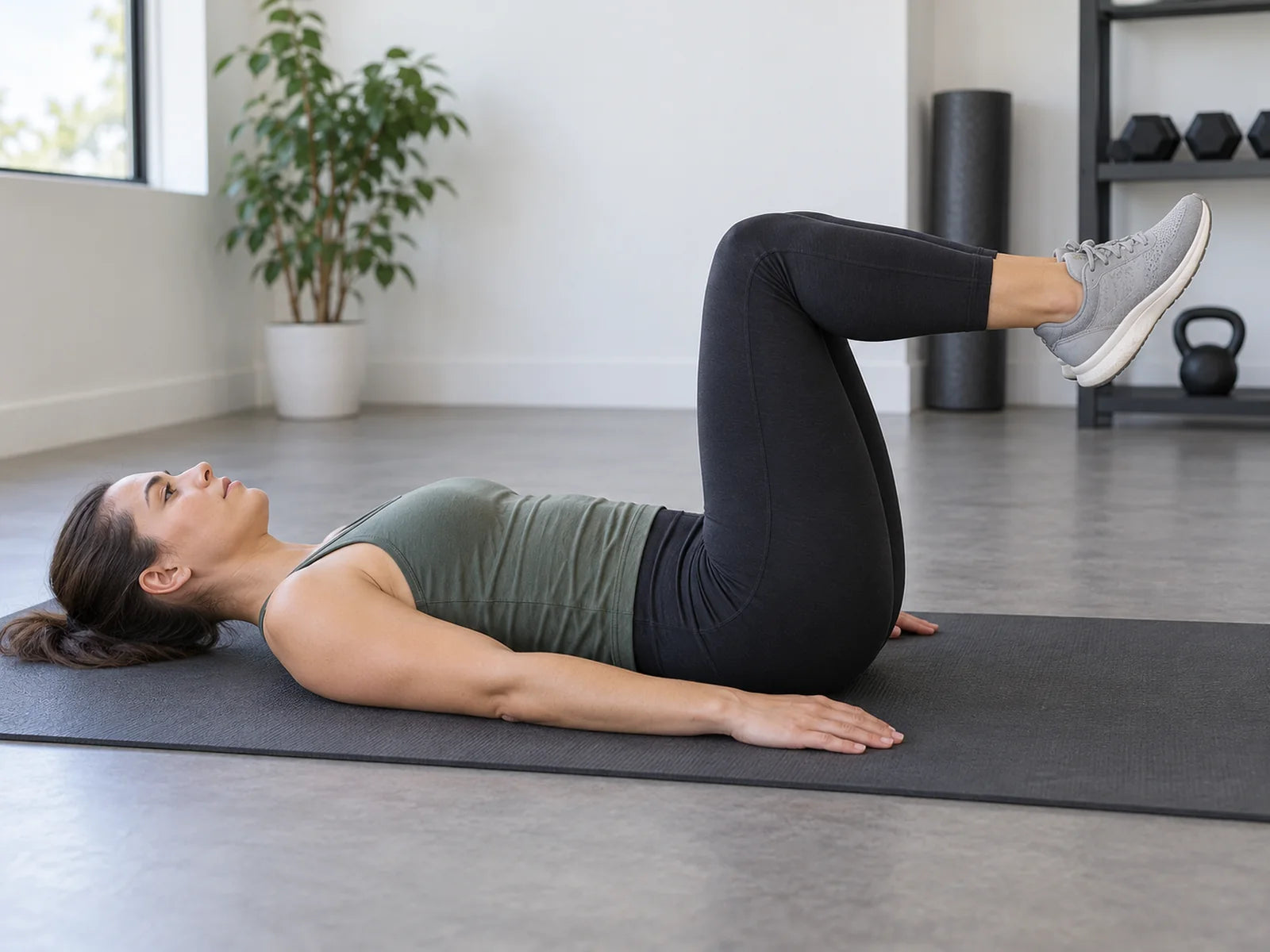
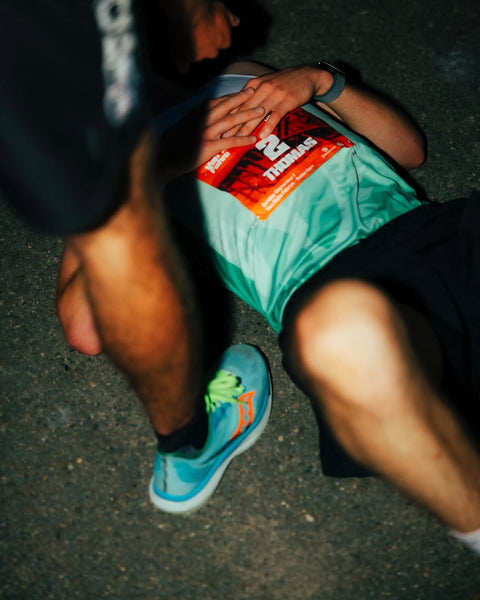
The photograph shows the starting position before the pelvic curl, rather than the finishing position.
Is your pelvis curling, or are only your legs moving?
Compare two moments during a gentle attempt: the start and the small curl. Look at both the point where your pelvis contacts the mat and your knees. Your feet can travel a long way without your pelvis lifting. Conversely, a small pelvic curl can be clear even when your feet move very little. Do not use the height of your shoes as a score.
| What do you see or notice? | What should you adjust first? | What should you check afterwards? |
|---|---|---|
| Your knees move closer, but your pelvis stays down | Start again above your hips and focus on a small pelvic curl | Does your pelvis now lift slightly? |
| You swing your legs away from you first | Reduce the movement and start from stillness | Can you curl without an initial swing? |
| Your pelvis drops back onto the mat | Return from a smaller curl | Can you restore contact with the mat gently? |
| You roll onto your neck or lift your head | Reduce the range and keep your head supported | Do your head and shoulders stay resting quietly? |
This is a practical observation aid, not a validated test. On your next attempt, change only the point in the relevant row. Stop if you have sharp pain, tingling or persistent symptoms and have them assessed; making a painful exercise smaller does not automatically make it suitable.
Take your Nordic curl from the first rep to week 10.
A concrete 7-page plan: build up week by week, without pushing too fast.
- 01A clear week-by-week progression
- 02Technique and the mistakes to avoid
- 03A simple log you will actually use

≤51%
✓Backed by research
Van Dyk et al., 2019: meta-analysis of programmes with NHE. Not an effect test of Nordbelt or this protocol.
Open the download page again or check the email we sent you.
Open the download page ↗Which muscles are involved, and what does research show?
A laboratory study of 25 healthy participants compared five abdominal exercises using muscle-activity measurements, both in static positions and during movement. The reverse curl produced relatively high activity in the lower part of the rectus abdominis. That measures activity during a task; it does not prove greater muscle growth, local fat loss or a better exercise for everyone (Willett et al., 2001). Do not use this finding as a reason to throw your pelvis increasingly high.
Would you also like to do Nordic curls at home?
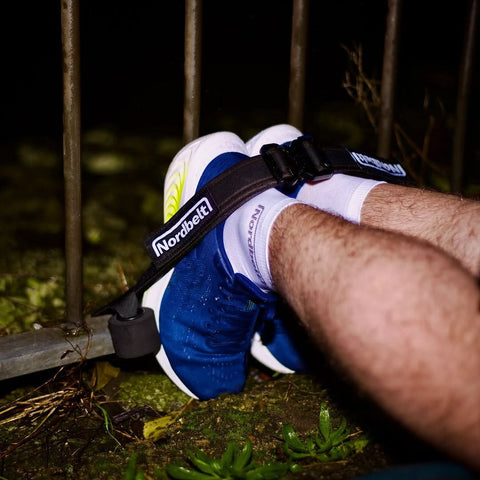
You do not need an ankle strap for a reverse crunch. If you separately choose to do Nordic curls at home, Nordbelt for Nordic curls at home provides bilateral ankle fixation without a training partner or large machine. You still need a suitable stable anchor point, knee padding and room to catch yourself with your hands. The strap does not perform a pelvic curl or determine which trunk exercise suits you. This is a separate training choice.
Make the movement smaller first
If you cannot yet curl your pelvis without swinging, first practise a small pelvic tilt with your feet on the mat. This is a simplified preparatory movement; do not record it as the same version as a reverse crunch with raised legs. Then try the starting position with your knees above your hips again.
Once you can repeat the small curl and return smoothly, keep that version while practising. Do not change range, speed and repetition count at the same time. If you want a different trunk task in which you resist turning, read about the Pallof press and resisting rotation.
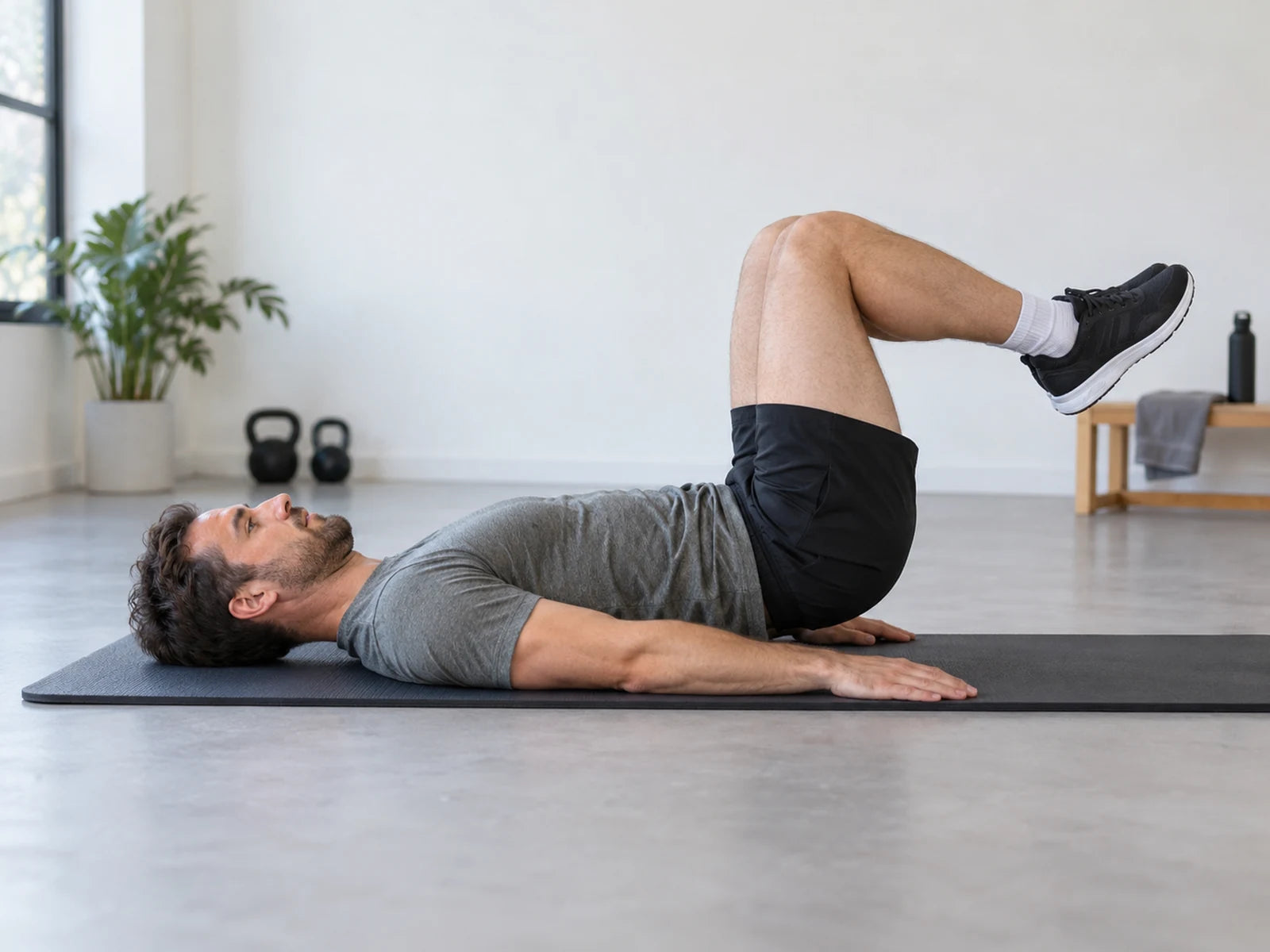
This small curl illustrates a position; the photograph does not show the return.
How many repetitions suit your technique?
There is no compulsory number for everyone. Choose a manageable amount within your existing training and end the set when you can no longer repeat the intended movement. Note whether you stopped because of fatigue, swinging or an uneven return. The explanation of repetitions in reserve in strength training helps describe effort, but does not set a compulsory target for this exercise.
Take the fictional example of Sam. First, Sam writes: “knees closer, pelvis stays down”. On the next attempt, Sam chooses a smaller movement and notes: “small curl, smooth return to the mat”. This describes a different execution, not proven strength gain. Compare repetition counts only when the starting position, range and return remain recognisably the same.
Frequently asked questions
Is a reverse crunch the same as a leg raise?
No. In this reverse crunch, you practise curling your pelvis towards your rib cage. Leg raises focus on lifting your legs. Knees moving closer alone do not show whether your pelvis also curls. Check the two features separately.
Can this specifically reduce belly fat?
Do not expect that from this exercise. In a study of 24 healthy, sedentary adults, six weeks of abdominal training did not significantly reduce the measured abdominal-fat or body-composition outcomes compared with the control group. It was a programme with several abdominal exercises, not an isolated reverse-crunch test (Vispute et al., 2011).
Must your feet reach the floor after every repetition?
No. Here, return to bent knees above your hips. Lowering your feet a long way adds another component to the movement and may create momentum for the next repetition. Put your feet down when ending the set.
What if you cannot make a small pelvic curl?
Simplify the task with a small pelvic tilt while your feet stay on the mat. Treat it as a separate preparatory movement. Do not force a larger curl or add weight to find the movement. If symptoms or uncertainty persist, seek appropriate guidance.