

Nordic curl or Romanian deadlift for hamstrings at home?


“Nordbelt is easy to secure and feels stable.”
When choosing between a Nordic curl or Romanian deadlift for hamstrings at home, choose the Nordic curl when you specifically want to train knee flexion with fixed ankles. Choose the Romanian deadlift when you want a loadable hip-hinge movement. If both movement tasks belong in your plan, use both, but assess them separately. Neither exercise is universally better: your goal, available home setup and manageable progression determine the choice.
Nordic curl versus Romanian deadlift: the difference at a glance
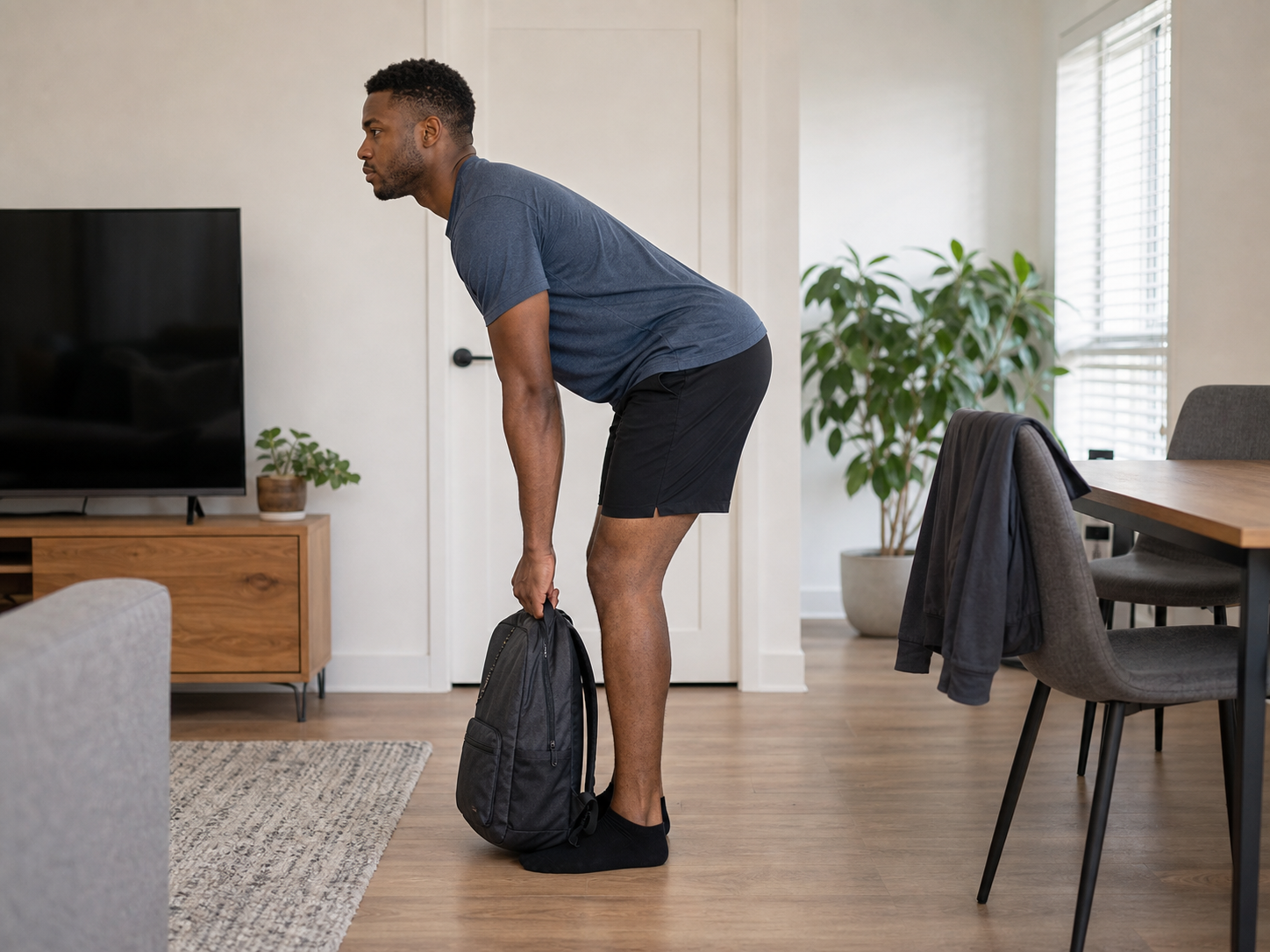
The two exercises load the hamstrings in different movements. During the Nordic curl, the hips remain relatively still while you resist the movement from the knee. During the Romanian deadlift, the movement comes mainly from the hip hinge while the knees remain slightly bent. That means neither exercise is a substitute for the other.
Research supports this distinction between tasks, but does not identify a universal winner. In a laboratory comparison with twenty active participants, the bilateral Romanian deadlift produced higher estimated peak forces and greater stretch for several hamstring muscles in that specific test than the Nordic hamstring exercise. The result also differed by muscle and task; it does not prove that the RDL is better for every goal (Breed et al., 2026).
Another study assigned twenty active participants to six weeks of Nordic hamstring exercises or single-leg Romanian deadlifts. Both groups improved on the single-leg hamstring bridge test used in the study, with no difference in improvement between the groups. This small study mainly shows that both routes can be useful; it does not make them mechanically identical or measure a complete home programme (Behan et al., 2024).
The two-axis decision chart for home training
Use the movement task first and the practical constraint second. This order prevents you from choosing an exercise just because the equipment happens to be nearby when you actually intended to train a different task.
| Question | Nordic curl | Romanian deadlift | Both |
|---|---|---|---|
| Which movement do you specifically want to include? | Bending the knee and resisting a forward fall with fixed ankles | A hip hinge against a chosen external load | Tracking both tasks separately |
| What needs to be available at home? | A comfortable kneeling surface, clear forward space and reliable low ankle fixation | Enough standing and hinging space plus a manageable load | Both setups must be safe to arrange independently |
| What do you record as progress? | The same regression, support and controlled range of motion | The same chosen variation and manageable load | A separate measure for each exercise |
The chart is an editorial synthesis of the movement differences and practical conditions at home. It is not a medical protocol or a personal training programme.

What stable ankle fixation do you need for Nordic hamstring curls at home, without a training partner or large fitness machine?
Would you also like to add Nordic curls at home? Before the first repetition, check for a suitable anchor point, low and symmetrical ankle fixation, a comfortable kneeling surface and clear space along your forward path. Test the fixation with light force first and choose a range of motion that you can resist under control. Only then does it make sense to compare the Nordic with the RDL in your plan.
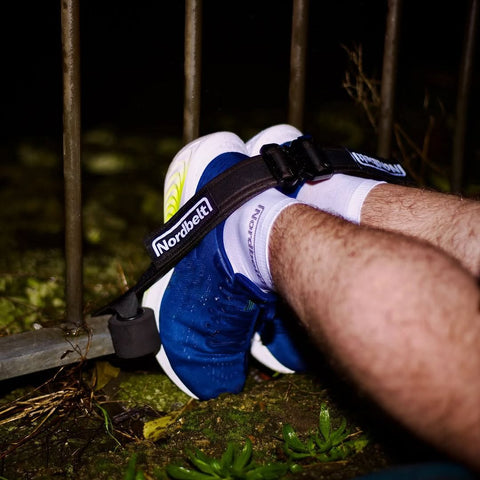
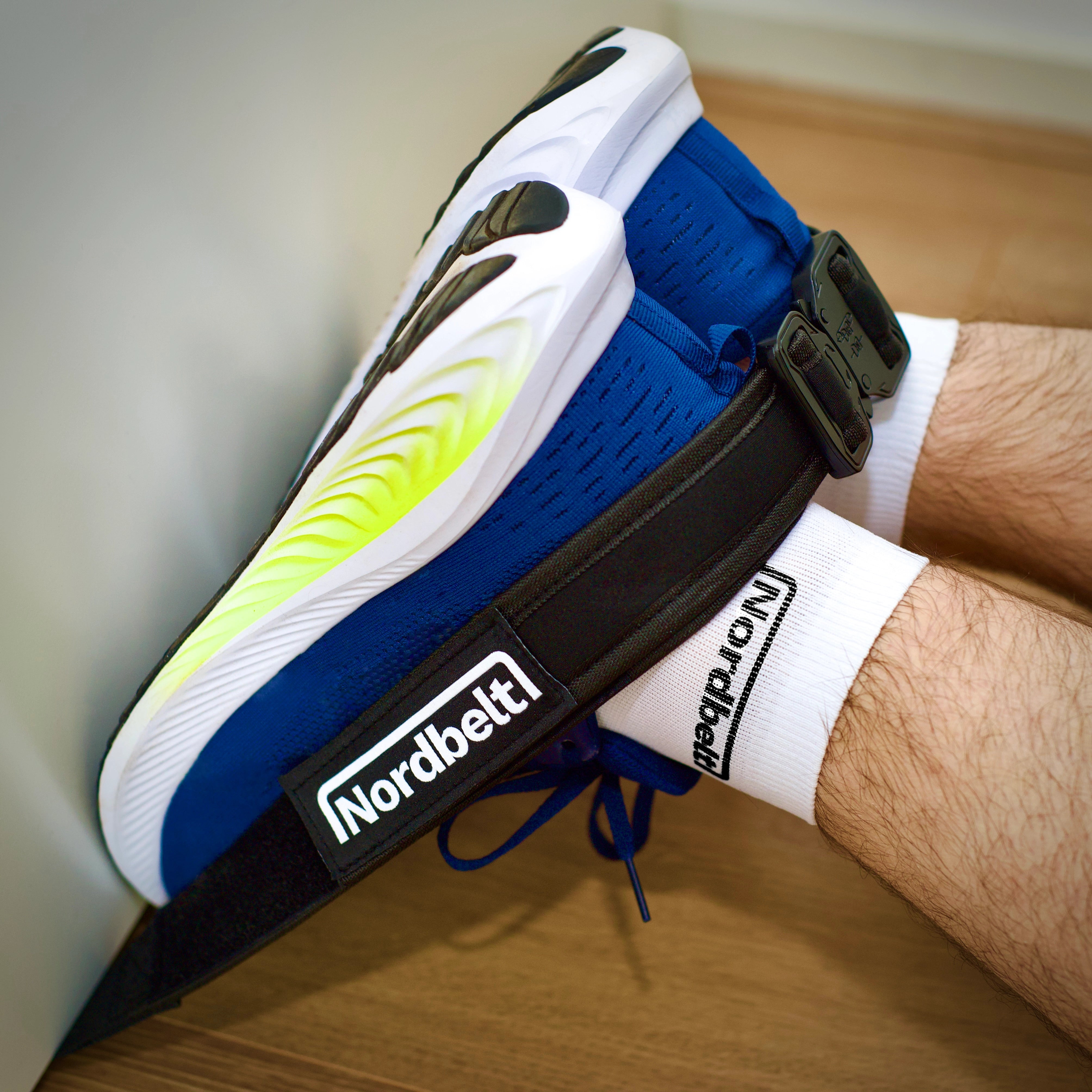
With Nordbelt for Nordic curls at home, you can arrange stable ankle fixation without a training partner or large fitness machine. It solves only the practical fixation requirement of the Nordic. The equipment does not turn the Nordic into an RDL, select a training goal, correct your execution or replace gradual load selection. The anchor point, strap position, symmetry, kneeling surface and clear space must be suitable before every session.
Take your Nordic curl from the first rep to week 10.
A concrete 7-page plan: build up week by week, without pushing too fast.
- 01A clear week-by-week progression
- 02Technique and the mistakes to avoid
- 03A simple log you will actually use

−51%hamstring injuries
✓Backed by research
Meta-analysis of randomised trials of the Nordic Hamstring Exercise.
Open the download page again or check the email we sent you.
Open the download page ↗RDL or Nordic for hamstrings: choose with three questions
1. Which task is missing from your current home programme?
Do not look only at the word “hamstrings”. If you already perform several hip-hinge movements, specific knee-flexion work may be the missing task. If you mainly use knee-flexion variations and do not have a loadable hip-hinge movement, the Romanian deadlift may instead be the missing task. If both are new to you, start with the exercise whose setup and light starting variation are easiest to control clearly.
2. Which setup can you reproduce?
A Nordic requires reliable low ankle fixation, knee comfort and room to catch yourself. An RDL requires an appropriate external load and enough clear space to perform the chosen variation under control. An improvised setup that feels different in every session makes comparison harder. Do not choose the theoretically most attractive exercise when the practical conditions at home are not yet right.
3. Which measure can you track honestly?
For the Nordic, for example, use the same regression, support and controlled path. For the RDL, use the measures from the existing technique owner without turning this comparison into a second execution guide. Do not change the equipment, difficulty and movement limit at the same time. This makes it easier to see which task actually changed.
For full execution guidance, the Romanian deadlift as a hamstring exercise remains the RDL owner. If the hip hinge itself is still unfamiliar, start by learning the hip hinge.
The difference between the Nordic curl and Romanian deadlift across a week at home
You do not necessarily have to remove one exercise permanently. When both movement tasks suit your goal, you can use them in the same wider plan. Keep them clearly separate at first: record the chosen variation, setup and stopping rule for each exercise. This prevents extra fatigue from one exercise from changing the execution of the other without you noticing.
There is no universal rule saying that both exercises must be in the same session, or on different days. The small comparative study by Behan and colleagues examined two separate programmes, not an optimal combined weekly schedule (Behan et al., 2024). Do not use that research as a prescription for sets, frequency or exercise order.
A simple choice for your next session:
- Write down the desired task: knee flexion, hip hinge or both.
- Check whether the corresponding home setup is reliable today.
- Choose one manageable variation for each task.
- Decide in advance when to stop: as soon as the chosen movement quality or setup changes.
- Evaluate the two exercises separately, not only by total fatigue.
When to stop comparing and stop the exercise first
Stop an exercise if you experience unexpected sharp pain, new swelling, loss of sensation, clear loss of strength or a setup that shifts. Comparing the Nordic with the RDL is then not the relevant next step. Ask an appropriate healthcare professional to assess what is sensible if symptoms are new, severe or persistent.
This page does not diagnose a condition or provide a rehabilitation or prevention protocol. If you have an existing issue or are returning after an injury, exercise selection belongs within the personal advice of the professional involved.
Nordic versus RDL hamstring training: the decision rule
Do not decide by asking which exercise sounds “harder”. Choose according to the movement task you want to train and the setup you can reliably reproduce at home. Use the Nordic for specific knee flexion with fixed ankles; the RDL for a loadable hip-hinge movement; and both when you deliberately want to track both tasks.
To check the Nordic door, strap and starting position, use the Nordbelt guide for Nordic curls at home. For a broad explanation of the exercise itself, the guide to the Nordic hamstring curl and hamstring curls remains the owner.
Frequently asked questions
Is a Nordic curl better than a Romanian deadlift for the hamstrings?
Not in general. The Nordic emphasises a knee-flexion task with fixed ankles; the Romanian deadlift is a hip-hinge movement with external load. Choose according to the movement missing from your plan and the setup you can control at home. Research finding different forces and activation patterns does not prove a universal winner (Breed et al., 2026).
Can you do Nordic curls and Romanian deadlifts together?
You can when both movement tasks suit your goal and you can arrange both setups reliably. Track a separate variation, measure and stopping rule for each exercise. There is no universal order or frequency; adjust the combination to your wider programme and the quality of your execution.
Which exercise should you choose at home without weights?
A Nordic can be performed without external weights, but it still requires reliable low ankle fixation, a kneeling surface and room to catch yourself. An unloaded or lightly improvised RDL is not automatically the same training task as a progressively loadable RDL. Do not choose only by the phrase “without weights”, but by the task and a manageable setup.
Which exercise should you choose if knee flexion is missing from your plan?
The Nordic curl then fits that missing movement task better than an RDL. Start with a regression and range of motion that you can resist and test the ankle fixation beforehand. For complete technique and progression guidance, use the general Nordic owner rather than this comparison page.
Which exercise should you choose if you have not yet mastered the hip hinge?
First become familiar with the hip hinge before turning a Romanian deadlift into a heavier hamstring exercise. Use the separate hip-hinge owner for that movement skill. Consider adding the Nordic only if the Nordic setup and a suitable regression are independently reliable.