★ 4.6
Nordic curl break-point angle: what can a video tell you?

What can a Nordic video break-point angle tell you about strength? Separate research measurements, ordinary recordings and personal conclusions.
FREE 10-WEEK TRAINING PROTOCOLSend my free protocol ↓The break-point angle in a Nordic curl describes where an athlete can no longer brake the forward descent under a defined test protocol. Research in footballers found an association with measured knee-flexor strength, but the angle is not a direct force measurement. It cannot tell you your personal force value, left–right difference or injury risk. An ordinary training video is not a validated test either. Use this explanation to assess measurement claims, not to perform a maximal falling test at home (Lee et al., 2017).
If you separately want to train Nordic curls at home, see how Nordbelt fixes your ankles without a training partner. You still need a suitable, checked anchor and a manageable exercise. The tool does not measure force, catch your upper body or judge whether you are ready for a harder variation.
What exactly does the break-point angle mean?
In a Nordic curl, you kneel with your ankles fixed while your hamstrings brake the forward movement from your knees. The research term break-point angle identifies where that controlled descent changes into acceleration according to the chosen measurement definition. It therefore combines a body angle with an agreed way of identifying that moment.
Always ask which reference line defines the angle. Lee and colleagues used the line between the hip and knee relative to the initial vertical position. They identified the moment through movement analysis and a preselected velocity criterion. Simply choosing a still frame in which someone leans far forwards does not reproduce that measurement (Lee et al., 2017).
An angle without a reference line, test definition and execution tells you little. Do not directly compare an angle measured from the floor with one measured from vertical. A larger number does not necessarily mean leaning farther forwards.

What did the studies actually measure?
Sconce and colleagues studied sixteen footballers, seven men and nine women. They compared the video angle with isokinetic knee-flexor torque averaged across both legs. There was a clear association within this small sample. The study does not provide a personal conversion formula or a separate force value for each leg (Sconce et al., 2015).
Lee and colleagues studied thirty young male semi-professional footballers. Their classification described the dynamic video measurement as moderately repeatable, and it was associated with measured knee-flexor torque. They used a high-speed camera, body markers and standardised analysis. The authors explicitly warn that their result neither predicts injury risk nor provides a normative angle (Lee et al., 2017).
These are measurement studies, not evidence that improving a video angle prevents injuries. Their participants do not automatically represent beginners, injured athletes or everyone training at home. A phone recording can help you revisit a movement, but that does not make it the same research protocol.
Context image of watching something together; the screen shows no assessable measurement or professional supervision.
Repeatability differs from validity
Repeatability asks whether the same method gives a similar result under comparable conditions. Validity asks whether the result actually represents what you want to measure. An angle can be found consistently without precisely representing your hamstring strength.
An association between people also differs from accuracy for you. A group in which stronger participants generally descend farther does not tell you how much force one athlete produces at a particular angle. Do not turn a correlation into a rule for calculating kilograms or newton-metres. Comparison with a strength-measuring device in these studies does not justify that personal conversion (Sconce et al., 2015; Lee et al., 2017).
Take your Nordic curl from the first rep to week 10.
A concrete 7-page plan: build up week by week, without pushing too fast.
PDF7 pagesStraight to your inbox
- 01A clear week-by-week progression
- 02Technique and the mistakes to avoid
- 03A simple log you will actually use

Open the download page again or check the email we sent you.
Open the download page ↗≤ 51%
✓Backed by research
Van Dyk et al., 2019: meta-analysis of programmes with NHE. Not an effect test of Nordbelt or this protocol.
Three questions before trusting a measurement claim
This reading guide helps you examine the claim behind a number. It is neither a test nor a validated score.
| Question about the result | What needs to be clear? | Which conclusion goes too far? |
|---|---|---|
| What exactly was measured? | Reference line, chosen break point and documented protocol. | Calling an arbitrary video frame a force measurement. |
| Was the same task compared? | Assistance, body posture and measurement method must be identifiable. | Describing a different execution as proven strength gain. |
| Who does the result apply to? | The study population and measured outcome must support the claim. | Turning a group association into an individual injury prediction. |
Suppose someone shows two clips and says: “I go farther, so my hamstrings are stronger.” First ask whether the execution stayed the same and what “farther” means. Different hip positioning, assistance or frame selection can change the comparison. Without an appropriate strength measurement, the strength claim remains unproven. You do not need to invent a target angle to recognise this.
For the separate question of describing the descent, catch and return, read the guide to Nordic curl tempo. That practical movement description does not replace a measurement protocol.
What can you safely do with an ordinary training video?
You can look back at the movement you performed and discuss it with someone guiding your training. You do not need to lose control or descend as far as possible. Do not turn an ordinary exercise into a maximal attempt to capture a break point.
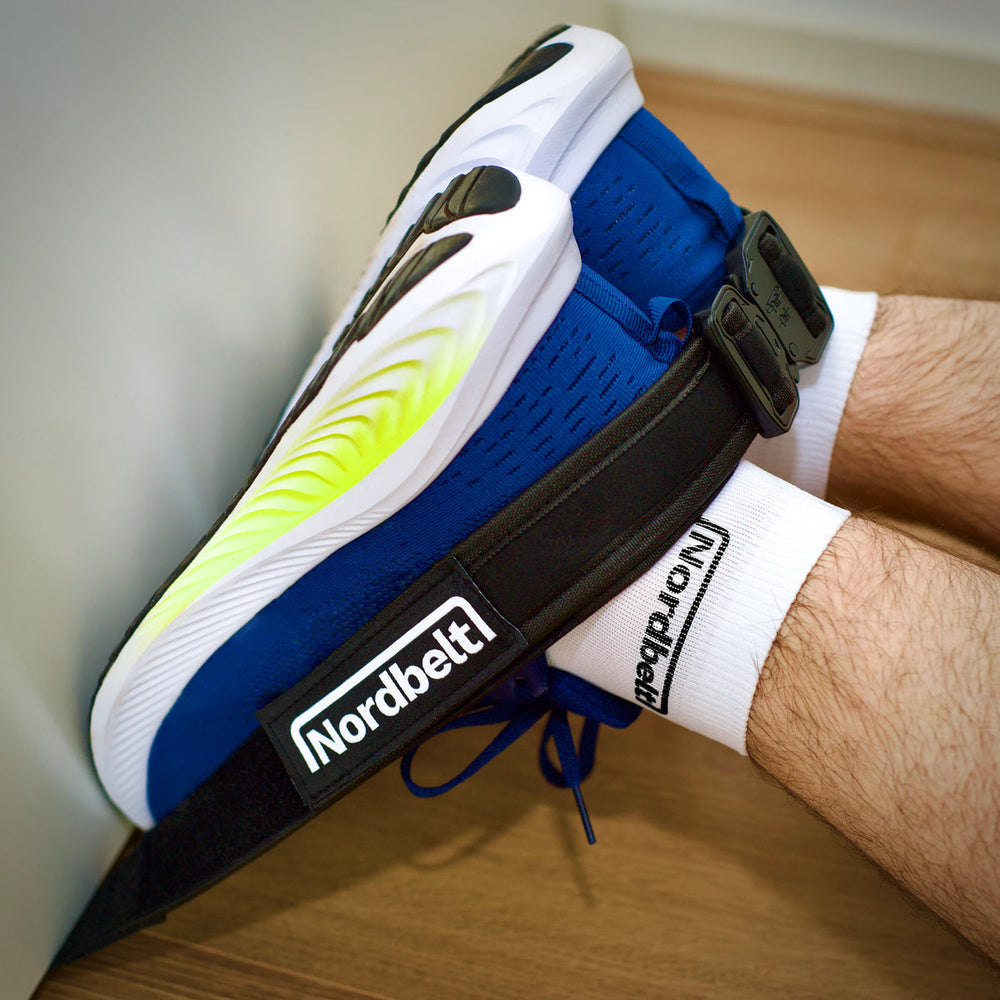
Keep the exercise manageable: kneel on stable knee padding, keep your hands available and use assistance before you can no longer brake the descent. A consistent ankle position is an execution requirement, not a guarantee of a comparable strength result. The separate explanation of ankle position in Nordic curls addresses that choice.

Detail of the starting setup; the cropped image shows no complete repetition, break point or force measurement.
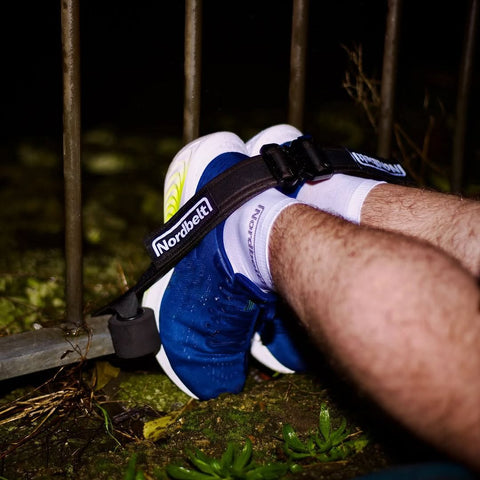
Check the setup according to the instructions. A door must be suitable and fully closed and must not open unexpectedly. A bench or fence must withstand pulling at the attachment point without sliding or tipping. Do not use a doubtful anchor to finish a recording. The guide to a stable Nordic setup at home covers these checks in more detail.
Stop for pain, tingling, shifting fixation or loss of control. Have persistent or unexplained symptoms assessed by a doctor or physiotherapist. A video angle cannot diagnose a condition or clear you to return to sport.
Frequently asked questions
What is a good break-point angle in a Nordic curl?
The studies discussed do not establish a universal target angle for everyone. The measurement definition and study population matter. Lee and colleagues explicitly provide neither normative values nor a direct prediction of injury risk (Lee et al., 2017).
Can I calculate my hamstring strength from a phone video?
No. The studies compare a video outcome with a separate strength measurement; they provide no validated personal conversion for an ordinary phone recording. An angle is not a force value in kilograms, newtons or newton-metres.
Does the angle show which leg is weaker?
No. In this two-legged movement, one video angle gives no separate force value for the left and right legs. Sconce and colleagues also used the average knee-flexor torque of both legs for their comparison (Sconce et al., 2015).
Must I descend to the break point to assess my training?
No. Keep ordinary training within a manageable movement and use assistance in time. A maximal falling attempt is not a necessary progress check. Discuss a genuine measurement question with a qualified professional who can choose an appropriate method and explain its limitations.