

Strength training or plyometrics for runners: which to choose?


Choose strength training or plyometrics alongside running according to your goal, experience and available equipment. Lifting weights and jumping drills are different supplementary tasks, and better running economy does not automatically mean a faster race. First consider what you want to train, which movements you know and what fits alongside your running. Here is the research and a decision guide, without declaring one method the winner for every runner (Eihara et al., 2024).
What are you actually comparing?
In resistance training, you choose an exercise and an adjustable external load: a leg press, calf raise or another suitable strength exercise. Plyometrics focus on a quick push-off following a short transition from landing or a preparatory movement. Execution and the type of jump therefore matter; simply writing “more repetitions” does not describe the task adequately.
The comparison below used exercises including leg presses and leg curls against different jumping drills. It did not compare an arbitrary home circuit with an arbitrary jump challenge (Eihara et al., 2024). For individual exercises, see the existing guide to hamstring exercises for runners.

What does the research say about running economy?
Running economy describes the energy required to run at a given submaximal speed. A review in middle- and long-distance runners found potential improvements with heavy strength training and plyometrics; the speed tested was among the factors that mattered. It does not establish a personal speed threshold above which you must switch to weights (Llanos-Lagos et al., 2024).
An earlier meta-analysis gave greater average support to heavy resistance training than to plyometrics. However, the varied research programmes do not prescribe your exercises or starting weight (Eihara et al., 2022).
A small direct comparison divided twenty middle-aged recreational runners into two groups. They added strength or jump training for ten weeks. Both groups improved their running economy, without a significant improvement in five-kilometre time. There was no running-only control group. Use this finding to distinguish outcomes, rather than to conclude that the methods are equivalent for everyone (Eihara et al., 2024).
Which choice fits your starting point?
This table is an editorial decision aid, not a tested training protocol. Work through it before adding a session. Choose a manageable task first; its amount and timing belong within your own plan.
| Your starting point | Practical choice | Clarify this first |
|---|---|---|
| You know strength exercises and have suitable equipment | Discuss a focused strength block using familiar movements | Which exercise, load and execution can you repeat? |
| You want to practise jumping skills | Choose suitable plyometrics, with guidance for unfamiliar landings | Which jump, surface and execution standard do you mean? |
| Both methods are new | Start by learning one task | Is technique guidance available, and does the introduction fit alongside running? |
| Your running plan is already hard to maintain | Reconsider your available capacity before adding work | Which existing training takes priority? |
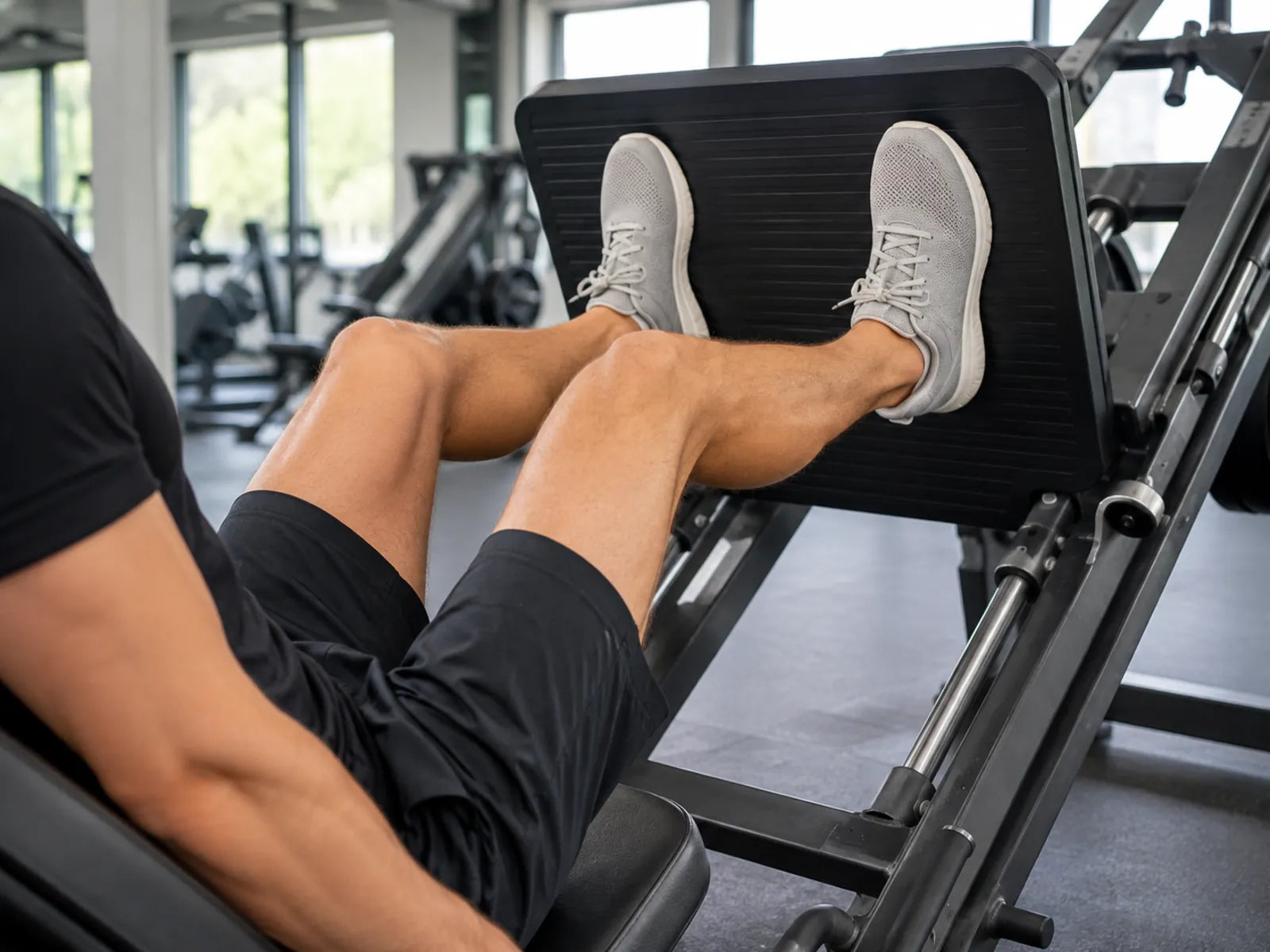
Illustrative image of strength equipment. It does not prescribe foot placement or training weight and does not show plyometrics. For the separate equipment question, read what a leg press means for your hamstring training.
Take your Nordic curl from the first rep to week 10.
A concrete 7-page plan: build up week by week, without pushing too fast.
- 01A clear week-by-week progression
- 02Technique and the mistakes to avoid
- 03A simple log you will actually use

≤ 51%
✓Backed by research
Van Dyk et al., 2019: meta-analysis of programmes with NHE. Not an effect test of Nordbelt or this protocol.
Open the download page again or check the email we sent you.
Open the download page ↗Do you need an additional Nordic curl?
Choosing a method is not a reason to add another hamstring exercise automatically. First review what your strength block already includes. A Nordic curl is a separate exercise; it does not replace all the weights or jumps discussed here. The Nordic hamstring curl guide helps with that separate decision.
If you also want to do a suitable bilateral Nordic curl at home, Nordbelt for home training provides stable ankle fixation without a training partner or a large machine. You still need a suitable, secure anchor and clear space. The aid solves the attachment task; choosing a training method requires no purchase, and the product promises no faster running time.
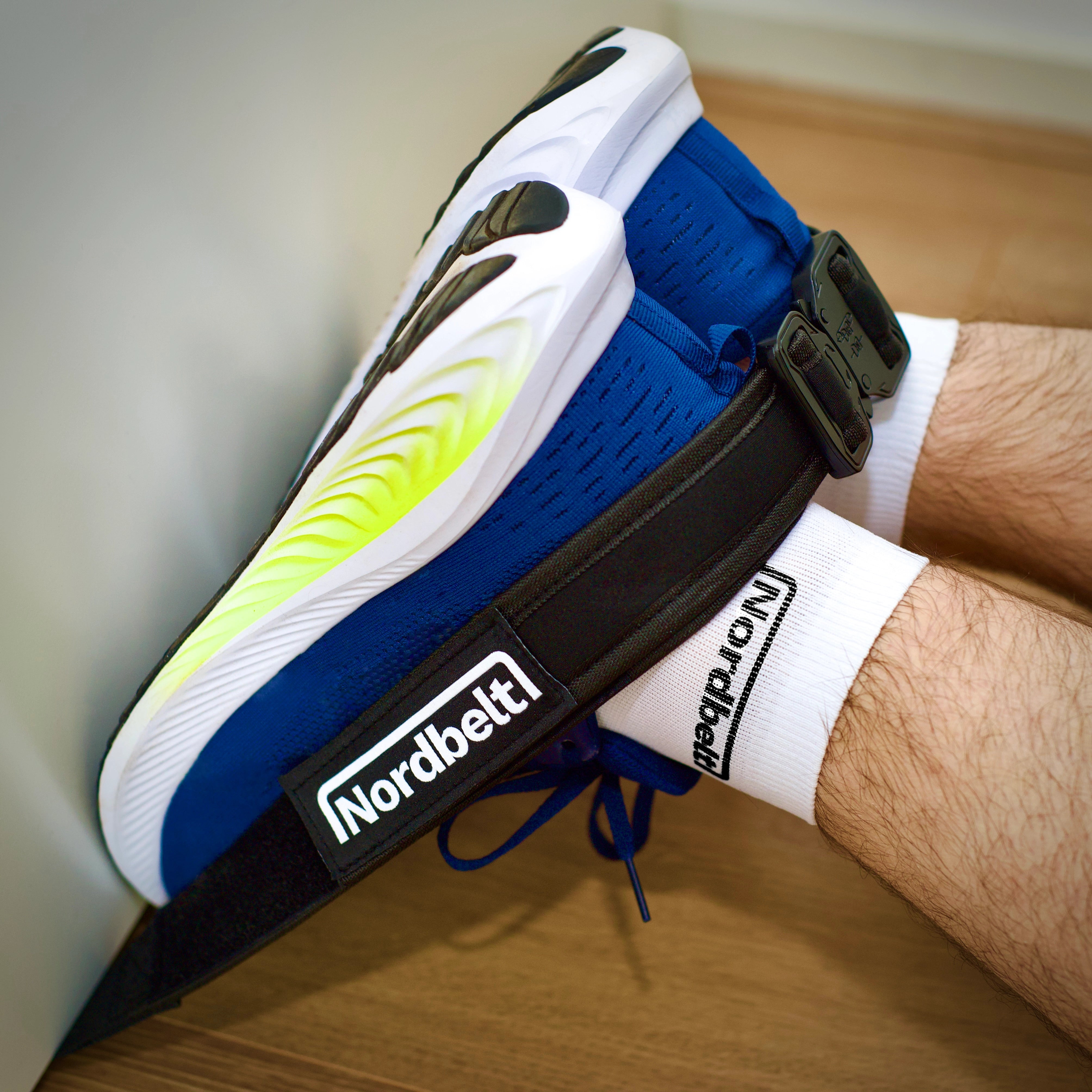
Attachment detail: the full setup and a completed Nordic curl are not visible. Check your own anchor using the home setup guide.
Make your next training decision traceable
Before a new block, write down what you want to learn or track. “Complete my strength work consistently” is a different question from “run five kilometres faster”. For strength work, record the execution and load. For jumps, record the drill, surface and whether repetitions still met your agreed execution standard. Recording fatigue alone does not make those tasks comparable.
Also note whether your important runs remain manageable. One easier-feeling long run does not prove improved running economy; that requires standardised measurements. When comparing race results, record the course and conditions too. Your log supports decisions, but it is not a controlled experiment and cannot attribute a change to one method.
For base, peak and taper phases, use the existing guide to strength training during marathon preparation. Here you choose the task, rather than a second weekly schedule. If pain increases or changes how you move, stop the exercise concerned and seek an assessment.
Example: a runner with gym experience
A fictional runner knows the leg press and calf raise, has gym access and wants a repeatable strength block. They first discuss how to continue familiar exercises. Adding a jump circuit because it “looks more like running” does not automatically improve the choice. The practical decision is to track familiar strength work and separately record how running goes. No expected time gain is attached to this example.
Example: a runner learning to jump
Another fictional runner wants to learn a simple jump with a coach. Execution quality is the first learning goal. Adding higher jumps, more repetitions and heavier lifting simultaneously would obscure what changed. They therefore agree on one task and review it before expanding the programme. This is not a proven progression, a landing tutorial or permission to jump through symptoms.
Frequently asked questions
Is heavy strength training always better than plyometrics?
No. A meta-analysis found greater average support for heavy resistance training, but the groups and programmes varied. That average does not decide which method you know or can accommodate. Consider the evidence alongside your starting point and goal, without turning a group result into a universal winner (Eihara et al., 2022).
Does better running economy mean I will run faster?
Not automatically. In the study of middle-aged recreational runners, economy improved without a significant change in five-kilometre time. A measured intermediate effect and race performance are different outcomes. Lifting a heavier weight is not, on its own, evidence of a faster running time either (Eihara et al., 2024).
Can I combine both methods?
That may be an option in an individual plan, but you need not do both to use this article. Give each task a purpose and check what remains manageable alongside running. If both are new, first decide which one to learn and how its execution will be assessed. This page prescribes no combined training volume.
Should I start with almost maximal weights?
No. A load category used in research is not a starting weight for the reader. You need suitable exercises, technique and an individual progression. Running experience does not tell you which weights you can handle. Have a new exercise and its load assessed instead of directly copying a research percentage.
Can Nordic curls replace jumping drills?
No: they are different tasks. Choose a Nordic curl only when that separate knee-flexion exercise fits your plan. It does not make a plyometric task redundant or replace a complete strength programme. Nor do you need to add Nordic curls simply because you are starting jump training.