

Strengthen your hamstrings at home: 9 exercises and a four-week plan

You can strengthen your hamstrings at home with a hip bridge, a hip-hinge movement and an exercise that bends your knees, such as a sliding hamstring curl. Choose two or three variations you can control and progress one thing at a time. Below you will find nine options, equipment guidance and an adaptable four-week plan. A Nordic curl is one possible next step; you do not need to start with it.

Choose movements at both the hip and the knee
A useful home routine starts with the movement you want to train. In a hip hinge, your hips move backwards as your torso tips forwards. In a hamstring curl, you bend your knees or control their straightening. These are different ways to load the back of your thighs.
Research in recreationally active men found different hamstring activation patterns in hip-extension and knee-focused exercises. This supports choosing exercises thoughtfully, but muscle activation alone does not tell us which home routine produces the greatest strength gains (Bourne et al., 2017).
Make the choice practical:
- Little training experience: practise a hip bridge and an unloaded hip hinge. Add a short heel walkout once you can control your pelvis.
- Comfortable with bridges and hinges: consider a sliding curl or a single-leg variation as well.
- Ready to try Nordics: check the complete setup first, then start with hand support and a short movement.
A longer exercise list is not a request to do everything in one session. Choose variations you can repeat and record what you do. If needed, first learn the hip hinge without weights.
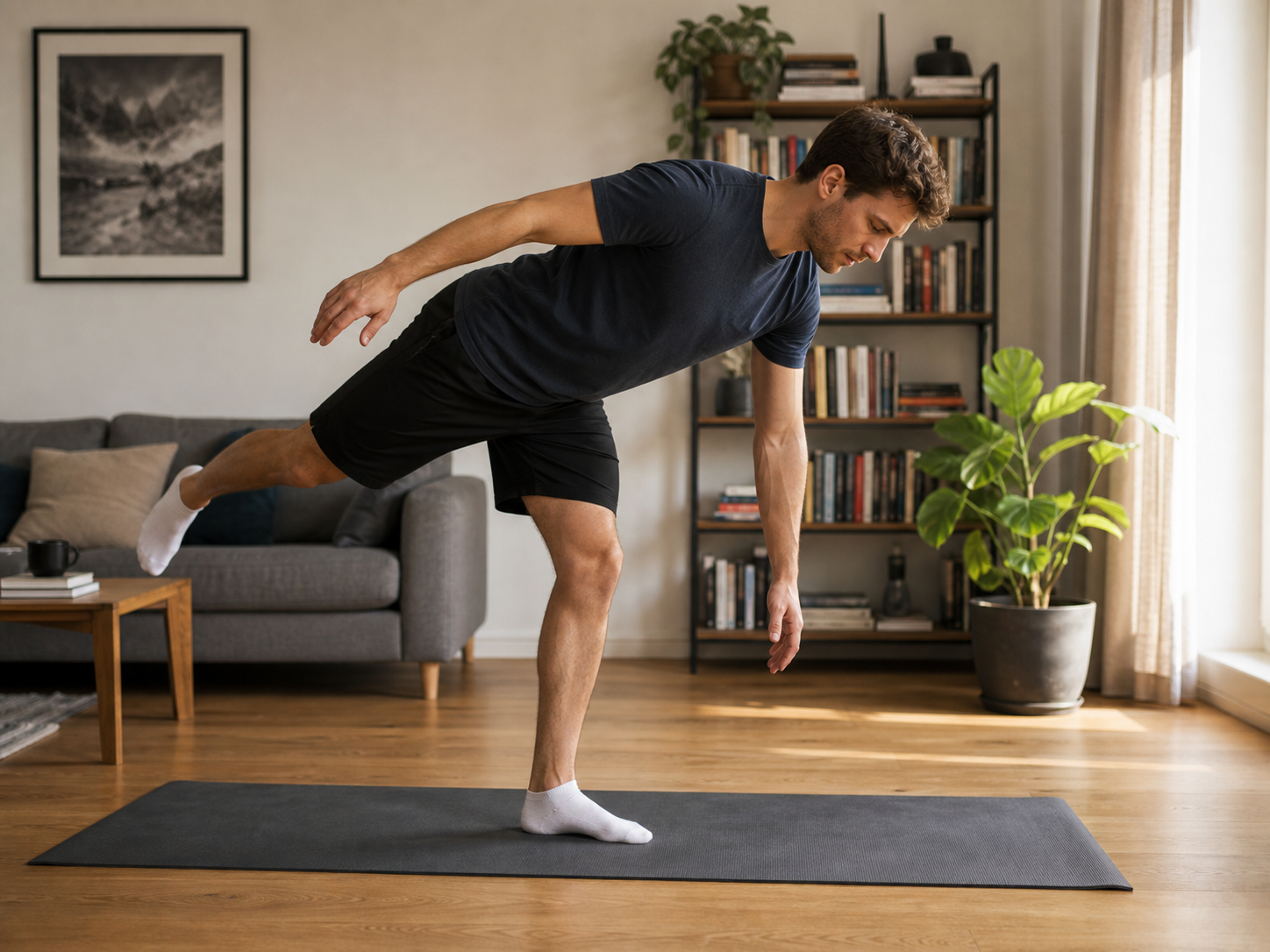
An illustration of one exercise option: an unloaded single-leg hip hinge. Follow the instructions below for the movement.

What do you need at home?
For a bridge or heel walkout, you need a flat surface, enough room and, if helpful, a mat. For sliding curls, use towels or sliders that move smoothly on your floor. A securely closed backpack with light contents can later add load to a hip hinge. Choose your exercise before buying extra equipment.
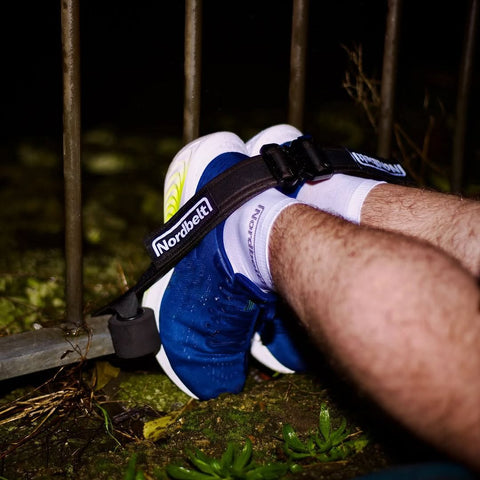
A Nordic curl needs something different: reliable ankle fixation, knee padding and clear space to catch yourself with your hands. Check the anchor point and all connections before each session. An arbitrary door, chair or loose piece of furniture is not automatically suitable. A strap holding your ankles does not support your upper body.
If you want to do Nordic curls independently, Nordbelt ankle fixation can serve that practical purpose: you do not need someone to hold your feet. The tool does not replace knee padding, a controlled catch or an appropriate progression. You do not need it for the bridges, hinges or sliding curls in this article.
For a suitable door, bench or fence structure, follow the setup and exercise guide. Assess the entire attachment before putting your body weight on it.
Nine exercise options for home training
1. Two-leg hip bridge with heel pressure
Lie on your back, bend your knees and place both feet on the floor. Press through your heels and lift your pelvis slowly. Lower with control. Use a smaller movement if you mainly arch your lower back; height is not the goal.
2. Hamstring heel walkout
Start in a low bridge. Take a small step away from your buttocks with each heel, then step back in. Keep your pelvis as still as possible. In the plan, walking out and back once counts as one repetition. Shorten the distance as soon as your hips drop.
3. Sliding hamstring curl
Lie on your back with your heels on towels or sliders. Lift your pelvis, slide your heels a short distance away and pull them back. If you cannot control the return, lower your pelvis first and slide your feet back without the load. Find more options in the hamstring slider exercises.
4. Hamstring curl on an exercise ball
Lie on your back with your heels on an exercise ball. Lift your pelvis, slowly pull the ball towards you and roll it back out. If the ball rolls sideways, first practise a short bridge without rolling or choose a more stable floor variation.
5. Single-leg Romanian deadlift
Stand on one leg with a slightly bent knee. Move your hips backwards, tipping your torso forwards and moving your free leg behind you. Keep your pelvis facing the floor, then return. Use a wall for balance or start with both feet on the ground.
6. Hip hinge with a light backpack
Practise without weight first. Keep your knees slightly bent, move through your hips and return without leaning backwards. Add a securely closed, light backpack only when you control the movement. Hold it close to your chest. Bending further forwards is not a goal in itself.
7. Single-leg hip bridge
Take the bridge position and lift one foot off the floor. Push through the other heel and keep your pelvis level. Lower slowly. Start with a small movement; put both feet down again if you twist, cramp or lose control of the height.
8. Short Nordic curl with hand support
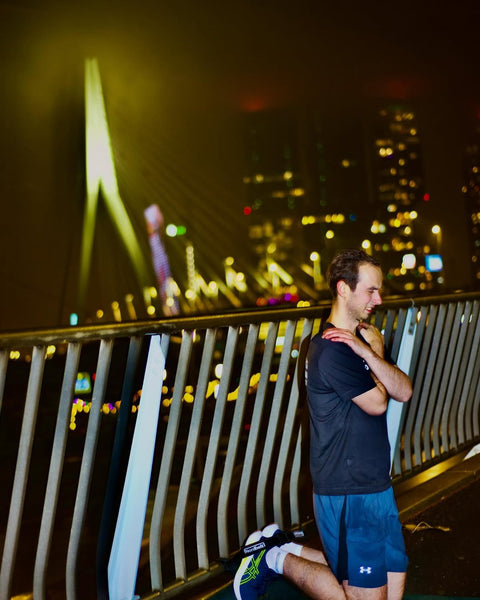
Kneel with your ankles secured and padding under your knees. Keep shoulders, hips and knees roughly in a straight line and lean forwards a little. Control the descent, catch yourself early with your hands and use your arms to help you return. Stop before you fall without control.
9. Nordic curl through a larger range
Increase the descent only while maintaining your body line and braking control. You may keep using your hands; a full repetition is not a compulsory final test. If the exercise is not suitable yet, choose one of the simpler alternatives and Nordic variations.
Nordic training studies report improvements in eccentric knee-flexor strength and muscle fascicle length. These findings concern the programmes studied, not a particular anchoring product or a guaranteed result within four weeks (Medeiros et al., 2020).
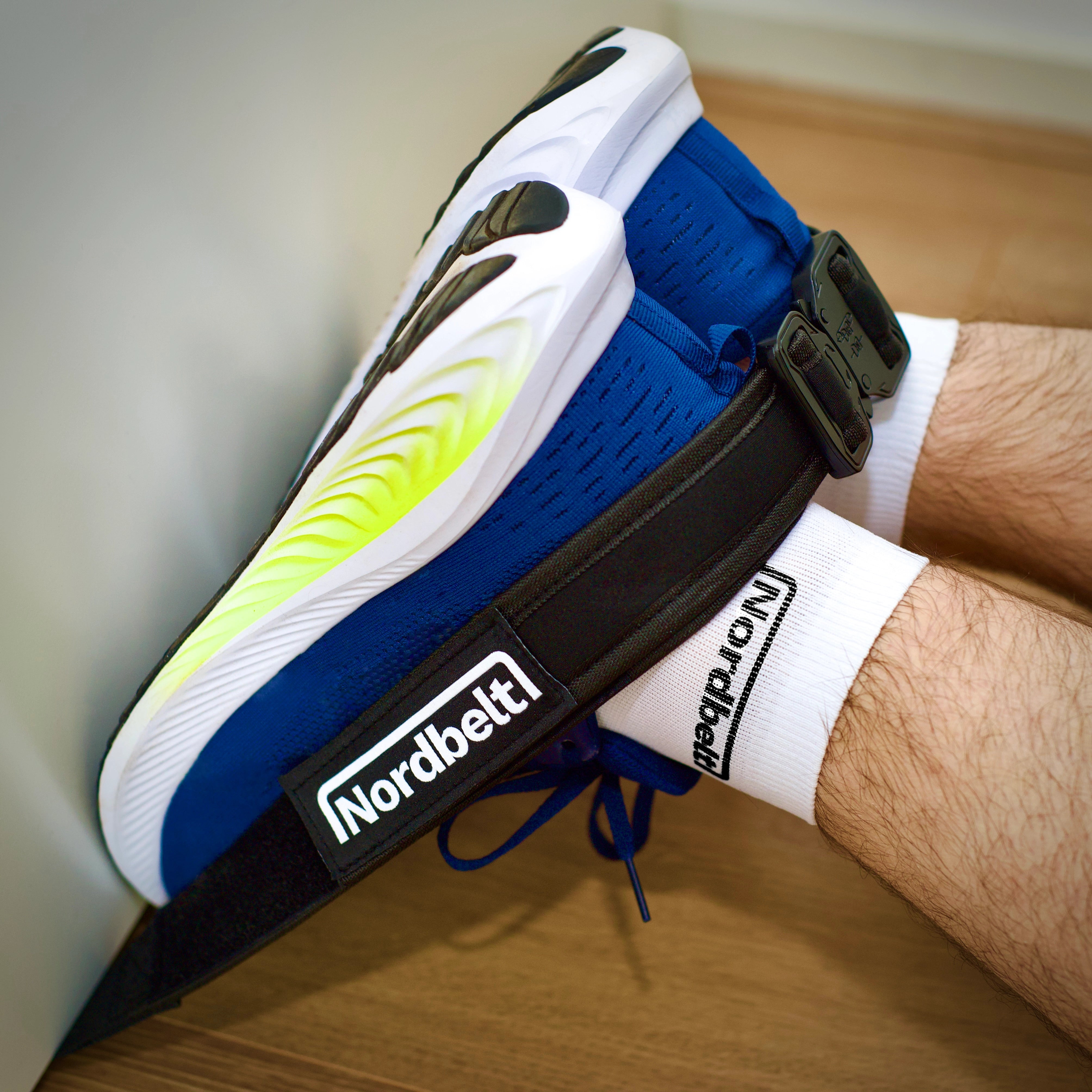
Ankle-attachment detail. The complete anchor, knee padding and space to catch yourself cannot be assessed from this image.
Take your Nordic curl from the first rep to week 10.
A concrete 7-page plan: build up week by week, without pushing too fast.
- 01A clear week-by-week progression
- 02Technique and the mistakes to avoid
- 03A simple log you will actually use

≤ 51%
✓Backed by research
Van Dyk et al., 2019: meta-analysis of programmes with NHE. Not an effect test of Nordbelt or this protocol.
Open the download page again or check the email we sent you.
Open the download page ↗An adaptable four-week plan
This is a practical example for healthy adults, not a tested four-week protocol or an individual rehabilitation plan. You could schedule two sessions on non-consecutive days each week. Leave at least 48 hours between demanding hamstring sessions and allow longer if you still feel clearly limited. Account for sprinting and other leg training too.
The numbers below are suitable only if you already control the exercises. Just starting? Choose two exercises and begin with one or two sets. A set is a series of repetitions; 3 × 8 means three sets of eight. Rest long enough between sets to move with control again, for example one to two minutes or longer if needed.
Week 1: learn the movements
- Two-leg hip bridge: 3 × 10.
- Hamstring heel walkout: 3 × 6.
- Single-leg Romanian deadlift: 3 × 8 per leg.
Use hand support for the deadlift if needed, or keep both feet on the floor.
Week 2: choose an appropriate next step
- Sliding hamstring curl: 3 × 8.
- Single-leg hip bridge: 3 × 8 per leg.
- Hip hinge with a light backpack: 3 × 10.
You can repeat week 1. New variations are options, not a deadline.
Week 3: add only manageable work
- Sliding hamstring curl: 4 × 8.
- Single-leg Romanian deadlift: 3 × 8 per leg.
- Short Nordic curl with hand support: 2 × 4.
Leave out the Nordic if the execution or attachment is not suitable yet. You do not need extra sets to make up for it.
Week 4: make the routine repeatable
- Hamstring heel walkout: 3 × 8.
- Hip hinge with a light backpack: 3 × 10.
- Short Nordic or a suitable supported variation: 3 × 4–5.
Keep the previous workload if your recovery or control calls for it. You do not need to lower yourself further in week four.
Make progression repeatable
After each session, record the exercise, sets, repetitions and support used. For a Nordic, also note how short the descent was. This makes the next session comparable. Then change one thing: a few more repetitions, a small extra load or a larger movement.
A recent synthesis of resistance-training research in healthy adults supports progressive strength training and finds that complex exercises or a particular type of equipment do not consistently produce better outcomes. This does not validate this specific home plan, but it is a reason to take simple, repeatable choices seriously (Currier et al., 2026).
End the set when you can no longer control the movement. Sharp pain, a sudden twinge or symptoms that keep worsening are not cues to train harder. If you have an existing injury or recurring pain, base your exercise choices on an assessment by a doctor or physiotherapist.
Frequently asked questions
Can I strengthen my hamstrings at home without machines?
Yes. Bridges, heel walkouts and hip hinges can form a home routine. Suitable towels or sliders are enough for sliding curls. More important than having lots of equipment is choosing a variation that challenges you while remaining controllable.
How often can I train my hamstrings at home?
Two sessions on non-consecutive days are a practical starting point for this example. Adapt the amount to your experience and other sporting activity. If you are still clearly limited at the next session, reduce the workload or allow more recovery.
Do I need all nine exercises in one session?
No. They are options to choose from. Begin with two or three exercises and keep them consistent at first. Constantly changing variations makes it harder to tell whether your execution is improving or the same work is becoming easier.
Do I need a Nordic curl to get started?
No. A Nordic is one way to load your hamstrings, not an entry requirement for strength training. Start with bridges, heel walkouts and a hip hinge if you prefer. Add a supported Nordic only when it suits your control, workload and setup.
What does Nordbelt help with in this plan?
The tool holds your ankles during Nordic curls so you can arrange that exercise without a partner. It does not automatically make a full repetition possible. A suitable anchor, knee padding, a controlled hand catch and appropriate progression remain necessary.