

Strength training for a marathon: a guide to each phase


During marathon preparation, keep familiar strength exercises as your running load increases, but reduce the strength work if it crowds out your key runs. Experienced lifters can adapt an existing programme; late starters do not need to catch up with a demanding one. At each phase, decide what to maintain, how much room you have and what response would prompt a change. This is a practical decision framework, not a universal marathon schedule.
What changes as your mileage increases?
In a marathon block, the emphasis shifts from building capacity to fitting training together. Start by writing down which runs matter most in this phase, which strength exercises you already know and how much recovery time you actually have between them. An empty slot in your diary does not automatically mean room for another hard session.
Strength training can be useful, but its effects depend on the method and the runners studied. A meta-analysis in middle- and long-distance runners found that heavy and combined strength training improved running economy compared with endurance training without a comparable strength stimulus. Evidence certainty varied by method; this does not establish a particular marathon or Nordic programme (Llanos-Lagos et al., 2024).
For individual exercise choices, use the existing guide to hamstring exercises for runners. This article focuses on what to change in that programme when your running block enters a different phase.

Which choice suits your training phase?
The table below is an editorial planning aid. Its phases are not fixed calendar weeks: use the structure of your own running plan. The table has not been tested as a complete protocol and does not prescribe a universal training load.
| Phase of your running block | You already train strength regularly | You are new to strength training |
|---|---|---|
| Base and familiarisation | Choose familiar movements and record what you currently do. Use this phase to assess how they fit alongside your running. | Learn a small number of movements with a manageable load. Have your technique checked if needed before adding more weight. |
| Building running volume | Keep your exercise selection familiar. If everything no longer fits, reduce supplementary work before also adding new exercises. | Do not increase running volume, the number of strength exercises and the weight all at once. Agree with your coach which change takes priority in this phase. |
| Peak weeks | Focus strength work on what you can already accommodate. Drop extra sets or an additional exercise if they displace your key runs. | Do not try to catch up on missed strength weeks. A new heavy Nordic programme is not a requirement for your marathon. |
| Tapering towards the race | Coordinate a smaller strength component with your overall taper. Keep movements familiar; this is not the time to test personal bests. | Do not start an intensive programme simply because race day is approaching. Consider a gentle introduction with guidance, or postpone a new strength block. |
The experienced lifter's column is not automatically the destination for a beginner. Running experience does not mean you are accustomed to heavy strength training. Equally, someone who has lifted for years does not need to relearn every movement. Establish your starting point for each exercise, rather than judging it solely by the number of marathons you have run.

Illustrative scene of preparation at home; the photograph does not show a strength exercise being performed.
Strength training in peak weeks: what should change first?
First consider the purpose of the session. Are you practising a familiar movement, maintaining an existing strength stimulus or aiming to get stronger? Those are different decisions. You are not obliged to keep doing the same long workout as your running week gets busier.
Then work through these planning steps:
- Remove new experiments. Leave out an unfamiliar exercise or an unexpectedly harder variation before reorganising the whole programme.
- Review supplementary work. An additional exercise or set can be dropped if time and capacity are limited. Record what you leave out so your next decision has a clear reference point.
- Check the timing. Leave room around the run that takes priority. Your execution and response should show what works for you, rather than a calendar rule for every runner.
- Discuss persistent problems. Recurring pain or clearly poorer function calls for assessment by a healthcare professional, rather than continued experiments with training load.
These are practical decision steps, not an established minimum maintenance dose. More strength does not automatically mean a faster run. In a study of well-trained female endurance athletes, additional heavy strength training improved strength, but did not improve running economy or performance in a forty-minute all-out running test compared with endurance training alone. That result applies to the population and intervention studied, not to every strength method (Vikmoen et al., 2016).
Take your Nordic curl from the first rep to week 10.
A concrete 7-page plan: build up week by week, without pushing too fast.
- 01A clear week-by-week progression
- 02Technique and the mistakes to avoid
- 03A simple log you will actually use

≤51%
✓Backed by research
Van Dyk et al., 2019: meta-analysis of programmes with NHE. Not an effect test of Nordbelt or this protocol.
Open the download page again or check the email we sent you.
Open the download page ↗Is any additional hamstring work still needed?
First decide whether your programme already includes suitable hamstring work. A marathon block does not need Nordic curls to be complete. If you also want to do Nordic curls at home and already know the exercise, the setup is a separate practical decision. Do not add an unfamiliar heavy exercise in the final training phase to fill a supposed gap.
Nordbelt makes a bilateral Nordic curl practical at home with stable ankle fixation, without a training partner or a large machine. You still need a suitable, secure anchor point and enough clear space. Consider the Nordbelt home setup only if that additional exercise fits your plan; the equipment does not replace your running or your complete strength programme.
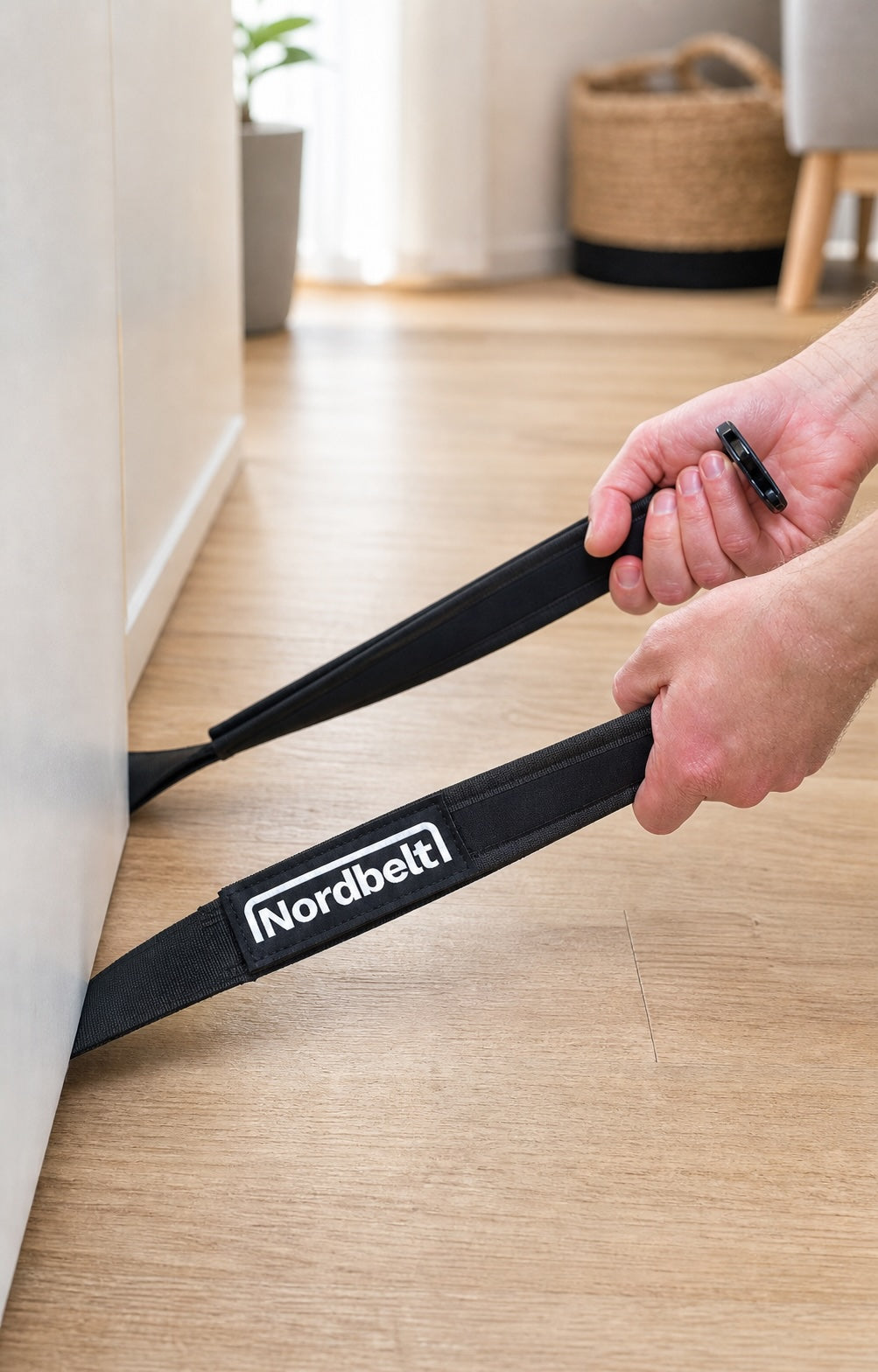
Attachment detail beside a door; the full setup and a completed repetition are not visible. Check whether your own anchor point is suitable using the home setup guide.
What does an adjustment look like in practice?
The following situations are fictional examples of a decision, not customer stories or tested weekly schedules. Use the reasoning, rather than automatically copying the amount of training.
An experienced lifter entering a busier running phase
A runner already does a familiar strength session after an easy running day. During the build-up, the long run grows and the additional hamstring exercise becomes difficult to fit in. The runner temporarily drops that extra work, keeps the familiar main exercises and records how the next key run goes. If the combination remains unworkable, they discuss further adjustments.
The change here is to supplementary work, rather than adding more weight and changing the exercise at the same time. Someone already using a Romanian deadlift can revisit its technique on the dedicated exercise page. This situation is not a reason to add Nordics on top.
A runner wanting to start just before the peak phase
Another runner has done very little strength training and finds a demanding hamstring programme. It is tempting to make up for the missing weeks. A more useful planning decision is to establish what is realistic now: a gentle introduction with guidance, or a separate strength block after the race. This runner does not need to copy the experienced lifter's programme.
If you want to learn Nordic curls later, first read the explanation of the Nordic hamstring curl. Interest in the exercise is not, by itself, a reason to add a demanding version during an already busy marathon build-up.
What should you record for the next phase?
Alongside your running plan, record which strength exercises you actually did, what you changed and how manageable the combination was. For example: ‘Additional exercise omitted, familiar movements retained, next endurance run completed as planned.’ That gives you more to work with than simply ‘good session’.
Reassess your goal at the next phase change. A change in your diary does not necessarily indicate a problem, and a problem does not necessarily call for more training. Your notes support a conversation with your coach, but do not measure muscle strength or provide a diagnosis. Check whether the reason for your previous adjustment still applies.
Frequently asked questions
Should I stop strength training during peak weeks?
Not automatically. Consider your existing experience, the priorities of your running plan and whether the combination is manageable. Sometimes a smaller, familiar strength component fits; sometimes more needs to go. This page does not prescribe a universal maintenance dose or a required number of sessions.
Can I start Nordic curls during the taper?
Do not use the taper to catch up with a new heavy Nordic programme. Discuss when an introduction to the exercise would be useful and whether a later strength block would fit better. The taper overview above belongs to the same phase decision; the name of the race does not change that principle.
Does getting stronger mean I will run a faster marathon?
You cannot draw that conclusion directly. Strength and running performance are different outcomes. In well-trained female endurance athletes, for example, the strength programme studied produced strength gains but no better performance in a forty-minute running test. That study does not predict your marathon time (Vikmoen et al., 2016).
Do I need special hamstring equipment for my preparation?
No. First choose the training goal and movements that suit your experience. Equipment follows from the exercise you choose. An ankle-fixation aid is relevant only if you also want to perform a suitable Nordic curl; it does not replace a complete strength or running programme.