Hamstring exercises for volleyball: jump, brake and land stronger

Hamstring exercises for volleyball should match jumping, landing, short approach steps, quick braking and repeated push-offs. A few hamstring curls after training are too narrow for that job. A useful volleyball hamstring plan combines landing technique, hip strength, eccentric control, single-leg stability and calm Nordics that are not placed right before a hard practice or match. Start with control, keep the volume small and only progress when the hamstrings feel normal the next day.

4.8/5 reviews 120+ athletes preceded you 30-day return period
View Nordbelt Open manual
Female volleyball player tying her shoe on an indoor volleyball court.

In brief

Volleyball does not load the hamstrings mainly through long sprints. It loads them through repeated jumps, landings, short approaches, lunges and fast defensive reactions. A volleyball injury review shows that ankle, knee and shoulder problems are studied more often, while prevention knowledge per injury type is still limited (Kilic et al., 2017). That is exactly why hamstring work should stay practical: choose exercises that improve landing, hip control and eccentric strength without ruining jump quality.

Use this article as a volleyball-specific addition to the broader guide to hamstring exercises. The order is simple on purpose: control first, then strength, then heavier Nordics, and only then more speed or jump volume.

Why volleyball loads the hamstrings differently

Volleyball looks less hamstring-heavy than football or track because you do fewer maximal sprints. In practice, the hamstrings still do a lot of work. You push off for an attack or block, land asymmetrically, brake after a short approach, drop low for a pass and react immediately to the next ball. The hamstrings do more than bend the knee; they help brake movement, extend the hip and coordinate with the glutes, calves and trunk.

For volleyball, making the hamstrings stronger means training three qualities:

  • control when landing and moving on
  • strength for short approaches, split-steps and defensive lunges
  • eccentric braking strength when you push off or absorb speed

A meta-analysis on hamstring prevention found that eccentric training can reduce hamstring injuries and improve hamstring strength, fascicle length and asymmetry (Rudisill et al., 2023). For volleyball players, that does not mean everyone should start heavy Nordics immediately. It does mean eccentric control deserves a fixed place in the week.
Which volleyball hamstring exercises should you choose first?

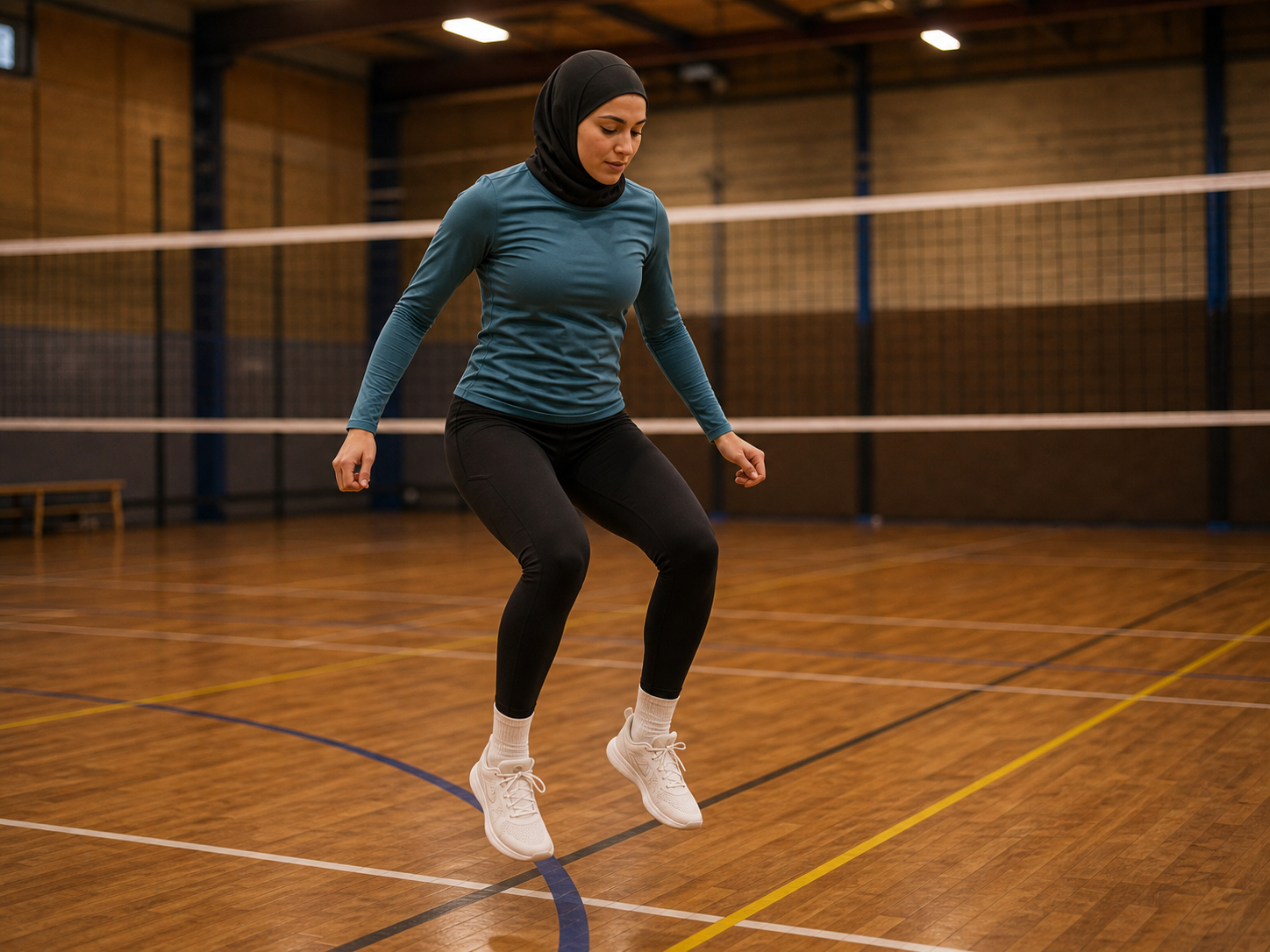
Choose exercises you can repeat cleanly. If the knee caves in, the pelvis rotates or the lower back takes over, the exercise is too heavy or too tiring. Volleyball already gives you a lot of jump and landing volume, so extra hamstring work should support that load instead of competing with it.

  1. glute bridge with calm hamstring pressure
  2. hamstring walkout
  3. split squat hold with trunk control
  4. single-leg Romanian deadlift
  5. sliding leg curl
  6. lateral lunge or Cossack squat
  7. assisted Nordic hamstring curl
  8. short landing and braking drills once the base responds well

This order works because it builds control and capacity first. Only after that do you make the exercise longer, heavier or faster.

Young woman rolling out an exercise mat for a short workout.

The 6 best hamstring exercises for volleyball

Start with two or three exercises per block. More is not automatically better. The best hamstring exercises for volleyball are the ones you can repeat consistently without losing jump quality or match freshness.

1. Glute bridge with hamstring pressure

Lie on your back with your feet slightly farther from your hips than in a standard bridge. Press the heels into the floor, tighten the glutes and lift the hips calmly. Hold for two seconds. You should feel pressure in the glutes and hamstrings, not only in the lower back.

2. Hamstring walkout

Start at the top of a bridge and slowly walk the feet away from the body. Keep the hips as high as possible without forcing the back. Walk back under control. This lengthens the hamstrings under tension while staying lighter than a full Nordic.

3. Single-leg Romanian deadlift

This exercise fits volleyball because it combines hip control, balance and hamstring strength. Keep the standing knee soft, hinge from the hip and let the free leg move backward. The trunk and pelvis stay as quiet as possible.

4. Sliding leg curl

Use sliders, socks on a smooth floor or a towel. Start in a bridge, slide the heels out slowly and pull them back under control. The lowering phase matters more than speed. For more context on these choices, use the guide to eccentric hamstring exercises.

5. Lateral lunge

Volleyball is not only straight ahead. A lateral lunge trains the hip and hamstring in side positions that resemble defending, passing and recovering after a block landing. Step sideways, send the hip back and return with control.
6. Assisted Nordic hamstring curl

The Nordic hamstring curl is heavy, but useful when dosed well. A structured eccentric hamstring programme with Nordics reduced hamstring injuries in football players (Petersen et al., 2011). That evidence is not directly from volleyball, so treat it as a training principle rather than a guarantee.

Start assisted: hands ready to catch, short range, few reps and plenty of distance from match day. Read the technique guide for the Nordic hamstring curl before making the exercise heavy.

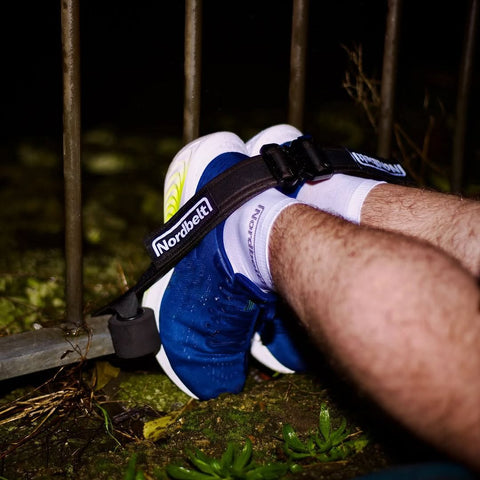
Close-up of blue shoes fixed with Nordbelt to a wet metal fence or upright rail outside.

Nordic hamstring for volleyball: when and how heavy?

For volleyball, the Nordic is most useful as a controlled strength stimulus away from the busiest jump days. Do not use it as a heavy finisher after a long session with many jumps. That mainly trains fatigue. Place it on a separate strength day, or early in a light session with low jump volume.

  • weeks 1-2: 2 sets of 3 assisted reps
  • weeks 3-4: 2 sets of 4-5 assisted reps
  • weeks 5-6: 3 sets of 4-5 reps with a slightly longer range
  • after that: maintain with 1-2 short sessions per week

A recent biomechanical study found that exercises such as the Nordic hamstring exercise, unilateral bridge and eccentric slider can create high hamstring loading that is relevant in prevention and rehabilitation contexts (Breed et al., 2026). In practice, dose these exercises as real training, not as a casual cool-down.

Nordbelt can make ankle fixation repeatable for solo Nordics at a stable anchor point. Use it only after the technique, volume and timing are clear. The How-to guide helps you test the setup before increasing difficulty.

Hamstring training for volleyball in a weekly plan

A good weekly plan depends on your practice days, match day and current capacity. This setup works as a starting point for many recreational and competitive players.

With 2 volleyball sessions per week

  • Day after match or heavy training: recovery, walking and mobility.
  • Strength day 1: bridge, Romanian deadlift and sliding curl.
  • Light volleyball session: short activation, no heavy Nordics.
  • Strength day 2: assisted Nordic and lateral lunge with low volume.
With 3 or more volleyball moments per week

  • Keep hamstring strength work shorter.
  • Choose one heavier exercise per session.
  • Plan Nordics at least 48 hours before a match or heavy jump session.
  • Use light bridges or walkouts for maintenance in busy weeks.

The goal is not to train maximally every week. The goal is stronger hamstrings while jump rhythm, timing and match quality stay intact.

Reducing hamstring injury risk in volleyball without overdoing it

You can never completely prevent hamstring injuries in volleyball. You can reduce the chance that the hamstrings are surprised by sudden volume, fatigue or strength work that is too heavy.

  • build jump volume gradually after a break or injury
  • do hamstring strength before symptoms force you to
  • combine strength with landing, hip control and trunk control
  • avoid heavy Nordics right before match day
  • take cramping, pulling or unusual next-day stiffness seriously

For players with pain, a recent strain or recurring symptoms, this article is not a substitute for assessment by a physiotherapist. Start lighter and use the plan to ask better questions about progression, timing and exercise choice.

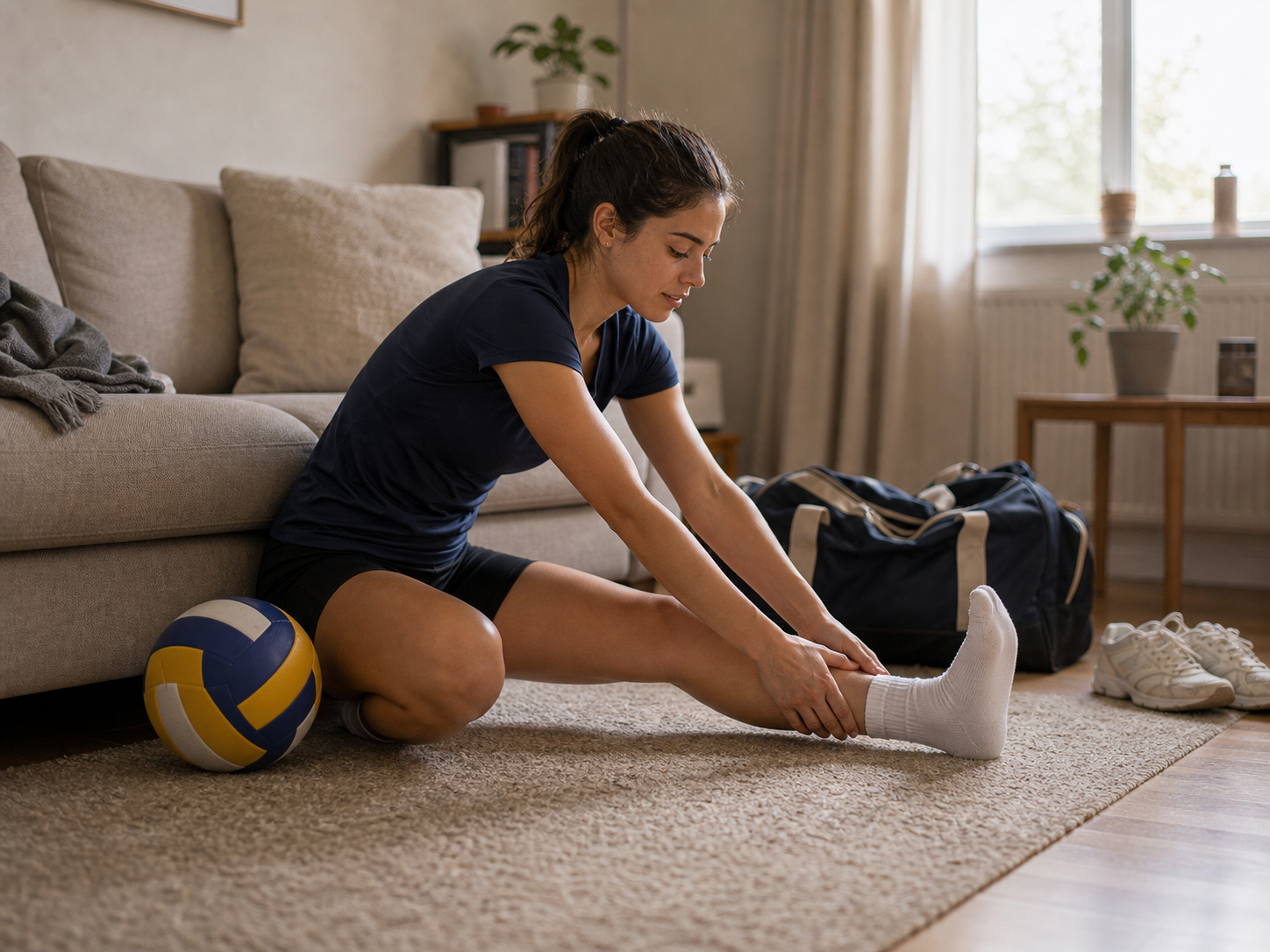
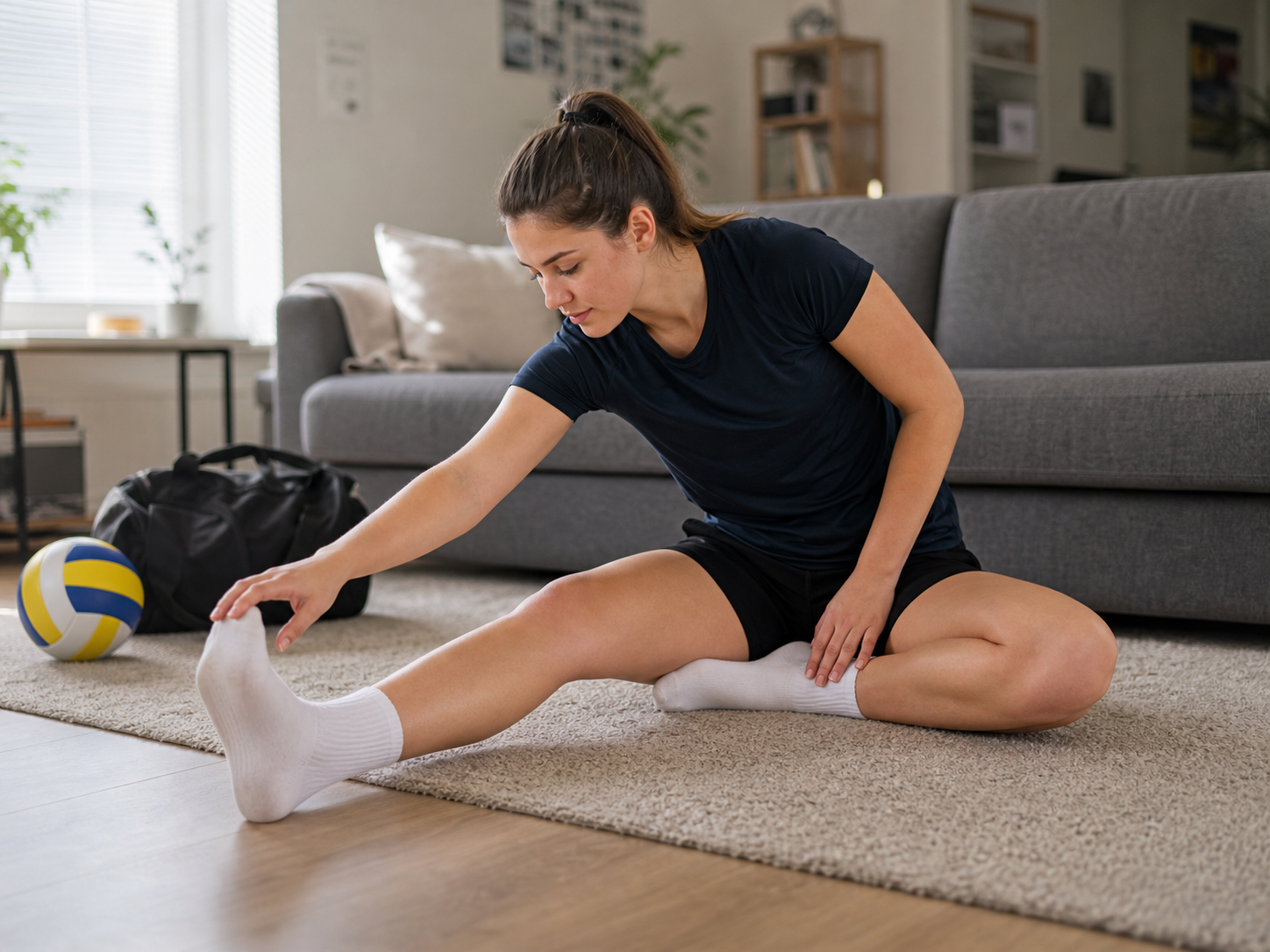
Young volleyball player stretching her hamstring on the floor after training.

Frequently asked questions

Which hamstring exercises for volleyball matter most?

The most useful exercises combine landing control, hip control and eccentric strength. Start with glute bridges, hamstring walkouts, single-leg Romanian deadlifts and sliding leg curls. Add assisted Nordics later if the basics feel good.

Does the Nordic hamstring curl fit volleyball?

Yes, but it has to be dosed carefully. The exercise is heavy and can create soreness. Start assisted, use few reps and avoid placing it just before match day.

How often should I train hamstrings next to volleyball?

For most volleyball players, two short hamstring sessions per week are enough. In a dense competition week, one light maintenance session can be smarter than two heavy sessions.

Which volleyball hamstring exercises can I do at home?

Good home options are glute bridges, hamstring walkouts, bodyweight single-leg Romanian deadlifts, sliding leg curls with socks or a towel, and assisted Nordics with safe ankle fixation.

Can hamstring injuries in volleyball be prevented?

No programme can guarantee that. You can improve preparation with gradual jump volume, eccentric strength, landing technique, recovery and smart timing of heavy strength work.

Nordic Hamstring Curl Tool

Strengthen your hamstrings to top-sport standards.

Up to 50% fewer hamstring injuries, now possible with Nordbelt at home or wherever you train. Up to 50% fewer injuries.

Works on door, bench, fence or beam. Includes storage bag + training protocol. Up to 50% fewer injuries No partner needed.
No partner needed. Start within 1 minute. Can be used anywhere: at home, gym or field Developed with professional physio input
Trustpilot 4.4/5 4.8/5 Google Reviews4.8/5 20+ partner physio practices
30 days of risk-free testing Secure checkout Ordered before 11 PM, delivered tomorrow
Strengthen your hamstrings to top-sport standards.

Trusted by professionals and athletes

Trustpilot 4.4/5 Google Reviews 4.8/5
Google Reviews 4.8/5
We use the Nordbelt in our physio practice and recommend it for recovery, performance and specific hamstring training.
Chantal - Sports physiotherapist MSc Google review
Trustpilot 4.4/5
G Google Reviews 4.8/5

Trusted by professionals and athletes

★★★★★ 4.8/5 120+ athletes 30-day return period 20+ partner physio practices
Google Reviews 4.8/5

We use the Nordbelt in our physio practice and recommend it for recovery, performance and specific hamstring training.

Chantal - Sports physiotherapist MSc Google review

Easy and quick to use, anywhere

Super fast and easy to use: in three short steps you are ready for your first rep.

1

Choose your setup: door, fitness bench or fence.

Place Nordbelt under a sturdy door and pull it through the buckles.

2

Clip in and adjust the length.

Clip the buckles closed and adjust the length for the right fit.

3

Start immediately with your first set.

You are locked in. Time for Nordic Hamstring Curls and stronger hamstrings.

Where can Nordbelt be used?

Use Nordbelt everywhere, regardless of your training location

Swipe for more examples

Nordbelt attached to door

Nordbelt attached to door

Doors

Place under a sturdy door and train at home without additional equipment.

View setup in manual
Nordbelt on fence or beam

Nordbelt on fence or beam

Fences or beams

Simply attach to a fence or beam and train on the field or in the park.

View setup in manual
Nordbelt on fitness bench

Nordbelt on fitness bench

Fitness bench

Use Nordbelt on almost any stable fitness bench and train directly in the gym.

View setup in manual

Evidence

Up to 50% fewer hamstring injuries with consistent Nordic Hamstring Curl training.

The Nordic Hamstring Curl is the safest and strongest proven exercise for strong, resilient hamstrings.

*Source: Petersen et al., BJSM 2011

Nordic Hamstring Curl animation

Evidence-basedResearch shows NHC can be built up safely, including during hamstring rehab.

Top sport provenWidely used in elite sport (football and athletics) and directly usable at home, gym or field.

A few reps per weekHighly studied and safe to progress gradually with controlled loading.

Open: view protocol, clinic quotes and source detail

Programmes with the Nordic Hamstring Exercise. 51%  fewer hamstring injuries reported.

The Nordic Hamstring Exercise is a strongly researched training principle; programmes with NHE report up to 51% fewer hamstring injuries.

Nordbelt facilitates the Nordic Hamstring Curl and makes the exercise practical, repeatable and controlled in clinic, sport setting and at home.

Progressive protocol

10-week progression protocol included

A practical progression the clinician can adapt to load tolerance, technique and the agreed pathway.

Reps per session
  1. 5 5×1 W1
  2. 6 6×2 W2
  3. 7 7×3 W3
  4. 8 8×3 W4
  5. 9 9×3 W5
  6. 10 10×3 W6
  7. 10 10×3 W7
  8. 12 12×3 W8
  9. 12 12×3 W9
  10. 12 12×3 W10

Source: van Dyk N, Behan FP, Whiteley R. Br J Sports Med. 2019;53(21):1362-1370. PMID: 30808663. DOI: 10.1136/bjsports-2018-100045.

“Programmes that include the Nordic Hamstring Exercise reported up to 51% fewer hamstring injuries.”
van Dyk, Behan & Whiteley · Br J Sports Med · 2019
“Nordbelt makes the same exercise setup practical in the treatment room and at home.”
Nordbelt clinic flow
−51% hamstring injuries reported in programmes with Nordic Hamstring Exercise
8,459 participants in the systematic review and meta-analysis
10 weeks practical progression plan for guided instruction
1 setup recognisable in clinic, sport setting and at home

Nordbelt is a training tool for performing the Nordic Hamstring Curl. Its use within treatment, rehabilitation or return-to-play is determined by the treating professional. Always use a stable anchor point, correct attachment and suitable load.

Check Nordbelt via Trustpilot and Google Reviews

Check external reviews for extra confidence before ordering.

4.8/5 Google reviews
4.4/5 Trustpilot reviews
GooglePhysio
A great solution for performing the Nordic Hamstring Curl properly and easily. Useful during my work as a physiotherapist and usable in different locations.
GooglePhysio
Very good tool for performing the Nordic Hamstring Curl. A must-have for every physiotherapy clinic. Very happy with it!

Real videos

See exactly what you get and how to start safely

Real unboxing and short demos: less doubt, faster first set.

@Nordbelt open Instagram
How-to video

Set up Nordbelt at home

See how to attach, adjust and prepare Nordbelt at home for your first safe repetition.

Unboxing

First impression in 15 sec

See the packaging, finish and size exactly as it arrives at home.

Review

Instagram unboxing

Raw Instagram unboxing for a realistic view of delivery and first setup.

Meet the team behind Nordbelt

Built by a team with a medical and sports science base

When I suffered a hamstring injury, I noticed how difficult it was to train properly at home without expensive equipment or help from others. That's why I developed Nordbelt.
  • Originated from real injury experience
  • Further developed with medical professionals
  • Practically tested for home, field and gym

Nordic Hamstring Curls without a partner, bench or hassle

Nordbelt makes one of the best hamstring exercises practical to perform: at home, on the field or in the gym. Fixed in under a minute and ready to train.

01

No partner needed

Secure your feet independently and train whenever you want. No teammate, physio or training partner needed.

02

No expensive Nordic bench needed

Use a sturdy door, gym bench, fence or beam. You do not need to buy a large or expensive machine.

03

Ready in under 1 minute

Compact, quick to secure and easy to carry in your sports bag. Ideal for home, practice or the gym.

04

Training protocol included

You get clear guidance to build up calmly and work consistently on hamstring strength.

It's that easy

Watch the full flow on video

In a few seconds, see exactly how to place, adjust and start training with Nordbelt.

4.8/5 customer score 30-day return period Used by 20+ partner physio practices

Answers to frequently asked questions

How do I use the Nordbelt™?

You use Nordbelt™ to perform the Nordic Hamstring Curl with a stable attachment to a door, fitness bench, fence or beam.

Choose a fixed spot, click the buckle closed, adjust the band to size and immediately start with controlled repetitions. This way you can train consistently at home, outside or in the gym.

Can I use the Nordbelt™ if no door is available?

Yes. Nordbelt™ also works on fitness benches, fences and beams, so you are not dependent on a door.

This means you can train almost anywhere: at home, on the sports field or in the gym. Always choose a sturdy, stable mounting location for a safe implementation.

What is included with the purchase?

With your order you will receive the Nordbelt™ itself, a storage bag and a practical manual with training protocol.

So you immediately have everything you need to start safely and follow your build-up in a structured manner.

Can I also order outside the European Union?

We currently ship within Europe and to England.

Orders outside this region are not yet available. For business or specific shipping questions, please contact contact@nordbelt.com.

What does shipping cost?

Shipping within the Netherlands is free.

For delivery outside the Netherlands, shipping costs are calculated automatically based on your location and the available carrier. You always see this clearly during checkout.

How soon can I start training?

Most athletes can start their first set within about 1 minute.

The quick setup and fixed protocol make it easy to incorporate your training into your weekly routine.

Is Nordbelt suitable for rehabilitation of hamstring injuries?

Nordbelt™ is widely used for controlled hamstring building, also in a rehabilitation context.

Always build up progressively and follow the advice of your physiotherapist or doctor in case of complaints or recovery process.

Do I need additional equipment or a partner?

No. You don't need an expensive machine or a training partner to get started.

With Nordbelt™ you create a stable setup on a door, bench, fence or beam and you can train independently.

Can I return if the product does not suit me?

Yes, you have a 30-day return period on your order.

If you return, the return shipping costs are borne by the customer.

This way you can evaluate Nordbelt™ within your own training situation without unnecessary purchasing risk.

Where can I find the complete manual and training protocol?

You will find the complete explanation on the How-to Guide.

You will also receive a practical manual with protocol upon purchase, so that you can start straight away in a structured manner.

For clinics, teams and groups

Work with multiple athletes?

Request a trial Nordbelt for your clinic or view Nordbelt for sports clubs, teams and gyms.

Strengthen your hamstrings to top-sport standards.

Ordered before 11 PM, delivered tomorrow 30 days of risk-free testing Secure checkout
Strengthen your hamstrings to top-sport standards.

Train anywhere. Immediately feel the Nordbelt vibe.

Start today with stronger hamstrings: one compact tool with which you can immediately train safely and effectively at home, outside and in the gym.

Ready to start immediately Less risk of injury Can be used anywhere