

Reverse Nordic vs Nordic hamstring curl: what’s the difference?


In a reverse Nordic vs Nordic hamstring curl comparison, the names sound similar, but the movements serve almost opposite purposes. In the reverse Nordic, you lean backward from a kneeling position and your quadriceps do most of the work to control the movement. In the Nordic hamstring curl, you tip forward from the knees while your ankles are secured, and your hamstrings provide most of the braking force.
Neither exercise is automatically better. Choose the reverse Nordic for the front of the thigh. Choose the Nordic hamstring curl when you want to train the knee-flexion function of the hamstrings. Below, you will see how their technique, muscles, equipment and progression differ.
The difference at a glance
The quickest way to tell these exercises apart is to look at the direction in which your torso moves and the joint action you actively control.
- Reverse Nordic: your knees stay on the floor, your hips remain extended and your whole body leans backward. The knee bends further while the quadriceps control the descent. Ankle fixation is not required.
- Nordic hamstring curl: your knees stay on the floor, your hips also remain extended and your whole body leans forward. The knee extends while the hamstrings control the descent. Stable ankle fixation is required.
- Primary training function: the reverse Nordic is a knee-extension exercise that mainly targets the front of the thigh. The Nordic hamstring curl is a knee-flexion exercise that mainly targets the back of the thigh.
- Main progression variable: in both exercises, you can adjust the range of motion and descent time. With the hamstring Nordic, you can also use hand support, a band or a raised catch point.
The main similarity is therefore the kneeling starting position and the straight body line. That makes the names confusing, but it does not make the exercises interchangeable.

What is a reverse Nordic?
A reverse Nordic is a bodyweight exercise in which you kneel upright, lightly engage your glutes and lean backward from the knees. Keep your body in one line from knees to shoulders as much as possible. Your hips should not fold backward; the increasing knee bend is what creates the resistance.
The quadriceps work eccentrically as you lower yourself slowly and concentrically as you return. A study comparing the reverse Nordic with squat variations supports its use as a bodyweight option for the quadriceps, but found no basis for claiming that it always produces more eccentric activity than every squat variation (Pereira et al., 2024). Treat it as a specific choice, not a universal replacement.
How to perform a reverse Nordic step by step
- Place a mat under your knees and kneel with your lower legs relaxed on the floor.
- Make yourself tall: your knees, hips and shoulders should form one line.
- Lightly engage your glutes and core without forcefully pulling your ribs down.
- Slowly lean backward as one unit. Stop before your hips bend or you lose control.
- Press the tops of your feet or lower legs gently into the floor and use your quadriceps to return upright.
Start with a short range of motion. A wall, bench or sturdy block behind you can provide a clear end point. Only make the exercise harder by leaning a little farther or lowering more slowly once you can maintain the same body line. You do not need to anchor your ankles or place anything over your feet.
Take your Nordic curl from the first rep to week 10.
A concrete 7-page plan: build up week by week, without pushing too fast.
- 01A clear week-by-week progression
- 02Technique and the mistakes to avoid
- 03A simple log you will actually use

≤ 51%
✓Backed by research
Van Dyk et al., 2019: meta-analysis of programmes with NHE. Not an effect test of Nordbelt or this protocol.
Open the download page again or check the email we sent you.
Open the download page ↗What is a Nordic hamstring curl?
For the Nordic hamstring curl, you also kneel with your hips extended, but your ankles are securely fixed. From this position, you lower your entire body forward under control. Your hamstrings resist knee extension. When you can no longer control the descent, catch yourself with your hands and, if needed, use a light push to return.
Kinematic research shows that technique and body dimensions affect movement and muscle loading during the exercise (Šarabon et al., 2019). A systematic review also reported that Nordic hamstring training can increase eccentric knee-flexor strength and fascicle length of the biceps femoris long head, although programmes and participants differed between studies (Medeiros et al., 2020). This is evidence of a training stimulus, not a guaranteed individual outcome.
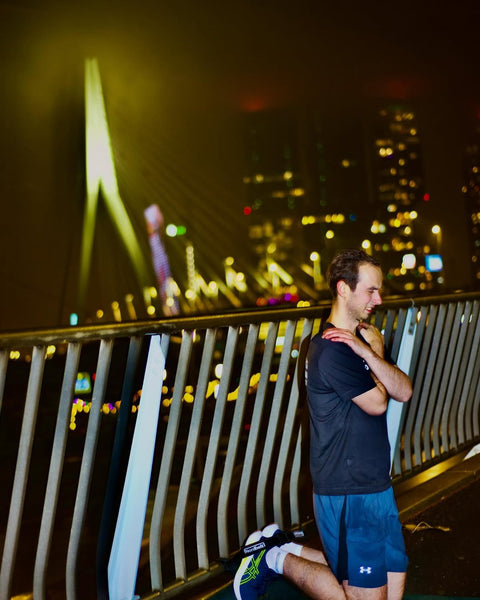
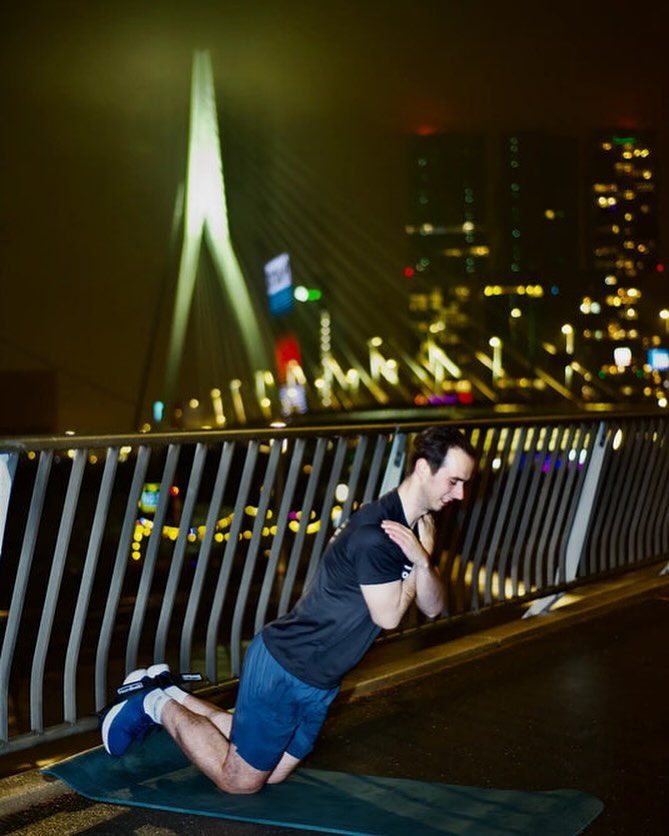 Athlete leaning forward in a Nordic hamstring curl beside a fence. Context image; the full exercise with the equipment described is not shown.
For a broader explanation of regressions and technique, use the existing guide to the Nordic hamstring curl. This page remains focused on how it differs from the reverse Nordic.
Ankle fixation for Nordic curls at home
For the hamstring Nordic, you then need a reliable way to keep both ankles in place. With Nordbelt for stable ankle fixation during Nordic curls at home, you can perform the exercise at home without a training partner or large gym machine, provided that the door and anchor point are suitable and have been checked.
That product role is deliberately narrow. Nordbelt is not needed for the reverse Nordic and does not change that exercise. For the hamstring Nordic, the setup provides ankle fixation; it does not choose your range of motion, assistance, training volume or technique. Also use soft support under your knees and keep the area in front of you clear.
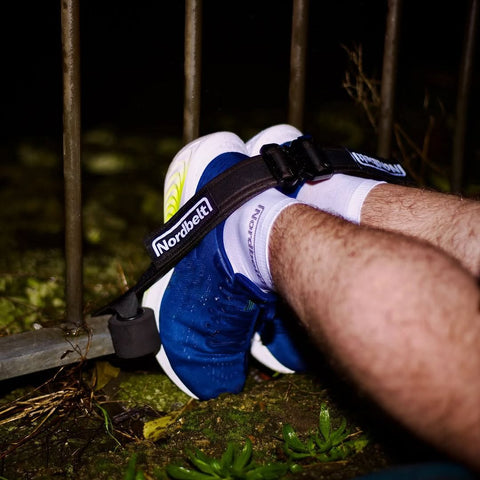
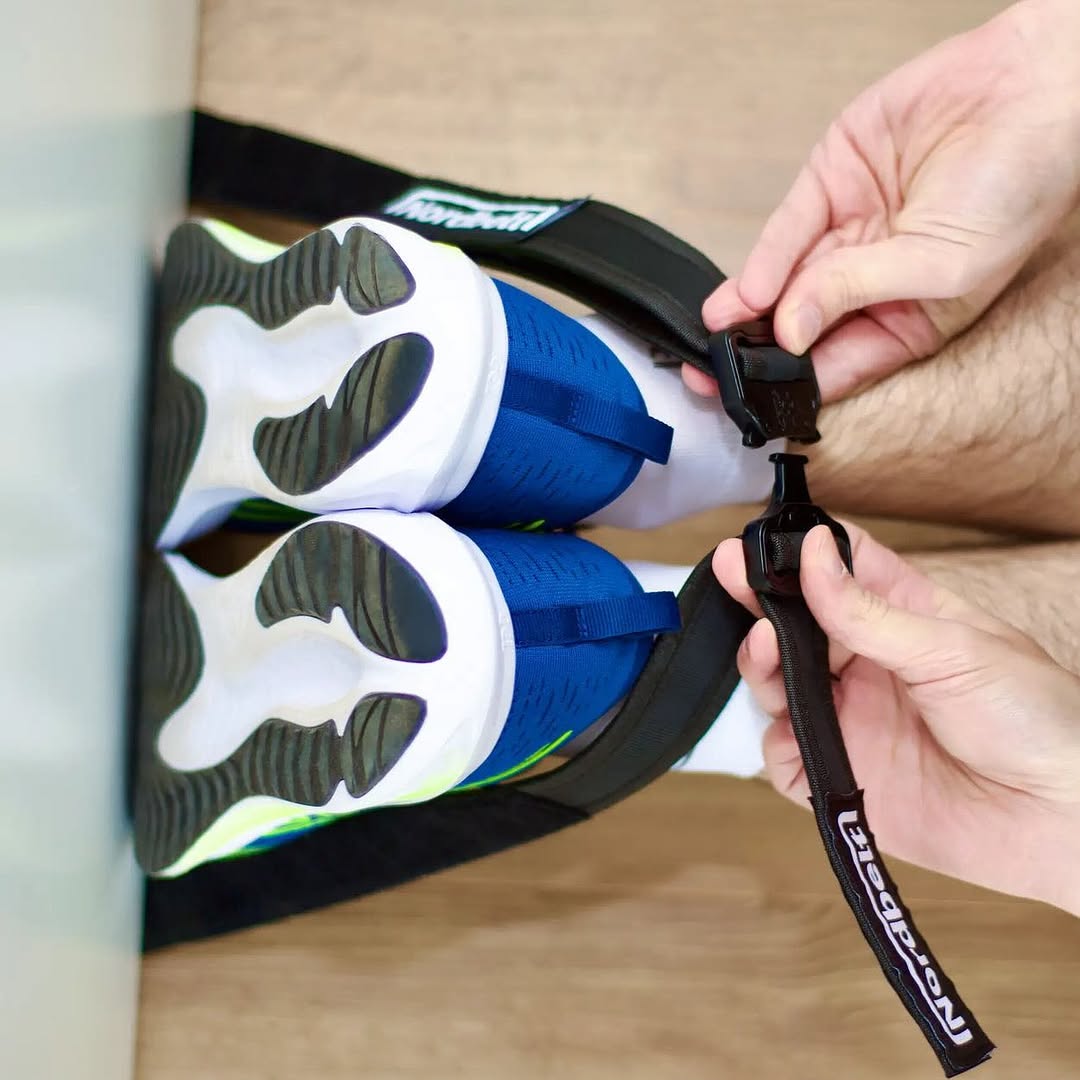 Hands fastening Nordbelt straps around the shoes. Context image; the full exercise with the equipment described is not shown.
How to perform a Nordic hamstring curl step by step
- Check the anchor point, place firm but soft support under your knees and clear space for your hands.
- Secure both ankles evenly and kneel upright with your hips extended.
- Lightly engage your core and glutes, keeping your knees, hips and shoulders in one line.
- Lower yourself slowly forward by allowing your knees to extend gradually.
- Catch yourself under control as soon as your hamstrings can no longer hold the lever.
- Use your hands or a regression to return; a full unassisted repetition is not a requirement for useful training.
Many technique errors occur when someone pushes the hips backward, catches themselves too late or uses unreliable fixation. The separate guide to common Nordic hamstring curl mistakes covers these points in more detail. For home training, also check the complete safe home setup for Nordic curls.
Which muscles does the reverse Nordic train?
The quadriceps are the main muscles involved. This muscle group extends the knee and consists of the rectus femoris and the three vasti. Because your knee bends further during the descent while your hip remains extended, the exercise demands considerable control from the front of the thigh. The glutes and core mainly help keep your body in one straight line.
This does not mean that you completely isolate one quadriceps muscle. Foot position, range of motion, tempo and individual anatomy change how the exercise feels. Keep your knees aligned and avoid creating extra backward lean through the lower back alone. If you feel sharp pain or the movement becomes unstable, stop and choose a shorter range; persistent symptoms should be assessed by a qualified healthcare professional.
Which muscles does the Nordic hamstring curl train?
The hamstrings at the back of the thigh provide most of the braking force. They try to keep the knee flexed while your body weight slowly extends it. The calves, glutes and core contribute to your position, but the exercise is primarily a demanding knee-flexion stimulus.
This also makes the exercise different from a hip hinge or Romanian deadlift, where most of the movement occurs at the hip. If you want to combine several functions of the posterior chain, use the general selection of hamstring exercises and treat the Nordic as one targeted option within the wider programme.
Reverse Nordic or Nordic curl: which should you choose?
Choose according to the function that is missing from your training:
- Choose the reverse Nordic if you want to load the quadriceps with bodyweight through controlled knee flexion without using ankle fixation.
- Choose the Nordic hamstring curl if you specifically want to train eccentric knee-flexor strength in the hamstrings and have safe fixation plus a suitable regression available.
- Choose both if your programme needs targeted work for both the front and back of the thigh and you can recover from the total load.
Harder does not mean more suitable. The hamstring Nordic feels more demanding to many beginners because of the long lever, but it can be scaled down substantially with hand support or a limited range. The reverse Nordic can also become difficult as you lean farther backward. Compare control and progression within the same exercise, not the ego effect between two different goals.
Can you do both exercises in the same workout?
Yes, as long as the quality of both movements remains good and the total load is appropriate. A simple starting point is two controlled sets of each exercise, with assistance for the hamstring Nordic. General guidelines emphasise that resistance, volume, frequency and rest should be adjusted together (Ratamess et al., 2009). Keep repetitions in reserve and increase one variable per training block.
Common mistakes when comparing the exercises
Here, “reverse” does not mean that you train the same muscle in the opposite direction: the dominant muscle function changes. Other mistakes include bending the hips, chasing the full range without control and mixing up the setups. For the reverse Nordic, comfort under the knees and tops of the feet is sufficient; for the hamstring Nordic, ankle fixation must be stable. If needed, review assembly and use in the practical how-to guide.
Frequently asked questions
Is the reverse Nordic a hamstring exercise?
Not as its primary function. The hamstrings may contribute to position and tension, but the quadriceps control and reverse the increasing knee bend. For a targeted knee-flexion stimulus at the back of the thigh, the Nordic hamstring curl is more suitable.
Does the reverse Nordic train the quadriceps?
Yes. The quadriceps control the backward descent and help you return to the upright kneeling position. Start with a limited range so that your hips stay extended and your torso remains steady.
Do you need ankle fixation for a reverse Nordic?
No. Your knees and lower legs rest on the floor as you lean backward. A soft mat can improve comfort, but a strap over your ankles is not part of the basic technique.
Do you need ankle fixation for a Nordic hamstring curl?
Yes. Without reliable fixation, your feet can lift and you lose the counterpoint against which the hamstrings control the forward movement. Check the anchor before every session and use a regression you can control.
Can you do reverse Nordics and Nordic hamstring curls on the same day?
Yes. They target different dominant functions and can fit into the same thigh workout. Keep the starting volume modest and let movement quality determine whether you add another set.
Summary
In the reverse Nordic, you move backward and the quadriceps do most of the controlling. In the Nordic hamstring curl, you move forward and the hamstrings provide most of the braking force. They do not replace each other: choose the muscle function you want, scale the lever until you retain control and progress one variable at a time.