

Nordic curl as your only hamstring exercise at home


A Nordic curl can be enough as your only hamstring exercise at home if you deliberately want to train one task: controlled knee flexion while your body moves forwards. For a broader hamstring programme it is usually incomplete, because a hip-dominant movement adds another function. Do not choose based on which exercise feels hardest; decide whether your goal needs one or both movement tasks.
When can the Nordic curl be your only hamstring exercise?
One exercise can be enough for a deliberately narrow goal. If your main aim at home is to learn to move your body forwards from the knees under control, maintain a straight body line and visibly slow each descent, the Nordic curl can be the entire main component of that small training block. That is different from claiming that the exercise covers every possible hamstring task.
The boundary is therefore not the number of exercises, but what your programme promises. A focused programme may have one clear task. A broad programme promises more: producing force not only around the knee, but also organising force and control while the hip moves. Once that second goal matters, ‘Nordics only’ is no longer a complete description.
A biomechanical study involving ten male participants compared the Nordic curl, a single-leg deadlift and a single-leg Roman-chair hold. In that experiment, the Nordic generally produced the highest peak hamstring forces and more fascicle lengthening, while the other exercises had different force and length profiles. This supports the Nordic as a powerful, specific task; the small acute study does not prove that one exercise is complete for every training goal (Van Hooren et al., 2022).
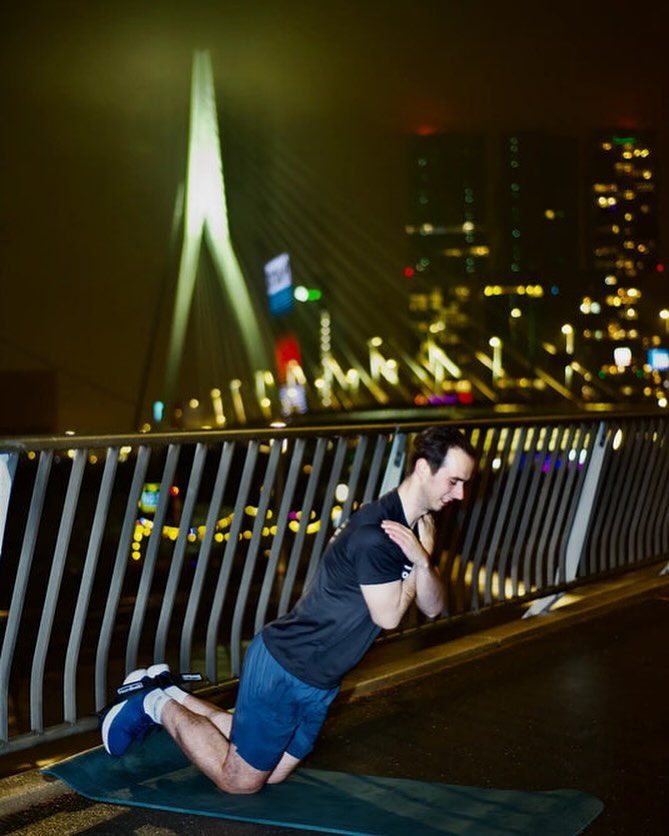
For the execution basics, the general explanation of the Nordic hamstring curl remains the primary resource. This page decides only whether that single movement task is sufficient for the scope of your programme.

Ankle fixation for Nordic curls at home
If you want to use the Nordic as a regular knee-flexion task at home, start with an anchor that cannot move, low and even fixation around both ankles, sufficient kneeling comfort and a regression you can deliberately slow down. Test the anchor with your hands first and increase the pulling force gradually. The separate guide to a safe Nordic setup at home covers those conditions in more detail.
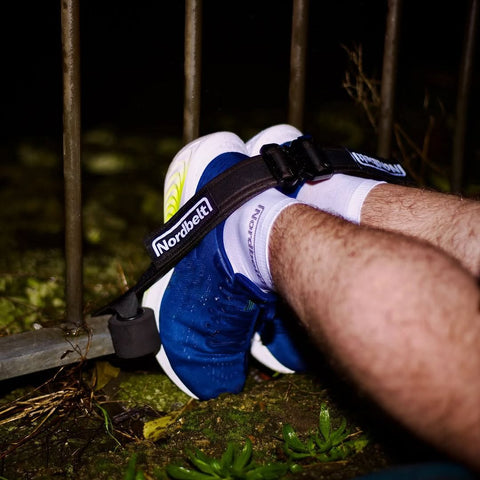
With Nordbelt for Nordic curls at home, stable ankle fixation becomes practical without a training partner or large fitness machine. This reduces setup friction for the Nordic task, but it does not turn one knee-flexion movement into a complete hamstring programme. The equipment does not add a hip-dominant movement or replace an anchor check, technical control or gradual load selection.
Use the two-axis check for your programme
The two-axis check is an editorial decision framework, not a researched training protocol. First assess which movement task your programme genuinely needs to contain. Only after consciously choosing both axes can you honestly say whether one exercise is enough.
| Axis | Question | When the Nordic may be enough | When an addition makes sense |
|---|---|---|---|
| Knee flexion | Do you mainly want to produce force under control as the knee straightens and bends again? | When this is your defined primary task and you can repeat the variation with sound technique | When you also want another knee-flexion variation with an easier range or different resistance |
| Hip extension | Do you also want to learn to produce force as the hip flexes and extends? | Not applicable: this is not the Nordic's primary task | Add a manageable hip-dominant movement when this function belongs to your goal |
Use the result as a programming choice. ‘One axis’ is not automatically worse; it is narrower. ‘Two axes’ is not automatically better; it is broader. The distinction becomes a problem only when a narrow programme is presented as though it covers everything.
Take your Nordic curl from the first rep to week 10.
A concrete 7-page plan: build up week by week, without pushing too fast.
- 01A clear week-by-week progression
- 02Technique and the mistakes to avoid
- 03A simple log you will actually use

≤51%
✓Backed by research
Van Dyk et al., 2019: meta-analysis of programmes with NHE. Not an effect test of Nordbelt or this protocol.
Open the download page again or check the email we sent you.
Open the download page ↗Why knee flexion and hip extension are not the same
During a Nordic curl, the hips ideally remain relatively stable while movement occurs mainly around the knees. During a hip hinge, the pelvis deliberately moves backwards and the back of the thigh produces force around the hip. Both tasks use the hamstrings, but their joint movement, position and distribution of load are not identical.
In the same ten participants, Van Hooren and colleagues found that peak forces and fascicle behaviour differed between the Nordic, single-leg deadlift and Roman-chair hold. The authors also reported that the Nordic and hip-dominant tasks did not produce the same profile for individual hamstring muscles. Treat that result as evidence of task specificity, not as a ranking with one universal winner (Van Hooren et al., 2022).
A training study assigned thirty recreationally active male athletes to ten weeks of Nordic training, hip-extension training or no training. Both the Nordic and hip-extension groups showed an increase in fascicle length of the biceps femoris long head. In this study, the hip-extension group had a greater increase in that muscle's volume, while both exercise groups showed changes in the semitendinosus. This supports the idea that exercises can produce partly overlapping and partly different adaptations; it is not an individual prescription (Bourne et al., 2017).
Which exercise belongs alongside the Nordic curl?
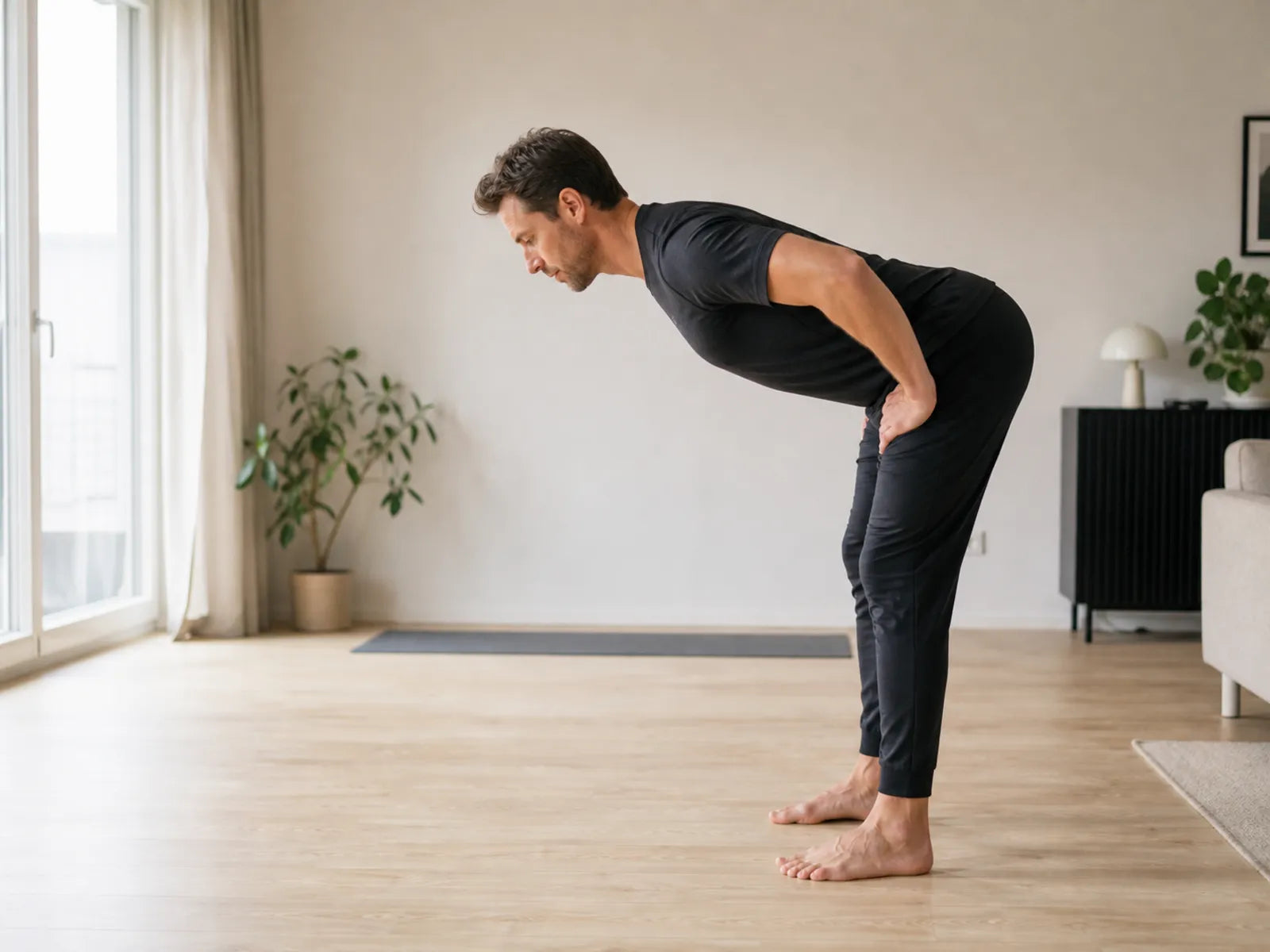
Do not add an exercise merely because a list says you need ‘more variety’. Add it only when the missing task belongs to your goal. For most home programmes, the clearest addition is a movement in which you move the hips backwards under control and then extend them again while keeping the trunk and pelvis organised. Start simply enough to distinguish the hip movement from knee flexion.
This can begin as an unloaded hip-hinge drill. Extra resistance becomes meaningful only once the movement is recognisable and repeatable. The primary guide on learning the hip hinge covers the movement itself; this page does not prescribe a particular variation, load or frequency.
If you only want a lighter knee-flexion variation alongside the Nordic, the second exercise mainly changes the difficulty or form of resistance, not the second axis of your programme. That can help exercise quality, but it does not answer the need for hip extension. The two-axis check prevents you from confusing ‘two exercises’ with ‘two different functions’.
Build a minimalist programme without false completeness
A minimalist home programme can remain clear with one primary task and no more than one additional task. Write down the function first and the exercise name second:
- Primary knee-flexion task: choose a Nordic variation that you can repeat under control with the same setup.
- Optional hip-dominant task: add a simple hip hinge only when hip extension is part of your goal.
- One variable at a time: do not change range, support, volume, resistance and exercise selection simultaneously.
- Evaluate the task: check whether technique and control remain recognisable, not merely whether the session feels hard.
This framework deliberately gives no universal number of sets or training days. The two cited studies used specific participants, exercises and outcomes. They support the distinction between tasks and adaptations, but do not determine your personal dose (Van Hooren et al., 2022; Bourne et al., 2017).
For the question of whether to place Nordic curls earlier or later in a session, the separate decision guide on Nordics as a main block or finisher remains the primary resource. To choose between strength and muscle growth, use the specific guide to Nordic curls for strength or muscle growth at home. This keeps this URL responsible for one question: is one exercise functionally sufficient for the chosen programme scope?
When is simply adding more Nordic volume not the answer?
Extra repetitions do not add a new movement task. If your programme contains only knee flexion, it remains a knee-flexion programme even when you increase the volume. Do not use more volume as a substitute for a deliberately missing hip-dominant task.
The reverse also applies. Do not add a hip hinge if you cannot organise the movement or if your goal deliberately consists only of a controlled Nordic task. Define the scope first, then expand it. If the question arises from pain, a recent injury or unexplained loss of strength, it falls outside this non-medical programming decision; an assessment by a qualified healthcare professional is more appropriate than independently adding exercises.
If you want to review the strap position, anchor check and starting line before deciding, use the Nordbelt guide to Nordic curls at home. That setup information helps you perform the Nordic task consistently; it does not prove that the exercise alone covers your entire programme.
Frequently asked questions
Are Nordic curls enough for all the hamstrings?
Nordic curls load several hamstring muscles, but ‘enough for all the hamstrings’ depends on what your programme must accomplish. Acute biomechanical and longer training studies show that Nordic and hip-dominant exercises do not have exactly the same force, length and adaptation profiles. The Nordic may be sufficient for a narrow knee-flexion task; for a broader programme, a hip-dominant task is often a deliberate addition (Van Hooren et al., 2022; Bourne et al., 2017).
Can you train only Nordic curls?
Yes, if you deliberately build a small programme around controlled Nordic knee flexion and do not claim broader completeness. Check the setup, regression and execution quality. If you also want to train hip extension, the goal changes and a separate hip-dominant task belongs in the decision.
Which exercise should you do alongside the Nordic curl?
Choose a hip-dominant movement when hip extension is the second axis of your programme. Begin with a simple hip hinge that you can technically recognise without extra resistance. A second knee-flexion exercise can be a useful regression, but it does not automatically represent another movement task.
Can you do Nordic curls and a hip hinge in the same workout?
You can if both movement tasks belong to your goal and you can perform each one independently. Keep the first combination simple: do not change exercise selection, range, resistance, volume and session position at the same time. This page does not prescribe a universal order or dose.
Is the Nordic curl a complete hamstring programme for home?
The Nordic curl can be a complete, focused knee-flexion block, but it is not automatically a complete, broad hamstring programme. Use the two-axis check: if you also want to train hip extension, add an appropriate hip-dominant task. If your goal is deliberately narrower, ‘complete’ does not have to mean collecting more exercises.