

Hamstring exercises for volleyball: jump, brake and land stronger


“Nordbelt is easy to secure and feels stable.”
Hamstring exercises for volleyball should match jumping, landing, short approach steps, quick braking and repeated push-offs. A few hamstring curls after training are too narrow for that job. A useful volleyball hamstring plan combines landing technique, hip strength, eccentric control, single-leg stability and calm Nordics that are not placed right before a hard practice or match. Start with control, keep the volume small and only progress when the hamstrings feel normal the next day.
In brief
Volleyball does not load the hamstrings mainly through long sprints. It loads them through repeated jumps, landings, short approaches, lunges and fast defensive reactions. A volleyball injury review shows that ankle, knee and shoulder problems are studied more often, while prevention knowledge per injury type is still limited (Kilic et al., 2017). That is exactly why hamstring work should stay practical: choose exercises that improve landing, hip control and eccentric strength without ruining jump quality.
Use this article as a volleyball-specific addition to the broader guide to hamstring exercises. The order is simple on purpose: control first, then strength, then heavier Nordics, and only then more speed or jump volume.
Why volleyball loads the hamstrings differently
Volleyball looks less hamstring-heavy than football or track because you do fewer maximal sprints. In practice, the hamstrings still do a lot of work. You push off for an attack or block, land asymmetrically, brake after a short approach, drop low for a pass and react immediately to the next ball. The hamstrings do more than bend the knee; they help brake movement, extend the hip and coordinate with the glutes, calves and trunk.
For volleyball, making the hamstrings stronger means training three qualities:
- control when landing and moving on
- strength for short approaches, split-steps and defensive lunges
- eccentric braking strength when you push off or absorb speed
A meta-analysis on hamstring prevention found that eccentric training can reduce hamstring injuries and improve hamstring strength, fascicle length and asymmetry (Rudisill et al., 2023). For volleyball players, that does not mean everyone should start heavy Nordics immediately. It does mean eccentric control deserves a fixed place in the week.
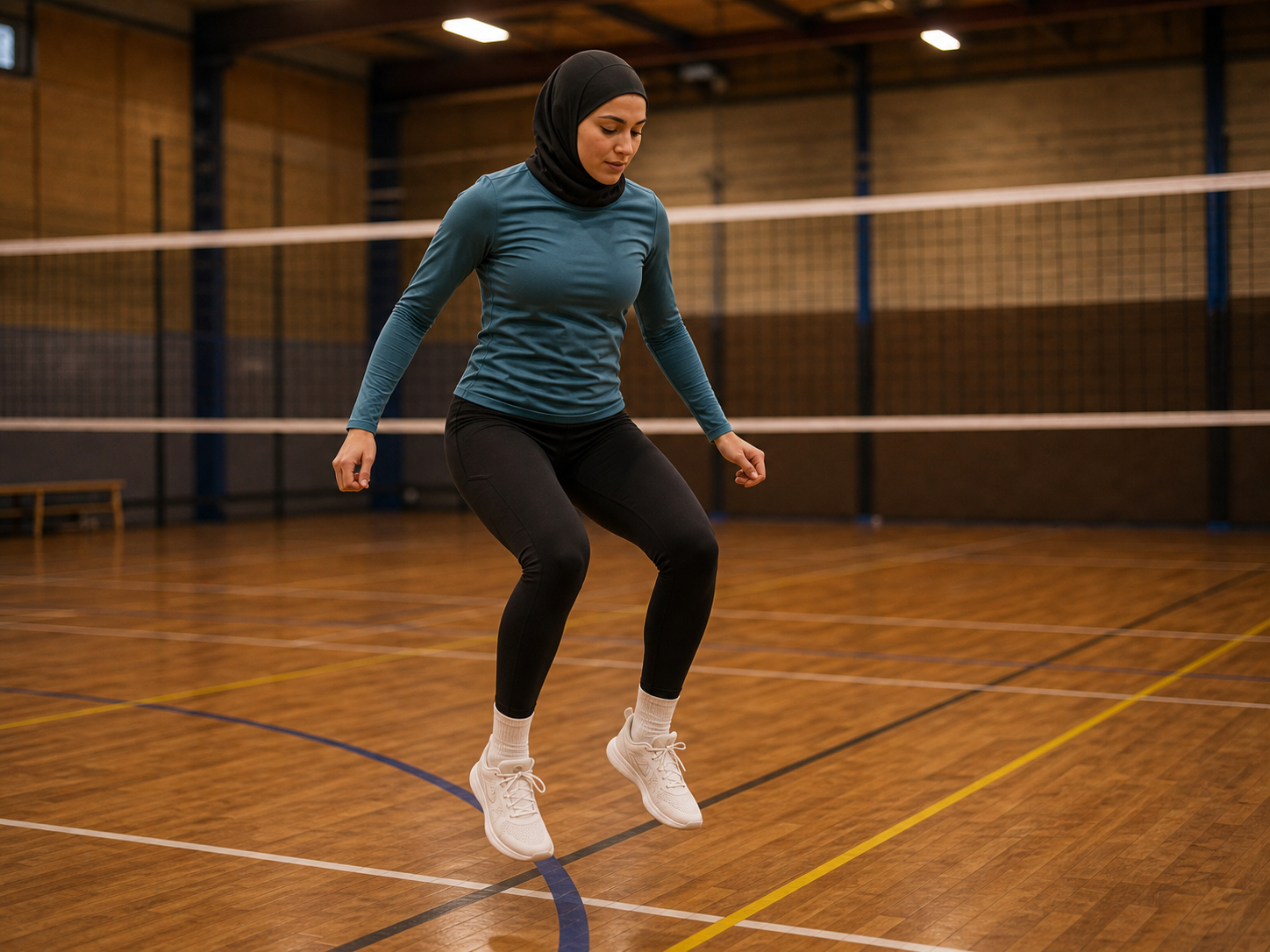

Which volleyball hamstring exercises should you choose first?
Choose exercises you can repeat cleanly. If the knee caves in, the pelvis rotates or the lower back takes over, the exercise is too heavy or too tiring. Volleyball already gives you a lot of jump and landing volume, so extra hamstring work should support that load instead of competing with it.
- glute bridge with calm hamstring pressure
- hamstring walkout
- split squat hold with trunk control
- single-leg Romanian deadlift
- sliding leg curl
- lateral lunge or Cossack squat
- assisted Nordic hamstring curl
- short landing and braking drills once the base responds well
This order works because it builds control and capacity first. Only after that do you make the exercise longer, heavier or faster.
Take your Nordic curl from the first rep to week 10.
A concrete 7-page plan: build up week by week, without pushing too fast.
- 01A clear week-by-week progression
- 02Technique and the mistakes to avoid
- 03A simple log you will actually use

≤51%
✓Backed by research
Van Dyk et al., 2019: meta-analysis of programmes with NHE. Not an effect test of Nordbelt or this protocol.
Open the download page again or check the email we sent you.
Open the download page ↗The 6 best hamstring exercises for volleyball
Start with two or three exercises per block. More is not automatically better. The best hamstring exercises for volleyball are the ones you can repeat consistently without losing jump quality or match freshness.
1. Glute bridge with hamstring pressure
Lie on your back with your feet slightly farther from your hips than in a standard bridge. Press the heels into the floor, tighten the glutes and lift the hips calmly. Hold for two seconds. You should feel pressure in the glutes and hamstrings, not only in the lower back.
2. Hamstring walkout
Start at the top of a bridge and slowly walk the feet away from the body. Keep the hips as high as possible without forcing the back. Walk back under control. This lengthens the hamstrings under tension while staying lighter than a full Nordic.
3. Single-leg Romanian deadlift
This exercise fits volleyball because it combines hip control, balance and hamstring strength. Keep the standing knee soft, hinge from the hip and let the free leg move backward. The trunk and pelvis stay as quiet as possible.
4. Sliding leg curl
Use sliders, socks on a smooth floor or a towel. Start in a bridge, slide the heels out slowly and pull them back under control. The lowering phase matters more than speed. For more context on these choices, use the guide to eccentric hamstring exercises.
5. Lateral lunge
Volleyball is not only straight ahead. A lateral lunge trains the hip and hamstring in side positions that resemble defending, passing and recovering after a block landing. Step sideways, send the hip back and return with control.
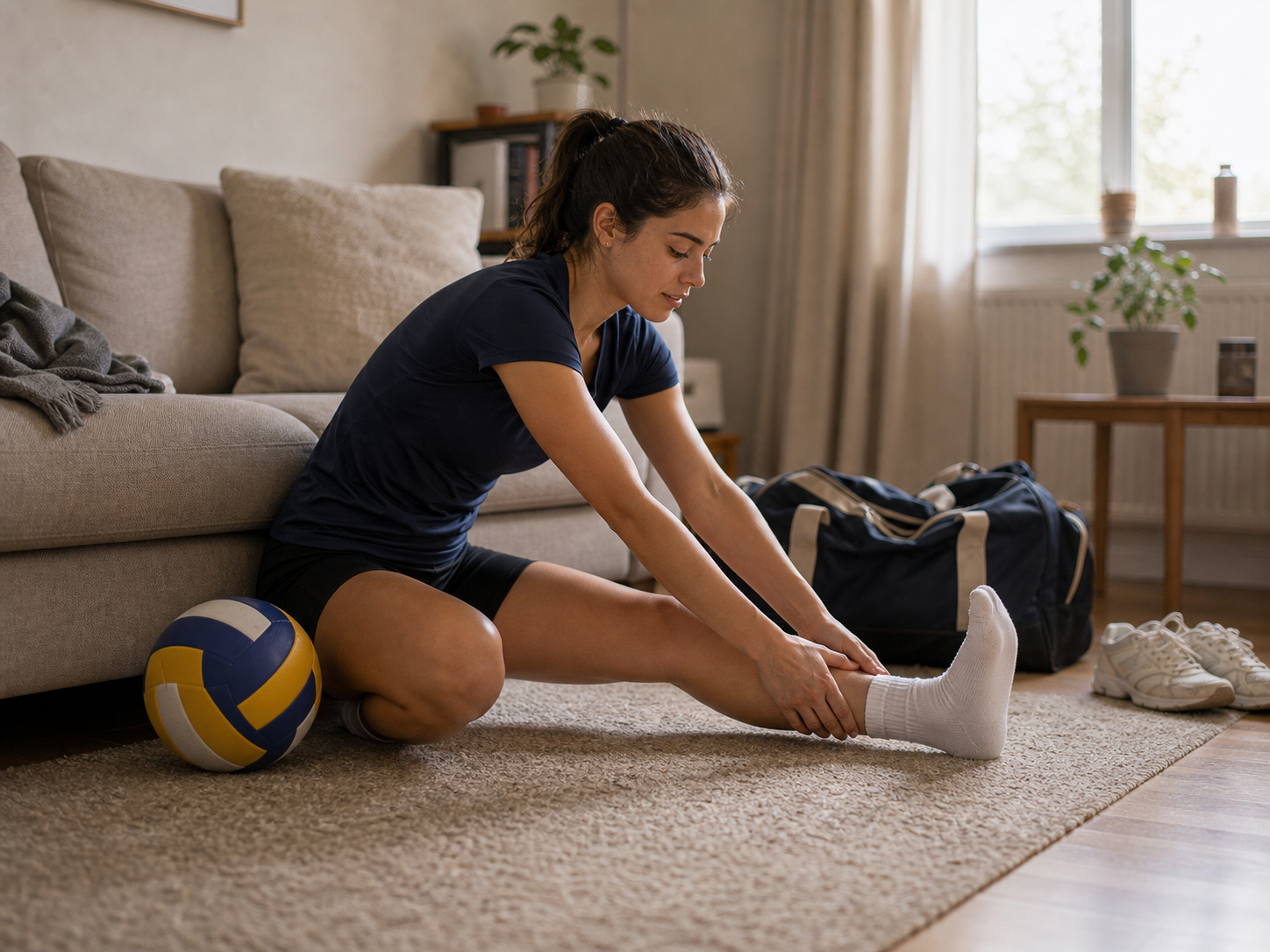
6. Assisted Nordic hamstring curl
The Nordic hamstring curl is heavy, but useful when dosed well. A structured eccentric hamstring programme with Nordics reduced hamstring injuries in football players (Petersen et al., 2011). That evidence is not directly from volleyball, so treat it as a training principle rather than a guarantee.
Start assisted: hands ready to catch, short range, few reps and plenty of distance from match day. Read the technique guide for the Nordic hamstring curl before making the exercise heavy.
Nordic hamstring for volleyball: when and how heavy?
For volleyball, the Nordic is most useful as a controlled strength stimulus away from the busiest jump days. Do not use it as a heavy finisher after a long session with many jumps. That mainly trains fatigue. Place it on a separate strength day, or early in a light session with low jump volume.
- weeks 1-2: 2 sets of 3 assisted reps
- weeks 3-4: 2 sets of 4-5 assisted reps
- weeks 5-6: 3 sets of 4-5 reps with a slightly longer range
- after that: maintain with 1-2 short sessions per week
A recent biomechanical study found that exercises such as the Nordic hamstring exercise, unilateral bridge and eccentric slider can create high hamstring loading that is relevant in prevention and rehabilitation contexts (Breed et al., 2026). In practice, dose these exercises as real training, not as a casual cool-down.
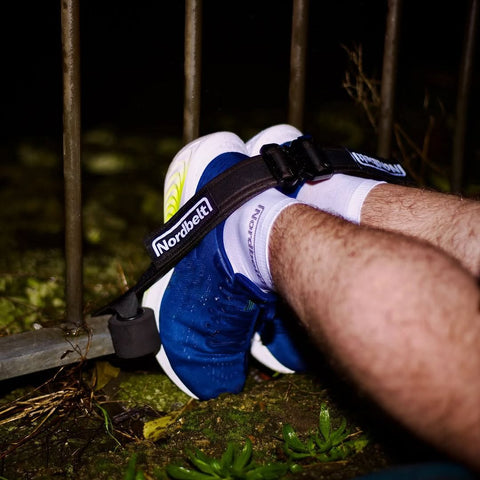
Nordbelt can make ankle fixation repeatable for solo Nordics at a stable anchor point. Use it only after the technique, volume and timing are clear. The how-to guide helps you test the setup before increasing difficulty.
Hamstring training for volleyball in a weekly plan
A good weekly plan depends on your practice days, match day and current capacity. This setup works as a starting point for many recreational and competitive players.
With 2 volleyball sessions per week
- Day after match or heavy training: recovery, walking and mobility.
- Strength day 1: bridge, Romanian deadlift and sliding curl.
- Light volleyball session: short activation, no heavy Nordics.
- Strength day 2: assisted Nordic and lateral lunge with low volume.
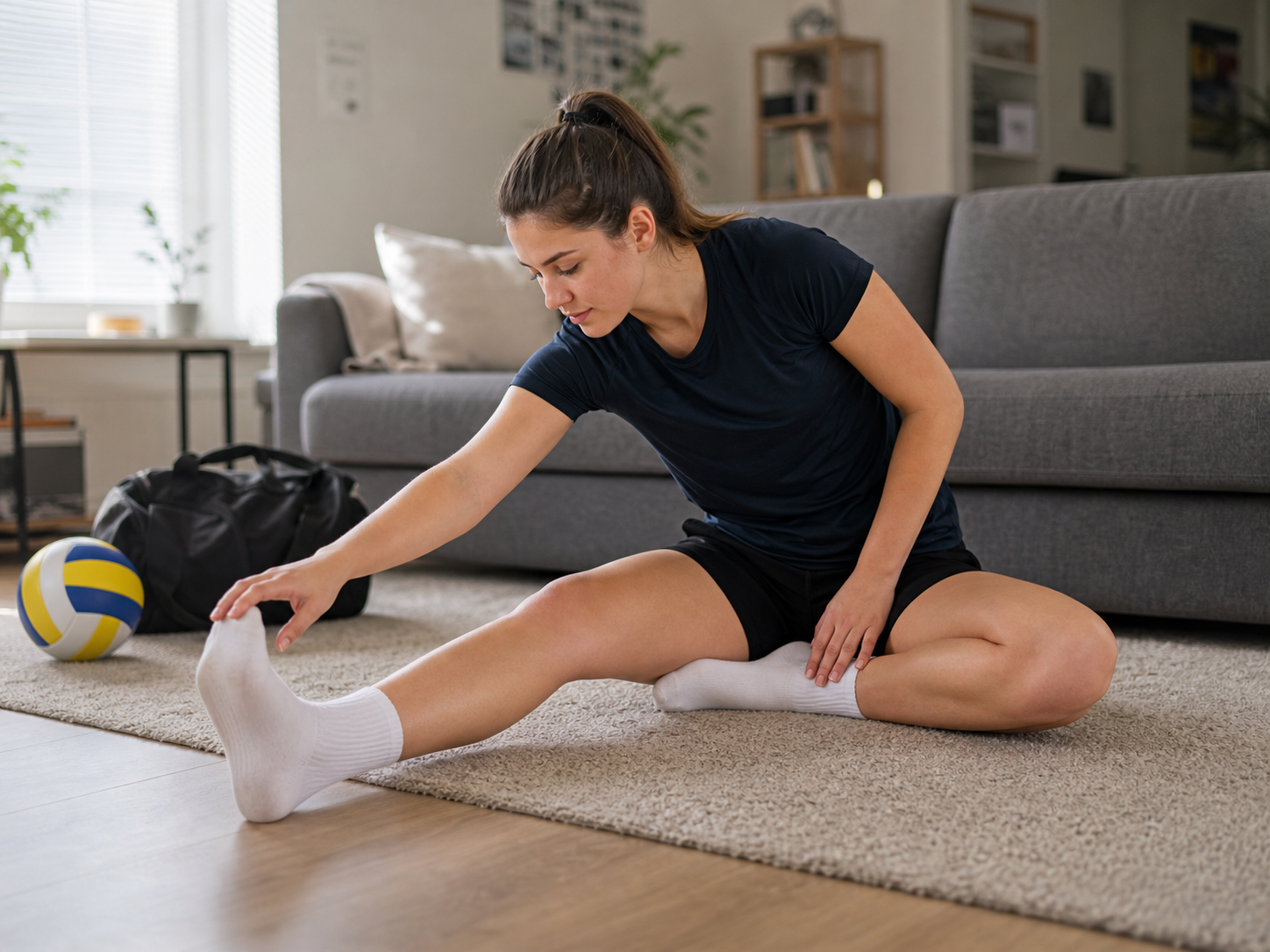
With 3 or more volleyball moments per week
- Keep hamstring strength work shorter.
- Choose one heavier exercise per session.
- Plan Nordics at least 48 hours before a match or heavy jump session.
- Use light bridges or walkouts for maintenance in busy weeks.
The goal is not to train maximally every week. The goal is stronger hamstrings while jump rhythm, timing and match quality stay intact.
Reducing hamstring injury risk in volleyball without overdoing it
You can never completely prevent hamstring injuries in volleyball. You can reduce the chance that the hamstrings are surprised by sudden volume, fatigue or strength work that is too heavy.
- build jump volume gradually after a break or injury
- do hamstring strength before symptoms force you to
- combine strength with landing, hip control and trunk control
- avoid heavy Nordics right before match day
- take cramping, pulling or unusual next-day stiffness seriously
For players with pain, a recent strain or recurring symptoms, this article is not a substitute for assessment by a physiotherapist. Start lighter and use the plan to ask better questions about progression, timing and exercise choice.
Frequently asked questions
Which hamstring exercises for volleyball matter most?
The most useful exercises combine landing control, hip control and eccentric strength. Start with glute bridges, hamstring walkouts, single-leg Romanian deadlifts and sliding leg curls. Add assisted Nordics later if the basics feel good.
Does the Nordic hamstring curl fit volleyball?
Yes, but it has to be dosed carefully. The exercise is heavy and can create soreness. Start assisted, use few reps and avoid placing it just before match day.
How often should I train hamstrings next to volleyball?
For most volleyball players, two short hamstring sessions per week are enough. In a dense competition week, one light maintenance session can be smarter than two heavy sessions.
Which volleyball hamstring exercises can I do at home?
Good home options are glute bridges, hamstring walkouts, bodyweight single-leg Romanian deadlifts, sliding leg curls with socks or a towel, and assisted Nordics with safe ankle fixation.
Can hamstring injuries in volleyball be prevented?
No programme can guarantee that. You can improve preparation with gradual jump volume, eccentric strength, landing technique, recovery and smart timing of heavy strength work.