

Basketball hamstring exercises: jump, brake and land stronger


Basketball hamstring exercises should match jumping, landing, braking, cutting and short accelerations. A few random hamstring curls after practice are too narrow. A useful basketball hamstring plan combines landing mechanics, hip strength, eccentric control, single-leg stability and calm Nordics that are not placed right before a hard practice or game. Start with control, keep volume modest and only progress when your hamstrings feel normal the next day.
Quick answer
Basketball loads the hamstrings when you rebound, close out, stop hard or accelerate again from a low position. Seventeen seasons of NBA data show hamstring strains as a recurring injury category, even though ankle and knee problems are more frequent overall (Drakos et al., 2010). That does not mean you should train cautiously forever. It means your hamstring work should fit landing, braking and repeated acceleration.
Use this article as a basketball-specific layer on top of the broader guide to hamstring exercises. The order is simple: move cleanly, build strength, add Nordic work and plan it around basketball sessions.
Why basketball stresses the hamstrings
Basketball is not just sprinting in a straight line. You jump repeatedly, land on one leg, cut in small spaces and have to get low again after contact or fatigue. The hamstrings help control the knee, hip and trunk when you decelerate.

A systematic review on neuromuscular warm-ups in basketball found that balance, strength and multicomponent programs remain relevant for lower-limb injury prevention, even though the evidence base is less broad than in some other sports (Davis et al., 2021). In practice: combine hamstring strength with control, landing quality and gradual loading.
Which basketball hamstring exercises come first?
Choose exercises that keep your landing and hip control clean. If your knee drops inward, your pelvis rotates or your lower back takes over, the exercise is too hard or too tired. A good progression is glute bridge pressure, hamstring walkouts, split squat holds, single-leg Romanian deadlifts, sliding leg curls, lateral lunges and assisted Nordic hamstring curls.
The 6 best basketball hamstring exercises
1. Glute bridge with hamstring pressure
Lift your hips, keep your heels slightly farther away and gently pull the heels toward you without moving them. Hold for two seconds and lower with control.
2. Hamstring walkout
Start in a bridge and walk your feet forward in small steps. Stop before your lower back takes over.
3. Split squat hold
Hold a low split stance for 20 to 30 seconds. Keep the front knee over the foot and the trunk quiet.
4. Single-leg Romanian deadlift
Hinge from the hip and let the free leg move back. Stop when the pelvis opens. This builds one-leg control for landings and cuts.
5. Sliding leg curl
Use sliders, socks or a towel. Slide out slowly and pull back without letting the hips drop. Range and control matter more than high reps.

6. Assisted Nordic hamstring curl
Kneel, fix your ankles, lower slowly, catch yourself with the hands and press back. Start with a short range and a few reps. Programs that include the Nordic hamstring exercise are associated with lower hamstring injury rates across sport settings, but the stimulus needs gradual exposure (van Dyk et al., 2019).
The research findings apply to the programmes and participants studied. The exercise plan on this page has not itself been tested as an injury-prevention programme for this sport. Treat the suggested schedule as a practical example and adapt it to your training and recovery.
Nordic hamstring for basketball
The Nordic hamstring curl fits basketball, but it is not an ego test. A study in college women basketball players found that a six-week neuromuscular program could improve balance, landing mechanics and hamstring and quadriceps strength, with some gains maintained over the season (Pfile et al., 2016). Strength works better when it is trained together with landing and control.
Use a simple plan: weeks 1-2, two sets of three assisted reps once per week; weeks 3-4, two sets of four to five reps; weeks 5-6, three sets of four to six only if the next day feels normal. In game weeks, cut the volume in half. Read the Nordic hamstring curl guide and the how-to guide if you want the setup first.
Basketball hamstring training in a week
Do not place heavy hamstring training right before your hardest practice, game or pickup run. Keep at least one easier day between heavy eccentric work and a lot of jumping or sprinting. One session can focus on bridge variations and single-leg control; the second can use sliders or assisted Nordics. For more choices, use the guide to eccentric hamstring exercises.
Reducing hamstring injury risk in basketball
No exercise can promise that you will never get injured. You can make the risk profile better with gradual loading, enough recovery, better landing mechanics and strength in different joint angles. Sharp pain, one-sided weakness or symptoms that change your running or jumping mechanics are reasons to scale back. The football-focused Nordic hamstring curl plan can be a useful comparison if you adjust the volume to basketball.
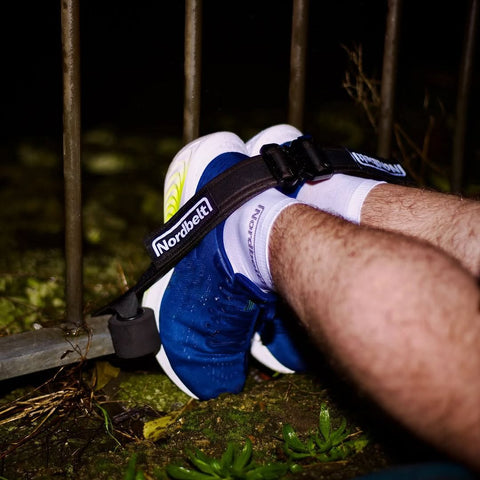
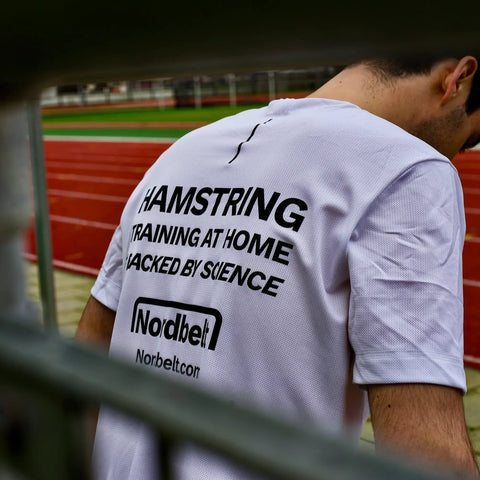
If you want repeatable Nordics at home or outside, Nordbelt can serve as a compact ankle-fixation point. Keep the principle the same: clean technique, small volume, progress only when recovery is normal.
FAQ
Which basketball hamstring exercises matter most?
Start with glute bridge variations, hamstring walkouts, single-leg Romanian deadlifts, sliding leg curls and assisted Nordics. Add landing and braking drills only once the base stays controlled.
Does the Nordic hamstring curl fit basketball?
Yes, if you start assisted and keep the dose low. Do not place heavy Nordics in the middle of a loaded game week.
How often should basketball players train hamstrings?
One or two short sessions per week is enough for most players. Lower the volume when practices and games are already intense.
Can basketball hamstring injuries be prevented?
They cannot be ruled out completely, but smart loading, landing control, recovery and gradual eccentric work can improve the risk profile.