

Explosive hamstring exercises: build sprint strength safely


“Nordbelt is easy to secure and feels stable.”
Explosive hamstring exercises are not random jumps or heavy curls. For sprint strength, you need three things: real sprint exposure, hamstring force at longer muscle lengths, and control to brake high speed safely. Combine short sprints or accelerations with eccentric exercises such as Nordic curls, sliders and hip-hinge work. Progress gradually, train with full attention and make clean technique more important than a heavy rep or a tiring circuit.
What counts as an explosive hamstring exercise?
An explosive hamstring exercise helps the hamstrings produce force quickly or absorb force quickly. That is different from simply feeling a pump. During sprinting, the hamstrings extend the hip, help control the knee and, above all, brake the leg at high speed as it swings forward. Sprint mechanics research shows that the hamstrings handle large forces, length changes and power demands at high speed, especially late in swing (Schache et al., 2012).
The best approach is therefore not one magic exercise. Use a small set that covers sprinting, eccentric knee flexion, hip-dominant strength and controlled regressions. For a wider exercise overview, start with hamstring exercises for strength and flexibility. This article focuses specifically on sprint strength.
Why sprinting asks more than ordinary strength work
Sprinting is not just a fast leg curl. It needs timing, stiffness, hip control and high velocity. Research comparing sprinting with isolated hamstring exercises shows that maximal sprinting stays unique; exercises can improve the conditions, but they do not fully replace sprinting (Prince et al., 2020).

That matters for football players, sprinters and field-sport athletes. If you only lift slowly, you miss the speed stimulus. If you only sprint and never build targeted strength, the load can rise too quickly. A football study comparing sprint and strength training found that both can affect different risk factors: sprinting improved speed-related qualities, while strength and Nordic work affected eccentric strength more directly (Sancese et al., 2023).

Five exercises for speed, braking force and control
1. Short accelerations
Start with 10 to 20 metre accelerations. This is not conditioning work. Rest fully, keep every repetition sharp and stop before your sprint shape drops. Four to six clean reps are enough for many athletes.
2. Flying sprints
A flying sprint means you build speed gradually and then run a short fast section, such as 10 metres. Use it only when you are already used to sprinting. Keep the volume low and leave at least 48 hours between hard speed sessions.
3. Nordic curl or assisted Nordic
The Nordic curl is not a speed drill, but it is a strong eccentric stimulus. A meta-analysis in team-sport athletes found that Nordic hamstring training can improve eccentric knee-flexor strength and may provide small sprint benefits, although study quality varies (Bautista et al., 2021). If full reps are too hard, use short eccentric reps or hand assistance. For more options, use eccentric hamstring exercises.
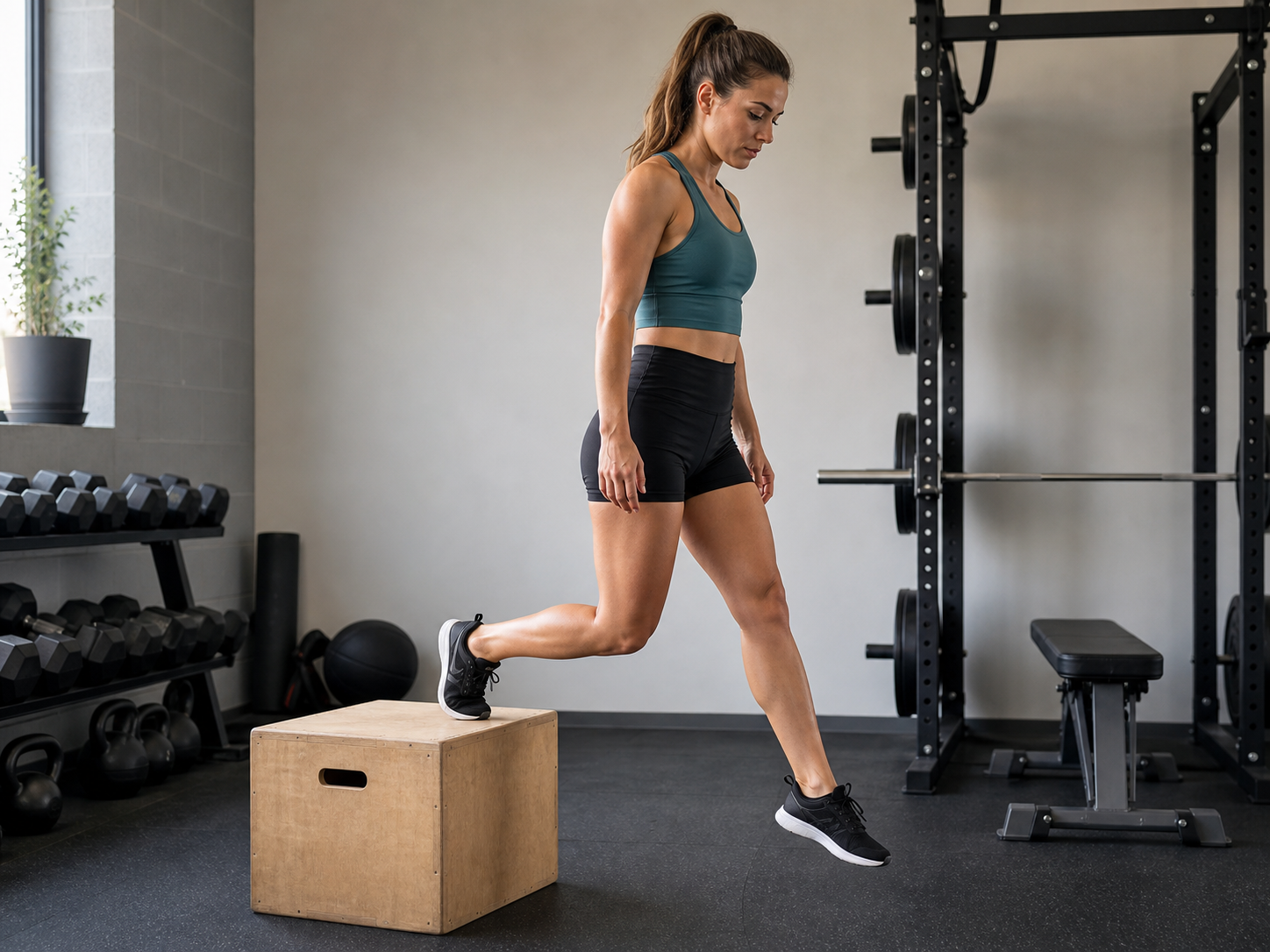
4. Slider curl with fast hip control
Slider curls are a useful bridge. Pull in faster if you want a more powerful finish, but keep the outward phase controlled. The braking phase matters more than one fast-looking repetition.
5. Hip-dominant strength
A Romanian deadlift or similar hip hinge does not copy sprinting, but it supports hip extension and trunk control. Treat it as a foundation next to speed work, not as a replacement for sprinting or Nordics.
Take your Nordic curl from the first rep to week 10.
A concrete 7-page plan: build up week by week, without pushing too fast.
- 01A clear week-by-week progression
- 02Technique and the mistakes to avoid
- 03A simple log you will actually use

≤51%
✓Backed by research
Van Dyk et al., 2019: meta-analysis of programmes with NHE. Not an effect test of Nordbelt or this protocol.
Open the download page again or check the email we sent you.
Open the download page ↗How to build an explosive hamstring session
Put the fastest work early. If you do sprint drills after heavy strength blocks, you mostly train tired movement. A cleaner order is warm-up, accelerations or flying sprints, Nordic or slider work, hip-hinge strength and then light mobility.
Start with two sessions per week. Do not choose more than two heavy hamstring stimuli in one session. For example, use accelerations plus assisted Nordics on one day, and flying sprints plus sliders on another. Football players should place the heavier eccentric work far enough away from match day. Nordic hamstring curl plan for football explains how to place sets and reps in a football week. If the goal is injury risk reduction in football, also read preventing hamstring injuries in football. Eccentric hamstring programs can reduce acute hamstring injuries in football when they are performed consistently and dosed well (Petersen et al., 2011).
Where does Nordbelt fit?
Nordbelt fits the part where you need repeatable ankle fixation: Nordic curls, assisted Nordics and some field or home setups. You do not need a product for sprinting itself. For the strength work afterward, your feet should be low, stable and predictable.

Use Nordbelt as a setup tool, not as permission to train too hard. Test the anchor with your hands first, start with short range and progress only when you keep control. View Nordbelt if you want a compact setup for home, bench or fixed anchor points, and use the how-to guide to check fixation step by step.
FAQ
Which hamstring exercise is the most explosive?
For true speed, sprinting itself is the most specific. Short accelerations or flying sprints train timing, force and velocity together. Nordic curls and sliders are complementary because they build braking force and control.
Do Nordic curls help speed?
They can improve eccentric hamstring strength and may support small sprint improvements in some athletes, but they are not a direct speed shortcut. Combine sprint practice with targeted hamstring strength.
How often should I train explosive hamstrings?
Start with two sessions per week. Keep sprinting and heavy eccentric work away from daily fatigue. A few sharp sprints and a few controlled sets usually beat high-volume circuits.
Are these exercises suitable after an injury?
Not as the first step. After injury, restore pain-free basic loading, strength and running progressions first. Explosive work comes later, when sprinting and eccentric strength are again loadable.
Can I do this at home?
Some parts, yes. Slider curls, assisted Nordics and hip-hinge variations work at home. Maximum sprint work needs space and a safe surface, so place it on a field, track or clear straight lane.