

Copenhagen plank: support your knee or your foot?

The Copenhagen plank is a side-support position with your upper leg resting on a stable raised surface. Start with a short lever, supporting the leg near the knee and keeping the lower leg on the floor if needed. Support at the foot creates a longer lever and changes the load. First choose a position you can control; longer holds are only comparable when the support point, assistance and technique stay the same. A static plank is also different from dynamic Copenhagen adduction.
Hold still or move up and down?
In the plank, you keep your pelvis raised while pressing your upper leg into the support. Your adductors, the muscles on the inside of your thigh, produce force. In dynamic Copenhagen adduction, you lower and raise yourself under control. Record what you do, not just the exercise name.
A studied progression distinguished supported isometric holds from the final dynamic variation. That distinction matters: plank duration is not a number of dynamic repetitions, and the variations are not interchangeable (Polglass et al., 2019).

Knee or foot: what changes?
| Choice | What do you record? | What do you check? |
|---|---|---|
| Short lever | Support beneath the upper leg near the knee | Does the leg rest comfortably over a broad surface, without pressure from a hard edge? |
| Long lever | Support farther away, at the foot or ankle | Can you control your pelvis and trunk without twisting? |
| Extra assistance | Lower knee or foot stays on the floor | Are you using the same assistance when comparing sessions? |
A longer lever is not a compulsory end goal. The height of the support and help from the lower leg also change the setup. Avoid moving from an assisted knee variation to a high foot support and a longer hold all at once. For a broader overview, training your legs at home remains a separate question.
Check the support before you start
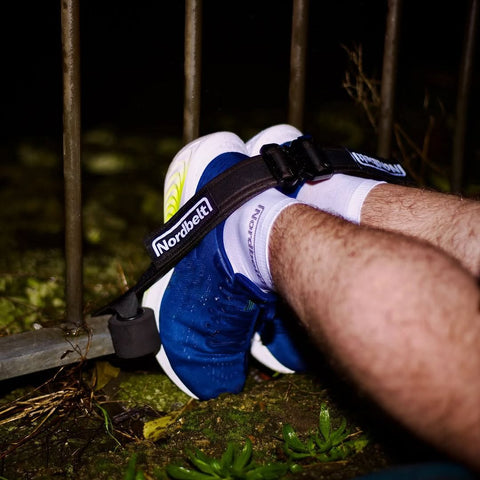
Use a sturdy exercise bench or box that cannot slide or tip. A wheeled chair, a stack of loose cushions or a slippery edge is not a reliable substitute. Choose a surface on which your leg can rest comfortably. The opening photo only shows a bench check, not a Copenhagen demonstration or a prescribed bench height.
- Clear the floor and place a mat under your forearm if needed.
- Lie on your side with your elbow beneath your shoulder. Place your upper leg on the support.
- For an assisted knee variation, keep the lower knee on the floor. Press gently through the upper leg and lift your pelvis.
- Keep your trunk and pelvis steady, breathe normally and lower yourself under control. Stop before you sag or twist.
Sharp pain in the groin, knee or shoulder is not a signal to push through. Stop the exercise; ask a physiotherapist or doctor to assess persistent or recurring symptoms. This guide helps you choose an exercise, not treat groin pain.
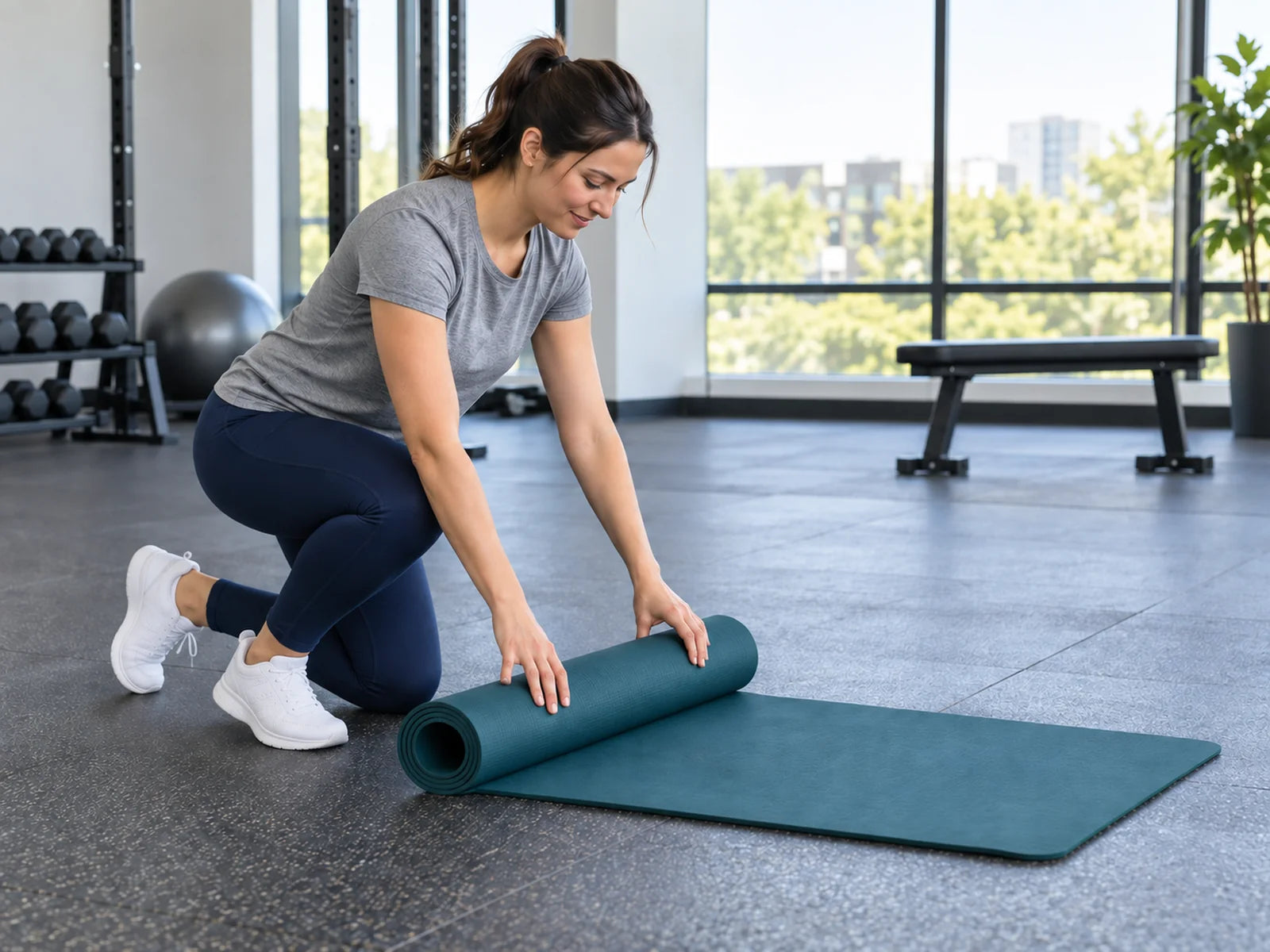
Context image: preparing the exercise space; the Copenhagen plank is not being performed here.
Take your Nordic curl from the first rep to week 10.
A concrete 7-page plan: build up week by week, without pushing too fast.
- 01A clear week-by-week progression
- 02Technique and the mistakes to avoid
- 03A simple log you will actually use

≤51%
✓Backed by research
Van Dyk et al., 2019: meta-analysis of programmes with NHE. Not an effect test of Nordbelt or this protocol.
Open the download page again or check the email we sent you.
Open the download page ↗Progress with comparable notes
Keep the same support, leg position and assistance first. Then change one element, such as assistance or duration. A longer hold with more help does not prove better execution. Make the exercise easier whenever you cannot maintain the chosen position calmly.
This fictional training log helps distinguish variations; it is not a training prescription:
| Log entry | Setup | Meaning |
|---|---|---|
| A | Knee on the same bench, lower knee on the floor, short controlled hold | A starting point to repeat |
| B | Foot on the bench, lower foot on the floor | A new variation; not directly comparable with A |
| C | The same setup as A, held steadily for longer | A comparable observation, without inferring a percentage gain in strength |
What does research say about this progression?
In Polglass and colleagues’ study, seventeen male professional footballers completed an eight-week supervised programme; twenty-five players had been recruited. Their measured eccentric hip-adduction strength increased. There was no control group, and normal training continued. This does not establish a personal minimum dose or a guaranteed result for beginners (Polglass et al., 2019).
Train your hamstrings separately too?
If you also want to do Nordic curls at home, that requires a separate setup with both ankles secured. Nordbelt for strength training at home provides ankle fixation without a training partner or a large machine. You still need a suitable anchor point, knee support and room to catch yourself with your hands. It is not a support for the Copenhagen plank or an adductor-training device; choosing between knee and foot support does not require a purchase.
The comparison of Nordic curls and Romanian deadlifts helps with that separate hamstring decision. Keep an additional exercise distinct from the question of how to perform the Copenhagen plank.
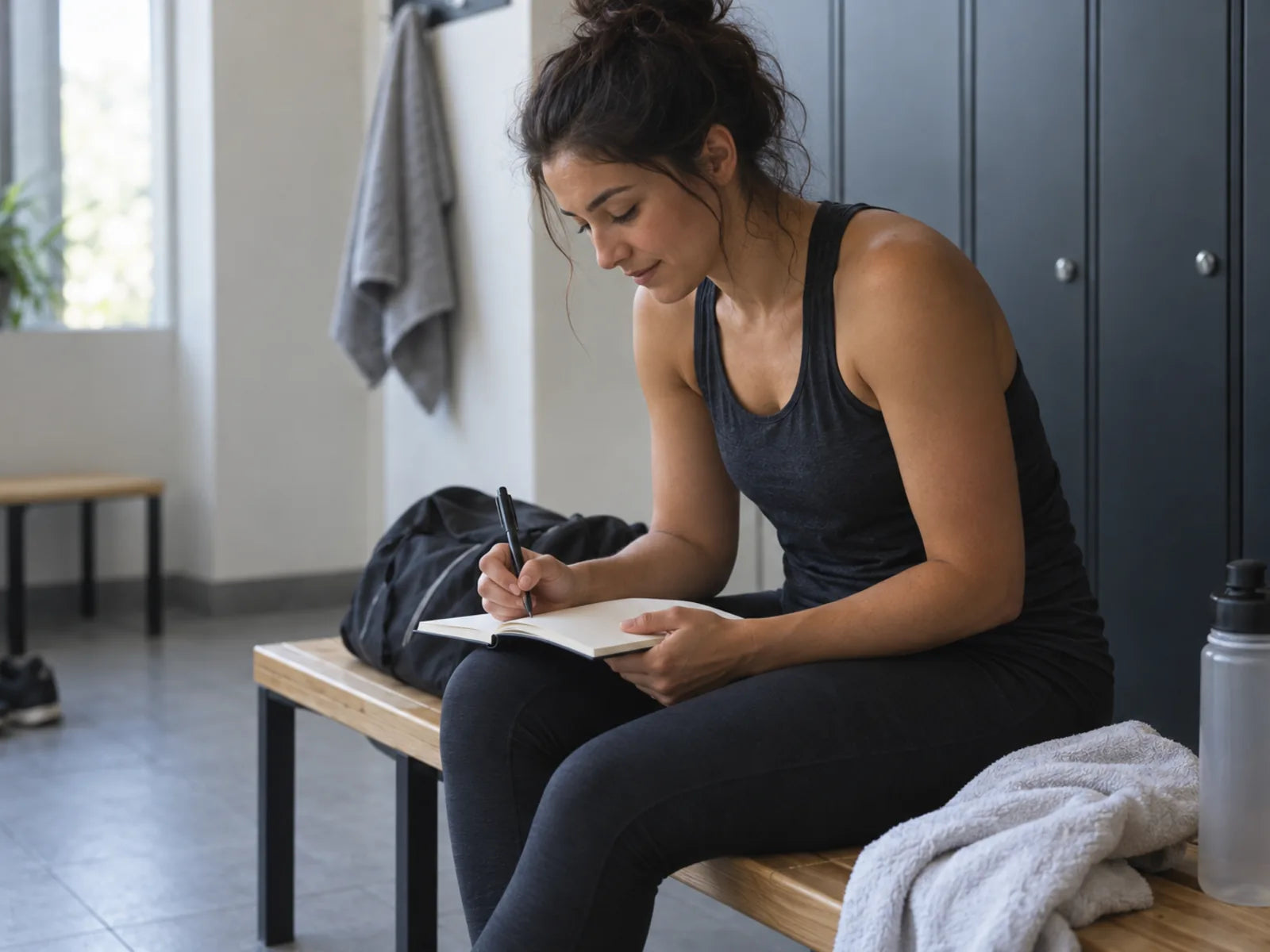
Context image for recording your setup; the notebook does not show a tested programme or measured results.
Frequently asked questions
How long should a beginner hold the Copenhagen plank?
There is no universal number of seconds that suits every beginner and every variation. Choose a short hold you can finish calmly and record the technique. The studied progression for professional footballers was supervised and did not establish a minimum dose for beginners training alone. Do not copy its hold times as a personal target (Polglass et al., 2019). If you mostly sag or hold your breath, make the variation easier before adding time. Also note how you exited the position and how the exercise felt the next day. This helps distinguish an uncontrolled attempt from a deliberately harder variation.
Is foot support always better than knee support?
No. The support point changes the lever, so it changes the task. A controlled knee variation is more useful than a foot variation you can only sustain by twisting or sagging. Record where the lower leg is placed too, because it can help bear weight. You do not need to reach the longest lever as quickly as possible. Choose a variation that fits your aim and that you can repeat in the same way next time.
Does the Copenhagen plank prevent groin injuries?
A single plank offers no guarantee. In a randomized study involving thirty-five male semiprofessional football teams, a specific adductor programme led to fewer self-reported groin problems than normal training. It was a programme spanning preseason and the competitive season, not an arbitrary hold time or treatment for existing pain (Harøy et al., 2019). Do not use that result as proof that every plank variation prevents injury or that pain during exercise can be ignored.
Can I do this exercise without a training partner?
A supported plank can be performed with a suitable fixed support. Check that your leg will not slip and that you can enter and leave the position calmly on your own. That does not make a bench variation identical to a dynamic version with a partner. Without suitable support, improvising with unstable furniture is not a good solution. Ask someone to demonstrate the setup or an alternative if you do not know where to support the leg comfortably.
Is a Copenhagen plank the same as a Nordic curl?
No. In the Copenhagen plank, you support yourself sideways through the upper leg; in a Nordic curl, you work from a kneeling position with both ankles fixed. These are different tasks and setups. The word “isometric” only means holding a position; it does not mean exercises train the same muscles or movement. The guide to the isometric Nordic curl explains that different exercise separately.