

Cannot touch your toes: test and plan


Not being able to touch your toes usually does not mean a muscle is damaged or permanently short. It is often a mix of hamstring mobility, hip hinging, pelvic control, calf tension, long sitting and how confidently your back moves. Use the toe-touch as a rough self-check, not as a diagnosis. Test gently, avoid forcing the end range and then build mobility plus light strength.
In brief
The useful question is not only how deep you can go, but what stops the movement. Sometimes the hamstrings are stiff. Sometimes the pelvis does not tilt well. Sometimes your back stays protective after long sitting. Use this article together with stretch or strengthen tight hamstrings and hamstring exercises when you want a wider exercise overview.
Toe touch is not a diagnosis
Toe-touch and sit-and-reach tests are useful rough checks, but their validity for hamstring flexibility is only moderate (Ayala et al., 2012). Limited hamstring flexibility can be one factor associated with later low back pain, but it is not a complete diagnosis (Sadler et al., 2017). In athletes, toe-touch style tests can miss part of the picture (Muyor et al., 2014). Hamstring stretching may help some people with low back pain when dosed calmly (Gou et al., 2024), and pelvic control matters during stretching (Han et al., 2016). Hip and core work can support function in non-specific low back pain (Kim and Yim, 2020). Nordic hamstring training is a later strength option, not the first test (Medeiros et al., 2020).
Why you may not reach your toes
Common reasons are limited hamstring range, calf tension, an unfamiliar hip hinge, protective back tension after long sitting and too much effort during the test. Compare the result before and after a short walk. If the movement changes quickly, it is probably not a fixed muscle length problem.
- Keep the knees slightly soft during the first check.
- Stop at clear stretch, not at pain.
- Notice whether the tension is in the hamstrings, calves, back or behind the knee.
- Use hamstring exercises for tight hamstrings if stiffness is the main issue.
How to read the result
Use the first score as a baseline, not as a verdict. A useful home check is to note where the first clear stretch appears, then retest after walking, hip hinges and light bridges. If the reach improves, the system responds to movement and warm-up. If nothing changes, reduce intensity rather than pulling harder. Consistency matters more than depth: repeat the same setup, the same breathing and the same knee position so the next test actually compares the same movement.
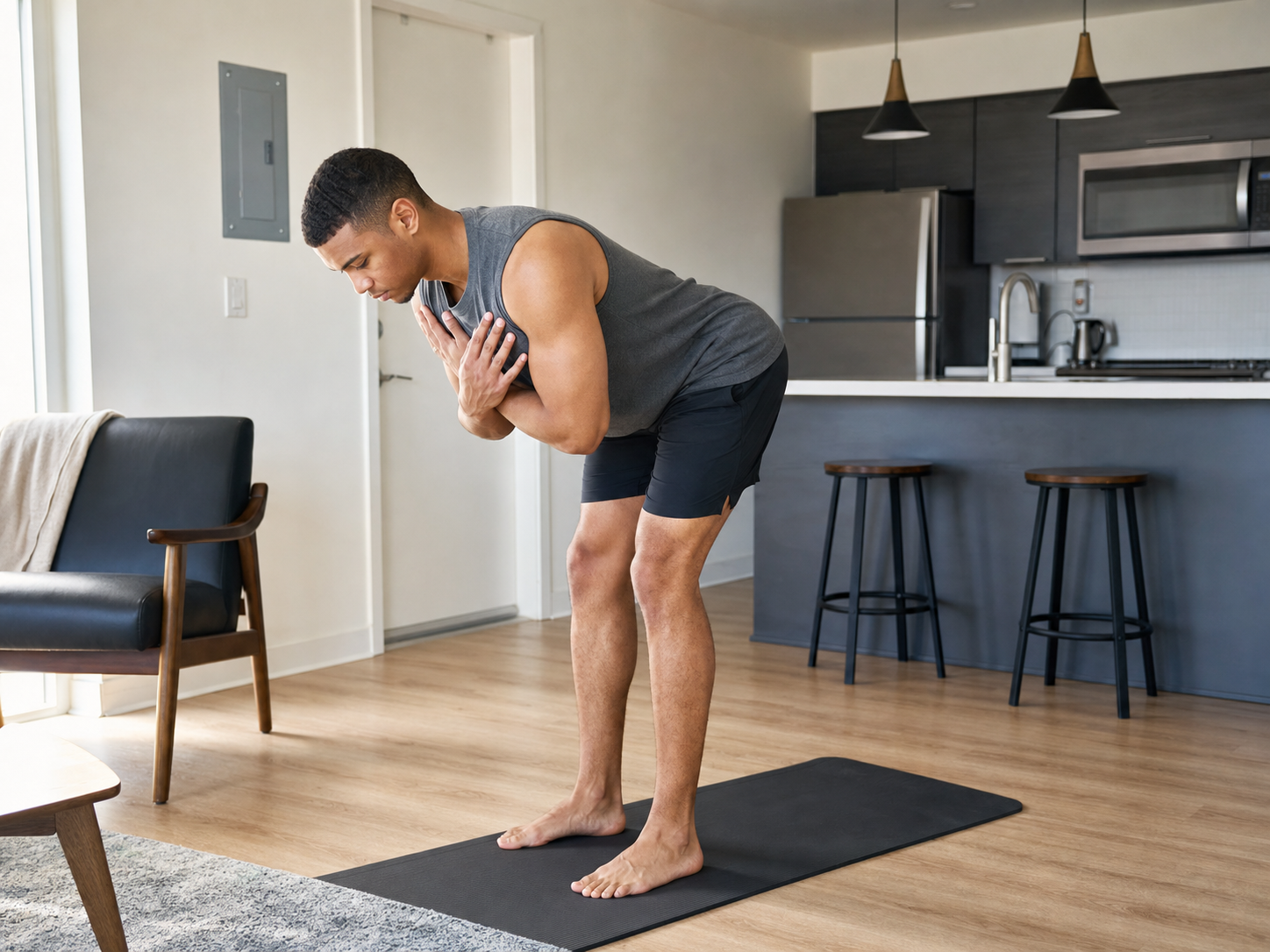
A safe hamstring tightness check
A safe check is simple: stand tall, soften the knees, breathe out, hinge from the hips and stop at the first clear stretch. Repeat with more knee bend. If the second version is much easier, hamstrings probably matter. If the back still blocks first, learn the hinge before chasing depth.
- Walk for two minutes.
- Do six slow hip hinges.
- Hold a mild hamstring stretch for 20 seconds each side.
- Do eight glute bridges.
- Retest without trying to set a record.
When forward bending feels blocked
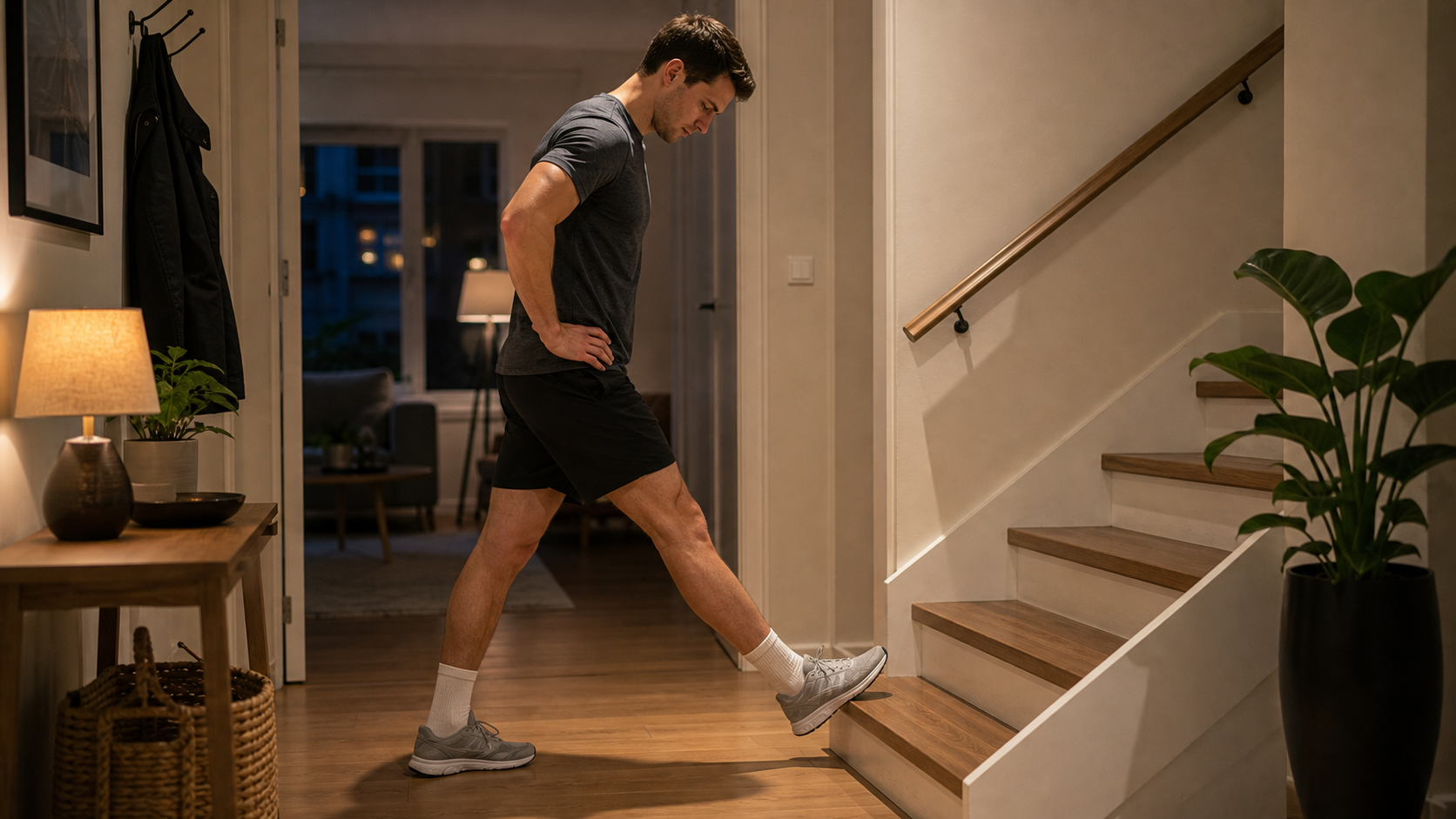
Start with two minutes of walking, six slow hip hinges, a mild hamstring stretch with the heel on a low step, eight glute bridges and one relaxed re-test. Keep the stretch easy. If it gives tingling, sharp pain or symptoms below the knee, stop and choose assessment rather than more stretching.
From mobility check to strength
When stretching helps only briefly, add easy control. A good start is hip hinges, glute bridges, heel slides and later light hamstring curls. If lower back symptoms are part of the picture, read lower back pain from tight hamstrings. If pain is mainly at the back of the thigh, use pain in the back of the thigh. For a practical routine, see home hamstring exercises.
When it is not simple stiffness
Get professional assessment if symptoms travel below the knee, if you notice numbness, tingling, clear strength loss, pain after trauma, night pain, fever, or steady worsening. Do not keep forcing the same stretch when the response is sharp or nerve-like.
FAQ
Is it bad if I cannot touch my toes?
Usually no. It is a movement signal, not a diagnosis. It matters more when it comes with pain, radiation, numbness, weakness or worsening symptoms.
Does it mean my hamstrings are too short?
Not automatically. Hamstrings may contribute, but hips, calves, pelvis, back tension and test technique can all limit the movement.
Which test is safe?
Use a gentle standing toe-touch with soft knees or a heel-on-step stretch. Stop at stretch, not pain, and compare before and after walking.
What should I do if bending forward feels blocked?
Use short walks, mild stretching, hip hinges and light bridges. Do not try to force a daily record; aim for repeatable calm movement.
How long does it take to touch my toes?
Some people notice change in a few sessions, but lasting progress usually needs several weeks of repeated mobility, control and light strength.
Later strength work
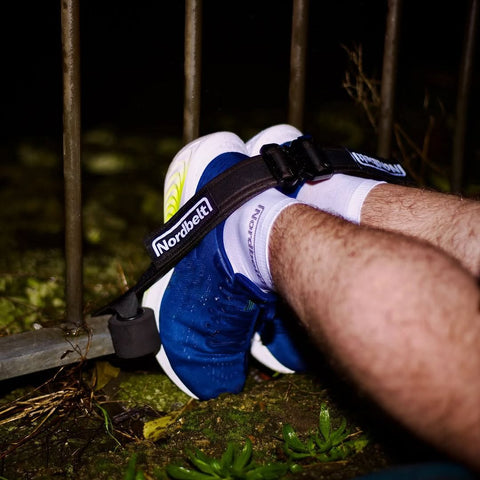
During slider curls, your heels must remain free to slide across the floor. Nordbelt provides ankle fixation for supported Nordic curls. Check the anchor, knee padding and space for early hand support, and choose a progression you control. With pain or a recent injury, have suitability assessed first.
First check setup and regressions in the Nordbelt how-to guide. When you are ready to review the tool, go to Nordbelt.