Sciatica or hamstring pain: how to tell the difference

When pain travels down the back of the leg, it is easy to label everything as a hamstring problem. Sometimes the hamstring is the main tissue. Sometimes the signal comes from the low back or sciatic nerve. The useful question is not the label on day one, but which pattern you see: local muscle pain that reacts to stretch and contraction, or nerve-like symptoms that travel, tingle or change with back position.

4.8/5 reviews 120+ athletes preceded you 30-day return period
Open manual
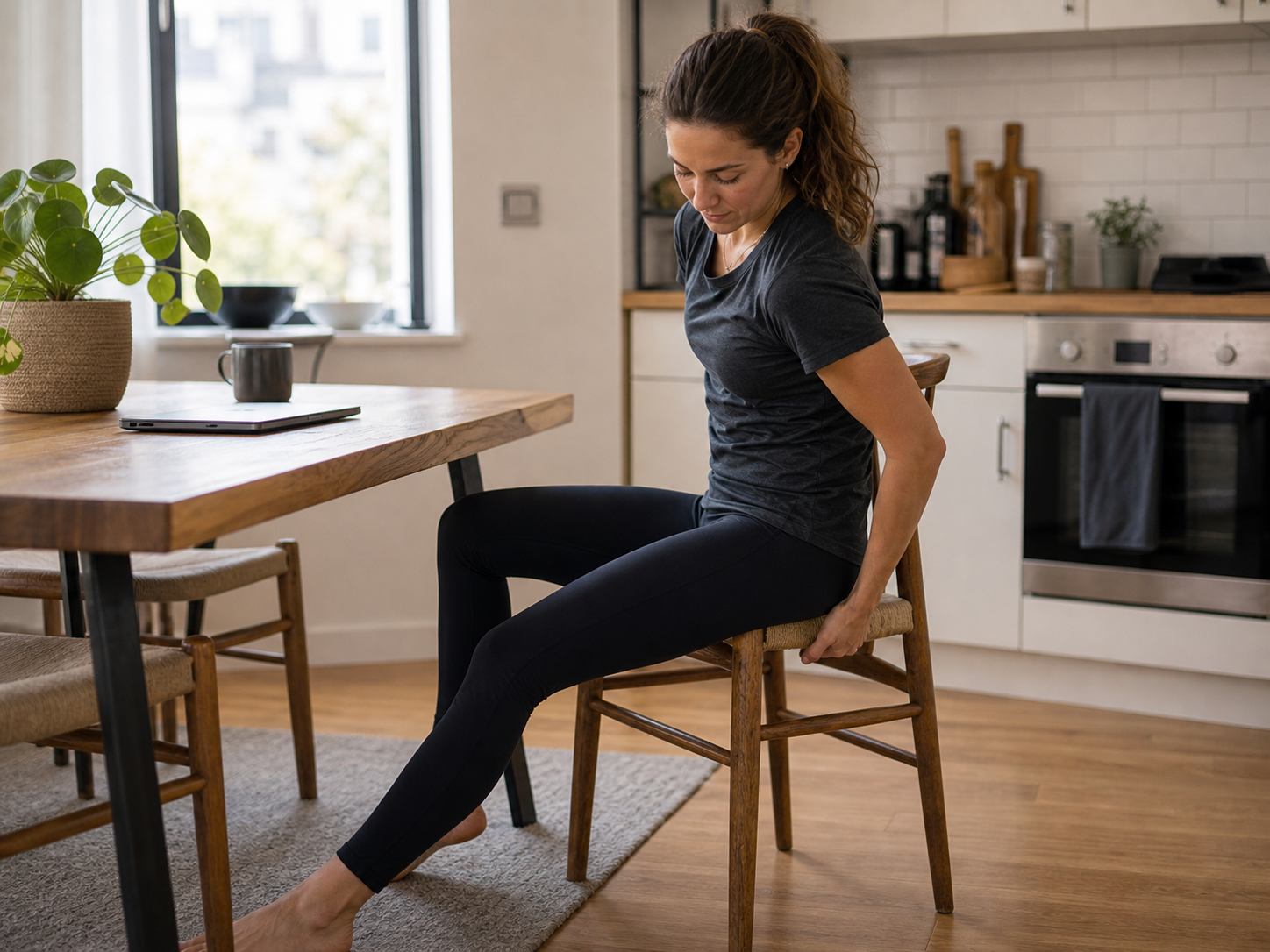
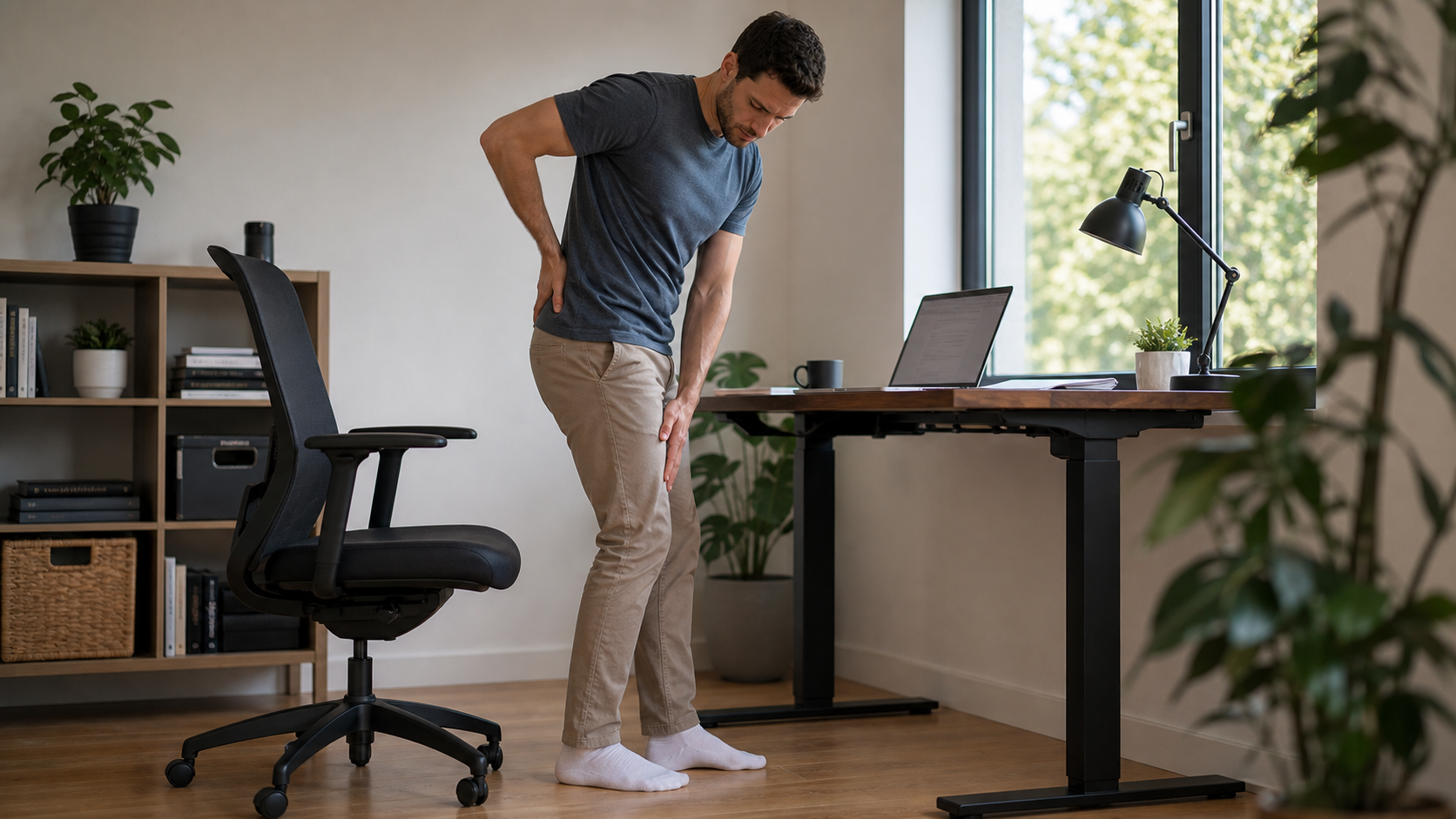
Young adult notices back-of-thigh stiffness after getting up from a desk chair.

The quick distinction

Use this first pass before you decide what to do next. It does not replace a clinician, but it helps you avoid the common mistake of stretching a nerve-like symptom as if it were a simple muscle tightness.

  • Sciatica-like pain often starts in the lower back or buttock and can travel below the knee.
  • Hamstring pain is usually more local in the back of the thigh and often feels clearer during sprinting, hinging, bending forward or resisted knee flexion.
  • Both can coexist, especially when you protect the leg for several days and the whole posterior chain becomes guarded.

What the symptoms usually feel like

Sciatica is a symptom pattern, not one single diagnosis. It may involve nerve root irritation, disc-related irritation or another source that sensitises the sciatic nerve pathway. The pain may feel sharp, electric, burning or deep, and it can be accompanied by tingling, numbness or weakness.

A hamstring problem is usually easier to localise. People can often point to a specific spot in the back of the thigh or near the sitting bone. Stretching the hamstring, accelerating, decelerating, bending forward or resisting a curl can reproduce it more directly than changing back posture.
Clinical reviews emphasise that sciatica presentations vary and that symptom distribution, neurological signs and response to movement matter more than one isolated test. Jensen et al.

Three calm checks you can do

Run these checks gently and stop if symptoms increase sharply. The aim is to compare patterns, not to prove pain tolerance.

  1. Change back position: sit tall, slump gently, then return to neutral. If the leg symptoms change a lot with the back and neck position, nerve sensitivity is more likely.
  2. Contract the hamstring: press the heel lightly into the floor or bend the knee against your hand. Local back-of-thigh pain points more toward hamstring involvement.
  3. Map the symptoms: note whether the feeling stays in one area or travels below the knee with tingling, numbness or calf/foot symptoms.

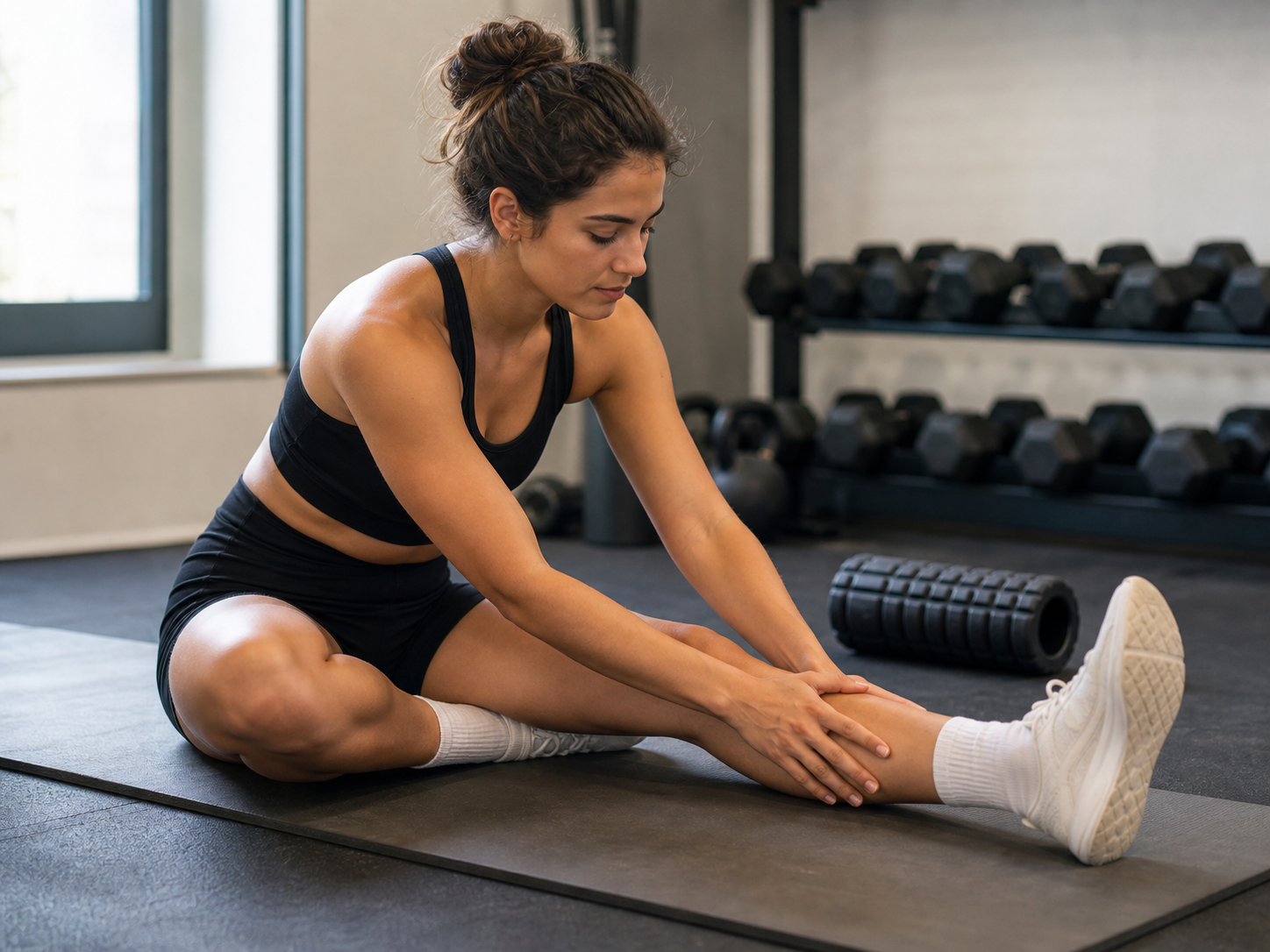
Young adult practises a controlled hamstring heel slide on a small towel.

How to decide without over-testing

A useful rule is to track what changes the symptom after a movement, not only during it. If a gentle hamstring contraction feels acceptable but the leg tingles more when you sit slumped, protect the nerve pathway first. If back position barely changes anything but a light bridge or heel dig recreates a local spot, manage it like a hamstring load problem.

Keep a short note for two days: where the pain starts, whether it travels below the knee, which movements calm it, and whether symptoms are better, worse or unchanged the next morning. That pattern is more useful than repeating strong tests every hour.
Safe first steps for the next 48 hours

If you are unsure, start with the least provocative option. Avoid aggressive stretching into nerve symptoms, heavy hinges, sprinting and repeated pain tests. Keep walking easy if it feels better afterwards, and choose positions that reduce symptoms rather than chasing a strong stretch.

  • For nerve-like symptoms: short walks, position changes and gentle unloaded movement usually make more sense than hard stretching.
  • For local hamstring pain: use a pain-light range, avoid explosive work, and begin with isometrics or small controlled movements.
  • If symptoms are worsening, spreading, or paired with neurological changes, treat that as a medical assessment issue rather than a training problem.

For more context, use the guides on pain at the back of the thigh, low back pain with tight hamstrings, hamstring pain, hamstring exercises for pain and Nordbelt How-to guide.

When to get assessed

Get professional assessment urgently if you have progressive weakness, numbness around the saddle area, bladder or bowel changes, fever, trauma, unexplained weight loss or severe night pain. Also get assessed when leg pain keeps travelling below the knee or does not settle with a few days of sensible activity modification.
Systematic reviews and clinical guidance describe sciatica as a condition where red flags, neurological signs and functional loss need careful triage. Soar et al. Evidence reviews on neural mobilisation also show why nerve-related symptoms should not be treated as simple muscle tightness. Nasser et al.

How to return to loading

Once symptoms are calm, rebuild by matching the load to the pattern. A local hamstring issue usually tolerates a staged return from isometrics to sliders, hip hinges, bridges and later faster running. A nerve-dominant pattern often needs symptom-guided exposure, back and hip tolerance work, and slower progression into hamstring loading.

Hamstring rehabilitation research supports progressive loading and criteria-based return instead of guessing from one pain-free day. Hickey et al.

Nordbelt setup with ankle strap, round slider pad and storage pouch.

FAQ

Can sciatica feel like a pulled hamstring?

Yes. Sciatica can be felt in the buttock and back of the thigh, which can mimic a hamstring strain. Tingling, numbness, symptoms below the knee or strong changes with back position make nerve involvement more likely.

Should I stretch if I am not sure?

Do not force a stretch into travelling or tingling symptoms. Choose gentle movement and get assessed if the pattern is unclear or worsening.

When can I train the hamstring again?

Start when daily movements are calm and light contractions do not increase symptoms later that day. Progress gradually and stop using sharp pain as a training target.

Nordic Hamstring Curl Tool

Strengthen your hamstrings to top-sport standards.

Up to 50% fewer hamstring injuries, now possible with Nordbelt at home or wherever you train. Up to 50% fewer injuries.

Works on door, bench, fence or beam. Includes storage bag + training protocol. Up to 50% fewer injuries No partner needed.
No partner needed. Start within 1 minute. Can be used anywhere: at home, gym or field Developed with professional physio input
Trustpilot 4.4/5 4.8/5 Google Reviews4.8/5 20+ partner physio practices
30 days of risk-free testing Secure checkout Ordered before 11 PM, delivered tomorrow
Strengthen your hamstrings to top-sport standards.

Trusted by professionals and athletes

Trustpilot 4.4/5 Google Reviews 4.8/5
Google Reviews 4.8/5
We use the Nordbelt in our physio practice and recommend it for recovery, performance and specific hamstring training.
Chantal - Sports physiotherapist MSc Google review
Trustpilot 4.4/5
G Google Reviews 4.8/5

Trusted by professionals and athletes

★★★★★ 4.8/5 120+ athletes 30-day return period 20+ partner physio practices
Google Reviews 4.8/5

We use the Nordbelt in our physio practice and recommend it for recovery, performance and specific hamstring training.

Chantal - Sports physiotherapist MSc Google review

Easy and quick to use, anywhere

Super fast and easy to use: in three short steps you are ready for your first rep.

1

Choose your setup: door, fitness bench or fence.

Place Nordbelt under a sturdy door and pull it through the buckles.

2

Clip in and adjust the length.

Clip the buckles closed and adjust the length for the right fit.

3

Start immediately with your first set.

You are locked in. Time for Nordic Hamstring Curls and stronger hamstrings.

Where can Nordbelt be used?

Use Nordbelt everywhere, regardless of your training location

Swipe for more examples

Nordbelt attached to door

Nordbelt attached to door

Doors

Place under a sturdy door and train at home without additional equipment.

View setup in manual
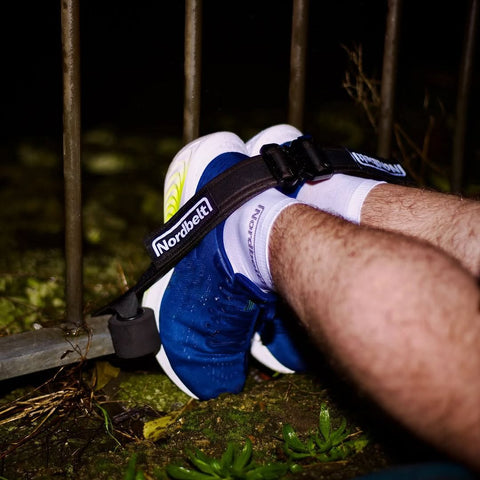
Nordbelt on fence or beam

Nordbelt on fence or beam

Fences or beams

Simply attach to a fence or beam and train on the field or in the park.

View setup in manual
Nordbelt on fitness bench

Nordbelt on fitness bench

Fitness bench

Use Nordbelt on almost any stable fitness bench and train directly in the gym.

View setup in manual

Evidence

Up to 50% fewer hamstring injuries with consistent Nordic Hamstring Curl training.

The Nordic Hamstring Curl is the safest and strongest proven exercise for strong, resilient hamstrings.

*Source: Petersen et al., BJSM 2011

Nordic Hamstring Curl animation

Evidence-basedResearch shows NHC can be built up safely, including during hamstring rehab.

Top sport provenWidely used in elite sport (football and athletics) and directly usable at home, gym or field.

A few reps per weekHighly studied and safe to progress gradually with controlled loading.

Open: view protocol, clinic quotes and source detail

Programmes with the Nordic Hamstring Exercise. 51%  fewer hamstring injuries reported.

The Nordic Hamstring Exercise is a strongly researched training principle; programmes with NHE report up to 51% fewer hamstring injuries.

Nordbelt facilitates the Nordic Hamstring Curl and makes the exercise practical, repeatable and controlled in clinic, sport setting and at home.

Progressive protocol

10-week progression protocol included

A practical progression the clinician can adapt to load tolerance, technique and the agreed pathway.

Reps per session
  1. 5 5×1 W1
  2. 6 6×2 W2
  3. 7 7×3 W3
  4. 8 8×3 W4
  5. 9 9×3 W5
  6. 10 10×3 W6
  7. 10 10×3 W7
  8. 12 12×3 W8
  9. 12 12×3 W9
  10. 12 12×3 W10

Source: van Dyk N, Behan FP, Whiteley R. Br J Sports Med. 2019;53(21):1362-1370. PMID: 30808663. DOI: 10.1136/bjsports-2018-100045.

“Programmes that include the Nordic Hamstring Exercise reported up to 51% fewer hamstring injuries.”
van Dyk, Behan & Whiteley · Br J Sports Med · 2019
“Nordbelt makes the same exercise setup practical in the treatment room and at home.”
Nordbelt clinic flow
−51% hamstring injuries reported in programmes with Nordic Hamstring Exercise
8,459 participants in the systematic review and meta-analysis
10 weeks practical progression plan for guided instruction
1 setup recognisable in clinic, sport setting and at home

Nordbelt is a training tool for performing the Nordic Hamstring Curl. Its use within treatment, rehabilitation or return-to-play is determined by the treating professional. Always use a stable anchor point, correct attachment and suitable load.

Check Nordbelt via Trustpilot and Google Reviews

Check external reviews for extra confidence before ordering.

4.8/5 Google reviews
4.4/5 Trustpilot reviews
GooglePhysio
A great solution for performing the Nordic Hamstring Curl properly and easily. Useful during my work as a physiotherapist and usable in different locations.
GooglePhysio
Very good tool for performing the Nordic Hamstring Curl. A must-have for every physiotherapy clinic. Very happy with it!

Real videos

See exactly what you get and how to start safely

Real unboxing and short demos: less doubt, faster first set.

@Nordbelt open Instagram
How-to video

Set up Nordbelt at home

See how to attach, adjust and prepare Nordbelt at home for your first safe repetition.

Unboxing

First impression in 15 sec

See the packaging, finish and size exactly as it arrives at home.

Review

Instagram unboxing

Raw Instagram unboxing for a realistic view of delivery and first setup.

Meet the team behind Nordbelt

Built by a team with a medical and sports science base

When I suffered a hamstring injury, I noticed how difficult it was to train properly at home without expensive equipment or help from others. That's why I developed Nordbelt.
  • Originated from real injury experience
  • Further developed with medical professionals
  • Practically tested for home, field and gym

Nordic Hamstring Curls without a partner, bench or hassle

Nordbelt makes one of the best hamstring exercises practical to perform: at home, on the field or in the gym. Fixed in under a minute and ready to train.

01

No partner needed

Secure your feet independently and train whenever you want. No teammate, physio or training partner needed.

02

No expensive Nordic bench needed

Use a sturdy door, gym bench, fence or beam. You do not need to buy a large or expensive machine.

03

Ready in under 1 minute

Compact, quick to secure and easy to carry in your sports bag. Ideal for home, practice or the gym.

04

Training protocol included

You get clear guidance to build up calmly and work consistently on hamstring strength.

It's that easy

Watch the full flow on video

In a few seconds, see exactly how to place, adjust and start training with Nordbelt.

4.8/5 customer score 30-day return period Used by 20+ partner physio practices

Answers to frequently asked questions

How do I use the Nordbelt™?

You use Nordbelt™ to perform the Nordic Hamstring Curl with a stable attachment to a door, fitness bench, fence or beam.

Choose a fixed spot, click the buckle closed, adjust the band to size and immediately start with controlled repetitions. This way you can train consistently at home, outside or in the gym.

Can I use the Nordbelt™ if no door is available?

Yes. Nordbelt™ also works on fitness benches, fences and beams, so you are not dependent on a door.

This means you can train almost anywhere: at home, on the sports field or in the gym. Always choose a sturdy, stable mounting location for a safe implementation.

What is included with the purchase?

With your order you will receive the Nordbelt™ itself, a storage bag and a practical manual with training protocol.

So you immediately have everything you need to start safely and follow your build-up in a structured manner.

Can I also order outside the European Union?

We currently ship within Europe and to England.

Orders outside this region are not yet available. For business or specific shipping questions, please contact contact@nordbelt.com.

What does shipping cost?

Shipping within the Netherlands is free.

For delivery outside the Netherlands, shipping costs are calculated automatically based on your location and the available carrier. You always see this clearly during checkout.

How soon can I start training?

Most athletes can start their first set within about 1 minute.

The quick setup and fixed protocol make it easy to incorporate your training into your weekly routine.

Is Nordbelt suitable for rehabilitation of hamstring injuries?

Nordbelt™ is widely used for controlled hamstring building, also in a rehabilitation context.

Always build up progressively and follow the advice of your physiotherapist or doctor in case of complaints or recovery process.

Do I need additional equipment or a partner?

No. You don't need an expensive machine or a training partner to get started.

With Nordbelt™ you create a stable setup on a door, bench, fence or beam and you can train independently.

Can I return if the product does not suit me?

Yes, you have a 30-day return period on your order.

If you return, the return shipping costs are borne by the customer.

This way you can evaluate Nordbelt™ within your own training situation without unnecessary purchasing risk.

Where can I find the complete manual and training protocol?

You will find the complete explanation on the How-to Guide.

You will also receive a practical manual with protocol upon purchase, so that you can start straight away in a structured manner.

For clinics, teams and groups

Work with multiple athletes?

Request a trial Nordbelt for your clinic or view Nordbelt for sports clubs, teams and gyms.

Strengthen your hamstrings to top-sport standards.

Ordered before 11 PM, delivered tomorrow 30 days of risk-free testing Secure checkout
Strengthen your hamstrings to top-sport standards.

Train anywhere. Immediately feel the Nordbelt vibe.

Start today with stronger hamstrings: one compact tool with which you can immediately train safely and effectively at home, outside and in the gym.

Ready to start immediately Less risk of injury Can be used anywhere