

Resistance bands: comparing kg ratings and colours


To compare resistance band kg ratings, you also need to consider stretch. The number does not represent a fixed weight throughout the movement. Besides the rating, you need the band type and the elongation associated with that value. A colour or a range on the packaging is not enough. First check which test condition the manufacturer specifies. If none is given, treat the kg rating as incomplete product information, not a fixed training load. Research on elastic tubing explains why length and elongation matter (Thomas et al., 2005).
What does a band's kg rating mean?
A label such as “15 kg” may make you think of a weight you can lift. With an elastic band, first establish the length at which that value applies. Does it describe resistance at a particular percentage elongation, the upper end of a stated range, or an unspecified test method? These are different kinds of information. Do not fill in missing details yourself.
A mechanical study measured the relationship between force and percentage elongation in Thera-Band tubing. The researchers did not find a proportional relationship from the very start of the stretch: the initial phase differed from the later phase. They tested material in a machine; they did not study muscle growth or your personal training load (Patterson et al., 2001).
This does not make the label useless. It becomes useful when linked to the correct product series and test condition. Keep the packaging or product information. A loose band identified only by colour will be harder to compare with a later purchase.

Calculate elongation without inventing a force value
Percentage elongation describes how much longer the same section of material becomes relative to its resting length. It is a length measurement, not a force measurement. The calculation is: additional length divided by resting length, multiplied by one hundred.
For example, a resting section measures 40 cm and stretches to 60 cm. The extra length is 20 cm; dividing 20 by 40 gives 0.5, so elongation is 50%. If that same section reaches 80 cm, elongation is 100% and the final length is twice its resting length. These figures only illustrate the calculation. They do not prescribe a safe stretch limit.
You still cannot infer how many kilograms of resistance you have. You would need the force curve for your particular material. Thomas studied specific Thera-Band and Cando tubing. Do not turn those relationships into a universal conversion chart for every flat band, loop or other brand (Thomas et al., 2005).
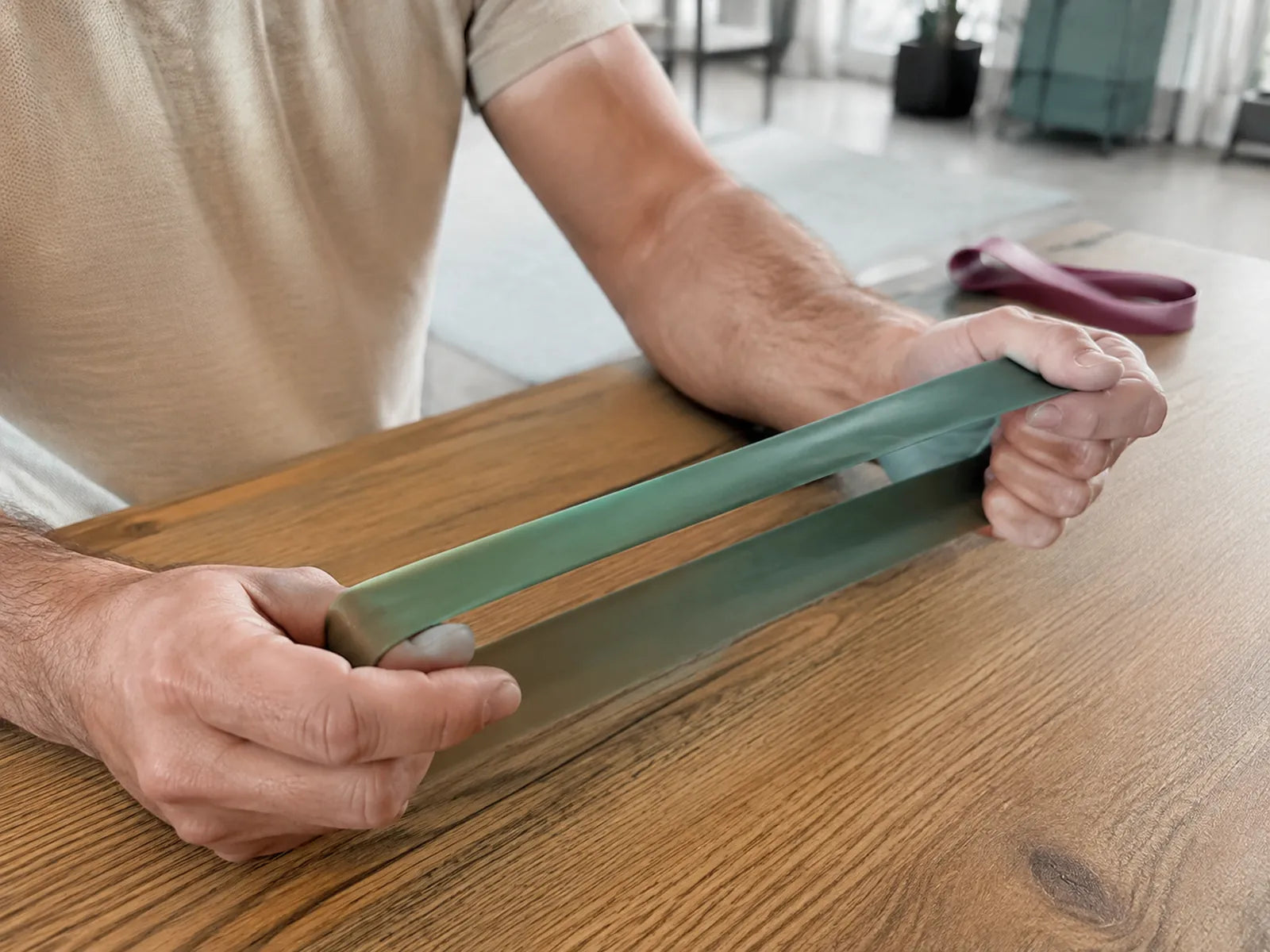
The hands illustrate material elongation. This image is not a force measurement and does not demonstrate a band curl or a recommended maximum stretch.
Compare two labels under the same conditions
Place both products' information side by side before choosing by colour or the largest number. The following table is an editorial purchasing checklist, not a table of measured band resistance.
| What does the label show? | How can you use it? | What else do you need? |
|---|---|---|
| A colour only | Identify the band within the stated series | The brand, product series and corresponding resistance information |
| One kg value | Look up a specified measurement point | The elongation and method used to determine that point |
| A range in kg | Check the lower and upper stated values | The lengths or test conditions associated with both ends |
| A force curve with product type and elongation | Compare measurement points under the stated conditions | Confirmation that your band and setup match that description |
A green band from another brand need not be equivalent to your current green band. Even “heavier” only becomes meaningful when you specify the elongation used for comparison. If the seller omits the test conditions, you can still consider dimensions, attachment and intended use. An accurate load comparison remains unresolved.
Take your Nordic curl from the first rep to week 10.
A concrete 7-page plan: build up week by week, without pushing too fast.
- 01A clear week-by-week progression
- 02Technique and the mistakes to avoid
- 03A simple log you will actually use

≤ 51%
✓Backed by research
Van Dyk et al., 2019: meta-analysis of programmes with NHE. Not an effect test of Nordbelt or this protocol.
Open the download page again or check the email we sent you.
Open the download page ↗Make your setup repeatable
For a training log, a recognisable setup is often more useful than a seemingly exact number. Record the brand and band type, the resting section used, the anchor point, and your starting and finishing positions. Describe how the band runs: a single strip and a doubled loop are not identical measurement setups. Do not derive a made-up kg value from these notes.
Measure between the same identifiable points on the same section each time. With a closed loop, do not confuse the circumference with the length of one stretched section. Follow the product's attachment and elongation instructions. A calculation cannot establish whether an anchor point is suitable.
To apply this to knee flexion with a band, consult the separate resistance band hamstring curl guide for exercise technique. If you are still choosing a way to train at home, use the home hamstring equipment guide. A better-described band is not, by itself, a reason to change exercises.
Which additional exercise might you choose?
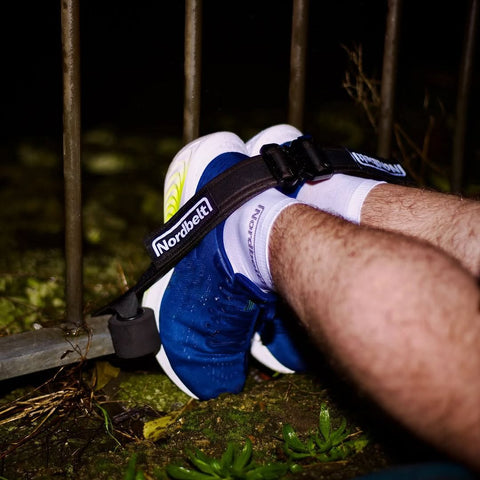
The label question is now answered: compare test conditions and record your setup. Choosing another exercise is a separate decision. If you also choose to perform bilateral Nordic curls at home with your knees supported, Nordbelt ankle fixation can secure your feet to a suitable anchor point without a partner or large machine. It does not measure or calibrate band resistance and does not replace an elastic band. You do not need it to compare band labels.
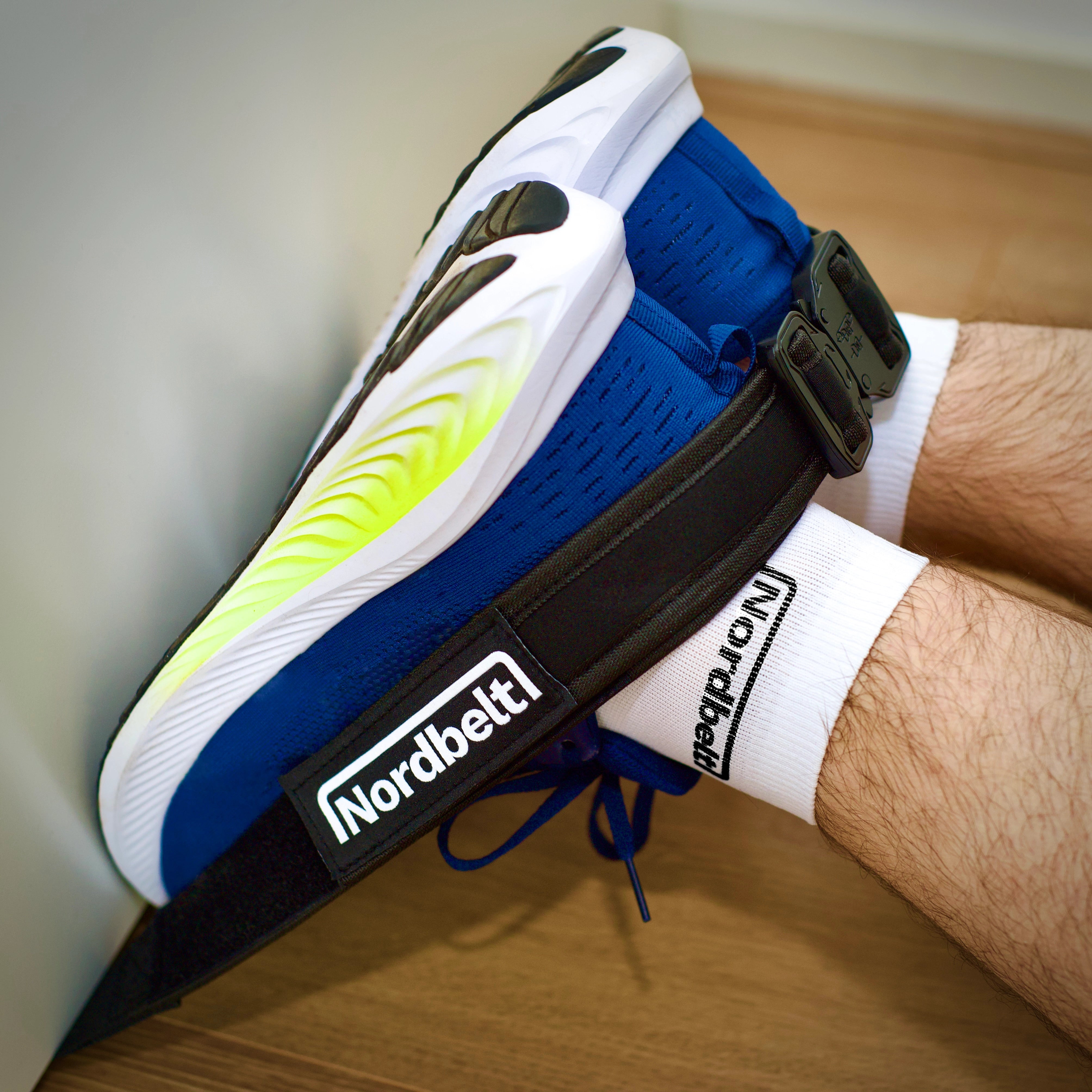
The photograph shows the fit of the ankle straps, not the complete exercise or verification of the anchor. Read the attachment instructions and the separate Nordic hamstring curl explanation if you choose that movement.
Two examples of a useful decision
An imaginary shopper sees two advertisements with the same kg rating. One names an elongation percentage and a product series; the other only says “heavy”. This does not establish that they are equivalent or that the first is stronger. Only the first describes a measurement point you can check. Ask for the missing conditions in the second advertisement before selecting a precise resistance.
A second imaginary athlete uses the same band but moves the mat farther from the anchor, while still recording only the colour. The log now misses a change in setup. A more useful approach is to record the new position and decide which setup to repeat next time. This makes the comparison clearer without claiming to have measured force at home.
When replacing a band, take that description with you: band type, dimensions, attachment and movement space. “I used the green one” tells you less than a photograph of the packaging with a short setup note. These two examples support a decision; they are not a tested training protocol or a promise of results.
Frequently asked questions
Is a 15 kg band the same as a 15 kg dumbbell?
No. The labels do not prove equal loading during an exercise. A band's force value relates to elongation, which is the relationship the material study investigated (Thomas et al., 2005). Force on the material also does not describe the load on a joint. There is therefore no general conversion chart for replacing a machine weight or dumbbell.
Do colours mean the same thing across brands?
Treat colour as information within a specific product series. Find the corresponding chart or product description and check that you are comparing the same version. Do not use your old band's colour as the sole reason to buy another brand. Without a shared test condition, a precise comparison is not justified.
Does 100% elongation mean the band stays the same length?
No. At 100% elongation, the additional length equals the resting length, so the section becomes twice as long. In this example, 40 cm becomes 80 cm. This only defines percentage elongation. It is not an instruction to stretch your band that far; follow the product's limits.
Can I measure resistance with a tape measure?
A tape measure measures length, not force. It can describe how far the same section of band has stretched. To assign a force value, you need suitable material data or an appropriate force measurement. Patterson used a mechanical testing machine; measuring length alone at home is not the same investigation (Patterson et al., 2001).
What should I record if no test condition is given?
Copy the label exactly and note that the test condition is unknown. Also record the band type, attachment, and start and end positions. This lets you recognise your setup without storing an uncertain kg value as a fixed training weight. For a future purchase, you can ask specifically for the missing product information.