

Running shoes for strength training: when should you change?

You do not always need to replace running shoes for strength training. Decide by exercise: your familiar running shoes are a reasonable starting point for a run; for a loaded squat, check that your foot stays secure inside the shoe and that you can control the movement. Change before your warm-up sets if the shoe gets in the way. A raised heel, soft cushioning and a firm sole are different features. Here is how to decide whether one pair is enough or a change makes sense.
Choose shoes for the task you are about to do
Decide before adding weight. The exercise, rather than the sign outside the gym, determines which questions matter. This table is a practical decision aid, not a tested safety score or a shopping recommendation.
| Part of your session | What should you assess? | Practical choice |
|---|---|---|
| A running block | Fit and your experience while running | Start with the running shoes you use for that run. |
| A loaded squat | Foot contact, movement inside the shoe and repeatable execution | If necessary, compare a well-fitting pair with a firm sole during light warm-up sets. |
| A deadlift or another standing strength exercise | Floor contact and the technique of that exercise | Do not automatically apply squat findings; assess this task separately. |
| A seated or lying exercise | The required points of support and gym rules | An extra pair is not automatically necessary just because you are lifting. |
If you cannot control the movement, make the exercise easier first. Changing shoes does not replace learning deadlift technique.
Heel height, sole firmness and fit are separate choices
A raised heel concerns the position of your foot; cushioning and sole firmness concern the construction beneath it. Look beyond sole thickness. Check that your heel stays inside the shoe and that the fastening holds your foot comfortably. Tightening a lace does not automatically make a moving sole firm.
Research mainly concerns squats with a barbell across the back. A review of fourteen studies describes changes in posture and joint loading with footwear and heel elevation. The separate effects of sole stiffness and heel height need more research, as does their application to beginners and women (Pangan & Leineweber, 2021). This supports a task-specific comparison, not a universal winner.
In a small study of nine men, squatting in running shoes involved greater ankle dorsiflexion than squatting in weightlifting shoes at the loads tested. These were immediate movement measurements, not better training outcomes months later (Whitting et al., 2016).
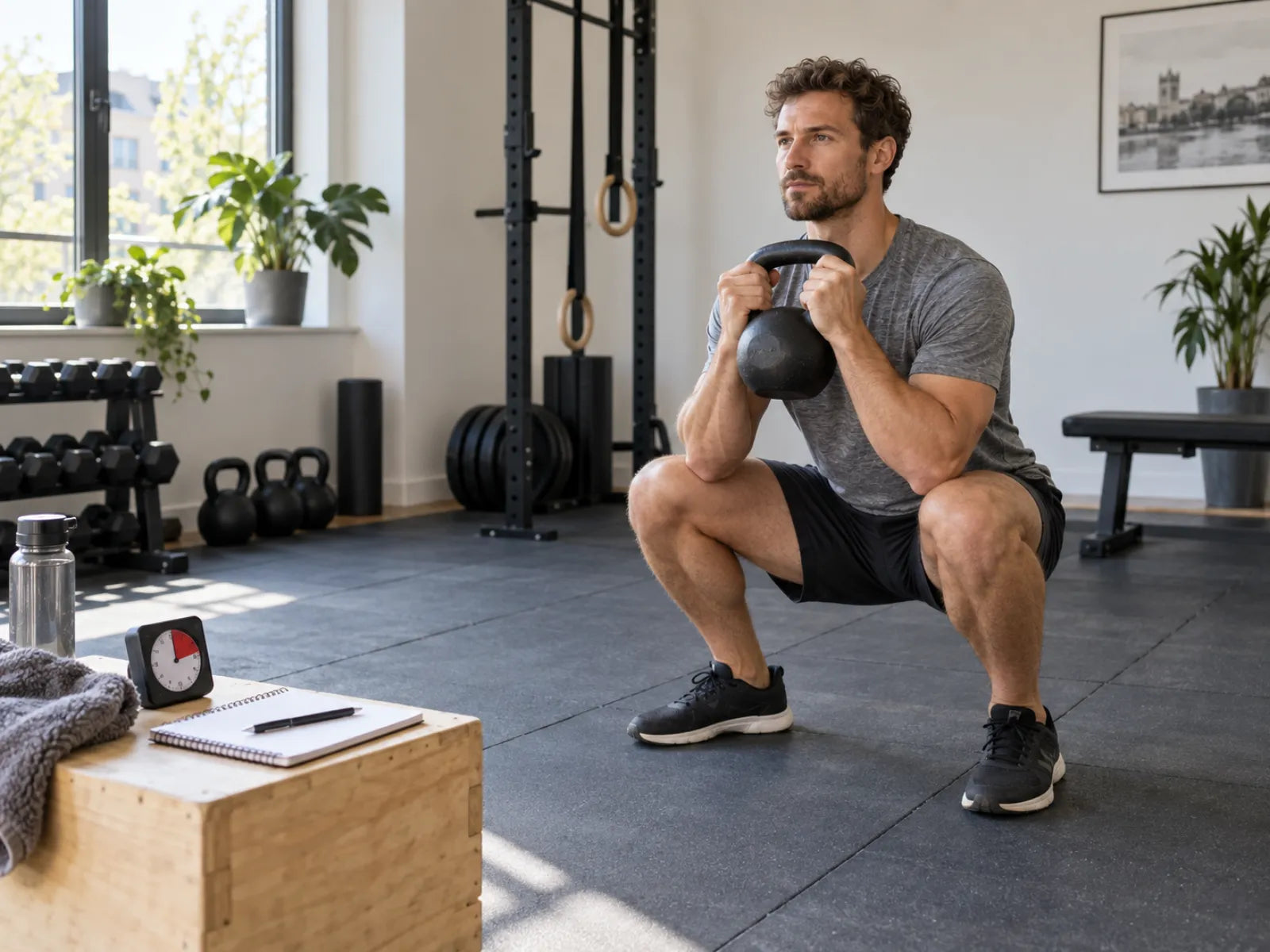
This illustrative library image shows a kettlebell goblet squat. The studies discussed examined back squats; the image does not establish the properties or suitability of the shoes shown.

Plan the change between your run and warm-up sets
Write down which strength task follows the run. Have a second pair ready if needed, choose your shoes, and then start your warm-up sets. During a comparison, avoid changing shoes, weight and exercise variation together: you would not know what caused the difference you noticed. Use a light, familiar movement and follow gym rules.
Two fictional situations illustrate the decision. Noor runs to the gym and then plans to squat. She brings a second, well-fitting pair because her current shoes bother her during that exercise. She changes before the light sets and checks her movement again. Her change addresses a specific experience.
Sam runs briefly on the treadmill and then mainly does seated exercises. He has no difficulty with the required points of support. Combining running and strength work alone is no reason to buy different shoes automatically. If he later chooses a new standing exercise, he assesses that task again.
Take your Nordic curl from the first rep to week 10.
A concrete 7-page plan: build up week by week, without pushing too fast.
- 01A clear week-by-week progression
- 02Technique and the mistakes to avoid
- 03A simple log you will actually use

≤51%
✓Backed by research
Van Dyk et al., 2019: meta-analysis of programmes with NHE. Not an effect test of Nordbelt or this protocol.
Open the download page again or check the email we sent you.
Open the download page ↗Would you also like to do a Nordic curl?
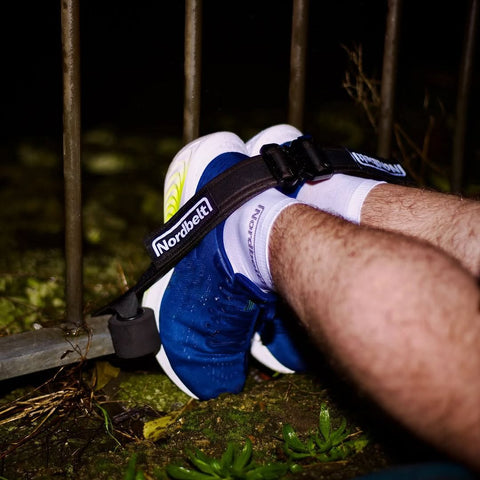
Your footwear choice is a separate decision. Only if you independently choose a Nordic curl might Nordbelt as an additional training setup be relevant for securing both ankles. It does not replace shoes, squat skill or a training plan, and it promises no performance improvement. The Nordic hamstring curl guide first helps you understand what that different exercise involves.
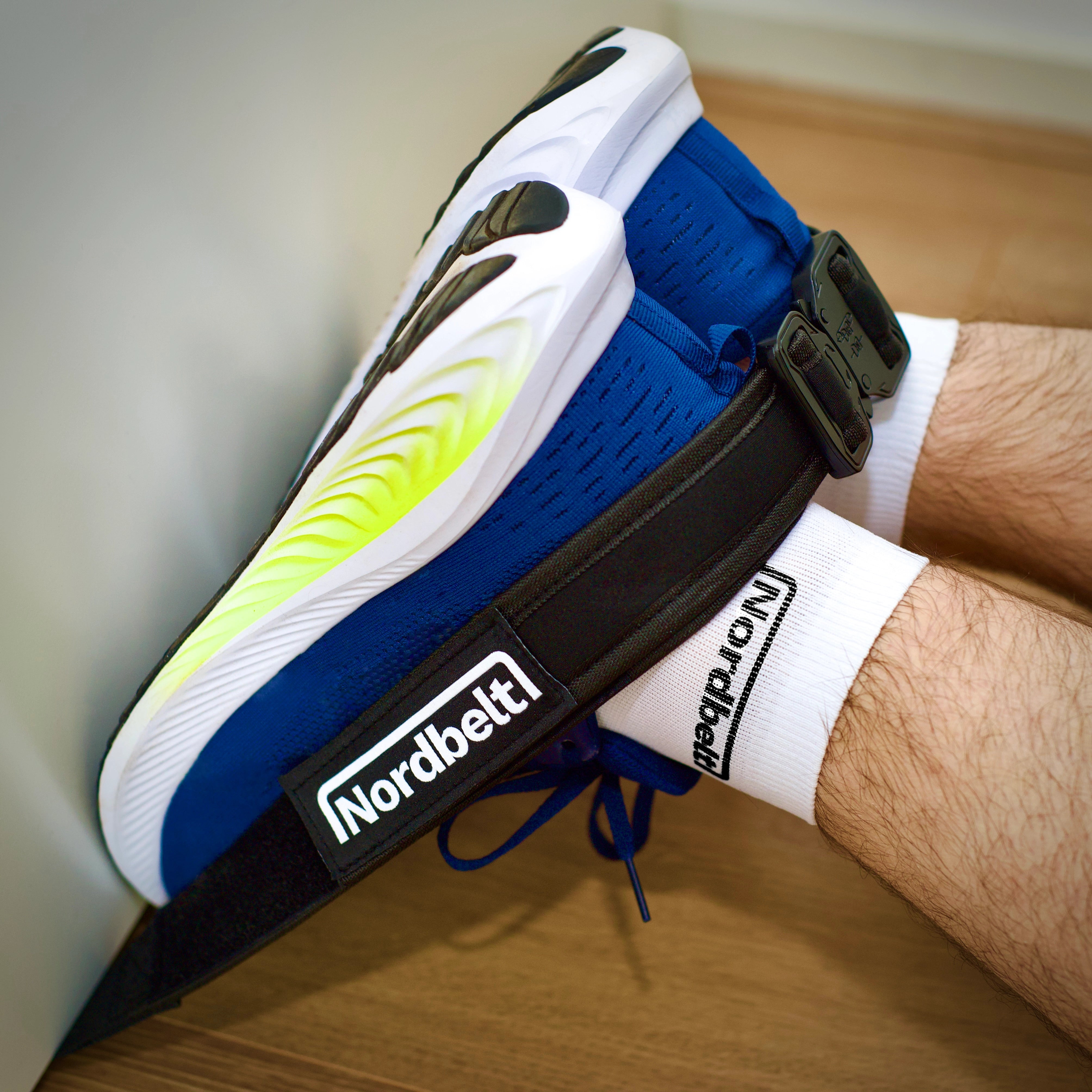
Ankle fixation in a separate Nordic setup; this is not a demonstration of footwear for squats or running.
Frequently asked questions
Are running shoes bad for strength training?
You cannot make that judgment for every exercise and shoe at once. In a study of 24 experienced weightlifters, the distribution of joint moments during back squats differed between barefoot, running-shoe and weightlifting-shoe conditions. These are immediate biomechanical differences, not measured injury risks or long-term muscle growth (Southwell et al., 2016). First ask what you are training and what your current shoe does during that task. A category label is not enough to reject every pair. Feeling comfortable also does not, by itself, establish protection from injury.
Do I always need weightlifting shoes for squats?
No. The available studies do not establish a general requirement. Heel elevation can change squat posture, but the populations and shoe constructions studied vary (Pangan & Leineweber, 2021). Assess fit, contact with the ground and execution under a light load before considering a purchase. A different posture is not automatically better for your goal. Ask a trainer to observe if you cannot distinguish whether a problem comes from your shoe, the exercise or the load you selected. Resolve that distinction first.
Can I run and then lift in one pair?
That can be practical when the pair suits both planned tasks. Note whether you will mainly sit, lie down or stand with a load after running, and assess the standing task during your warm-up. You do not need a separate pair for every part of the session. If something bothers you, plan a focused comparison or adapt the exercise. The hamstring exercises for runners guide covers other decisions about additional training; footwear choice does not determine which exercises you need.
Is training barefoot better than changing shoes?
A comparison of joint moments does not establish that. Barefoot lifting was one condition in the back-squat study, not a general gym recommendation (Southwell et al., 2016). Consider the surface, equipment and gym rules. Do not simply take shoes off between heavy sets to try a new sensation. Another well-fitting pair or an easier exercise variation may allow a practical comparison. If you have an individual foot complaint or prescribed footwear, keep the choice consistent with your existing professional advice.
What if I still wobble after changing shoes?
Do not increase the weight further. Reconsider fit, the surface, the task and the load, and ask a trainer to assess your movement if needed. Change one factor at a time so that you retain a useful observation. For example, note that your foot moves inside the shoe or that you lose control at a particular depth. This is more useful than simply saying the shoe feels unstable. Stop the loaded exercise if it hurts; persistent or unexplained symptoms need assessment, not an endless series of equipment trials.