

Marathon pacing: from your starting plan to race-day adjustments

Marathon pacing starts with a realistic goal and a controlled opening. Use split times as reference points, while also assessing effort and conditions. Do not automatically try to win back a lost minute, and prepare an alternative for when the original plan no longer fits. This guide helps you make a race card for 42.195 kilometres: what to record beforehand, what to compare on the course and when to let go of a time target.
Set your goal and alternative before the start
Start with a goal already assessed against your preparation. This page does not predict a finish time from a half marathon or prescribe your individual pace. If you are still unsure about the build-up, first read about moving from a half marathon to a marathon.
Put three things on your race card: your intended time, its corresponding average pace and the circumstances in which you would change the plan. The average is an arithmetic reference, not an instruction to run every kilometre identically. Record what takes priority if the day unfolds differently: continuing with control, dropping the time target or stopping when continuing no longer feels responsible.
Agree on a restrained start with yourself. Feeling capable of more in the starting area is not a fresh assessment of your preparation. Let faster runners go and avoid immediately making up time lost in congestion. Keep your original task clear instead of inventing a more ambitious plan in the opening kilometres.
Compare pace, elapsed time and effort separately
Pace is minutes per kilometre; a split is elapsed time at a distance marker. As an arithmetic example, 6:00 per kilometre means reaching five kilometres at 30:00 and ten at 60:00. This is a calculation, not a recommended pace or prediction. Time spent stopped is included in elapsed time.
Consider the pattern between recognisable distance markers and how demanding the running feels. A brief change on your watch does not automatically call for acceleration. In wind, on a slope or in congestion, holding exactly the same speed may become a different task. Distinguish the number you planned from the effort you are actually making.
Research involving 190,228 New York marathon finishers found less variation in speed among the faster groups. Every group studied slowed on average in the second half. This observation does not establish a prescribed faster second half as the best strategy for everyone (Santos-Lozano et al., 2014). Use the study to question how a race unfolds, not as a promise of a particular finish time.

Use a race card to guide adjustments
This table is an editorial decision aid, not a tested race protocol. Choose beforehand which signals you will assess together; one number need not determine the whole decision.
| What do you notice? | What do you compare first? | What choice fits? |
|---|---|---|
| Your first split is faster than planned. | Your agreed opening and the pace of runners around you. | Return to your own plan; do not treat the lead as permission to accelerate further. |
| You lose time at a busy point or stop. | Elapsed time, the reason for the delay and current effort. | Resume with control; do not try to recover everything in one fast kilometre. |
| The same pace feels clearly harder. | Conditions and the pattern since your last check. | Let go of the fixed pace number and assess whether continuing with control still fits. |
| You feel unwell or cannot continue responsibly. | Your condition, rather than your desired finish time. | Stop and seek help from the event's medical team. |
Consider heat before the start as well. An analysis of 668,509 Berlin marathon results from 1999–2019 found associations between weather and running speed. Weather variables explained only about ten per cent of the variation in race pace and did not significantly predict pacing distribution. This does not provide a personal correction in seconds per degree (Weiss et al., 2024).

Illustrative context image: the watch has no readable measurement. The photograph cannot establish pace, a race situation or recovery status.
Take your Nordic curl from the first rep to week 10.
A concrete 7-page plan: build up week by week, without pushing too fast.
- 01A clear week-by-week progression
- 02Technique and the mistakes to avoid
- 03A simple log you will actually use

≤51%
✓Backed by research
Van Dyk et al., 2019: meta-analysis of programmes with NHE. Not an effect test of Nordbelt or this protocol.
Open the download page again or check the email we sent you.
Open the download page ↗Does any separate hamstring work still fit your plan?
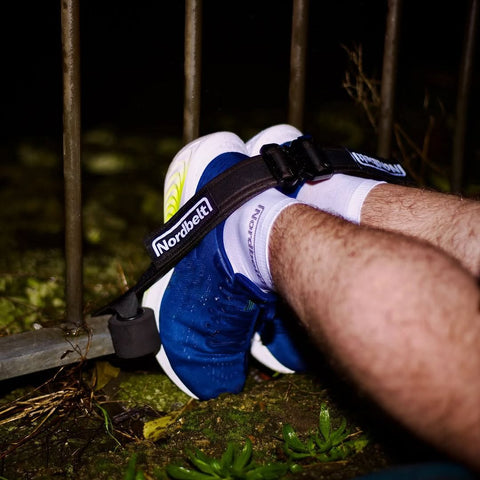
Your race plan requires no extra training equipment. Only if you separately choose Nordic curls at home might Nordbelt's ankle-fixation setup make that other exercise practical without a partner or large machine. A suitable, checked anchor remains necessary. The aid does not determine marathon pace, recovery or race readiness. For the place of familiar exercises in your preparation, read about strength training within a marathon build-up.
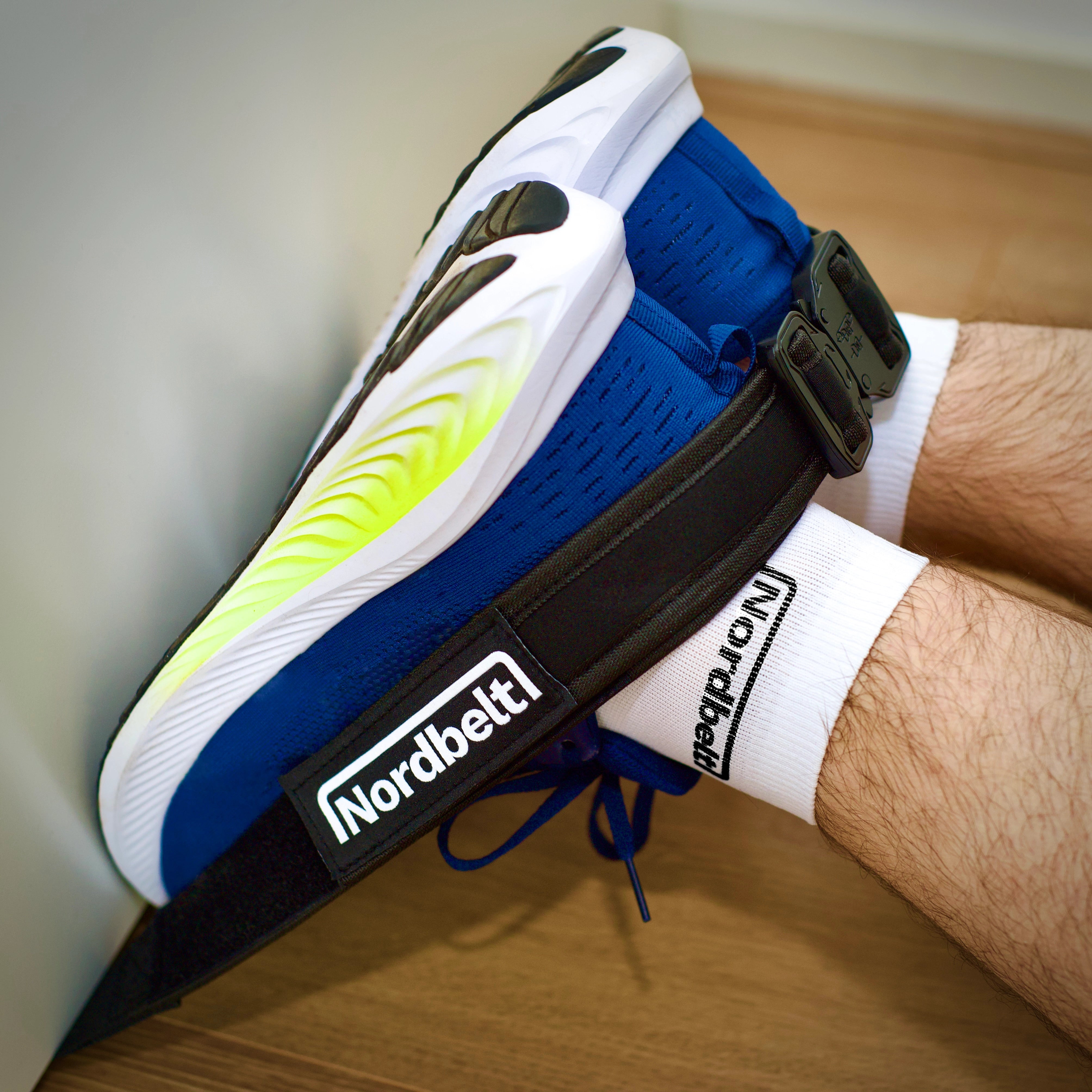
Equipment detail for a separate Nordic setup; not an aid to wear while running or a complete exercise demonstration.
Two fictional examples using the same race card
The following situations are invented to illustrate the table's choices. They are not customer results, tested strategies or predictions. Both runners start from an already assessed goal; the examples prescribe neither a training pace nor a session distance.
Lotte reaches the first distance marker earlier than her card indicates. She has followed a faster group. Conditions are as expected and she has no reason to adopt a new goal. She lets the group go and returns to her agreed opening plan. She does not see the gained seconds as a buffer to keep increasing. At another distance marker she reviews elapsed time and effort again.
Amir initially follows his plan, but the same pace starts to feel increasingly demanding as conditions differ from his preparation. He does not try to win back a fixed amount of time. His preselected alternative is to drop the time goal and reassess whether continuing is appropriate. Feeling unwell is a reason to stop and seek help, rather than wait for another checkpoint.
Afterwards, record which signal led to which choice. This supports a review of the race that goes beyond the finish time. Keep it separate from planning a marathon long run: choosing a training session and adjusting a race on the course are different decisions.
Frequently asked questions
Must I run the second half faster than the first?
A faster second half is called a negative split. It is neither compulsory nor a proven best recipe for every recreational runner. In the New York data, all groups slowed on average in the second half, while faster groups varied less. This compares race patterns; runners were not randomly assigned a strategy. Discuss an appropriate approach based on preparation and conditions (Santos-Lozano et al., 2014).
Should I immediately make up time lost at a drinks station?
Do not turn a short delay into an automatic instruction to accelerate. Consider why the gap appeared and whether the original plan still fits your current effort. A planned split is a reference, not a debt that must be repaid immediately. Resume with control and compare again at a useful distance marker. This card does not prescribe fuelling or hydration; use what you have prepared and discussed beforehand.
Does slowing after thirty kilometres mean I have run out of energy?
Pace alone cannot establish that. An analysis of more than four million race records used sustained slowing as a proxy for hitting the wall. The researchers did not thereby measure individual glycogen stores. Nor does the study establish a kilometre at which everyone must struggle. A timing pattern is not a diagnosis and does not automatically identify an appropriate intervention (Smyth, 2021).
How much slower should I run in hot weather?
These sources do not provide a reliable personal formula in seconds per kilometre. The Berlin study found weather–speed associations, but predictive value was limited. Assess conditions before the start and keep taking account of effort and how you feel. Do not prioritise a calculated finish time over continuing responsibly. Follow the event organiser's current instructions (Weiss et al., 2024).
Should my long run use the same pace as my marathon?
That does not follow from your race plan. An easy long run, a specified training pace segment and a full race have different goals. Clarify each session's task within your existing preparation. This page supplies no new schedule or compulsory longest run. Use the separate long-run guide for that training choice, and your race card to compare the plan with reality on race day.