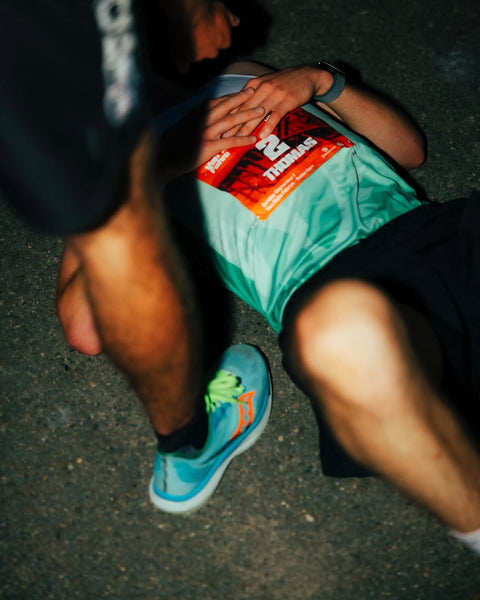
Hamstring pain in teenagers: when should the attachment be assessed?

Hamstring pain in teenagers needs particular attention when it starts suddenly during sprinting, jumping or kicking. In a growing athlete, the bone attachment may also be involved; the painful spot alone cannot tell you what is injured. Stop the sporting activity and arrange same-day assessment by a doctor for new severe pain, a pop with loss of function or difficulty walking. Gradually recurring pain also needs assessment rather than repeated attempts to train through it.
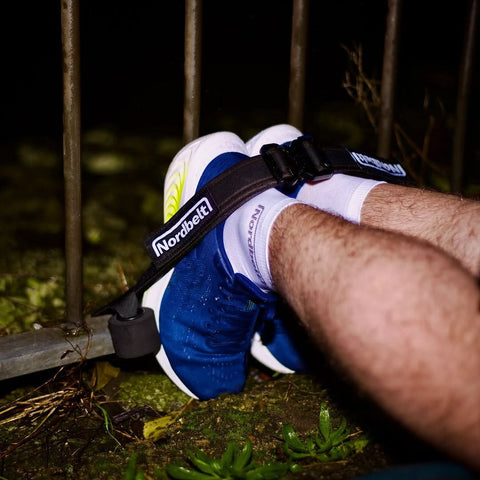
Only if a clinician later considers Nordic curls appropriate can Nordbelt's home setup provide low, even ankle fixation without a training partner or a large machine. It needs a suitable, solid anchor. This is a possible later training arrangement, not treatment or the first response to new symptoms.
Why does the attachment matter in teenagers?
The hamstrings run along the back of the thigh. Near the pelvis, their tendons attach to the sitting bone. In an immature skeleton, growth regions remain around certain muscle attachments. Symptoms there may therefore need a different assessment from an adult's complaint. A review of adolescent athletes describes both gradually developing overuse symptoms and injuries at these attachments (Frush and Lindenfeld, 2009).
This does not mean every young athlete with hamstring pain has a bone injury. It means “a tight muscle” is not a safe remote diagnosis. Age and growth are information for the assessor, not a reason to choose a label at home. This page helps you recognise the need for assessment, rather than identify damaged tissue.
For broader background, see types of hamstring injury. A growing athlete still raises a separate question: should the bone attachment itself be considered?

Did the pain start suddenly or build gradually?
Describe the beginning first. Was there one clear moment during a sprint, jump or kick? Or did the pain emerge over several sessions? Both histories help a healthcare professional. They are not a home test distinguishing a strain, an attachment complaint and an avulsion.
In an avulsion fracture, a bone fragment separates at the attachment. Schuett and colleagues retrospectively reviewed records of young people with diagnosed pelvic avulsion fractures. Their study describes these injuries; it does not tell you how likely an avulsion is in your child with thigh pain (Schuett et al., 2015). Report a pop as part of the history, not proof of a fracture.
Gradual pain also deserves attention if it recurs during sport or starts limiting daily activities. Mention any symptoms in the same area before a sudden painful event. Do not try to confirm that history with hard pressure, a deep stretch or one more sprint.
What should you do before assessment?
Take the young athlete out of the drill or match. Arrange medical assessment for severe pain or clear loss of function; do not first ask them to prove they can keep walking. For gradual symptoms, make an appointment with a doctor or sports physiotherapist and discuss suitable activity until assessment.
The first decision is practical: who calls the parent or carer, who stays with the athlete and who contacts the healthcare professional? Assign these tasks explicitly at the field. A coach does not need to diagnose anything to do this. Explain that the athlete is still growing and describe the limitations.
A general page about the early stage after a hamstring injury does not replace this age-specific assessment. Do not copy a stretching, strength or return-to-sport schedule for an unassessed painful attachment.
Take your Nordic curl from the first rep to week 10.
A concrete 7-page plan: build up week by week, without pushing too fast.
- 01A clear week-by-week progression
- 02Technique and the mistakes to avoid
- 03A simple log you will actually use

≤ 51%
✓Backed by research
Van Dyk et al., 2019: meta-analysis of programmes with NHE. Not an effect test of Nordbelt or this protocol.
Open the download page again or check the email we sent you.
Open the download page ↗How parents and coaches can prepare for the conversation
Make a short note with the athlete. Record what is known and leave unknown details open. A clear account helps more than a self-selected injury name.
- Onset: date, activity and any distinct painful moment.
- Course: what has changed, and were there earlier symptoms?
- Daily function: describe walking, sitting and attending school.
- Sport load: recent sessions, matches and changes the athlete recognises.
- Follow-up: agree who relays advice to parents and the coach.
This prepares a conversation; it is not a validated diagnostic score. Let the athlete describe events in their own words. Do not ask them to repeat a painful movement for a video. Existing information may help; provoking fresh pain is unnecessary.

Illustrative conversation between adults; no actual patient, medical assessment or evidence of professional supervision is depicted.
What should you ask about returning to sport?
After assessment, ask which activities are suitable now, what should prompt further contact and who will supervise progression. Clarify how school PE, club sessions and independent training should fit together. This avoids three adults giving the athlete three different instructions.
A calendar date from a general article is not personal clearance. The literature concerns different injuries and groups, not one universal recovery pathway. The duration and content of support depend on the assessed situation. For background on phases, see hamstring recovery and strength rebuilding; use it to prepare questions, not as a youth programme.
Where might a Nordic curl fit later?
A Nordic curl starts kneeling with the ankles secured. The athlete lowers the body forwards under control and catches themselves with their hands. This describes the movement; it is not advice to start with new attachment pain. Suitability, range and loading belong in the individual plan first.
If it becomes appropriate, the setup must also be suitable. Follow the fitting instructions for a suitable door, a fixed bench or a solid fence. A loose chair or moving bench is not a substitute anchor. Provide knee support and clear space for the hand catch. Fixation cannot make an unsuitable exercise safe.

Detail of a bench setup for later training; not exercise advice for new pain.
Frequently asked questions
Is hamstring pain in teenagers simply growing pains?
You cannot infer that from age or location. Have recurring or limiting symptoms assessed and explain that the athlete is still growing. Do not wait for another session with sudden severe pain or loss of function.
Does a pop mean something has pulled away from the bone?
No. A pop alone cannot establish a diagnosis. Explain when it happened, the movement involved and what the athlete could no longer do afterwards. Do not try the movement again.
Can you stretch the hamstring to find out what is wrong?
Do not use a painful stretch as a home test or force the movement. After assessment, ask which movements and exercises fit the situation; general stretching advice is not a personal plan.
When can a young athlete sprint again?
That depends on assessment and individual progression. Ask which conditions apply and who monitors progress. A quiet day or an upcoming match does not itself provide clearance to return.
Can an ankle strap treat this pain?
An ankle strap does not treat new hamstring or attachment pain. Fixation may only form part of a later appropriate exercise setup and cannot replace assessment, guidance or an individual plan.