

Machine occupied: can you change your strength training order?


You can change your strength training order when a machine is occupied, but first decide what takes priority today. Wait if that particular exercise matters and you have time to wait. Otherwise move a familiar exercise already in your plan, deliberately shorten the session or discuss a replacement with your trainer. Record the changed order: fewer repetitions under different conditions do not, by themselves, prove a loss of strength.
Which exercise takes priority today?
Start with your existing programme. Do you want to practise a particular exercise or track your progress in it? Use that task as your starting point. Ask how much work the other athlete has left and decide whether waiting fits your available time. Taking turns may also work if the settings, equipment and space allow it.
A meta-analysis of eleven training studies found that strength gains in specific exercises were generally greater when those exercises came earlier in the session. There was no clear average order effect across all strength tests combined or for muscle growth. That does not establish an ideal order for every individual, but it supports making your priority explicit (Nunes et al., 2021).

Four choices when a machine is occupied
Use this table to adapt your existing plan to the situation. It is an editorial decision framework, not a tested training protocol or a personal programme.
| Choice | When does it fit your plan? | What do you record? |
|---|---|---|
| Wait or take turns | The occupied exercise is your priority and the remaining time allows it. Agree who will use the machine and when. | Record a longer interruption; keep your usual preparation. |
| Bring a planned exercise forward | A familiar task from the same session is available. Remember that this moves the occupied exercise to later. | Write down the order you actually followed. |
| Shorten the session | Your available time is running out and you want to preserve your priority. Deliberately leave out a less important planned task. | Record what is missing; do not claim that the shorter session has the same effect. |
| Discuss a replacement | Waiting and reordering do not fit. Your existing trainer can help assess which other task fits the goal. | Record the replacement separately, including its execution and the load used. |
A review of time-efficient strength training discusses goals, available equipment and personal preferences. It did not test these four choices for an occupied machine. You therefore cannot use it to promise that every shortened or adapted programme delivers the same results (Iversen et al., 2021).

Shared training-space context; no prescribed exercise order.
Another machine is a separate exercise choice
Moving a planned exercise and choosing a different exercise are separate decisions. A dumbbell, cable station and machine can differ in support, movement path and load. Do not adopt a replacement without an explanation or automatically copy the weight from the old machine. Stick to familiar tasks or ask your trainer for an appropriate choice and execution.
A meta-analysis of thirteen studies in adults compared free-weight and machine training over at least six weeks. Strength changes depended partly on how strength was tested. The research provides no conversion table between machines and does not prove that two specific exercises are interchangeable (Haugen et al., 2023).
Keep your usual warm-up and the preparation for the exercise you will actually do. A shortage of time is no reason to attempt an unfamiliar maximum. If you have pain or an existing complaint, do not choose a new exercise to work around it; discuss the adjustment with the professional involved.

Context showing a different strength training task; no evidence that it replaces an occupied machine.
Take your Nordic curl from the first rep to week 10.
A concrete 7-page plan: build up week by week, without pushing too fast.
- 01A clear week-by-week progression
- 02Technique and the mistakes to avoid
- 03A simple log you will actually use

≤51%
✓Backed by research
Van Dyk et al., 2019: meta-analysis of programmes with NHE. Not an effect test of Nordbelt or this protocol.
Open the download page again or check the email we sent you.
Open the download page ↗Record the changed session
This fictional example shows how to record an interruption. The numbers are invented log entries, not a target or prescribed dose.
| Log field | Planned situation | Changed situation |
|---|---|---|
| Order | Machine exercise A, then planned exercise B | Exercise B first; machine A was occupied |
| Load for A | The previously recorded weight | The same recorded weight |
| Repetitions for A | Previous comparable session: 10 | This changed session: 8 |
| Context | A came first | A followed B; record interruption and rest separately |
| Conclusion | A reference under known conditions | No direct comparison under identical session conditions |
That distinction matters. A study of 23 women with at least two years of strength training experience found fewer repetitions when exercises came later in two opposite orders. It involved sets to fatigue under research conditions. This is not advice to test yourself to failure, no personal percentage loss and no measurement of your own strength change (Simão et al., 2007).
Do you also want to do Nordic curls at home?
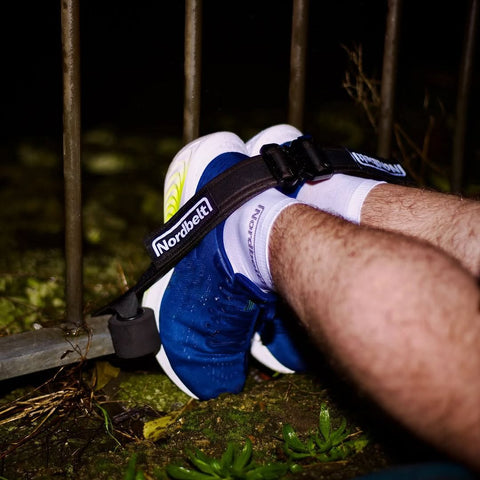
That is a separate choice from an occupied machine. If you independently want to do Nordic curls at home, Nordbelt can fix both ankles without a training partner or a large machine. You still need a suitable, checked anchor, support for your knees and clear movement space. On the Nordbelt homepage you can look at that home setup. The tool does not choose your exercise order, replace arbitrary gym machines or correct your execution.
Make your next comparison clear
Also record whether rest, execution or your reason for stopping differed. For recording breaks separately, see the explanation of rest between strength training sets. This keeps a queue, a different task and a different break from becoming one unclear number.
Afterwards, write one sentence explaining the adjustment: “A was occupied, so I did B first.” Put it beside the exercise, load and repetitions. Assess progress later using sessions in which the task and conditions are sufficiently similar. A different session need not disappear from your log; its context makes it useful.
If you also want to record estimated effort, read what RIR means in strength training. An estimated reserve is different from the number of completed repetitions. For the separate question of where a Nordic curl belongs in a home session, see the guide to the position of Nordic curls in a home session.
Frequently asked questions
Should you always wait until the machine is free?
No. Waiting is mainly a practical choice when that exercise is your priority and the wait fits your available time. Calmly ask how much work remains and whether you can take turns. Otherwise move a familiar exercise already in your plan or deliberately shorten the session. None of these choices guarantees the same training effect; record your decision so you know later what you did.
Should large muscle groups always come before small ones?
There is no universal rule that resolves every personal priority. In the meta-analysis of eleven studies, specific strength exercises generally benefited from an earlier position; an exercise for a smaller muscle group can therefore also matter in the chosen order. The combined strength and muscle-growth results did not establish a generally best order. Start with your existing goal and, if unsure, adjust a personal programme with your trainer (Nunes et al., 2021).
Have I become weaker if I manage fewer repetitions?
You cannot infer that from one differently organised session. The exercise may come later, your rest may differ, and your execution or reason for stopping may also change. Record those conditions first. The study in trained women shows that order can affect repetition performance; it does not determine the difference you should expect in yourself. Draw a conclusion only from appropriately comparable data (Simão et al., 2007).
Can I replace the occupied machine with a dumbbell exercise?
That is a new exercise choice, not an automatic one-to-one swap. Assess the goal, your experience with the other task and the execution it needs with your trainer. Do not automatically use the same weight or repetition count. The comparison of machine and free-weight training provides no individual conversion rule between exercises. Record any replacement separately so you do not treat the new task as an identical version of the old one (Haugen et al., 2023).
Should I make up skipped exercises later?
This decision table prescribes no extra session or makeup dose. Record what you skipped and discuss recurring availability problems with your trainer within your existing programme. Do not add work on your own to compensate for a short session. Different scheduling, an agreement to take turns or a previously discussed alternative may fit better. If you have symptoms or are unsure about execution, involve the relevant professional.