

Nordic curls at home: main block or finisher?


Choose whether to do Nordic curls at home as a main block or finisher according to your goal and the quality of your reps. Put them early, straight after your warm-up, when technique, control or gradual progression is the priority. Use them as a finisher only when you can perform an easier variation through a manageable range without fatigue affecting your braking phase or body line. There is no universally best position: the right order is the one in which your chosen variation remains controlled.
Nordic curl at the start or end of a workout: the short decision rule
A Nordic curl requires you to let your body travel forwards from a kneeling position while resisting the movement for as long as possible. That task becomes harder when your torso drops, your hip angle changes unexpectedly or you fall faster than you can control. Placement is therefore more than a scheduling choice: fatigue changes the variation you actually perform.
Choose the main block if you want to learn the Nordic, increase your range of motion or compare the same execution between sessions. Do it after a general warm-up and before exercises that noticeably fatigue your hamstrings, glutes or trunk.
Choose the finisher only if the Nordic is already familiar and you deliberately use an easier regression. This might mean a shorter forward range or clear assistance from your hands. A finisher is not an excuse to collect extra reps by falling without control.
Research does not answer this exact exercise-order question. A recent systematic review mainly compares higher and lower Nordic training volumes and shows that dose is a programmable variable; it does not establish that an early or late position is superior in every session (Cholp & Zemková, 2025). The placement rule here is therefore a transparent practical framework: maintain execution quality and adjust the difficulty to the control you still have.

The four-point decision check
Answer four questions before the session. If any answer is unfavourable, move the Nordic earlier, choose an easier variation or leave it out that day.
- What is today’s goal? Learning, assessing progress or gradually extending your range points towards an early main block. Briefly adding a familiar movement may suit a finisher.
- How fatigued are you when you start? If earlier leg exercises are already visibly changing your posture or braking phase, the finisher position is unsuitable.
- Which variation remains manageable? Choose your regression, support and range limit before the first rep. Do not make the variation harder while you are already falling.
- What comes after this session? Consider the rest of your workout and the training load you have planned afterwards. This page does not prescribe a universal frequency or recovery time; assess the placement within your own programme.
For the full movement explanation, the broader guide to the Nordic hamstring curl and hamstring curls remains the technique guide. Also use the separate check of common Nordic hamstring curl mistakes if your execution changes between sets.
Ankle fixation for Nordic curls at home
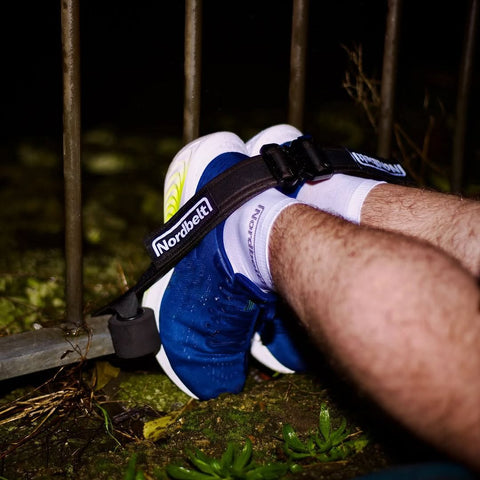
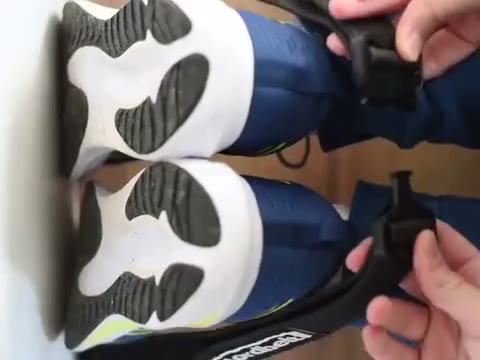
The setup must be the same before the first rep in either position: a suitable, tested anchor point, low and symmetrical ankle fixation, comfortable padding for your knees and clear space for your forward path. Test the fixation with light force first. The choice between a main block and finisher only begins once that setup remains stable.
With Nordbelt for Nordic curls at home, you can arrange stable ankle fixation without a training partner or large fitness machine. That makes a repeatable home setup practical when low ankle fixation is the missing element. The equipment does not choose your session order, correct your technique or replace gradual load selection. You must still check that the door, anchor point, strap position, symmetry, knee padding and clear space are suitable before every session.
Take your Nordic curl from the first rep to week 10.
A concrete 7-page plan: build up week by week, without pushing too fast.
- 01A clear week-by-week progression
- 02Technique and the mistakes to avoid
- 03A simple log you will actually use

≤51%
✓Backed by research
Van Dyk et al., 2019: meta-analysis of programmes with NHE. Not an effect test of Nordbelt or this protocol.
Open the download page again or check the email we sent you.
Open the download page ↗Nordic curls before or after other leg exercises
Put Nordic curls before heavy leg exercises when you want to compare whether your braking phase, range of motion and body line remain consistent. Keep the warm-up general and use the first Nordic rep as a calm execution check, not as a maximal attempt.
Place them after other leg exercises only if those exercises do not change your chosen regression. Check this with one calm test rep. If your torso drops sooner, your hips bend unexpectedly or you reach your stopping point more quickly, that is not a signal to push through. Choose a shorter range, use more hand assistance or skip the finisher.
A study comparing progressive and constant Nordic workloads deliberately treats load as a programmable variable. It supports gradual progression, but does not prove that one position in the session is better for everyone (Severo-Silveira et al., 2021).
Explore this topic further: Nordic curls at home: supersets or straight sets.
Session example A: Nordic curls as a main block
This example suits sessions in which execution is the priority. It is a conservative template, not an individual prescription.
- Complete a general warm-up and prepare your knee padding and ankle fixation.
- Perform one calm test rep with a regression you already control.
- Choose a small number of working sets with a few controlled reps. Stop each set before your braking phase or body line changes.
- Only then continue to your other leg exercises.
Do not record reps alone. Also note the regression, hand assistance and range limit you used. This lets you compare the same task in your next session instead of merely chasing a higher total.
Session example B: Nordic curl finisher at home
Use this example only if you can still perform a familiar, easier Nordic variation after the rest of your workout.
- Test the setup again; earlier exercises may not have changed the space around the door or floor.
- Perform one calm test rep with more hand assistance or a shorter range than in your fresh main block.
- Keep it to a short set and stop as soon as the braking phase speeds up or your body line changes.
- Do not add a harder regression to turn a fatigued finisher into a performance test.
The review of high and low Nordic volumes shows why “more” does not represent a single training goal: different doses may emphasise different adaptations (Cholp & Zemková, 2025). Do not use that finding to claim an optimal number of sets. This finisher template deliberately favours a small amount of controllable work.
Adjusting the order of Nordics in a home workout
Change only one variable at a time. If you move the Nordic from finisher to main block, keep the regression and range limit the same in the first comparable session. Do not make the execution longer, harder and higher in volume at the same time. That way, you can judge whether the new position really gives you more control.
If you first want to learn a shorter static variation, use the separate explanation of the isometric Nordic curl. For the complete home setup, door check and starting position, the safe Nordic hamstring curl setup at home remains the guide.
When not to choose a finisher
Skip the finisher if you have not retested the ankle fixation, the knee padding has shifted, you lack clear forward space or you cannot brake the first test rep under control. The same applies if you experience an unexpected sharp symptom, new swelling, loss of sensation or clear loss of strength: stop the exercise and ask an appropriate healthcare professional to assess what is sensible.
Nordic curls do not replace diagnosis, treatment or an individual rehabilitation plan. If you have an existing issue or are returning to training, session placement belongs within the advice of the professional involved, not a general finisher rule.
Planning the Nordic curl in a home workout
Decide three things in advance: the chosen position, the regression and your stopping criterion. For example: “after the warm-up; hand assistance; stop when the braking phase speeds up.” That is more useful than simply writing “do Nordics”, because after the session you can see which task you actually performed.
To check the exact door, strap and body position, follow the Nordbelt guide for Nordic curls at home. Work through that setup check before the main block and again before a late finisher; an earlier safe setup is no guarantee that the space remains unchanged later in the session.
Frequently asked questions
Is it better to do Nordic curls at the start or end of a workout?
Do them at the start when technique, control or progression is the goal. A position at the end suits only a familiar, easier variation that you can still brake calmly despite fatigue. If your body line or braking phase changes, use more support, shorten the range or skip the finisher.
Can you do Nordic curls after squats or deadlifts?
Only if one calm test rep shows that your chosen regression remains just as controllable. If the earlier exercises change your posture, range or braking speed, the Nordic curls belong earlier in the session or outside that workout. This page does not prescribe a personal squat or deadlift programme.
How do you use a Nordic curl as a finisher at home?
First retest the ankle fixation and available space. Then choose an easier regression with more hand assistance or a shorter range. Keep the work brief and stop before your braking phase speeds up, your hip angle changes or your body line collapses. A finisher should not become a maximal test.
How many sets of Nordic curls should you do in the main block?
There is no universal number for every level and goal. Choose a small number of sets in which every rep retains the same regression, range limit and control. Stop before execution changes and align volume and frequency with your wider programme. Research on high and low volume does not justify one optimal default number (Cholp & Zemková, 2025).
When should you skip Nordic curls in a home workout?
Skip them if the fixation, knee padding or clear space is unreliable, or if you cannot brake the first test rep under control. Also stop if you experience an unexpected sharp symptom, new swelling, loss of sensation or clear loss of strength, and seek an appropriate professional assessment if needed.