

Nordic curls at home during a deload week


You do not automatically need to remove Nordic curls at home during a deload week. Keep them when the movement remains technically stable and the quieter week mainly calls for less overall training stress. Make the variation easier when your braking phase, range of motion or starting position changes earlier than usual. Skip them temporarily when you can continue only by compensating or when pain is the reason. Do not choose a percentage blindly: define the purpose of your deload first and change one training variable at a time.
What does a deload week mean for Nordic curls at home?
A deload is a planned week of lighter training, not a test of whether you can still do the same amount. Its purpose may vary: allowing accumulated fatigue to subside, making room for the next training block or keeping a busy week manageable. That is why there is no fair standard rule prescribing the same number of sets, repetitions or range of motion for every athlete.
Start by distinguishing training stress from the mere presence of an exercise. You can keep the Nordic in your week and still ask less of yourself by turning down one component. Conversely, you can remove the exercise while keeping the rest of your week so demanding that you miss the purpose of the deload. The choice is therefore not simply “Nordics or no Nordics”, but which stimulus you deliberately reduce and which technical information you want to retain.
Research on Nordic training describes changes in eccentric knee-flexion strength and muscle architecture, but the programmes, volumes and progressions used differ. The literature does not provide a universal deload percentage for an individual training at home (Medeiros et al., 2020). Use research to avoid rigid assumptions, not to present one number as a personal prescription.
Ankle fixation for Nordic curls at home
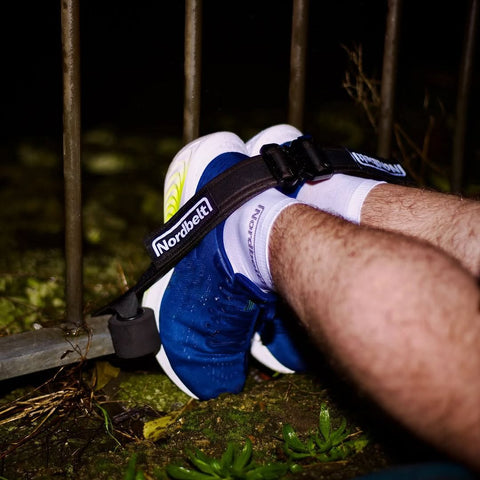
If you keep Nordic curls in your lighter week, make the setup predictable first. Test the anchor with your hands, check that both ankles are secured low and evenly, use comfortable knee support and leave enough clear space in front of you for the chosen short or assisted range. The dedicated guide to a safe Nordic setup at home covers these checks in more detail.
With Nordbelt for Nordic curls at home, stable ankle fixation becomes practical without a training partner or large fitness machine. That is the product's defined job: making the same home setup repeatable. The equipment does not decide whether you should keep, reduce or skip the exercise, and it does not replace an anchor test, technique checks or appropriate load management.

Choose whether to keep, reduce or skip them using two questions
Use two questions before the session. First, does the current variation remain technically recognisable from the first repetition? Second, does this choice support the purpose of the lighter week, or are you quietly turning the deload into a normal hard session? Together, the answers lead to three logical routes.
| Signal | Choice | Practical meaning |
|---|---|---|
| Execution is stable and overall weekly stress is clearly reduced elsewhere | Keep | Retain the same simple variation, but do not add range, tempo, repetitions or difficulty |
| Execution changes earlier or you deliberately want to reduce the Nordic stimulus | Reduce | Use more hand support, a shorter range, fewer working sets or another familiar regression |
| Only compensations keep the repetition going, the setup cannot be controlled or pain is the reason | Skip | Leave Nordics out temporarily; do not treat pain or injury as a routine deload decision |
This is an editorial decision framework, not a researched protocol. It makes your choice visible and testable. A planned deload should also not be confused with the article about resuming Nordic curls after a training break: after a longer interruption, you need to reassess your current starting level, whereas a deload usually sits within an ongoing training block.
Use one deload dial at a time
The Nordic has four useful dials: the number of exposures during the week, the number of working sets, the difficulty of the regression and the distance from the point at which your technique changes. Preferably turn down one dial clearly and keep the other conditions recognisable. This lets you understand afterwards what you actually changed.
For example, shorten the range of motion while keeping the anchor, knee support, session position and tempo the same. Or retain the variation but remove one working set. If you change range, support, volume and position in the session at the same time, the response becomes difficult to interpret. The page about Nordic curls as a main block or finisher helps when session position is the variable you want to keep fixed.
A randomised study of 45 resistance-trained men examined two lower follow-up volumes after a short phase of high-volume Nordic training. Strength and muscle-architecture adaptations were largely maintained in those specific groups, but the protocol is not a personal home programme and did not study a general deload week (Miura & Miyamoto, 2025). The useful boundary is modest: more volume is not automatically necessary to retain every previous training adaptation.
When can you keep Nordic curls in a deload?
Keep the exercise when you already know the variation, the setup remains the same and you complete the first repetitions without searching for your technique. “Keeping” it does not mean that everything must remain unchanged. It means the movement stays in the week as a familiar exercise while the total demand is demonstrably lower.
Decide before the session what must not increase. Do not add extra range because the first repetition feels light. Do not turn a planned lighter week into a harder regression. Use the first set as a check, not as a run-up to a normal hard session after all. If your main question is whether the Nordic supports a strength or muscle-growth goal, use the dedicated guide to Nordic curls for strength or muscle growth at home; you do not need to solve that goal choice again during a deload.
When should you make the Nordic variation easier?
Reduce the variation when you want to retain the exercise but its current difficulty does not suit the purpose of the lighter week. Choose a shorter controlled descent, more hand support or a clearly easier regression. The technique should become more recognisable as a result, not merely feel faster.
Watch for three changes: your hips move backwards earlier, your braking phase becomes shorter than planned or your catch becomes unexpectedly hard. These are not diagnoses, but visible signals that the chosen task is not remaining the same today. Use the checklist of common Nordic-curl mistakes to distinguish a regression from an unintended compensation.

A lighter week does not have to be carried by one exercise either. If you omit the Nordic, you can use a simple, familiar movement to maintain your routine, as long as you do not turn it into another hard replacement test. The image shows an unloaded hip hinge as a practical example, not as medical or personal advice.
When should you temporarily skip Nordic curls?
Skip the exercise when the anchor is unreliable, you cannot keep the path clear or your technique clearly changes from the first repetition. Sharp or increasing pain, visible swelling, changes in sensation or unexplained loss of strength are not part of “normal deload fatigue” either. Stop testing and, where appropriate, have the situation assessed by a qualified healthcare professional.
A study of 20 recreationally active men followed six weeks of Nordic training and then a period without that training. During detraining, the measured fascicle length moved back towards baseline faster than measured eccentric strength, which had not declined detectably after four weeks in this small group (Presland et al., 2018). The study does not say that skipping is always better. It mainly shows why one old performance measure or one week without Nordics cannot provide a complete personal decision.
Assess the deload at three points
Use the same short session check before, during and after training:
- Before the session: is the purpose of the deload clear, and is the chosen variation deliberately easier, unchanged or absent?
- During the session: do the anchor, range of motion, hip position and catch remain recognisable without adding difficulty as you go?
- After the session and the next day: does your general response fit a lighter week, and can you carry out the rest of your plan as intended?
Record the choice in one line: variation, number of working sets and reason for keeping, reducing or skipping it. This prevents you from reconstructing the changes afterwards from feeling alone. For assembly and basic execution, use the Nordbelt guide to the home setup. The guide shows the setup; it does not choose deload volume or replace professional assessment when you have symptoms.

For broader guidance on the movement itself, the general Nordic hamstring curl guide remains the starting point. This article keeps its narrower job: organising one planned lighter week without turning the deload into a test, return-to-training protocol or injury decision.
Frequently asked questions
Should you always skip Nordic curls during a deload week?
No. You can retain a familiar, technically stable variation when the total training demand is demonstrably lower. Decide in advance which other dial you will turn down, and do not add range, sets or difficulty during the session. If execution becomes less recognisable, choose an easier regression or leave the exercise out.
How much should you reduce Nordic volume during a deload?
There is no universal percentage that suits every home athlete, variation and training week. Define the purpose of your lighter week first. Then change one variable, such as working sets, range of motion or support, and assess execution and response. A fixed number without context can make a deload too demanding or unnecessarily empty.
Is a shorter Nordic descent a good deload variation?
It can be when the shorter range is clearly marked and you can repeat it with control. Keep the anchor, knee support and starting position the same so that only the range changes. A shorter fall without braking control is not a useful regression; use more hand support or temporarily skip the exercise instead.
What is the difference between a deload and returning after a training break?
A deload is a planned lighter phase within an ongoing training block. After a longer break, your old range, volume and setup data are not automatically current, and a new baseline assessment is appropriate. Do not use the same decision framework for a holiday, illness, injury or long interruption.
When should you stop Nordic curls instead of making them easier?
Stop when you cannot control the setup safely, your technique clearly changes from the first repetition, or you experience sharp or increasing pain, visible swelling, changes in sensation or unexplained loss of strength. Do not treat these signs as a routine deload choice; have them professionally assessed where appropriate.