

Leg raises: lying or hanging with control

Leg raises involve lifting your legs while lying on your back or hanging. Choose the lying variation if you want to learn the movement on a mat first; choose hanging only if you can stay comfortable and steady on a suitable bar. Start with bent knees or a smaller range when your back position changes or you begin to swing. Lower your legs calmly. The best starting variation is the one you can control, not the one that takes your feet highest.
Lying or hanging: which variation should you choose?
Look at your setup first, then the movement. On a mat, you do not have to maintain a hanging position. A bar also adds grip and shoulder comfort to the task. If your hands let go before you can assess the leg raise, that is not a useful comparison with the lying variation. Choose the mat for now.
Raising your legs also involves hip flexion. A small EMG study in six healthy men found activity in both the hip flexors and abdominal muscles during bilateral leg raises. This describes muscle activity during a task, not muscle growth or treatment (Andersson et al., 1997). Do not regard the exercise as a way to train just one isolated part of your abdomen.
Use a bar designed for hanging and installed according to its instructions. Leave room to get on and off with control. Furniture or a loose door cannot replace a suitable hanging setup. For the lying version, a mat and clear space are enough. Find a broader overview of other movements in training your legs at home without equipment.

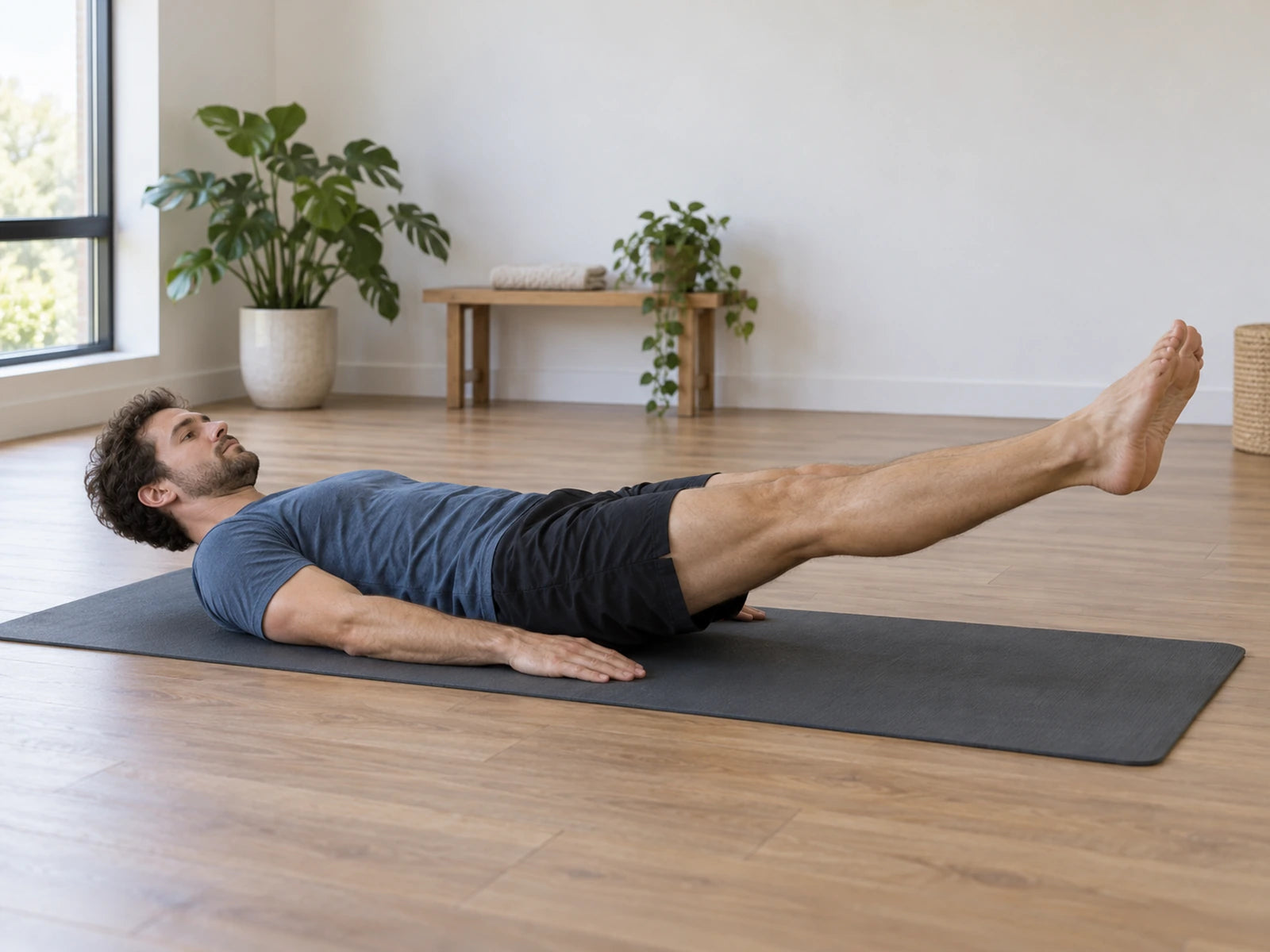
How to do lying leg raises
- Lie on your back with your arms beside your body. Find a comfortable head position and start with bent knees.
- Raise your legs slowly. Keep your trunk controlled; do not jerk into the movement.
- Lower your legs only as far as you can maintain your chosen back and pelvic position. Your heels do not have to reach the floor.
- Return calmly and keep breathing. End the set when you can no longer repeat the same movement.
Straight legs change the leverage of the task. Do not straighten both knees and increase the range at the same time. Choose one change so you can feel and see what happens. You do not need to press your lower back into the floor with maximum force. Aim for a repeatable position without pain or an increasing arch as you lower.
Hanging leg raises without swinging
Start in a quiet hang with a comfortable grip. Bring both bent knees forwards and up, only to a height from which you can return with control. Lower your legs slowly and start quietly again. If you need to swing backwards first to get up, reduce the range.
Straight legs and eventually bringing your toes to the bar are further options for people who already control the movement. They are not a required endpoint or a beginner standard. A photograph shows one position only; a still image cannot establish the tempo or control throughout a repetition. Choose the floor if hanging is uncomfortable or your grip dominates the task.
Take your Nordic curl from the first rep to week 10.
A concrete 7-page plan: build up week by week, without pushing too fast.
- 01A clear week-by-week progression
- 02Technique and the mistakes to avoid
- 03A simple log you will actually use

≤51%
✓Backed by research
Van Dyk et al., 2019: meta-analysis of programmes with NHE. Not an effect test of Nordbelt or this protocol.
Open the download page again or check the email we sent you.
Open the download page ↗Change one thing and check again
Use this table on your next attempt. It is a practical decision aid, not a validated test or a personal training programme.
| What do you notice? | First adjustment | What do you check next? |
|---|---|---|
| Your back arches more as you lower | Stop lowering earlier | Can you now repeat your chosen trunk position? |
| You cannot control straight legs | Bend your knees | Can you raise and lower calmly? |
| You swing on the bar | Restart quietly with a smaller range | Does the next repetition start without a swing? |
| Grip or shoulder comfort limits hanging | Choose the lying variation | Can you now assess the leg movement separately from hanging? |
Stop this exercise and have the problem assessed if you experience sharp pain, tingling or persistent symptoms. A smaller movement is not treatment and does not automatically make a painful exercise suitable. For a different trunk task, where you try to resist sideways rotation, read the Pallof press guide.
Want to add Nordic curls at home?
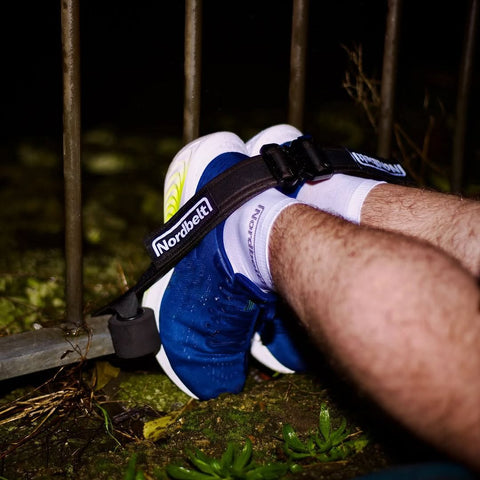
You do not need an ankle strap for leg raises. If you separately choose to add Nordic curls at home, Nordbelt for Nordic curls at home provides bilateral ankle fixation without a training partner or large machine. A suitable stable anchor, knee padding and room to support yourself with your hands remain necessary. The strap does not perform a leg raise or determine which exercise suits you. This is a separate choice, not a necessary next step after leg raises.
Keep variations separate in your training log
You can also raise one straight leg while keeping the other foot on the mat. Record this as a separate variation; you change the support and movement. It does not establish that the same dose or effect applies as for bilateral raises. The photograph below shows this different starting position.
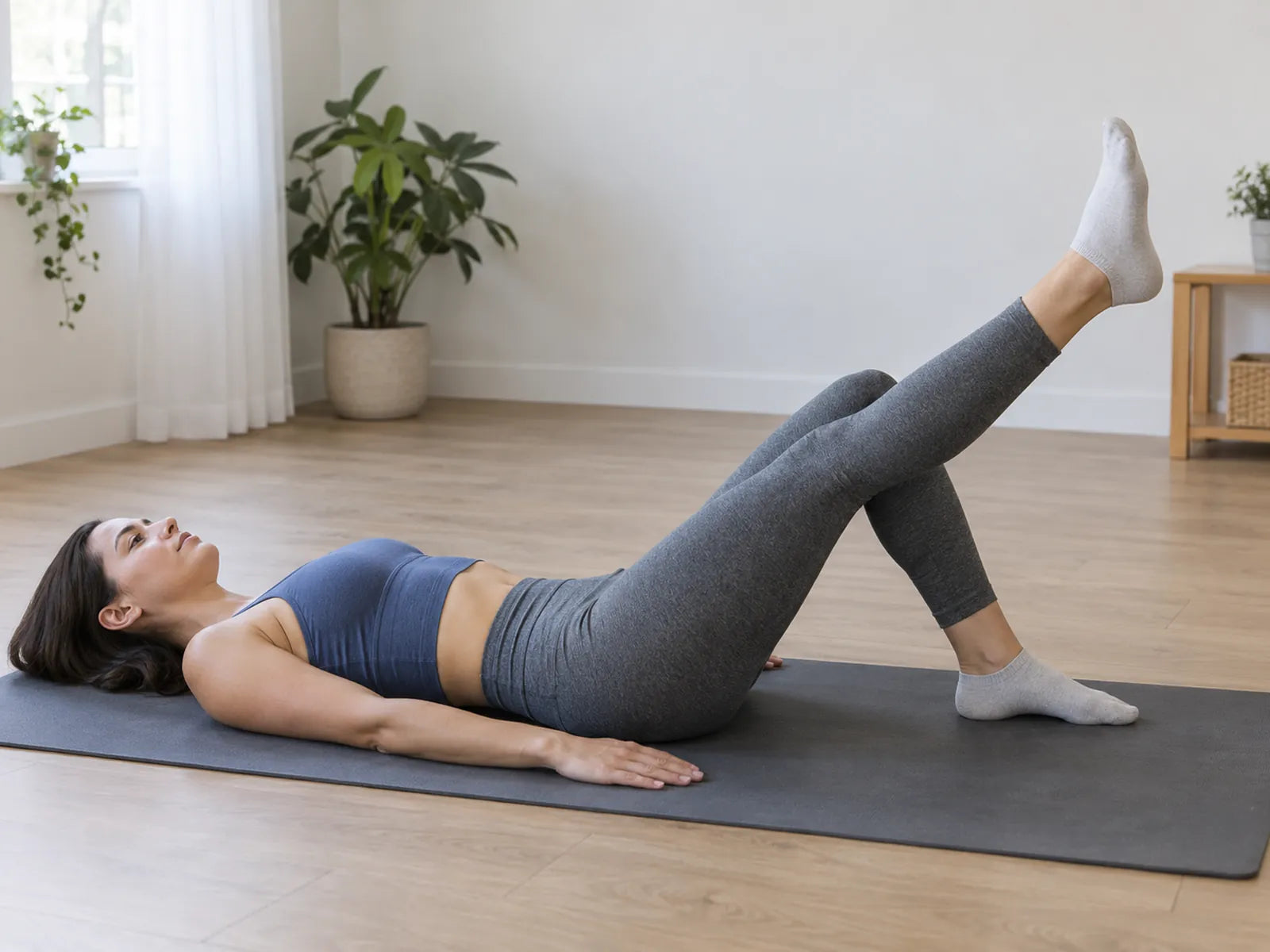
Research in ten healthy men measured hip-flexor activity while they held one straight leg at different angles. The study did not investigate a training programme or a hanging variation (Yamane et al., 2019). Do not use these measurements to set a universal lifting angle or a personal repetition target.
Choose repetitions within your existing training. A series of calm repetitions with the same range tells you more about execution than continuing with progressively shorter movements. To learn to record effort, read about repetitions in reserve in strength training. This is an estimate, not a mandatory target for this exercise.
Take the fictional example of Noor. She first records: “hanging, knees bent, swinging on return”. On her next attempt, she changes only the range and writes: “quiet return, lower endpoint”. She has adjusted the task. Without the same execution and conditions, this does not demonstrate increased strength. Record the variation, knee position, range and what ended the set before comparing counts.
Keep the circumstances recognisable too. An attempt immediately after other exercises cannot simply be compared with a fresh start. Note when you performed the variation and whether grip or trunk control ended the set. Your log describes what happened; it does not make a diagnosis.
Frequently asked questions
Are lying or hanging leg raises better?
That depends on the task you want to practise and the setup you can control. Lying lets you practise the leg movement without gripping or hanging. Hanging also requires you to assess whether you remain steady on the bar. Do not choose hanging just because it looks more advanced; the variations need not serve the same purpose.
Can you do leg raises with bent knees?
Yes. Bent knees and a smaller range of motion are useful ways to adjust the movement. Keep the same variation while you assess control. A larger movement is only a useful next choice when you can also return calmly; fully straight legs are not required.
Do your legs have to lower all the way to the floor?
No. For lying raises, choose an endpoint at which your back and pelvic position remain manageable. If that position keeps changing as you lower, stop earlier or bend your knees. Touching the floor is not a quality requirement, and a low endpoint does not demonstrate better training.
How many repetitions should you do?
There is no mandatory number for everyone. Choose a manageable amount within your existing training and end the set if your execution changes or symptoms occur. Record why you stopped as well. You can then compare the next session without attaching a universal programme, muscle-growth promise or treatment claim to the exercise.