★ 4.6
What can a single-leg bridge test tell you about your Nordic curl?

A higher bridge count on one side tells you how you did on that test. Keep the two scores to track your progress. Measuring Nordic strength takes a different setup.
FREE 10-WEEK TRAINING PROTOCOLSend my free protocol ↓In a single-leg hamstring bridge test, your coach counts how many times you can lift your hips with the same technique on each side. If your scorecard says ‘Single Leg Bridge Test’ and the number on the left is higher, you managed more bridges on the left. To find out how much force each leg produces as you lower into a Nordic curl, you need to measure force during the Nordic itself.
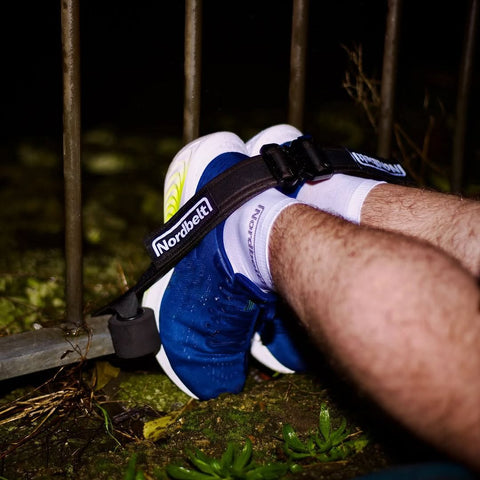
You don't need an ankle strap for the bridge test. If you also want to practise Nordic curls at home and there’s no one to hold your ankles, see how Nordbelt secures your ankles at a door, bench or railing. The setup examples will help you decide whether you have a suitable fixed point for the kneeling exercise.
What should you write down after the bridge test?
Say your coach counts 24 reps on the left and 20 on the right. Write down both counts and label the sides. Then ask what made the last rep count. Perhaps on the twentieth rep your hips just reached the agreed height, and on the next they fell short. Now you know what that 20 stands for. Those four extra reps on the left won’t tell you how much weight to add when training your right leg.
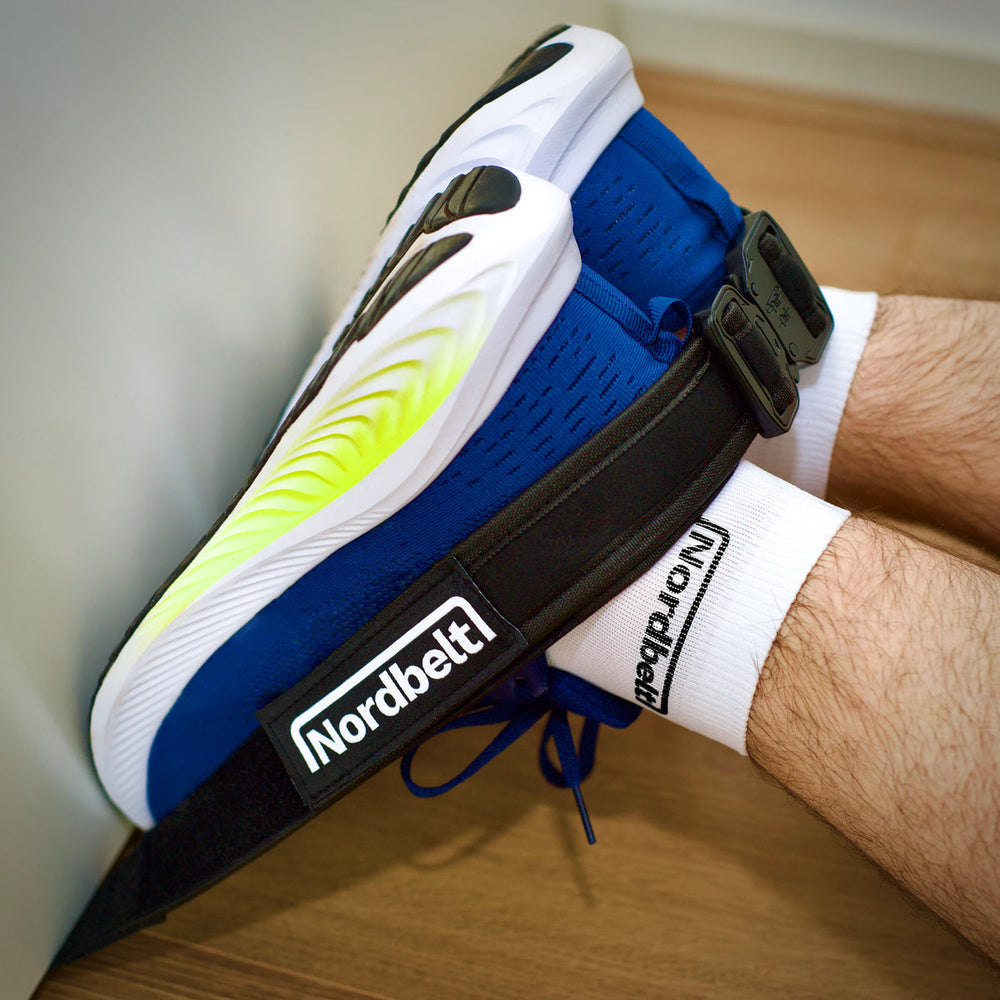
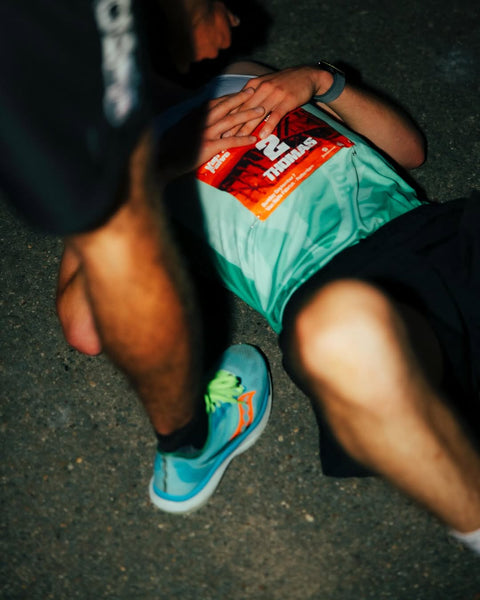
Make a note of where your heel rested, too. For a bridge at home, you might keep one foot on the floor, as in the opening photo. At the club, your heel might be on a raised support and your coach might ask you to cross your arms. You can keep a score for the floor version. If you want to know next month whether your club score has improved, ask to use the club setup again.
A useful entry might read ‘Left 24, right 20, heel on the same box, arms crossed, coach stopped counting when my hips fell short of the mark’. Those numbers are just an example. If pain made you stop earlier, write that down too. Next time you look at the scores together, your coach will know why that attempt ended.

What happens during a Nordic strength test?
For the bridge you lie on your back, press your heel into the support and lift your hips. Each completed lift gets one mark on the scorecard. For a Nordic curl you start on your knees with your ankles secured. As you lean forwards, the muscles at the back of your thighs work to slow your descent. Your coach may call this ‘eccentric’ work. It means the muscles are producing force as they lengthen.
To find out how much force each leg produces during that descent, ask whether the testing equipment records each side separately. Ask which number appears on your card, too. Peak force is the highest force recorded during the attempt. A side-on phone video can show you where you start to drop more quickly. That gives you an angle to look at or a clue about your technique. Here’s what the break-point angle in a Nordic curl can show.
Does the same leg come out ahead on both tests?
You can’t tell from bridge reps alone. Murakami and colleagues tested 38 male university footballers on both tasks. For the Nordic, the players lowered themselves forwards from kneeling as slowly as possible while their force was measured. For the bridge, the researchers counted reps on each leg. On neither side was a higher bridge score significantly associated with greater Nordic force in this group. The side-to-side differences in the two tests weren’t significantly related either. Murakami et al., 2023.
A second study used a different instrument. In 100 male footballers, researchers measured peak torque at the knee while players bent the knee or resisted it being straightened. Torque describes the turning effect of a force around a joint. Bridge counts had only a weak relationship with either peak value. The machine kept movement speed constant during the test. Taken together with the Nordic study, this helps explain why a coach can’t work out your personal strength from a score of 20 bridges. Gasparin et al., 2022.
Take your Nordic curl from the first rep to week 10.
A concrete 7-page plan: build up week by week, without pushing too fast.
PDF7 pagesStraight to your inbox
- 01A clear week-by-week progression
- 02Technique and the mistakes to avoid
- 03A simple log you will actually use

Open the download page again or check the email we sent you.
Open the download page ↗≤ 51%
✓Backed by research
Van Dyk et al., 2019: meta-analysis of programmes with NHE. Not an effect test of Nordbelt or this protocol.
How can you track your own progress?
Start with the question you want to answer in a few weeks. Want to know whether you can do more of the same bridge? Keep the setup, the counting rule and your two scores. Suppose you later get 23 reps on the right with the same setup and the coach using the same rule. You can now say you managed three more good right-leg bridges than last time. There’s no need to turn the difference into a percentage.
It’s worth being precise about endurance, too. In 40 healthy, physically active men, researchers compared bridge scores with two measures of fatigue during repeated knee bends on a testing machine. They looked at the drop in peak torque at the knee and in the work the men could produce. They found no significant relationship. You can use your card to track how many complete bridges you manage under the same conditions. How quickly the hamstrings fatigue when tested in isolation is a different question. Roberti et al., 2024.
If your training question is about the Nordic instead, take your scorecard to your coach and ask which test can measure force on each side. Doing a normal Nordic with both ankles held doesn’t give you a separate reading for each leg. Keep both ankles secured when using your two-leg setup at home. To choose a training variation, read about using one or both legs for Nordic curls.
How do you secure your ankles for Nordic curls at home?
Choose a setup that suits the spot where you’ll kneel. For a door, look at which way it swings from your kneeling position. Close it and use the side where tension on the strap pulls the door into the frame. Make sure anyone at home knows to leave it shut during your set. Rule out a bench that slides towards you or tips up. On a railing, choose a fixed section that doesn’t flex, with a smooth surface for the strap. If you’re unsure about the anchor, work through the checks for a secure home Nordic setup. The strap fitting guide shows how to attach it at your chosen spot.
Put padding under both knees and leave clear space for your hands. From tall kneeling, take up a little tension and check that both ankles stay in place and the anchor stays still. Then try a short descent you can control. The photo shows where the strap passes just above both heels on the bench. If you already have a suitable fixed setup, you can keep using it for this exercise.

Frequently asked questions
Is 20 reps on the right a low score?
That number alone can’t answer the question. Check who counted, where your heel was and what made a rep count. To track progress, compare it with your previous score on the same side using the same setup.
Can I convert a four-rep difference into Nordic strength?
There’s no established conversion for that. Record the four as a difference in bridge reps. If you want to know how much force each side produces as you lower, ask about a Nordic test that measures each side separately. Murakami et al., 2023.
What if I stopped on the right because it hurt?
Write down what you felt and which rep you stopped on. Leave it there for the day instead of making extra attempts to even up the scores. If you’re using the test during an injury rehabilitation programme, take that note to the physiotherapist guiding your return.
Do I need a higher bridge score before trying Nordic curls?
This test doesn’t set a minimum score for starting Nordic curls. Ask your coach which variation suits the part of the descent you can already control. Keep a rep count for the bridge and make a separate note of the Nordic variation you managed with control.