

Hamstring exercises for beginners: build strength calmly


Hamstring exercises for beginners should be simple, controllable and repeatable. Do not start with the heaviest Nordic curl or a long schedule, but with exercises in which you learn to create tension without immediately losing technique or recovery. A good start combines bridges, walkouts, light hinges, sliders and only later eccentric regressions towards Nordic hamstring curls. It is better to train gently twice a week than to train too hard once. This way you build strength without using every session as a test.
In short
For beginners, the best hamstring training is to build up from light to heavier: first feel tension, then increase the range, then apply more eccentric load. The hamstrings help with hip extension, knee flexion and slowing down movement. That's why a mix of hip-dominant exercises, such as a bridge or Romanian deadlift, and knee-dominant exercises, such as sliders or an assisted Nordic, works better than just any curl. Research into the Nordic hamstring exercise shows that eccentric training can be relevant for strength and muscle adaptation, but the exercise does require dosage (Medeiros et al., 2020).
If you want to train more broadly later, use the general guide withhamstring exercises. If you are specifically looking for a complete home schedule, then closehamstring exercises at homegood on. This article deliberately chooses the beginner route: less variation, more control and clear steps.

Where do you start as a hamstring exercise beginner?
As a beginner you have three goals. You want to learn where your hamstrings are, how to tighten them and what load you can tolerate well the next day. That sounds simple, but this is where things often go wrong. Many people start too heavy because the hamstring only really becomes "palpable" with heavy eccentric exercises. That feeling is not proof that the exercise is better. It is mainly evidence that the stimulus is heavier.
Therefore, start with these rules:
- choose two to three exercises per workout;
- train twice a week;
- rest at least a day between hamstring sessions;
- stop each set while your technique remains the same;
- Only increase your weight if you exercise normally the next day.
Mild muscle pain is normal. Sharp pain, pulling sensation when walking, marked asymmetry, or a reaction that is worse the next day means your step was too big. In that case, choose less range, fewer sets or a lighter exercise. The approach is different for complaints or pain; please use the guide firsthamstring exercises for painbefore you build.
Explore this topic further: Hamstring exercises for older adults: maintain strength safely.
7 easy hamstring exercises
These easy hamstring exercises are listed from lightest to heavier. Choose two or three and repeat them for a few weeks.
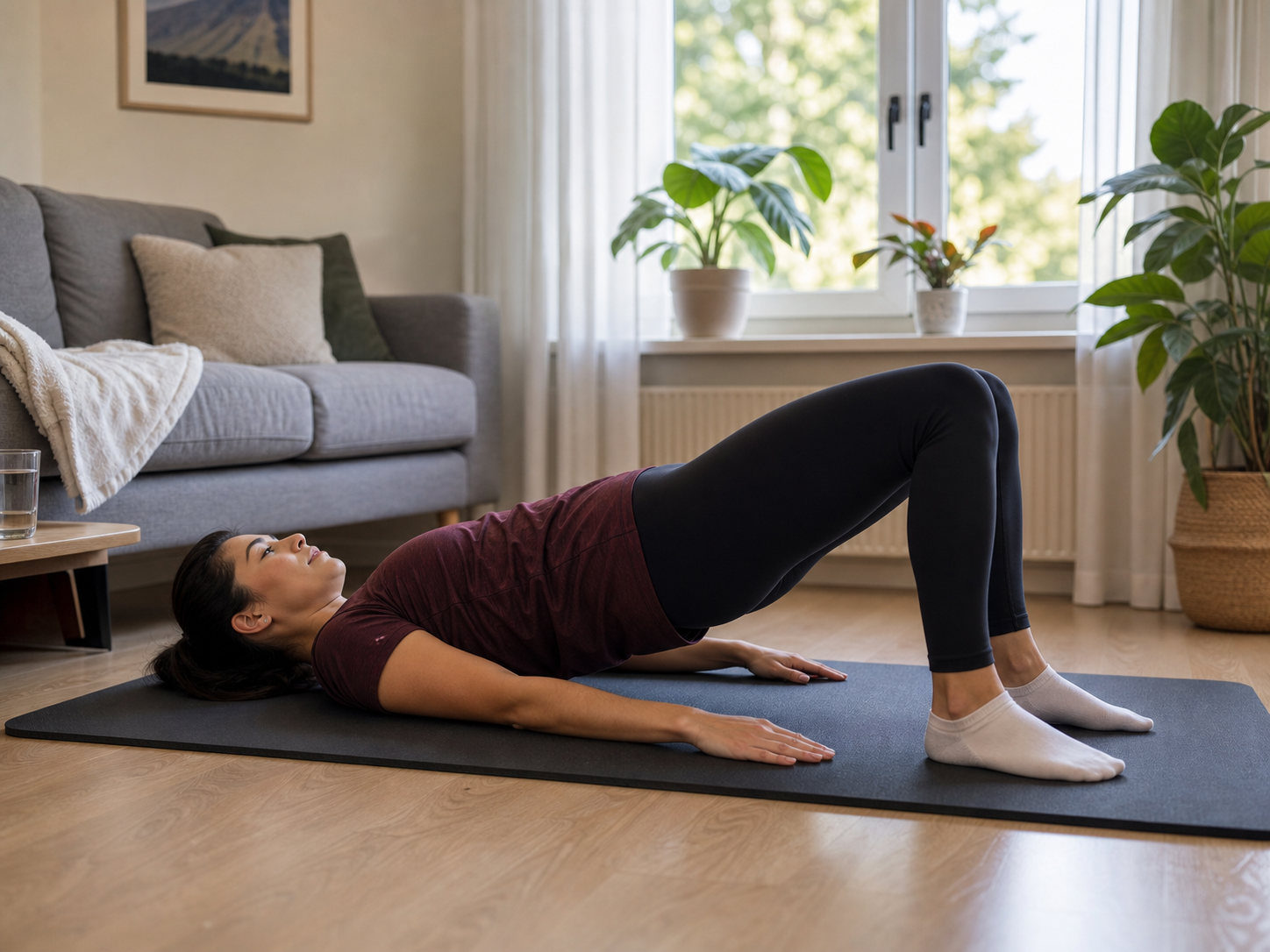
1. Glute bridge with heel pressure
Lie on your back, knees bent, feet flat on the floor. Push mainly through your heels, tighten your glutes and gently lift your hips. Hold for a second at the top. If you mainly feel your lower back, make the movement smaller and push your ribs down slightly.
Good first exercise: you learn to create tension without a large range. Start with 2 sets of 8 to 12 repetitions.
2. Hamstring bridge hold
Place your feet a little further from your buttocks than with a regular bridge. Lift your hips and hold for 10 to 20 seconds. Start small: the goal is calm tension, not cramps.
3. Hamstring walkout
Start in bridge position. Slowly walk forward a few small steps with your heels and then back. Keep your hips high enough and prevent your back from arching.
4. Light Romanian deadlift
Grab two light weights or start with no weight. Push your hips back, keep your back long and bend your knees slightly. You will feel stretch and tension at the back of your thighs. Come back up by pressing your feet firmly into the floor.
A light hinge teaches your hamstrings to work together with your hips and back. It's not a stretching match. The movement stops as soon as your back position changes.
5. Two-leg slider curl
Lie on your back, heels on sliders or towels. Lift your hips slightly, gently slide your heels away and pull them back. Keep the range short if the return route is too difficult. Slider curls are a nice bridge between easy hamstring exercises and more difficult knee-dominant training.
If you want more variants, use the separate guide withhamstring slider exercises.
6. Assisted Nordic over short range
Kneel on a mat with your ankles fixed low. Keep your hands ready in front of your body and lean forward just a little. Gently push yourself back. The goal is not to get deep, but to repeat the same braking phase.
The Nordic is tough because your hamstrings have to brake your body eccentrically. In studies of Nordic programs, consistent, measured implementation plays a major role; an exercise does not help if it is so heavy that you drop it after two weeks (Ripley et al., 2021).
7. Short eccentric Nordic
When assisted reps are going steady, you can try a short eccentric Nordic. Sink forward for three seconds, catch yourself with your hands and push back. Start with 2 sets of 3 reps. Full repetitions are not necessary until later.

For regressions and transitions, read the guideNordic hamstring curl alternative. If you want to understand the exercise itself first, go to the main guide on theNordic hamstring curl.
Take your Nordic curl from the first rep to week 10.
A concrete 7-page plan: build up week by week, without pushing too fast.
- 01A clear week-by-week progression
- 02Technique and the mistakes to avoid
- 03A simple log you will actually use

≤51%
✓Backed by research
Van Dyk et al., 2019: meta-analysis of programmes with NHE. Not an effect test of Nordbelt or this protocol.
Open the download page again or check the email we sent you.
Open the download page ↗Hamstring training for beginners: schedule for 4 weeks
Use this schedule as a basis. Stay longer in a week if the step does not yet feel stable.
Week 1
- Glute bridge with heel pressure: 2 x 10
- Hamstring bridge hold: 2 x 15 seconds
- Light Romanian deadlift: 2 x 8
Week 2
- Glute bridge with heel pressure: 3 x 10
- Hamstring walkout: 2 x 5 gentle walkouts
- Light Romanian deadlift: 2 x 10
Week 3
- Hamstring bridge hold: 3 x 20 seconds
- Slider curl with two legs: 2 x 6
- Light Romanian deadlift: 3 x 8
Week 4
- Hamstring walkout: 3 x 6
- Slider curl with two legs: 3 x 6
- Assisted Nordic over short range: 2 x 3
Train this schedule twice a week. If you also do a lot of running, football, strength training or intensive group lessons, keep the hamstring volume lower.
Hamstring strength for beginners without going too fast
Strengthening your hamstring for beginners is not just about lifting more pounds or doing more reps. You can gain weight via:
- more range;
- more repetitions;
- sink slower;
- perform one-legged;
- choose a heavier variant.
Just change one thing at a time. For example, first make the slider curl longer before moving to single-leg slider curls. Research comparing hamstring exercises with sprint loads shows that exercises have different accents; no exercise replaces all sports loads (Prince et al., 2020).
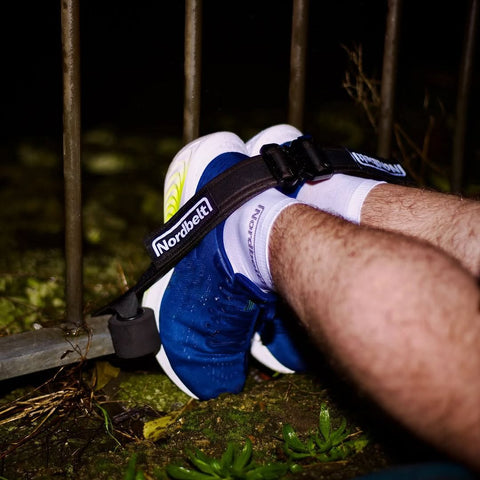
During slider curls, your heels must remain free to slide across the floor. Nordbelt provides ankle fixation for supported Nordic curls. Check the anchor, knee padding and space for early hand support, and choose a progression you control. With pain or a recent injury, have suitability assessed first. Related guidance: how to guide.
Safe hamstring exercises and common mistakes
Safe hamstring exercises are exercises that suit your current level and that you can repeat easily. A slider curl can be safe if you keep your range short. A Nordic may fit well later, but is often not a first step.
Above all, avoid these mistakes:
Too many exercises at once
A long list feels complete, but makes it difficult to see where your response is coming from. Start with a small selection and repeat.
Do each set to failure
Hamstrings often respond better to clean repetitions than to forcing. Stop when your hips drop, your back takes over or you no longer control the braking phase.
Going to full Nordics too quickly
The Nordic hamstring exercise has been well researched, but remains a difficult exercise. In soccer research, a progressive Nordic program reduced hamstring injuries, but that context doesn't mean that every beginner should do full reps right away (Petersen et al., 2011). Use regressions first.
Stopping strength work after the first improvements
Stopping after four weeks is a shame. Maintain a small maintenance incentive, for example a bridge variation, slider curl and light Nordic regression per week. When it comes to hamstring training, consistency is often more important than a spectacular start.
Frequently asked questions
Which hamstring exercises for beginners are the best?
The best hamstring exercises for beginners are glute bridges, hamstring bridge holds, short hamstring walkouts, light Romanian deadlifts and later slider curls. These exercises work your hamstrings without having to do a heavy Nordic curl right away. Choose two or three exercises and repeat them for a few weeks before adding more variation.
How often should a beginner train hamstrings?
For most beginners, twice a week is enough. Rest at least a day between sessions and do not increase sets, reps and difficulty at the same time. If you get a lot of muscle pain or have worse movement the next day, the stimulus was too great.
Are Nordic hamstring curls suitable for beginners?
Full Nordic hamstring curls are usually too heavy as a first step. Assisted Nordics or short eccentric Nordics may be suitable later, especially if you tolerate bridges, walkouts and sliders well. Start with a small range, few reps and hands ready to catch yourself.
What are safe hamstring exercises if you quickly get muscle pain?
Start with glute bridges, bridge holds and light Romanian deadlifts. Keep the range small and don't train to failure. Slider curls and Nordics come later. Muscle pain is not automatically dangerous, but sharp pain or a clear setback the next day is a signal to train lighter.
Can I do hamstring exercises for beginners at home?
Yes. You can do bridges, walkouts, slider curls with towels and light hinges at home. For heavier Nordics you do need a stable ankle fixation. Never use a loose piece of furniture that can slide and always test your setup with your hands first.
When do I make my hamstring exercises more difficult?
Make the exercise more difficult if you perform the same training technically well for two weeks in a row and move normally the next day. First extend the braking phase or range, then add more repetitions. Only move to a heavier variant if the previous variant remains controlled.