

Rest between sets: choose your strength-training break

Choose your rest between strength-training sets in relation to the next set: can you repeat the intended exercise with the same load and controlled execution? Use a timer to track elapsed time, but do not treat the beep as proof that you are ready. There is no single best break for every exercise and every person. Compare both the rest interval and what you actually do afterwards, without drawing conclusions about muscle growth from one workout.
What does the timer between two sets measure?
A set is a sequence of repetitions. Here, the rest interval runs from the end of that sequence to the start of the next. Start and stop the timer consistently. If you include the time spent putting weights down on one occasion but exclude it on another, you are comparing different breaks.
The clock records time; it does not measure recovery, technique or a suitable training load. Decide beforehand which exercise, execution and load you intend to repeat. Before the next set, check that you can deliberately take your starting position. Rushing because a preset time has elapsed does not make an unsuitable load appropriate.
This article concerns breaks within one strength-training session. Distributing work across training days is a different question; see our comparison of full-body and split routines for that.

How long should you rest if the next set turns out differently?
Use your existing programme as a starting point. Record the planned break and the actual time that elapsed. Then consider whether you completed the intended repetitions and range of motion. If not, extend the break as needed and reassess the load too. Waiting longer is not an instruction to force a set that you cannot control.
Keep the comparison simple. Use the same exercise, weight and execution when trying a different break. If you change the exercise or load at the same time, you cannot attribute the outcome to rest alone. A lighter set may be appropriate, but it is a different comparison.

Context image of a dumbbell set. The photograph does not show a prescribed load, rest interval or measured effort.
What does research say about rest between sets and muscle growth?
A systematic review with meta-analysis combined nine studies lasting five to ten weeks. Central estimates for arm and thigh muscle growth suggested a small possible advantage for rest periods longer than sixty seconds over shorter breaks, with wide uncertainty intervals. Most studies involved young, untrained participants. This does not establish your personal ideal rest interval (Singer et al., 2024).
One included study compared one-minute and three-minute breaks in 21 young, resistance-trained men over eight weeks. The three-minute group improved more in maximal squat and bench-press strength and in measured muscle thickness at the front of the thigh. This is a specific comparison, not evidence that three minutes is optimal for everyone or every exercise (Schoenfeld et al., 2016).
Separate two questions: what can you do in the next set, and what changes after weeks of training? A smoother next set can be a useful observation, but it is not itself a measurement of muscle growth. The rest intervals studied are comparison conditions, not mandatory timer settings for your workout.
Take your Nordic curl from the first rep to week 10.
A concrete 7-page plan: build up week by week, without pushing too fast.
- 01A clear week-by-week progression
- 02Technique and the mistakes to avoid
- 03A simple log you will actually use

≤51%
✓Backed by research
Van Dyk et al., 2019: meta-analysis of programmes with NHE. Not an effect test of Nordbelt or this protocol.
Open the download page again or check the email we sent you.
Open the download page ↗A log example that separates time from execution
The entries below are entirely fictional. They illustrate what you can record, not how many sets or repetitions you should do, or how long you should rest. The weight and exercise remain unchanged in this example; no real athlete was tested.
| Entry | Break before the next set | What was recorded? | What can you conclude? |
|---|---|---|---|
| A | Two minutes | Eight intended repetitions completed | The task was completed with this break |
| B | Forty-five seconds | Six of the eight intended repetitions completed | Both time and execution differ from A |
| C | Two minutes | Eight repetitions with a shorter movement | The same count does not mean the same execution |
Entry B does not prove that the shorter break was the only cause. Entry C shows why counting repetitions alone is insufficient. Also record noticeable changes, such as a different range of motion or setup. Leave the conclusion open when the entries are not comparable.

Context image for keeping a training log; the person pictured is not a participant in the fictional example.
Would you also like to do Nordic curls at home?
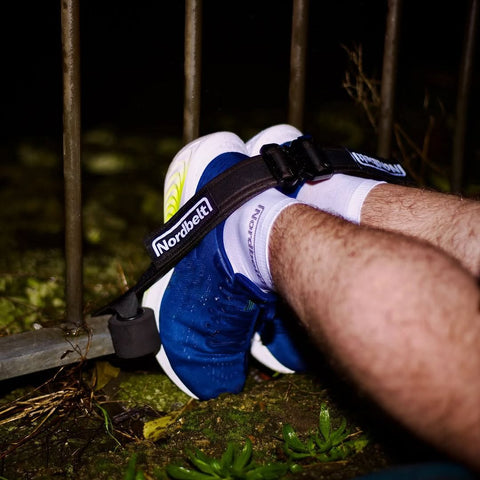
You do not need an ankle strap to choose a rest interval. If you separately decide to do Nordic hamstring curls at home, a strap can secure your ankles. You still need a suitable, checked anchor point, knee support and clear space to catch yourself. Nordbelt for home training provides that ankle fixation without a training partner or large machine. The strap does not determine your rest interval, recovery or training results. For how that separate exercise fits into a session, read about Nordic curls as supersets or separate sets.
Use your notes for your next workout
A useful log entry includes the exercise, load, planned and actual break, repetitions completed and noticeable changes in execution. You do not need to turn this into a score. The aim is to be able to see what you actually did later, including when a conversation or occupied equipment extended your break.
Look at several comparable workouts before identifying a pattern. Even then, a training log remains a practical record, not a controlled experiment. It can help you discuss which setting seems workable; it cannot establish guaranteed strength gains or recovery status. If you are instead choosing exercises for home, the hamstring programme with different home exercises addresses that separate question.
Stop if you experience sharp pain or lose control. Symptoms are not a timer problem to solve by taking a longer break. Have persistent or recurring symptoms assessed by a doctor or physiotherapist.
Frequently asked questions
Is one minute of rest always too short for muscle growth?
No. The review found muscle growth across different rest intervals and a small possible average benefit of longer versus short breaks. Uncertainty and differences between studies do not support a hard threshold at which a workout suddenly does or does not work. Consider whether your break suits the intended set, without treating one minute as a universal mistake or ideal standard (Singer et al., 2024).
Is resting three minutes automatically better than two?
The cited study in trained men does not establish that: it compared one minute with three, not two with three. Its findings concern the participants, exercises and study period examined. For your practical choice, record your actual break and the following set. If you take more time, note it; do not call it a proven optimal setting on the basis of that study (Schoenfeld et al., 2016).
Should rest intervals be the same for every exercise?
Not as a fixed rule. The review included different exercises, training approaches and participants, so it cannot provide a universal break for every task. Within your own comparison, keep the exercise and execution consistent. A break during an arm exercise and one during a heavy leg exercise are not interchangeable measurements. Discuss changes to a personal programme with the professional who knows that programme when needed (Singer et al., 2024).
Does an extra repetition after a longer break prove I will gain more muscle?
No. You have an observation about that set, not a measurement of later muscle growth. Also check whether the weight, range of motion and execution stayed comparable. The fictional log shows how the same number of repetitions can hide different execution. Use the observation to describe your training more accurately; a conclusion about long-term results requires other evidence.
What if an interruption makes me rest longer than planned?
Record the actual time and check your setup again before starting. An interruption does not automatically mean the workout has failed. Just do not compare the set as though you used exactly the same break as last time. Do not quietly compensate for lost time by rushing the next set either. Your note can stay simple: planned break, actual break and what you did afterwards.