


Hamstring exercises for CrossFit: lift, jump and sprint stronger


Hamstring exercises for CrossFit should make you stronger for hinges, squats, jumps, sled pushes, short sprints and long WODs without leaving you with heavy soreness every week. Start with control and a clean hip hinge, add eccentric strength, and use the Nordic hamstring curl only when your base work feels stable. CrossFit hamstring exercises work best when they fit the week, not when they become a random finisher after an already hard session.
Key points
The best hamstring training for CrossFit combines hip strength for deadlifts and kettlebell swings, eccentric control for jumps and sprint-like work, and enough dosage control to protect WOD quality. CrossFit injury papers often report the shoulder, back and knee as common problem areas, but the practical lesson is broader: fatigue, technique and training load matter (Weisenthal et al., 2014; Gardiner et al., 2020).
Use this article as a sport-specific layer on top of the broader guide to hamstring exercises. Choose two exercises first, place them in the week, and progress only when technique, soreness and WOD performance remain stable.
Why CrossFit loads the hamstrings differently
CrossFit can load the hamstrings in several ways in the same week. Deadlifts need hip extension. Kettlebell swings need rhythm and fast hip drive. Box jumps and double unders need repeated landing stiffness. Olympic lifts need speed, position and timing. In metcons, fatigue builds faster than in a single strength session.

That is why stronger hamstrings for CrossFit are not just about heavier curls. You want a clean hinge, eccentric control and local capacity. A systematic review on CrossFit risk factors found signals for training load and previous injury, while also noting that the evidence quality is limited (Mehrab et al., 2023). Keep the takeaway practical: build gradually and make the work measurable.

Which CrossFit hamstring training should come first?
Pick exercises that make your movement feel better. If extra hamstring work ruins your hinge or leaves you stiff for two days, the dose was too high. A sensible order is hip hinge, bridge, single-leg Romanian deadlift, walkout, slider leg curl, tempo Romanian deadlift, assisted Nordic and only then full Nordics.
The first five steps are enough for many athletes. The last three are heavier. Do not place them on the same day as heavy deadlifts, high-volume kettlebell swings or a WOD full of jumping lunges.
Take your Nordic curl from the first rep to week 10.
A concrete 7-page plan: build up week by week, without pushing too fast.
- 01A clear week-by-week progression
- 02Technique and the mistakes to avoid
- 03A simple log you will actually use

≤51%
✓Backed by research
Van Dyk et al., 2019: meta-analysis of programmes with NHE. Not an effect test of Nordbelt or this protocol.
Open the download page again or check the email we sent you.
Open the download page ↗The best CrossFit hamstring exercises
Use two or three exercises per session. Useful choices are a slow hip hinge, glute bridge with heel pressure, single-leg Romanian deadlift, hamstring walkout, slider leg curl, tempo Romanian deadlift and assisted Nordic hamstring curl. For more slider progressions, use the guide to hamstring slider exercises.

Exercise choice matters because different movements stress the hamstrings differently. A strengthening framework for hamstring injury prevention highlights that activation, architecture and function adapt according to the selected exercise (Bourne et al., 2018).
Nordic hamstring curl for CrossFit
The Nordic hamstring curl fits CrossFit when you already have basic control and want a compact eccentric strength stimulus. It fits poorly as a daily finisher, directly before heavy posterior-chain work, or as a forced full-range test.
Most Nordic evidence comes from team-sport and athletic populations. A meta-analysis found that programmes including the Nordic hamstring exercise reduced hamstring injury rates compared with control programmes (van Dyk et al., 2019). A broader review of randomized trials also found that eccentric strengthening can improve injury incidence and relevant risk factors (Rudisill et al., 2023). That does not make any CrossFit athlete injury-proof; it supports calm progression.
Start once per week with two sets of three to five assisted reps, lower for about three seconds, use the hands to return, and check the response over the next 24 to 48 hours. For technique details, read the Nordic hamstring curl. Nordbelt can help when you need a stable low ankle anchor for repeatable solo Nordics.
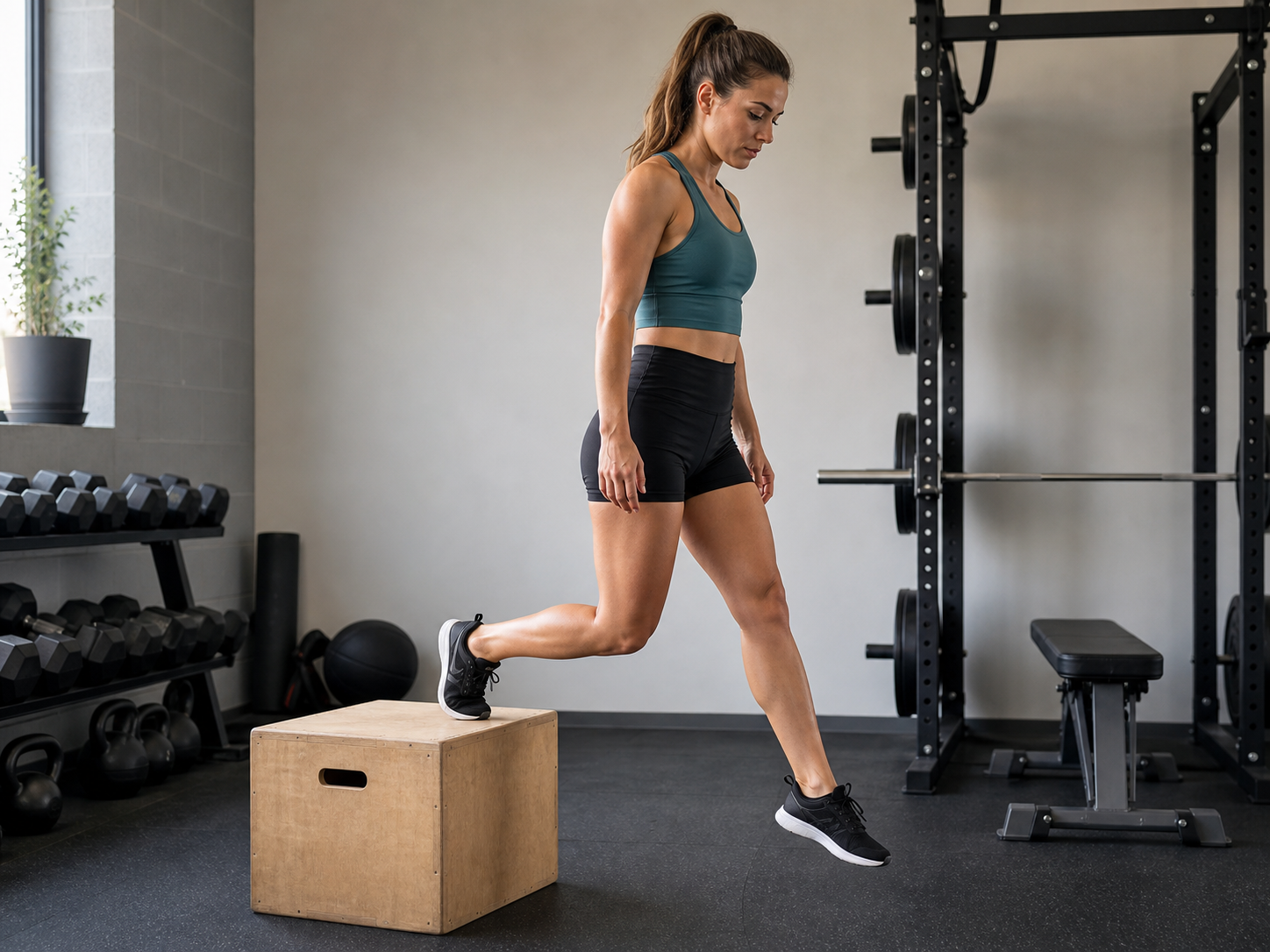
Weekly planning
Look at all posterior-chain stress: deadlifts, cleans, snatches, kettlebell swings, wall balls, box jumps, running intervals and sled work. Put heavier eccentric work away from the heaviest hinge day. A light day can use hinge drills and sliders; a heavier day can use tempo RDLs or assisted Nordics. For a broader progression list, use the guide to eccentric hamstring exercises.
Injury prevention without false certainty
You cannot fully prevent a hamstring injury in CrossFit with a list of exercises. Previous injuries, jumps in load, sleep, technique, mobility, fatigue and programming all matter. You can improve capacity by building strength, eccentric control and week planning. Research in football players showed that Nordic training does not automatically improve sprint capacity even when it trains eccentric strength (Ishoi et al., 2018). For CrossFit, hamstring training is one part of the base, not a replacement for pacing and skill.
FAQ
Which hamstring exercises matter most for CrossFit?
Start with hip hinge, single-leg Romanian deadlift, slider leg curl and assisted Nordic hamstring curl. They cover hinge control, balance, eccentric strength and heavier knee-flexion work.
How often should I train hamstrings around WODs?
One or two sessions per week is enough for most athletes. Keep one session light and place the heavier eccentric session away from deadlifts, cleans and jump-heavy workouts.
Can hamstring injuries in CrossFit be prevented?
The risk cannot be reduced to zero. You can lower avoidable risk by improving capacity, progressing volume slowly, keeping technique clean and respecting fatigue.