

Bulgarian split squat: setup, balance and technique

A Bulgarian split squat is a split squat with your rear foot resting on an elevated support and your front foot on the floor. First choose a stable setup that lets you lower, rise and step out under control. Consider front-foot contact, rear-foot support and trunk position together; a fixed bench height or prescribed force split will not suit everyone. This guide helps you find a repeatable movement without treating lost balance as a reason to add weight.
What changes when the rear foot is raised?
In a regular split squat, both feet stay on the floor. In a Bulgarian split squat, the rear foot rests higher. You do not step forwards or backwards on every repetition as you would in a moving lunge. Choose the setup first, then move within it.
That makes the support part of the exercise. An available bench is not automatically suitable for you. You should be able to use it without jumping, sliding or forcing your rear leg into an uncomfortable position. To practise with both feet on the floor first, see training legs at home without machines.
Make your setup easy to check
Start without added weight. Check that the support is designed to bear the load, cannot tip and stands on a surface with good grip. Clear loose objects from around your feet. Choose a height that lets you place and remove your rear foot calmly. A suitable low support may be more practical than a high bench you can barely get onto.
Use this table to connect a specific observation with a possible adjustment. It is an editorial aid, not a test that proves safety or ideal technique.
| Part of the setup | What can you observe? | What might you change? |
|---|---|---|
| Front foot | Does it stay in place as you lower and rise? | Reassess the distance; do not add weight yet. |
| Rear-foot support | Do the support and foot contact stay steady without sliding? | Stop and choose a more stable or better-fitting support. |
| Space between the feet | Can you move without constant sideways corrections? | Do not force your feet onto a single narrow line. |
| Trunk and pelvis | Can you repeat roughly the same position without suddenly twisting? | Reduce the range or use light hand support. |
| Getting in and out | Can you enter and leave the position calmly? | Practise a regular split squat on the floor first. |
The image below shows someone kneeling beside dumbbells and a training sheet. It illustrates preparation, not a Bulgarian split squat or advice to use dumbbells immediately.
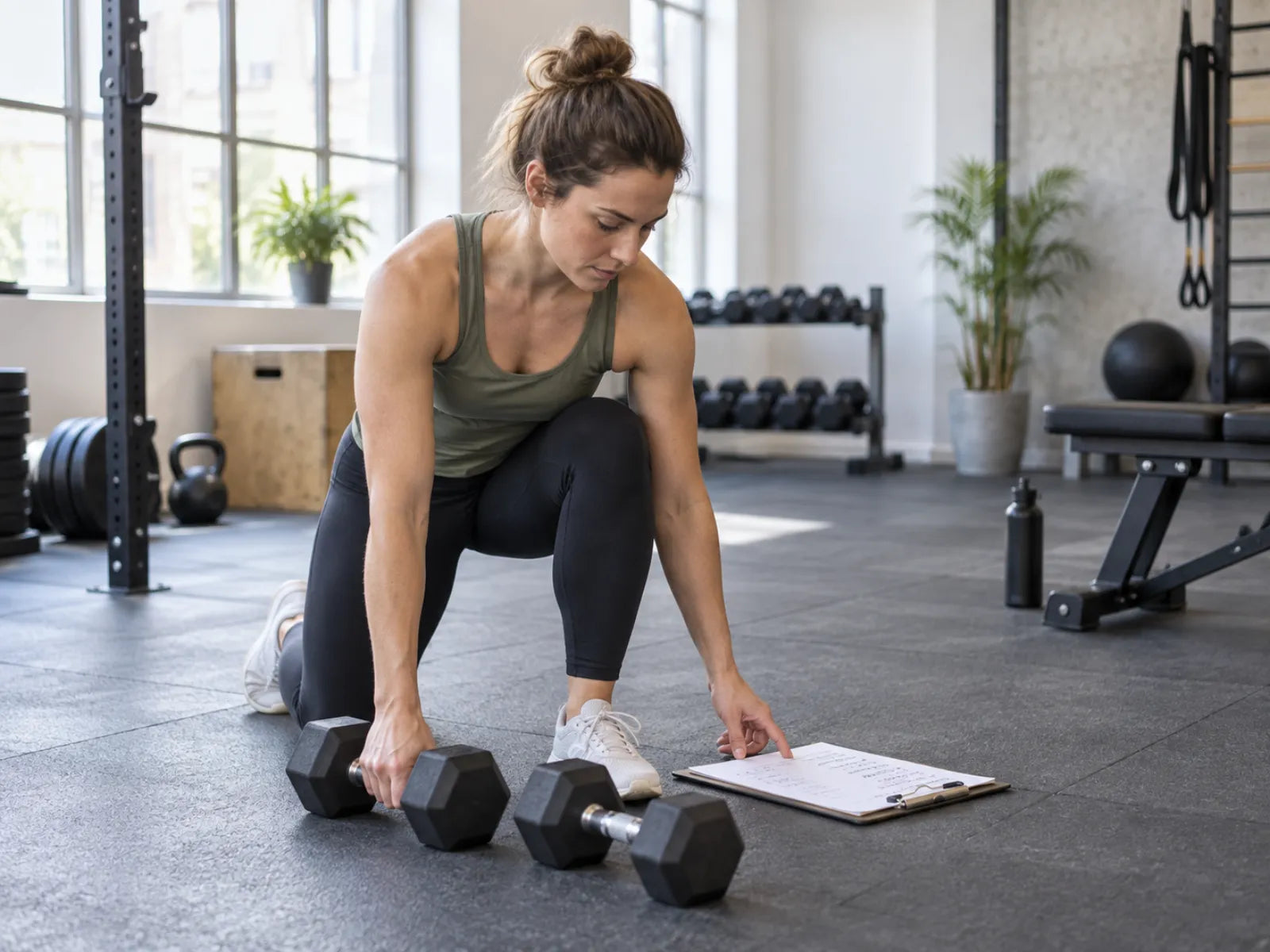
Preparation: choose and record the setup before deciding whether to add weight.

How to perform the movement
- Stand in front of a suitable support. Place your rear foot calmly and make sure you can step out again. Hold a solid support lightly with one hand if needed.
- Find a front-foot position that lets the whole foot stay in contact with the floor. Do not copy a fixed distance from someone with different proportions or a different support.
- Bend the front hip and knee under control, letting the rear knee lower too. Choose a range you can manage; the rear knee does not have to touch the floor.
- Rise while keeping the front foot in place. Let your trunk move in a repeatable way, without chasing a forced straight-back position or an exact angle.
- End the set if you start hopping, repeatedly reposition your foot or the support moves. Step out calmly before adjusting the setup.
If balance remains the limiting factor, try light hand support or a regular split squat. Making the task simpler is useful when you would otherwise spend the whole time trying not to fall. Record the support and foot position so you do not unknowingly change everything next time. Sharp pain, dizziness or an unstable support are reasons to stop; persistent symptoms need a qualified healthcare professional.
Take your Nordic curl from the first rep to week 10.
A concrete 7-page plan: build up week by week, without pushing too fast.
- 01A clear week-by-week progression
- 02Technique and the mistakes to avoid
- 03A simple log you will actually use

≤51%
✓Backed by research
Van Dyk et al., 2019: meta-analysis of programmes with NHE. Not an effect test of Nordbelt or this protocol.
Open the download page again or check the email we sent you.
Open the download page ↗Two examples of a changing setup
Fictional example: Noor moves her front foot after every repetition. She is using a different bench. Instead of adding weight, she stops and practises without dumbbells. She chooses a new starting position and records which support she uses. The question is whether the setup becomes repeatable, not how many kilograms she can lift.
Fictional example: Milan twists his trunk to keep his balance. Light hand support lets him observe the movement more calmly. He keeps that support for now or chooses the floor version. These examples illustrate decisions; they are not customer stories, diagnoses or demonstrated training outcomes.
Where might a separate hamstring exercise fit?
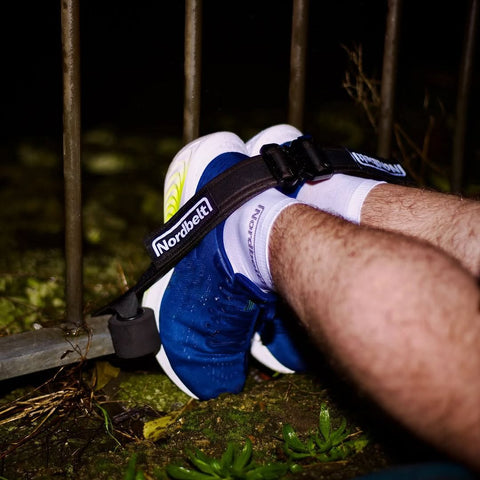
A Bulgarian split squat does not need an ankle strap. Choosing to practise Nordic hamstring curls at home as well is a separate exercise decision. Nordbelt for Nordic curls at home secures both ankles to a suitable anchor without a training partner or large machine. It is neither rear-foot support nor equipment for this single-leg exercise. Check that separate setup before using it.
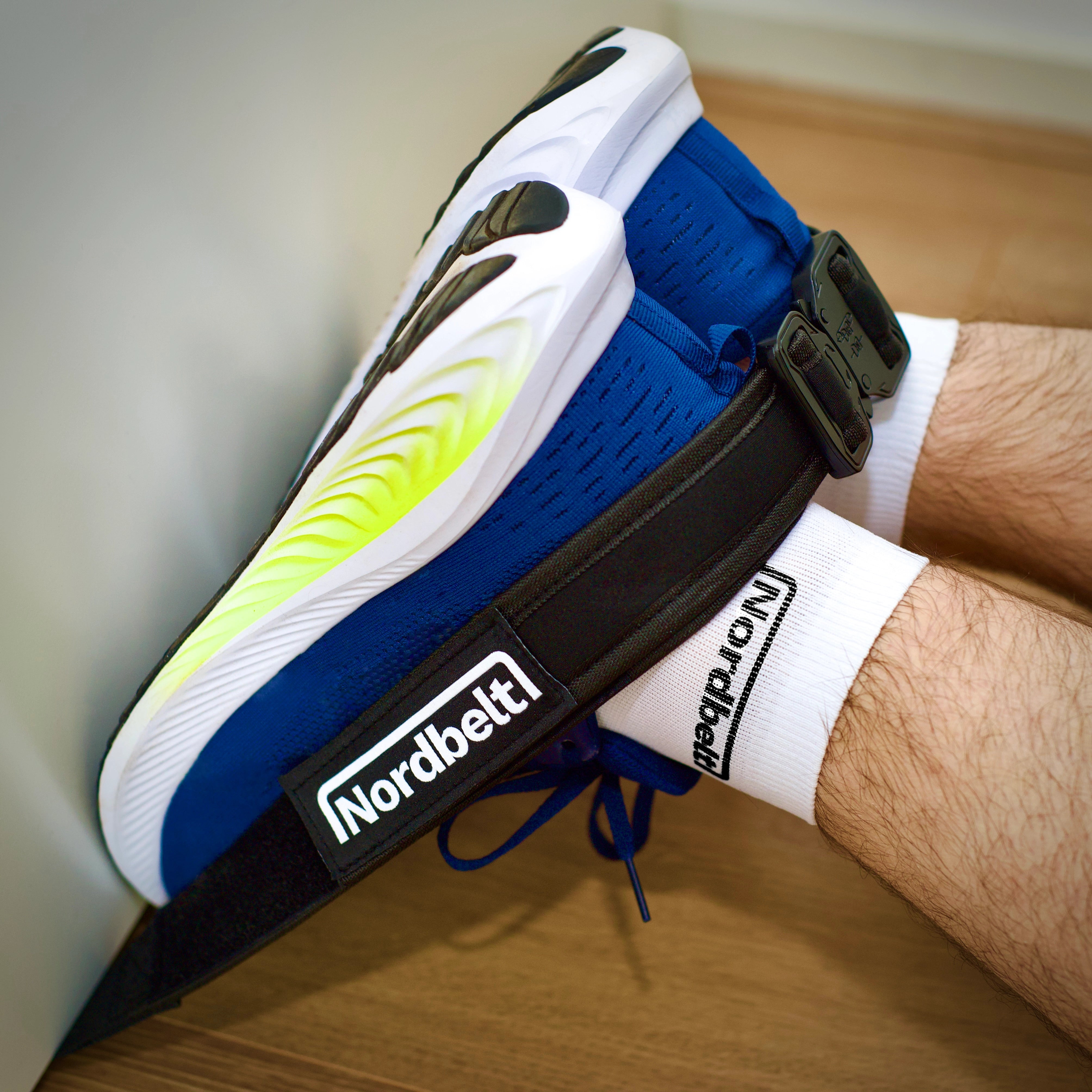
A separate Nordic setup: both ankles are secured. Do not use this for a Bulgarian split squat.
Why a force percentage is not a technique rule
A study of 26 recreationally trained men analysed 715 rear-foot-elevated split-squat repetitions. The lead foot contributed an average of 84.36% of total vertical force. This is an average from that experiment, not a universal 90/10 split to reproduce by feel. The study assessed forces during the movement, not long-term muscle growth or injury prevention (Helme et al., 2022).
Another study analysed nine trained men performing bodyweight Bulgarian split squats. Researchers compared distances between the front foot and rear support and different trunk positions. At the bottom of the movement, they calculated the rear leg's contribution to the external moment the front hip extensors had to overcome. Trunk position particularly affected that contribution with the shorter front-to-rear distance. The small sample, fixed support height and controlled movement limit application to other people or heavy dumbbells (Arakawa et al., 2025).
Vertical force beneath a foot and a turning moment around the hip describe different things. A moment also depends on where a force acts and its distance from the joint. Percentages from these studies are therefore not interchangeable. Nor do they tell you which bench height to use. Use research to understand the distinction and visible checkpoints to describe your own setup.
Frequently asked questions
How high should the bench be?
There is no universal height in centimetres here. Choose suitable, stable support on which you can place your rear foot without forcing it and from which you can step out calmly. A fixed support height in a laboratory is not a personal prescription. If the available bench is awkward, choose another suitable support or keep both feet on the floor.
How far forwards should I place my front foot?
Far enough to lower and rise under control with the foot staying in place, without the rear leg forcing the position. Consider support height and trunk position too. Change one element and try again without added weight. A foot position in a photograph is not a measurement for your body.
Is leaning forwards always wrong?
No. A forward-leaning trunk is not automatically a technique error. Consider whether the position is deliberate and repeatable or changes suddenly because you are losing balance. The biomechanical study described above does not provide one ideal trunk angle for everyone. Seek individual guidance if you cannot assess the movement or have symptoms.
What if my balance gives out before my strength?
Stop before you need to hop or catch yourself. Try light hand support, a smaller range or a regular split squat. Make the setup predictable before deciding on more load. This guide does not prescribe a new weekly programme; for broader exercise choices, see training your glutes at home.
Does this exercise replace every other leg exercise?
No. One exercise does not automatically cover every training goal. Decide which movement you want to practise and which other tasks your programme already includes. Our posterior-chain exercise guide helps distinguish different movement patterns. More weight or a stronger muscle sensation in this split squat does not prove other exercises are unnecessary.