Hamstring tendon avulsion: what should you ask about surgery?

If your hamstring tendon has avulsed, you and your specialist discuss whether surgery or nonoperative treatment suits your situation. Cover the diagnosed injury, loss of function, nerve symptoms, daily goals and demands of both pathways. Pain or bruising alone cannot establish this diagnosis. If sudden pain is severe or walking is difficult, seek prompt assessment by a doctor first; do not test the tendon yourself.
For possible strength training later, the Nordbelt homepage explains ankle fixation for Nordic curls at home without a training partner. This becomes relevant only if your clinician considers the exercise appropriate. The tool does not treat a tendon avulsion, protect a surgically repaired tendon or influence the choice of surgery.
First clarify the diagnosed injury
A proximal hamstring tendon avulsion involves the attachment high at the back of the thigh, near the sitting bone. This raises a different question from an ordinary muscle strain or gradually developing tendon pain. Ask your specialist to explain exactly what has been diagnosed, which tendons are involved and what remains uncertain. You do not need to turn an imaging report into a treatment choice yourself.
These discussion prompts are for adults after professional diagnosis. They provide no surgical threshold, deadline or recovery schedule. For symptoms that have not been assessed, start with the early phase after a hamstring injury. The question of when ultrasound or MRI adds information has its own explanation.
The 2024 Dutch guideline recommends discussing the advantages and disadvantages of both treatment options after diagnosis. Function, sporting level, nerve symptoms, preferences and tendon findings all matter. One isolated feature therefore does not create an online decision rule. Ask how your clinician considers your findings together.

What does research tell us about the two options?
Randomised research exists. The PHACT trial randomly allocated 119 adults to operative or nonoperative treatment; a separate observational cohort was also followed. Its primary question concerned self-reported pain and function after two years. Participants were aged 30–70, at least moderately active, with an acute, MRI-confirmed complete avulsion of at least two tendons. (Pihl et al., 2024)
This does not establish that both options are equal for everyone and every outcome. Limitations included the study's modest size and lack of participant blinding. Ask which findings matter for your goals and where uncertainty remains. Do not derive personal surgical advice for a teenager, elite athlete, partial tear or longstanding injury from this trial.
The Dutch guideline's literature assessment preceded this study. Its earlier description of an absence of randomised evidence should therefore not be repeated as the current state of knowledge. Discuss both the guideline and newer research in context. A research finding supports a conversation; it does not replace it.
Take these five points to your appointment
Write down what you know and leave unknown details open. This is an editorial conversation aid, not a validated decision aid or medical score. No movements or strength tests at home are required.
- What matters to me? Name concrete goals: sitting normally, doing your job or returning to a particular sport. Distinguish participation from your previous performance level. Ask which goal the proposed treatment addresses, without asking for a guaranteed result.
- What is difficult and what is changing? Describe walking, sitting and daily tasks. Report tingling, numbness or loss of strength. Ask which changes require earlier contact and whom to call. Do not provoke symptoms again to make your account more convincing.
- How do the tendon findings affect the discussion? Ask how the location and extent of the diagnosed injury relate to your symptoms and goals. A tendon count or distance on a scan is not a home test or a universal threshold for surgery.
- What would each pathway require? Discuss possible disadvantages and complications, support, appointments and practical effects on work, transport and help at home. Ask separately what nonoperative care involves. No surgery does not mean there is no treatment plan or follow-up.
- How will we record the next steps? Agree on a contact person, instructions until reassessment and how changes will be discussed. Ask clinicians to reconcile unclear or conflicting instructions.
A fictional example is: “I want to manage my work again and later return to recreational sport. Which benefits and disadvantages matter for those goals, what would each pathway require and when will we reassess?” This makes your preferences discussable without choosing surgery yourself.

Illustrative context for noting questions; no patient, specialist or medical assessment is shown.
Take your Nordic curl from the first rep to week 10.
A concrete 7-page plan: build up week by week, without pushing too fast.
- 01A clear week-by-week progression
- 02Technique and the mistakes to avoid
- 03A simple log you will actually use

≤ 51%
✓Backed by research
Van Dyk et al., 2019: meta-analysis of programmes with NHE. Not an effect test of Nordbelt or this protocol.
Open the download page again or check the email we sent you.
Open the download page ↗Agree on loading as well
Ask what you can and cannot do until the next contact. A general hamstring programme cannot account for your diagnosed tendon injury, treatment or instructions. Less pain on one day does not independently clear you for stretching, heavy strength training or sport. Discuss new or worsening symptoms through the agreed contact route.
A clinical review describes progressive loading for hamstring muscle strains. This is useful background, not a specific postoperative protocol for an avulsed tendon. Do not use it to choose exercises or starting weeks yourself. (Hickey et al., 2022) The existing guide to recovery and strength progression explains general concepts; your individual instructions remain decisive.
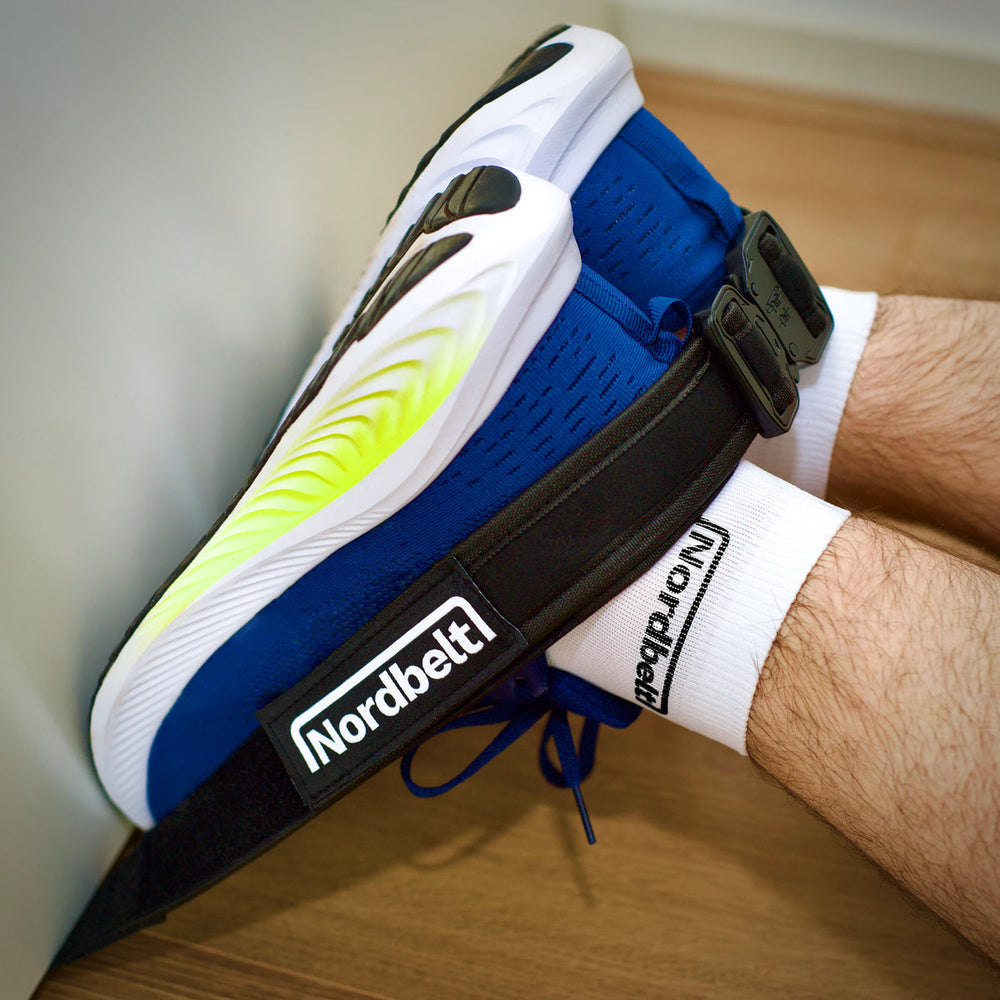
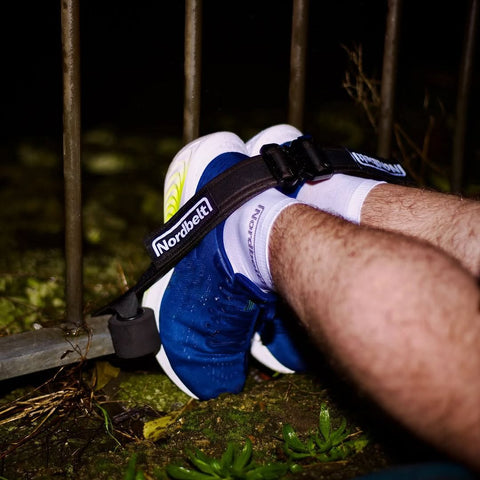
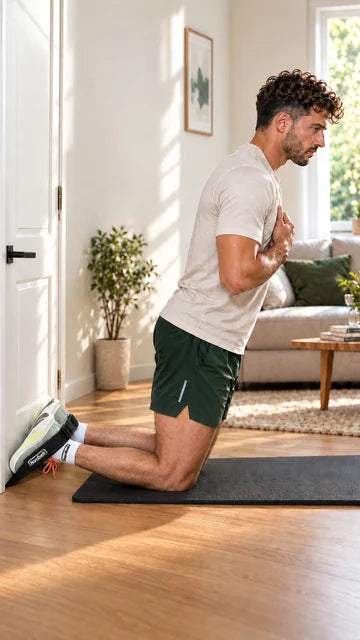
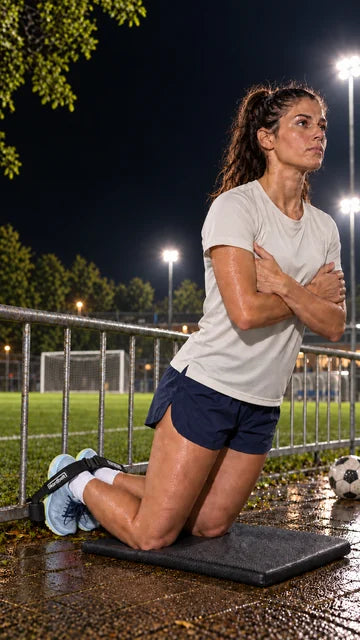
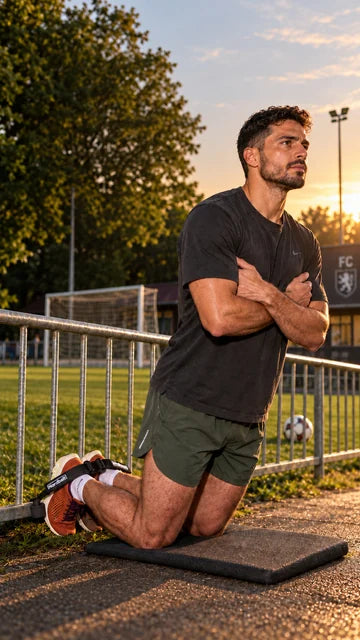
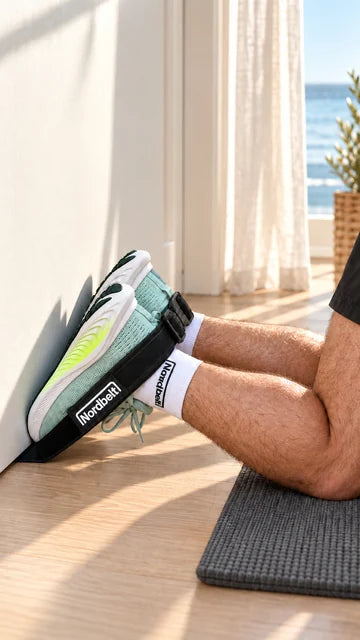
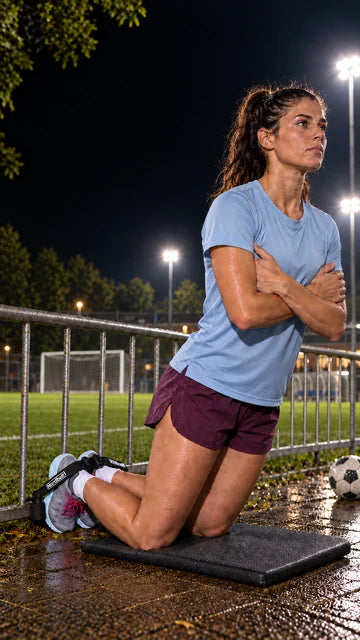
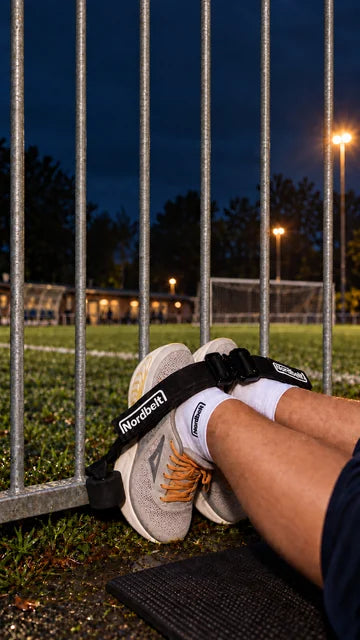
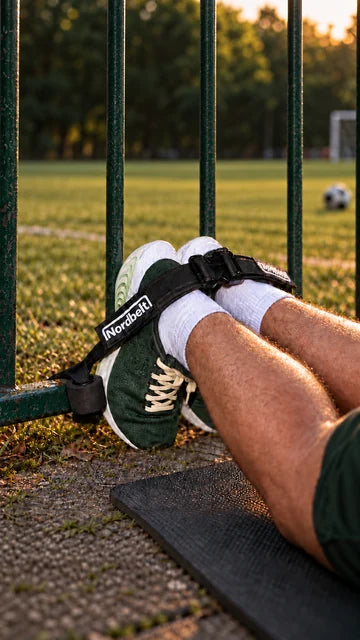
A Nordic curl involves kneeling with fixed ankles and lowering the body forwards under control. This describes the movement, not advice to try it now. If it becomes appropriate later, Nordbelt can fix the ankles. Follow the mounting instructions and check a suitable closed door, stable bench or sturdy low fence anchor, with knee padding and room to catch yourself. Not every door, bench or fence is suitable. Fixation cannot replace individual loading progression.

Setup detail for possible later training; no exercise after an avulsion or evidence of recovery.
Frequently asked questions
Does an avulsed hamstring tendon always need surgery?
There is no universal yes-or-no answer. After diagnosis, discuss with your specialist which treatment fits your injury, function, goals and preferences. This page provides no individual surgical decision or deadline for deciding yourself.
Can pain or bruising tell me the tendon has detached?
No. These symptoms do not establish the diagnosis or choose a treatment. Seek prompt assessment for severe acute pain, clear loss of function or difficulty walking. Do not try to confirm an avulsion by stretching, sprinting or performing a Nordic curl.
Does nonoperative treatment mean just waiting?
No. Ask what the agreed pathway involves, who provides support and when you will be reviewed. Agree which changes need earlier contact. Do not fill gaps in your instructions with a general training programme.
When can I return to sport or Nordic curls?
That depends on your individual assessment and supervised progression. A paper, less pain or a stable ankle anchor cannot clear you for sport. Ask which conditions apply and who assesses progress; these prompts prescribe no starting week or exercise dose.