

Stiff-leg deadlift or Romanian deadlift: what does your plan mean?


Choosing a stiff-leg deadlift or Romanian deadlift starts with the execution your plan intends. Look at knee bend, the start of the first repetition, the lower movement limit and how the next repetition begins. The exercise name alone does not settle these choices. Ask for a concrete description when two instructions contradict each other. Below, you can learn to record the differences without using the name to declare a winner for muscle growth or safety.
Why the same exercise name is not enough
Both names refer to a movement from the hips with a weight in your hands. Many explanations describe the Romanian deadlift, abbreviated to RDL, with slightly bent knees. A stiff-leg deadlift often emphasises less knee bend. These are useful clues, but they do not fully define your execution. A video with the same name may show a different bottom position or repetition start, for example.
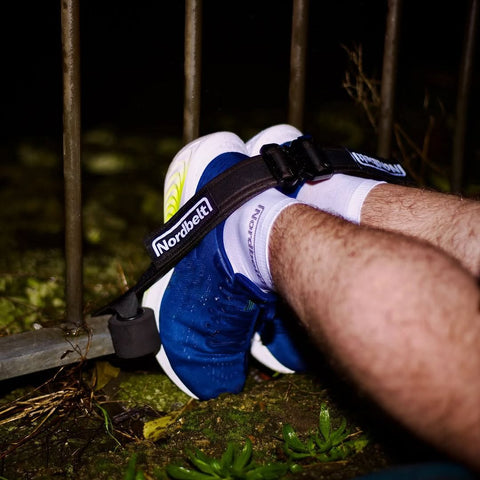
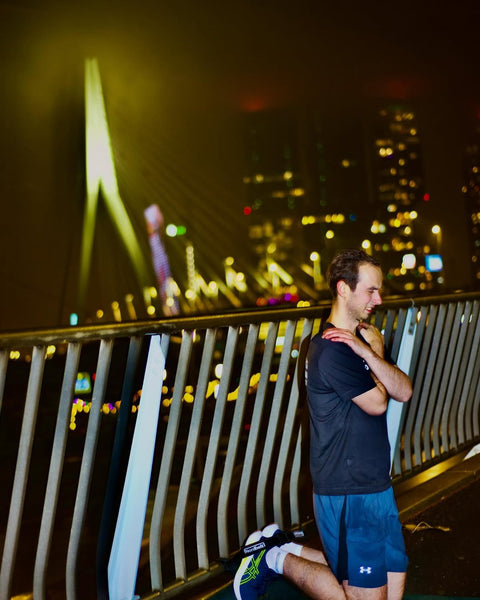
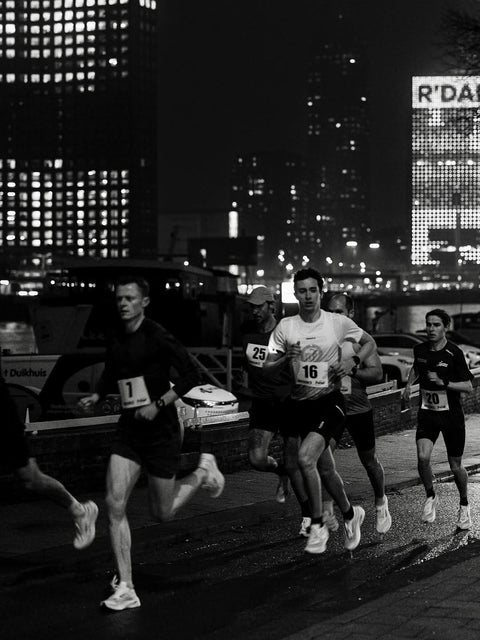
For a general explanation, read about the Romanian deadlift as a hamstring exercise. This comparison mainly helps you decide whether two instructions actually describe the same exercise. The images are illustrative training context; they do not prove an optimal knee angle or a difference in muscle activity.

Compare these execution choices in your plan
Use the following card to make an instruction concrete. The possible agreements are examples to discuss, not a prescription to try every variation.
| Choice | What do you record? | Which uncertainty does this resolve? |
|---|---|---|
| Knee bend | Slightly bent or less bent; does that position stay roughly the same? | The word stiff alone does not say what to do with your knees. |
| First start | Standing with the weight in your hands or from a specified lower position. | The first repetition need not start like the following ones. |
| Lower limit | An agreed movement point that you can control. | The floor is not automatically the goal. |
| Weight path | Where do the bar or dumbbells move relative to your legs? | Two videos may show a different path. |
| Next repetition | Continuous up-and-down movement or an agreed reset. | The same number of repetitions may represent a different task. |

Context image of a standing position with a straight bar. It does not show a full repetition or a prescribed knee angle.
Which execution do you choose when instructions conflict?
If your programme gives only an exercise name, ask about the intended execution. If a demonstration is provided, describe the choices from the card and check whether the written instruction agrees. Do not quietly combine the greater range of motion from one video with the heavier load from another.
For example, your plan says stiff-leg deadlift, but the explanation shows a standing start, slight knee bend and a stop above the floor. Record that execution instead of straightening your knees further to fit the name. If a reset at the lower position is prescribed, record that agreement too.
Do not force straight knees or extra depth. Do not change the execution to work around pain; have pain or persistent symptoms assessed and discuss a suitable exercise. Comparing names cannot establish your individual capacity to tolerate loading.
Take your Nordic curl from the first rep to week 10.
A concrete 7-page plan: build up week by week, without pushing too fast.
- 01A clear week-by-week progression
- 02Technique and the mistakes to avoid
- 03A simple log you will actually use

≤51%
✓Backed by research
Van Dyk et al., 2019: meta-analysis of programmes with NHE. Not an effect test of Nordbelt or this protocol.
Open the download page again or check the email we sent you.
Open the download page ↗What does research say about the difference?
An acute study had ten competitive bodybuilders perform Romanian, step-Romanian and stiff-leg deadlifts at 80% of their maximum weight for one repetition. Measured muscle activity differed during the upward movement: the RDL showed more semitendinosus activity than the stiff-leg variation, while the reverse was found for the gluteus maximus. This concerns those participants and those studied executions; the study did not measure long-term muscle growth or injury risk (Coratella et al., 2022).
A systematic review of electromyographic deadlift research in healthy, trained participants also emphasised the need for a more uniform measurement method. Muscle-activity measurements from different studies therefore do not provide a simple ranking for your training (Martín-Fuentes et al., 2020). Use such results as context for a described execution, not as proof that one exercise name is always better.
Do you also want to do Nordic curls at home?
You do not need an ankle strap for a stiff-leg deadlift or RDL. If you want to do Nordic curls separately at home, Nordbelt for Nordic curls can fix your ankles without a training partner or a large machine. A suitable, checked anchor point, knee support and clear space to catch yourself are still needed. Check the setup with the Nordbelt guide. The strap does not perform your deadlift or determine your training result. To choose between those different movement patterns, read the comparison of Nordic curls and Romanian deadlifts.
Make your next training log comparable
Alongside the name, record the equipment, starting position, knee bend, lower limit and repetition reset. Add the weight used and repetitions completed. You can then see later which task you actually repeated. A new personal record means less if you changed the range of motion or start without noticing.
The following log entries are fictional and contain no training advice:
| Log entry | Described execution | What can you compare? |
|---|---|---|
| A: RDL | Straight bar; start standing; slightly bent knees; stop above the floor; continuous repetitions. | A later set with the same described execution. |
| B: stiff-leg | The same agreements as A; only a different name. | The name alone does not prove it is a different exercise. |
| C: RDL | Dumbbells; start standing; the same knee agreement; shorter movement. | Equipment and movement limit differ; treat this as a different execution. |
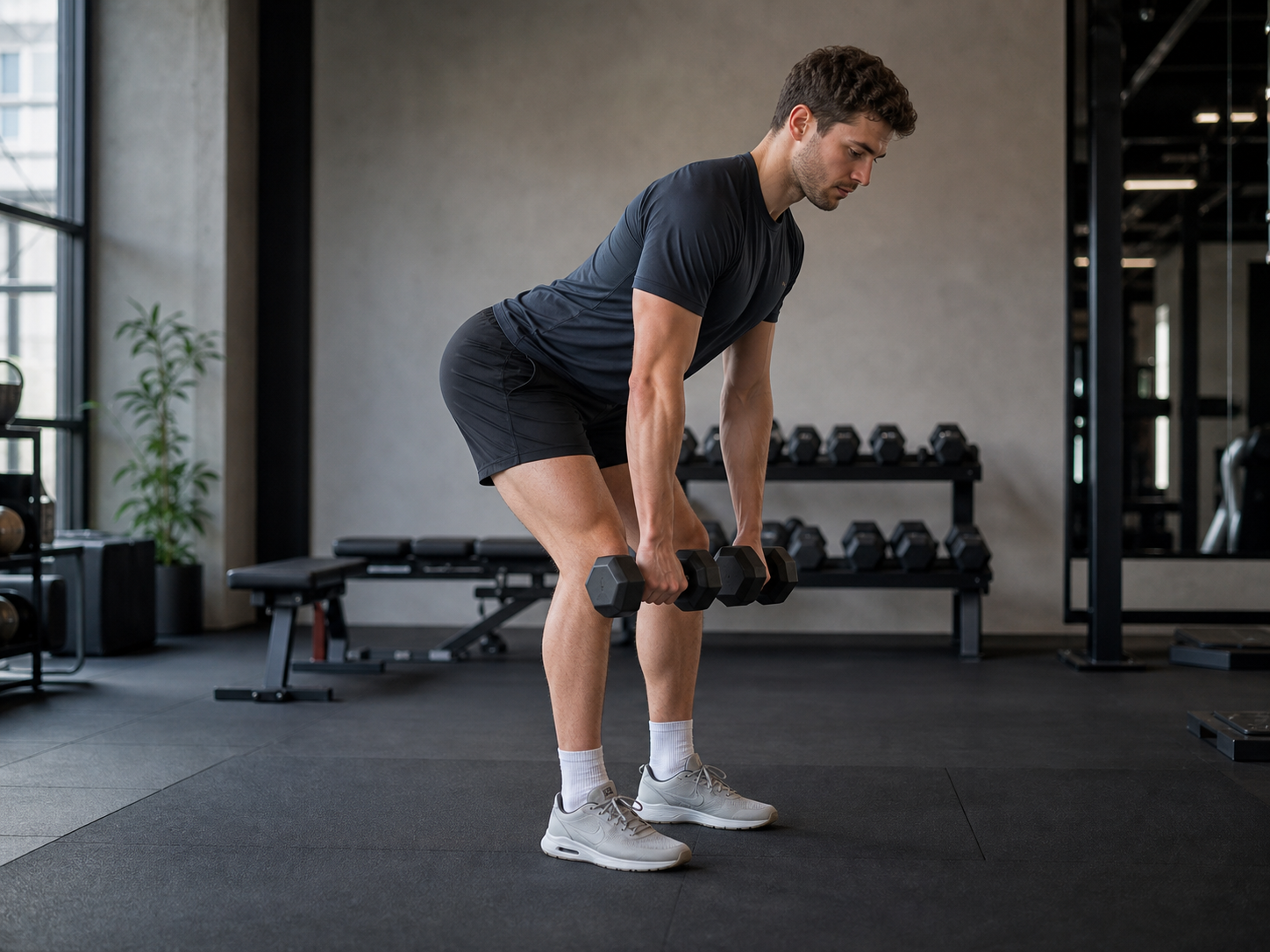
Equipment context with dumbbells, not a participant from the studies or the fictional log example.
You do not need to give variations a new label. A short execution note is enough. To learn the basic movement, use the explanation of deadlift technique for beginners; to choose your variation, keep the concrete agreements with your plan.
Frequently asked questions
Do your knees need to be completely straight in a stiff-leg deadlift?
Do not make that a requirement based on the name. Ask which knee position the instruction means and whether it should remain the same during the movement. Do not force a knee position to act out an exercise name literally. The comparison helps clarify instructions, but does not determine an individually suitable range of motion.
Must a stiff-leg deadlift always start from the floor?
The name alone does not establish that. Check separately where the first repetition starts, where you stop the movement and whether you set the weight down again between repetitions. A standing start and a reset at the bottom are different agreements; record which belongs to your plan.
Is the Romanian deadlift better for hamstring growth?
You cannot infer that from the muscle-activity measurements cited. The acute study compared activity during specific executions, not muscle growth after a training period. Choose based on a clear, suitable execution and your programme's goal; do not use a measurement difference as a universal promise of growth.
Can you also use the comparison with dumbbells?
You can ask the same questions about the start, knee bend, movement limit and reset. Record the equipment change, though. A dumbbell execution is not an identical copy of a bar execution and is not automatically one of the studied variations. Compare training notes only when you know which task you actually performed.