

Pallof press: setup and control against rotation

The Pallof press is a trunk exercise in which a band or cable tries to rotate you from the side. Stand with your side facing the anchor, hold the handle in front of your chest and slowly press your hands forwards while your chest and pelvis keep facing the same way. Choose a resistance and reach that let you do this without holding your breath. If you rotate, first shorten the movement or reduce resistance. Control comes before a heavier setting.
What does anti-rotation mean in the Pallof press?
Your arms move, but you try to keep your trunk from turning with the pull. This distinguishes the exercise from a rotating cable movement. The cable or band pulls from the side; facing straight towards the anchor creates a different task. Your hands move forwards from your own chest, rather than towards the attachment point.
Here, anti-rotation describes the task, not a medical property of your back. A still trunk in one photograph does not prove control throughout a repetition. Check both the outward and return movements. The photographs in this article show training notes, equipment and a conversation; they do not demonstrate the Pallof press.

Choose a band or cable and check the setup
With a cable, use a suitable handle and start with a light setting. With a band, follow the equipment's attachment instructions. Use a suitable fixed anchor that cannot move; inspect the band, connection and clear space before applying tension. A loose chair is not a reliable substitute for a fixed attachment point.
An attachment around chest height is a practical starting point for the standing variation. Stand beside it and hold the handle with both hands. Start close enough to control the resistance, while keeping tension in the band. Do not copy a universal starting weight. For the difference between stretch, colour and load, read about resistance bands and kilogram labels.
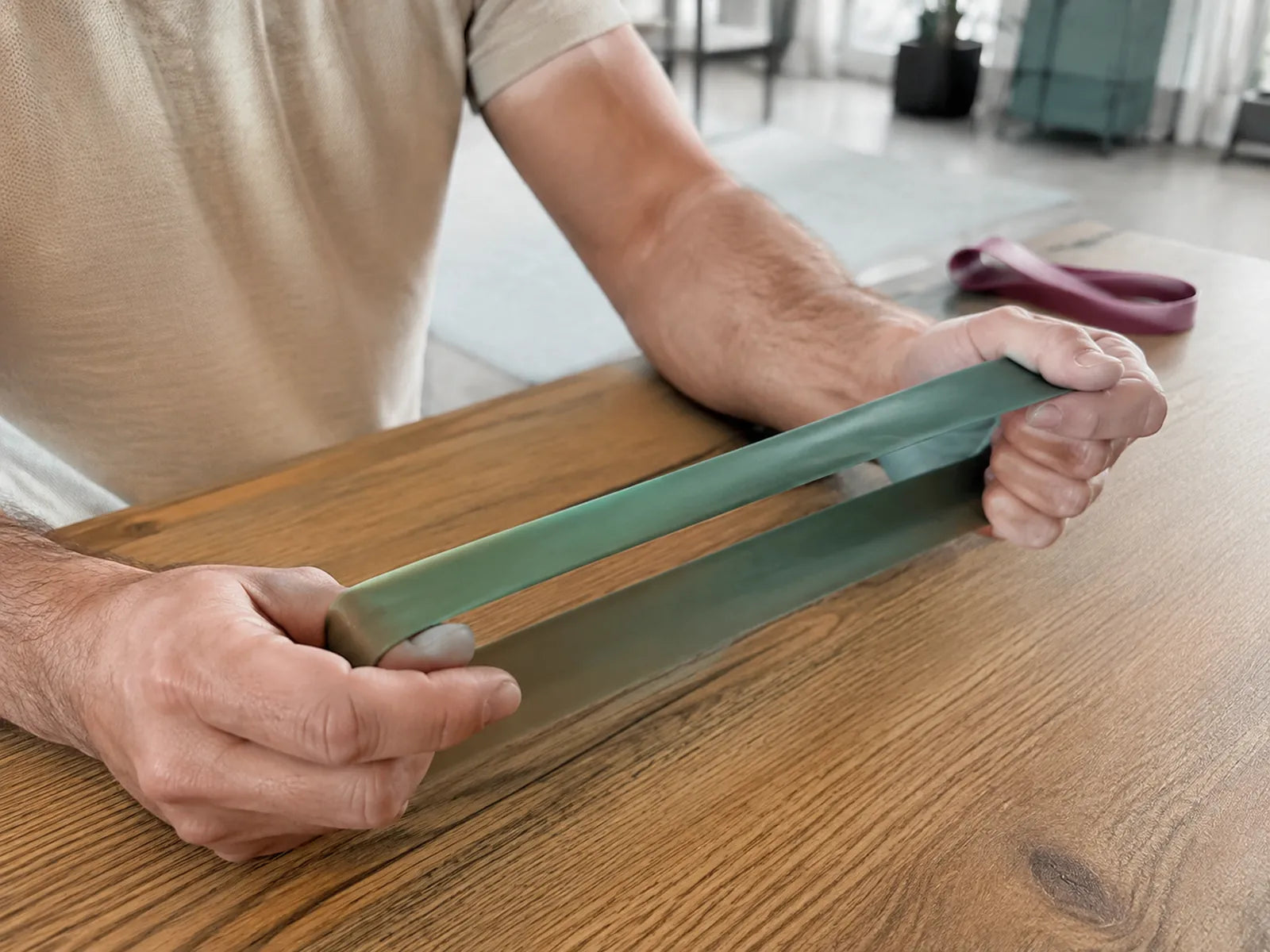
This equipment photograph shows band stretch, not a force measurement or Pallof setup. A kilogram value for this photograph is unknown.
Perform the Pallof press step by step
- Stand side-on. Place your feet at a comfortable width with your knees slightly bent. Your chest and pelvis face forwards, across the direction of pull. Hold the handle in front of your chest.
- Press slowly forwards. Move your hands away from your chest. Choose a reach that keeps your trunk and feet in position; fully straight arms are not a required endpoint.
- Return with control. Bring the handle back to your chest along the same path. Do not let it pull you towards the anchor, and keep breathing. Exhaling as you press out can be a useful cue.
- Switch sides. Reverse your setup so the resistance comes from the other side. Repeat the same practical checks. A difference between sides is not a diagnosis.
You can also hold a position briefly. Record that you are doing a hold variation: repetitions and holds are different tasks. Kneeling variations change the base of support again. Do not start with them on the assumption that they are automatically better.
Take your Nordic curl from the first rep to week 10.
A concrete 7-page plan: build up week by week, without pushing too fast.
- 01A clear week-by-week progression
- 02Technique and the mistakes to avoid
- 03A simple log you will actually use

≤51%
✓Backed by research
Van Dyk et al., 2019: meta-analysis of programmes with NHE. Not an effect test of Nordbelt or this protocol.
Open the download page again or check the email we sent you.
Open the download page ↗You rotate: change one thing and check again
First observe what happens, then decide what to change. This table is an editorial aid for planning another attempt, not a validated test or personal training programme.
| What do you see? | First adjustment | What do you check next? |
|---|---|---|
| Your chest or pelvis turns towards the anchor | Use less resistance | Do both keep facing forwards during the outward and return movements? |
| You move your feet as you press out | Shorten the reach | Do your feet stay in the same place? |
| You lean sideways to keep the handle away | Reduce resistance | Can you stay upright without moving sideways? |
| You hold your breath or raise your shoulders | Pause and resume with an easier task | Can you breathe calmly and move the handle without that compensation? |
Stop for sharp pain, dizziness or an unreliable anchor. Have persistent or recurring symptoms assessed by a doctor or physiotherapist. Discuss a personal programme with someone who knows your situation.
Do you also want to do Nordic curls at home?
A Pallof press requires a band or cable. If you separately choose Nordic hamstring curls at home, Nordbelt for Nordic curls at home can secure your ankles without a training partner or large machine. A suitable checked anchor, knee support and room to catch yourself remain necessary. This ankle strap does not guarantee trunk control or replace Pallof press equipment.
Make your next attempt comparable
A fictional example: Mira rotates when she reaches her arms a long way out. She keeps the band, anchor and foot position unchanged, then tries only a shorter reach. Her notes record whether her chest and pelvis now stayed facing forwards. This shows different performance of an easier task, not proven strength gain or treatment.
Record the equipment, resistance setting or band type, distance from the anchor, foot position, reach and what you observed. Then change one factor at a time. With a band, distance from the anchor can also change tension. Record that change without assigning it your own kilogram value.
You may ask a training partner to describe whether your chest, pelvis and feet move. A conversation helps put observations into words; it is not a professional assessment. High effort does not automatically mean good technique either. The explanation of repetitions in reserve addresses that separate estimate of effort.

Context photograph of two exercisers talking. They are not participants in the fictional example and do not demonstrate exercise technique.
What does research say, and what remains unknown?
A systematic review examined muscle activity during core exercises in healthy adults. Measurement methods differed between studies. An EMG signal describes activity during a task; this review establishes neither a universally best Pallof variation nor a personal starting load (Oliva-Lozano et al., 2020).
Another study tested the repeatability of resistance-band tests, including the Pallof press, in 35 adults: 18 with chronic low back pain and 17 healthy participants. A force sensor was used. This is measurement-reliability research, not a treatment trial showing that the exercise cures back pain. Its testing protocol is not a home programme to copy (Franco-López et al., 2024).
Frequently asked questions
Is a band or cable Pallof press better?
The main task stays the same: resist a sideways pull without turning with it. Choose equipment you can attach reliably and control. With a band, also record your distance from the anchor; with a cable, record the setting and handle. The studies discussed do not identify a universal winner between these options.
How much weight and how many repetitions should I use?
Start with a task that lets you maintain the described position on both the outward and return movements. One fixed kilogram value does not suit every cable, band or person. Use the counts in your existing programme and discuss unclear instructions. This guide prescribes no personal training dose. When distributing existing training across a week, full-body or split training is a separate choice.
Must my arms be completely straight?
No. Pressing further changes the task; a shorter reach can be a useful first adjustment if you otherwise rotate. Choose a comfortable range that lets you bring the handle back calmly. Do not increase reach, resistance and stance difficulty together if you want to understand which change affects your technique.
Does the Pallof press help with back pain?
This technique guide cannot determine which exercise suits your symptoms. The band study concerned test repeatability, not a cure or personal treatment plan (Franco-López et al., 2024). Have symptoms assessed and agree on exercises with your clinician. Do not make the exercise heavier or longer to use pain as a test.