

Hamstring curls with ankle weights: standing or lying?


A hamstring curl with ankle weights is practical when the weight stays securely yet comfortably in place and you can bend your knee under control without swinging your hip. Start without weight, choose either a standing position with light support or a prone position on a flat surface, and add only the smallest available weight once your trunk, pelvis and thigh remain still. Curl only as far as the cuff stays in place, pause briefly and lower your lower leg slowly. Stop if the weight pulls on your foot or ankle, the movement starts to swing or your lower back joins in.
What do you train with a hamstring curl using ankle weights?
In a hamstring curl, you bend the knee and move the heel towards the buttock. The hamstrings produce knee flexion. That is a different primary task from hip extension in an exercise such as a hip hinge or Romanian deadlift. Research comparing knee flexion with hip extension shows that hip and knee position change the contribution and length of the hamstrings during an exercise (Yanagisawa and Fukutani, 2020).
An ankle weight increases resistance at the lower leg. This makes cuff placement and a controlled return more important than choosing the highest number on the weight.

The position-load matrix
Make two consecutive choices instead of selecting a weight immediately:
- Choose the position. Standing requires reliable support; lying prone requires a flat surface, clear leg space and a steady pelvis.
- Choose the loading step. Practise without the cuff first. Add only the smallest weight if the cuff, body block, curl path and return remain unchanged.
Assess every set on four points:
- Cuff: the weight sits around the lower part of the lower leg, fastens comfortably and does not slide towards the foot or knee.
- Body block: the trunk, pelvis and thigh stay quiet; only the lower leg visibly moves.
- Curl path: the heel moves backwards without swinging and the knee continues to point in the same direction.
- Return: the lower leg descends under control and the weight does not hit the ankle, foot or floor.
If one point changes, take one step back: remove the cuff, shorten the range or choose the more stable position. Do not change position, load and tempo at the same time, because then you will not know which adjustment restored control.
Ankle-weight hamstring exercise: start unloaded
Before the exercise, check that the fastening, stitching and filling are intact and that the weight is suitable for this placement according to the product instructions. The cuff should fit securely without pulling your foot down or blocking the movement path. Do not use a loose weight that can shift during the curl.
Then practise without resistance:
- take the chosen standing or prone starting position;
- keep the thigh still and bend the knee slowly;
- stop before the pelvis, trunk or thigh starts to move;
- lower the lower leg slowly and compare control on both sides.
Only once this unloaded test feels predictable does it make sense to add the cuff. A heavier ankle weight cannot compensate for an unclear starting position.
Take your Nordic curl from the first rep to week 10.
A concrete 7-page plan: build up week by week, without pushing too fast.
- 01A clear week-by-week progression
- 02Technique and the mistakes to avoid
- 03A simple log you will actually use

≤ 51%
✓Backed by research
Van Dyk et al., 2019: meta-analysis of programmes with NHE. Not an effect test of Nordbelt or this protocol.
Open the download page again or check the email we sent you.
Open the download page ↗Standing curls with ankle weights
For a standing curl, you need stable support that cannot roll or shift. Stand upright, hold the support lightly and move your weight onto the standing leg. Keep the knee of the working leg next to the other knee.
Now bend the knee without moving the thigh forwards. Lift the heel only as far as your trunk stays upright and your pelvis remains steady. Pause briefly, then lower the lower leg under control without dropping the foot to the floor.
If you have to pull hard on the support, the standing leg keeps searching for balance or your hip rotates forwards, remove the weight. If balance continues to determine your technique, choose the prone version.
Lying leg curl with an ankle weight
For a lying leg curl with an ankle weight, lie prone on a flat, firm surface. Leave enough space behind your lower legs and check that the cuff does not hit the floor, an edge of a bench or your other leg at the start. Support your forehead comfortably and keep your pelvis still.
Bend one knee and move the heel towards the buttock while the thigh stays on the surface. Stop as soon as your pelvis tilts, your lower back takes over the movement or the cuff shifts. Let the lower leg return slowly until just before the weight touches the floor.
A lying leg curl and other hamstring exercises can load the hamstrings in different positions. Studies of exercise selection and regional activation support that exercises are not completely interchangeable, but they do not provide one universally best position or load for every person training at home (Hegyi et al., 2019).
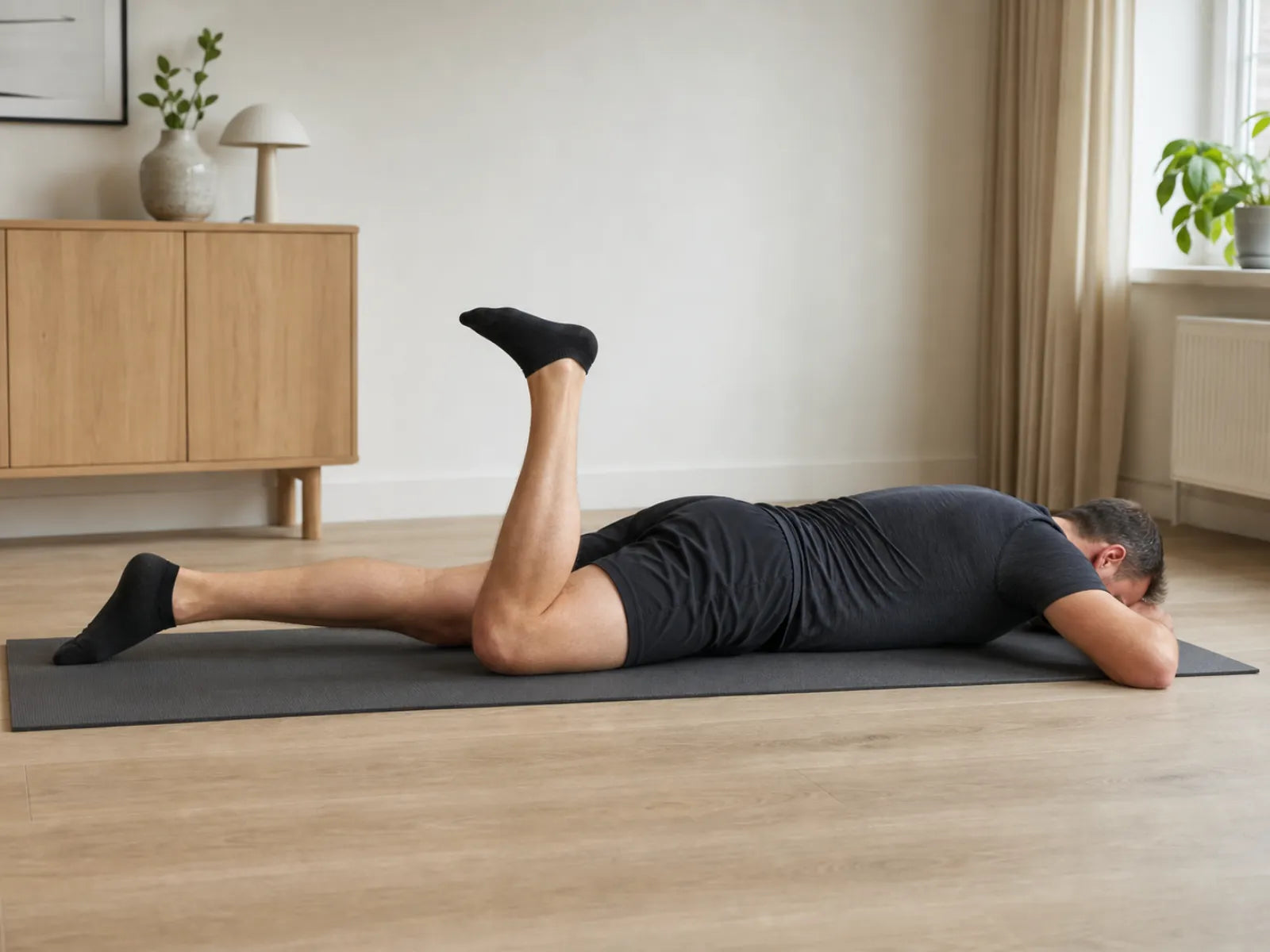 Prone knee curl without added resistance. Context image; the full exercise with the equipment described is not shown.
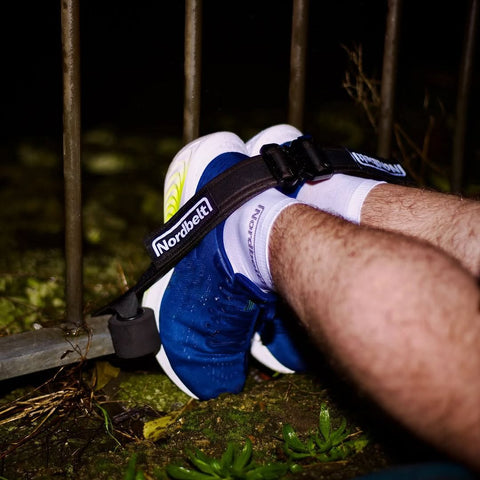
Ankle fixation for Nordic curls at home
That means choosing a different exercise task. In the ankle-weight curl, your lower leg moves while your thigh remains as still as possible; in a Nordic curl, both ankles stay fixed and your body moves forwards from a kneeling position. With Nordbelt for Nordic curls at home, you can create that stable ankle fixation without a training partner or large fitness machine, provided the door, anchor point, surface and clear space are suitable and checked beforehand.
Nordbelt is not an ankle weight and not a standing or lying leg-curl machine. The product does not perform a hamstring curl with ankle weights. Its role is solely to provide a compact home setup for Nordic curls. First choose the movement you want to train, then select the equipment that fits it.
Which load should you choose?
There is no universal starting weight that works equally well for every cuff, leg length, position and training background. Choose the smallest weight with which you can follow the same path as in the unloaded test. The repetition should start without swinging and end without the cuff striking your foot, ankle or the floor.
Use this order when you want to progress:
- keep the position and improve the return first;
- increase the range if the thigh and pelvis continue to stay still;
- then add one available loading step;
- step back if the cuff slides, the start accelerates or the finishing position changes.
Activation studies find differences between hamstring exercises, but a higher activation signal does not guarantee that a heavier ankle weight or one exercise produces a better training result for everyone (McAllister et al., 2014). Use the four control points as your decision rule.
How to perform a hamstring curl with ankle weights step by step
Follow the same sequence on each side:
- inspect the ankle weight and clear the movement area;
- test the chosen position without load;
- fasten the cuff according to the product instructions and check that it does not slide;
- keep your trunk, pelvis and thigh still;
- bend the knee without initiating the movement from the hip or foot;
- stop before the cuff, thigh or pelvis changes position;
- pause only while your form remains unchanged;
- return the lower leg under control;
- remove the cuff if the next repetition cannot follow the same path.
Your left and right sides do not necessarily need to reach exactly the same height if one side must rotate or swing to get there. The useful range is the range you can control on that side.
Common mistakes
Common mistakes when using ankle weights for the back of the thigh include:
- starting with a load before testing the path unloaded;
- fastening the cuff so loosely that it slides towards the foot;
- using the cuff in an uncomfortable position or one not intended by the manufacturer;
- initiating the standing curl with hip swing or by pulling hard on the support;
- lifting the pelvis or arching the lower back during the prone curl;
- forcing the heel as far as possible towards the buttock;
- dropping the return;
- increasing weight, range of motion and tempo at the same time;
- ignoring sharp, new or persistent symptoms.
Stop the set when you can no longer start or slow the weight under control, the cuff pulls on your foot or ankle, your support shifts or the exercise causes a sharp symptom. A technique article cannot diagnose a condition; have new or persistent symptoms assessed appropriately.
How does the exercise fit into a home programme?
A hamstring curl with ankle weights is primarily a knee-flexion variation. Do not automatically combine it with every other curl in one session. First decide which movement pattern you need. The page on effective hamstring exercises provides the broader overview.
To compare the same knee-flexion task with another resistance source, use the separate guide for the hamstring curl with a resistance band or the cable hamstring curl technique. For the broader choice of home equipment, hamstring equipment for home use remains the guide.
If you specifically want to check a Nordic setup at home, follow the practical Nordbelt how-to guide. Check the door, anchor, surface and clear space before every set; a Nordic setup does not turn an ankle-weight curl into the same exercise.
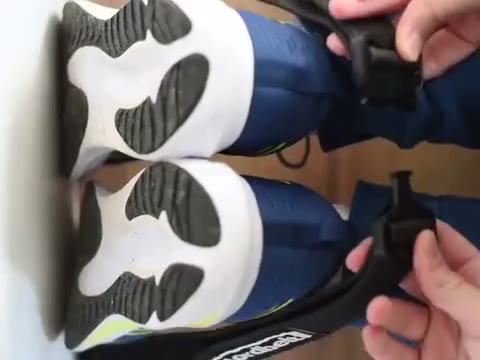 Hands fastening Nordbelt straps around the shoes. Context image; the full exercise with the equipment described is not shown.
Frequently asked questions
Are ankle weights suitable for a hamstring exercise?
Yes, ankle weights can add resistance to a hamstring curl when the cuff is suitable, fits securely yet comfortably and allows you to move the lower leg under control. Start unloaded and then use the smallest available weight. Stop if the cuff slides, pulls or changes your body position.
Is a standing or lying leg curl with an ankle weight better?
Neither is always better. Standing works when you have stable support and can keep your thigh still. Lying prone works when balance disrupts the standing technique and you have a flat surface with clear leg space. Choose the position in which the cuff, pelvis and return remain most predictable.
Where should you fasten an ankle weight for hamstring curls?
Follow the instructions for the specific ankle weight. The cuff should fasten securely around the lower part of the lower leg without sliding towards the foot or knee. Do not position it in a way the manufacturer does not allow, and do not use it if the fastening, stitching or filling is damaged.
How heavy should an ankle weight be for hamstring curls?
There is no universal starting weight. Test the movement without the cuff first, then add only the smallest available weight with which your trunk, pelvis, thigh and return remain unchanged. A smaller controlled load is more useful than a heavier repetition that starts to swing.
Is a hamstring curl with ankle weights the same as a Nordic curl?
No. In the ankle-weight curl, the knee bends while the thigh stays as still as possible. In a Nordic curl, both ankles remain fixed and the body moves from a kneeling position. The exercises use a different setup, movement task and progression.
Summary
A good hamstring curl with ankle weights starts without weight. First choose either standing with reliable support or lying prone on a flat surface. Add the smallest cuff only when four checks remain unchanged: cuff, body block, curl path and return. Increase just one factor at a time, and treat ankle-weight curls, band curls, cable curls and Nordic curls as different exercises, each with its own equipment choice.